2019 TOYOTA PRIUS PLUS service
[x] Cancel search: servicePage 370 of 568
3706-2. Maintenance
PRIUS +_OM_OM47D30E_(EE)
Maintenance requirements
Scheduled maintenance should be performed at specified intervals
according to the maintenance schedule.
For full details of your maintenance schedule, refer to the “Toyota Service
Booklet” or “Toyota Warranty Booklet”.
What about do-it-yourself maintenance?
Many maintenance items are easy to do yourself if you have a little
mechanical ability and a few basic automotive tools.
Note, however, that some maintenance tasks require special tools and
skills. These are best performed by qualified technicians. Even if you’re an
experienced do-it-yourself mechanic, we recommend that repairs and
maintenance be conducted by any authorized Toyota retailer or Toyota
authorized repairer, or any reliable repairer. Any authorized Toyota retailer
or repairer will keep a record of maintenance, which could be useful should
you ever require Warranty Service. Should you choose to select a qualified
and equipped professional other than an authorized Toyota repairer to ser-
vice or maintain your vehicle, we recommend that you request that a
record of maintenance be kept.
To ensure safe and economical driving, day-to-day care and reg-
ular maintenance are essential. Toyota recommends the follow-
ing maintenance:
Scheduled maintenance
Do-it-yourself maintenance
Page 371 of 568

3716-2. Maintenance
PRIUS +_OM_OM47D30E_(EE)
6
Maintenance and care
■Where to go for maintenance service?
In order to maintain your vehicle in the best possible condition, Toyota recom-
mends that maintenance service operations as well as other inspections and
repairs be carried out by authorized Toyota retailers or Toyota authorized
repairers, or any reliable repairers. For repairs and services covered by your
warranty, please visit an authorized Toyota retailer or repairer, who will use
genuine Toyota parts in repairing any difficulties you may encounter. There
can also be advantages in utilizing authorized Toyota retailers or repairers for
non-warranty repairs and services, as members of the Toyota network will be
able to expertly assist you with any difficulties you may encounter.
Your Toyota retailer or Toyota authorized repairer, or any reliable repairer will
perform all of the scheduled maintenance on your vehicle reliably and eco-
nomically due to their experience with Toyota vehicles.
■Does your vehicle need repairs?
Be on the alert for changes in performance and sounds, and visual tip-offs
that indicate service is needed. Some important clues are:
●Engine missing, stumbling or pinging
●Appreciable loss of power
●Strange engine noises
●A fluid leak under the vehicle (However, water dripping from the air condi-
tioning system after use is normal.)
●Change in exhaust sound (This may indicate a dangerous carbon monoxide
leak. Drive with the windows open and have the exhaust system checked
immediately.)
●Flat-looking tires, excessive tire squeal when cornering, uneven tire wear
●Vehicle pulls to one side when driven straight on a level road
●Strange noises related to suspension movement
●Loss of brake effectiveness, spongy feeling brake pedal, pedal almost
touches the floor, vehicle pulls to one side when braking
●Engine coolant temperature continually higher than normal (P. 449, 518)
If you notice any of these clues, take your vehicle to any authorized Toyota
retailer or Toyota authorized repairer, or any reliable repairer as soon as pos-
sible. Your vehicle may need adjustment or repair.
Page 373 of 568
3736-3. Do-it-yourself maintenance
PRIUS +_OM_OM47D30E_(EE)
6
Maintenance and care
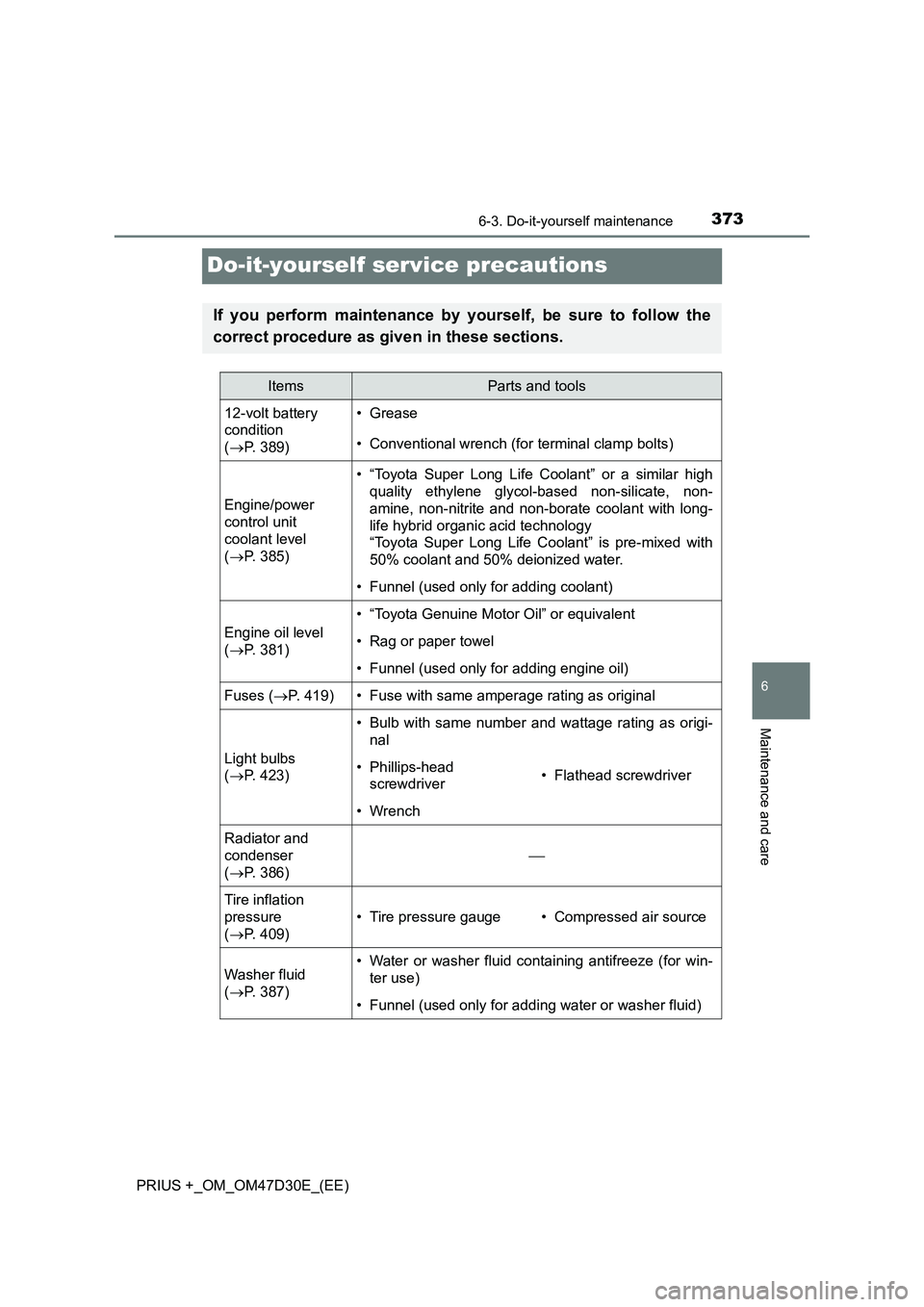
Do-it-yourself service precautions
If you perform maintenance by yourself, be sure to follow the
correct procedure as given in these sections.
ItemsParts and tools
12-volt battery
condition
(P. 389)• Grease
• Conventional wrench (for terminal clamp bolts)
Engine/power
control unit
coolant level
(P. 385)• “Toyota Super Long Life Coolant” or a similar high
quality ethylene glycol-based non-silicate, non-
amine, non-nitrite and non-borate coolant with long-
life hybrid organic acid technology
“Toyota Super Long Life Coolant” is pre-mixed with
50% coolant and 50% deionized water.
• Funnel (used only for adding coolant)
Engine oil level
(P. 381)
• “Toyota Genuine Motor Oil” or equivalent
• Rag or paper towel
• Funnel (used only for adding engine oil)
Fuses (P. 4 1 9 )• Fuse with same amperage rating as original
Light bulbs
(P. 423)
• Bulb with same number and wattage rating as origi-
nal
• Phillips-head
screwdriver• Flathead screwdriver
• Wrench
Radiator and
condenser
(P. 386)
Tire inflation
pressure
(P. 409)
• Tire pressure gauge• Compressed air source
Washer fluid
(P. 387)• Water or washer fluid containing antifreeze (for win-
ter use)
• Funnel (used only for adding water or washer fluid)
Page 384 of 568

3846-3. Do-it-yourself maintenance
PRIUS +_OM_OM47D30E_(EE)
WARNING
■Used engine oil
● Used engine oil contains potentially harmful contaminants which may
cause skin disorders such as inflammation and skin cancer, so care
should be taken to avoid prolonged and repeated contact. To remove used
engine oil from your skin, wash thoroughly with soap and water.
● Dispose of used oil and filters only in a safe and acceptable manner. Do
not dispose of used oil and filters in household trash, in sewers or onto the
ground. Call any authorized Toyota reta iler or Toyota authorized repairer,
or any reliable repairer, service station or auto parts store for information
concerning recycling or disposal.
● Do not leave used engine oil within the reach of children.
NOTICE
■To prevent serious engine damage
Check the oil level on a regular basis.
■ When replacing the engine oil
● Be careful not to spill engine oil on the vehicle components.
● Avoid overfilling, or the engine could be damaged.
● Check the oil level on the dipstick every time you refill the vehicle.
● Be sure the engine oil filler cap is properly tightened.
Page 408 of 568
4086-3. Do-it-yourself maintenance
PRIUS +_OM_OM47D30E_(EE)
NOTICE
■Repairing or replacing tires, wheels, tire pressure warning valves,
transmitters and tire valve caps
● When removing or fitting the wheels, tires or the tire pressure warning
valves and transmitters, contact any authorized Toyota retailer or Toyota
authorized repairer, or any reliable repairer as the tire pressure warning
valves and transmitters may be damaged if not handled correctly.
● Make sure to install the tire valve caps. If the tire valve caps are not
installed, water could enter the tire pressure warning valves and the tire
pressure warning valves could be bound.
● When replacing tire valve caps, do not use tire valve caps other than those
specified.
The cap may become stuck.
■ To avoid damage to the tire pressure warning valves and transmitters
When a tire is repaired with liquid sealants, the tire pressure warning valve
and transmitter may not operate properly. If a liquid sealant is used, contact
any authorized Toyota retailer or Toyota authorized repairer, or any reliable
repairer or other qualified service shop as soon as possible. After use of liq-
uid sealant, make sure to replace the tire pressure warning valve and trans-
mitter when repairing or replacing the tire. ( P. 394)
■ Driving on rough roads
Take particular care when driving on roads with loose surfaces or potholes.
These conditions may cause losses in tire inflation pressure, reducing the
cushioning ability of the tires. In addition, driving on rough roads may cause
damage to the tires themselves, as well as the vehicle’s wheels and body.
■ If tire inflation pressure of each tire becomes low while driving
Do not continue driving, or your tires and/or wheels may be ruined.
Page 412 of 568
4126-3. Do-it-yourself maintenance
PRIUS +_OM_OM47D30E_(EE)
WARNING
■When replacing wheels
● Do not use wheels that are a different size from those recommended in the
Owner’s Manual, as this may result in a loss of handling control.
● Never use an inner tube in a leaking wheel which is designed for a tube-
less tire. Doing so may result in an accident, causing death or serious
injury.
■ When installing the wheel nuts
● Never use oil or grease on the wheel bolts or wheel nuts.
Oil and grease may cause the wheel nuts to be excessively tightened,
leading to bolt or disc wheel damage. In addition, the oil or grease can
cause the wheel nuts to loosen and the wheel may fall off, causing an acci-
dent and resulting in death or serious injury. Remove any oil or grease
from the wheel bolts or wheel nuts.
■ Use of defective wheels prohibited
Do not use cracked or deformed wheels.
Doing so could cause the tire to leak air during driving, possibly causing an
accident.
NOTICE
■ Replacing tire pressure warning valves and transmitters
● Because tire repair or replacement may affect the tire pressure warning
valves and transmitters, make sure to have tires serviced by any autho-
rized Toyota retailer or Toyota authorized repairer, or any reliable repairer
or other qualified service shop. In addition, make sure to purchase your
tire pressure warning valves and transmitters at any authorized Toyota
retailer or Toyota authorized repairer, or any reliable repairer.
● Ensure that only genuine Toyota wheels are used on your vehicle.
Tire pressure warning valves and transmitters may not work properly with
non-genuine wheels.
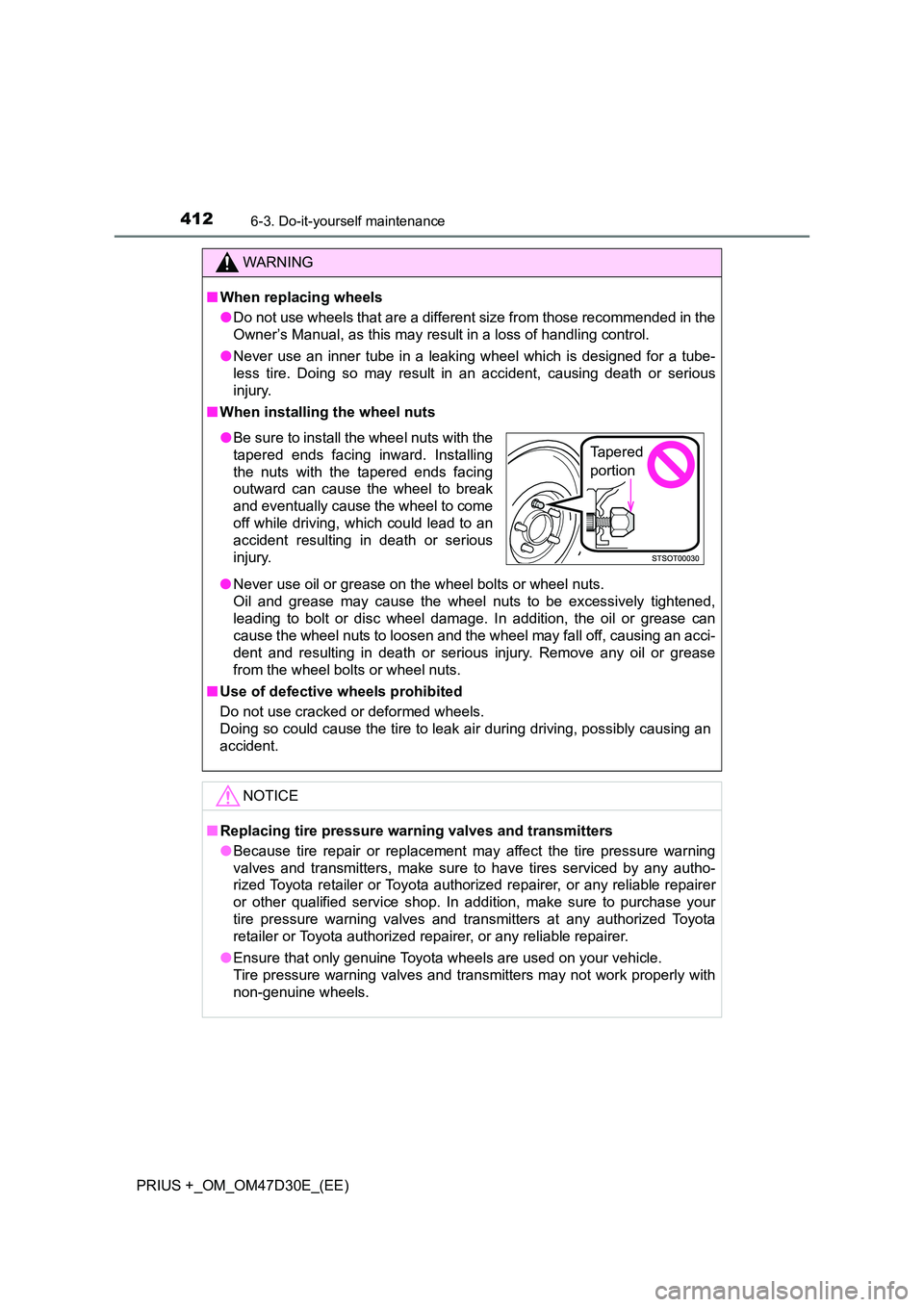
● Be sure to install the wheel nuts with the
tapered ends facing inward. Installing
the nuts with the tapered ends facing
outward can cause the wheel to break
and eventually cause the wheel to come
off while driving, which could lead to an
accident resulting in death or serious
injury.
Tapered
portion
Page 414 of 568
4146-3. Do-it-yourself maintenance
PRIUS +_OM_OM47D30E_(EE)
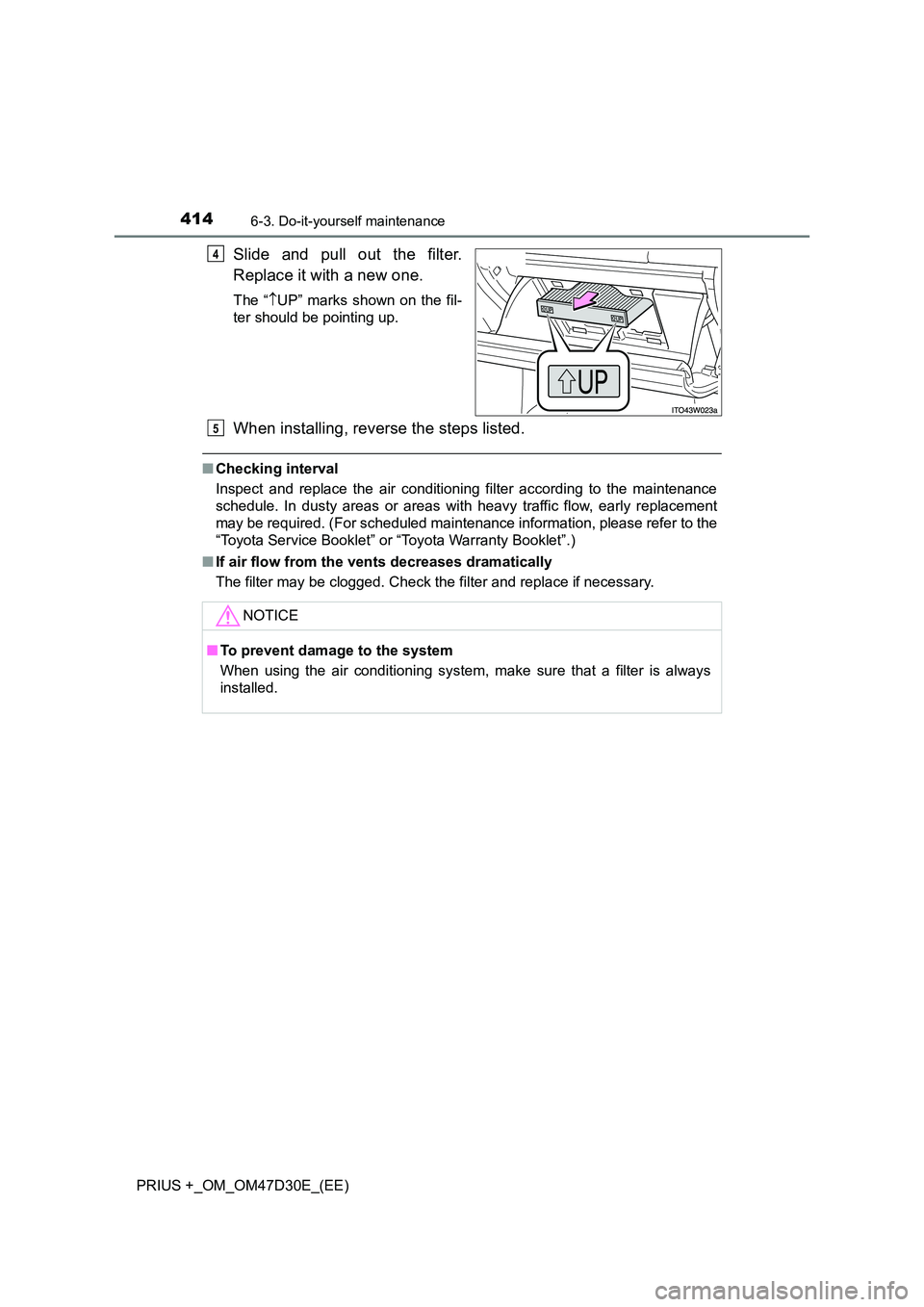
Slide and pull out the filter.
Replace it with a new one.
The “ UP” marks shown on the fil-
ter should be pointing up.
When installing, reverse the steps listed.
■ Checking interval
Inspect and replace the air conditioning filter according to the maintenance
schedule. In dusty areas or areas with heavy traffic flow, early replacement
may be required. (For scheduled maintenance information, please refer to the
“Toyota Service Booklet” or “Toyota Warranty Booklet”.)
■ If air flow from the vents decreases dramatically
The filter may be clogged. Check the filter and replace if necessary.
4
NOTICE
■ To prevent damage to the system
When using the air conditioning system, make sure that a filter is always
installed.
5
Page 437 of 568
4377-2. Steps to take in an emergency
PRIUS +_OM_OM47D30E_(EE)
7
When trouble arises
If your vehicle needs to be towed
In the following situations, it is not possible to be towed by another
vehicle using cables or chains, as the front wheels may be locked due
to the parking lock. Contact any authorized Toyota retailer or Toyota
authorized repairer, or any reliable repairer or commercial towing ser-
vice.
● There is a malfunction in the shift control system. (P. 447, 460)
● There is a malfunction in the immobilizer system. (P. 9 1 )
● There is a malfunction in the smart entry & start system. (P. 5 1 1 )
● The 12-volt battery is discharged. (P. 513)
The following may indicate a problem with your hybrid transmission.
Contact any authorized Toyota retailer or Toyota authorized repairer,
or any reliable repairer or commercial towing service before towing.
● The hybrid system warning light turns on or the hybrid system
warning message is displayed on the multi-information display and
the vehicle does not move.
● The vehicle makes an abnormal sound.
If towing is necessary, we recommend having your vehicle
towed by any authorized Toyota retailer or Toyota authorized
repairer, or any reliable repairer or commercial towing service,
using a wheel-lift type truck or flat bed truck.
Use a safety chain system for all towing, and abide by all state/
provincial and local laws.
Situations when it is not possible to be towed by another vehicle
Situations when it is necessary to contact dealers before towing