Page 183 of 568
1833-2. Opening, closing and locking the doors
3
Operation of each component
PRIUS +_OM_OM47D30E_(EE)
Page 184 of 568
1843-2. Opening, closing and locking the doors
PRIUS +_OM_OM47D30E_(EE)
Page 185 of 568
1853-2. Opening, closing and locking the doors
3
Operation of each component
PRIUS +_OM_OM47D30E_(EE)
Page 186 of 568
1863-2. Opening, closing and locking the doors
PRIUS +_OM_OM47D30E_(EE)
WARNING
■Caution regarding interference with electronic devices
● People with implantable cardiac pacemakers, cardiac resynchronization
therapy-pacemakers or implantable card ioverter defibrillators should main-
tain a reasonable distance between themselves and the smart entry &
start system antennas. ( P. 153)
The radio waves may affect the operation of such devices. If necessary,
the entry function can be disabled. Ask any authorized Toyota retailer or
Toyota authorized repairer, or any reliable repairer for details, such as the
frequency of radio waves and timing of the emitted radio waves. Then,
consult your doctor to see if you should disable the entry function.
● Users of any electrical medical device other than implantable cardiac
pacemakers, cardiac resynchronizati on therapy-pacemakers or implanta-
ble cardioverter defibrillators should consult the manufacturer of the
device for information about its operation under the influence of radio
waves.
Radio waves could have unexpected effects on the operation of such
medical devices.
Ask any authorized Toyota retailer or To yota authorized repairer, or any reli-
able repairer for details on disabling the entry function.
On vehicles with the navigation syst em, the entry function can be disabled
personally. ( P. 539)
Page 189 of 568
1893-3. Adjusting the seats
3
Operation of each component
PRIUS +_OM_OM47D30E_(EE)
WARNING
■When adjusting the seat position
● Take care when adjusting the seat position to ensure that other passen-
gers are not injured by the moving seat.
● Do not put your hands under the seat or near the moving parts to avoid
injury.
Fingers or hands may become jammed in the seat mechanism.
■ Seat adjustment
● To reduce the risk of sliding under the lap belt during a collision, do not
recline the seat more than necessary.
If the seat is too reclined, the lap belt may slide past the hips and apply
restraint forces directly to the abdomen, or your neck may contact the
shoulder belt, increasing the risk of death or serious injury in the event of
an accident.
Adjustments should not be made while driving as the seat may unexpect-
edly move and cause the driver to lose control of the vehicle.
● Manual seats: After adjusting the seat, make sure that the seat is locked in
position.
● When returning the seats to their upright positions, be careful not to catch
the seat belts.
■ Flattening the seats
Observe the following precautions. Failure to do so may result in death or
serious injury.
● Do not flatten the seats while driving.
● In a flat place, apply the parking brake firmly and shift the shift position to
P.
● Do not flatten the seats if they are occupied.
● Be careful not to get feet or hands caught in the moving parts or joints of
the seats while flattening.
● Do not allow children to flatten the seats.
● Do not drive with passengers sitting on the flattened seatback or in the lug-
gage compartment.
● Do not drive with luggage or passengers on the flattened seats.
● Do not allow children to enter the luggage compartment.
● After flattening, gently rock the seats to ensure they are firmly in place.
● Make sure that the seat belts are not caught in the gaps between the
seats.
Page 191 of 568
191
3
3-3. Adjusting the seats
Operation of each component
PRIUS +_OM_OM47D30E_(EE)
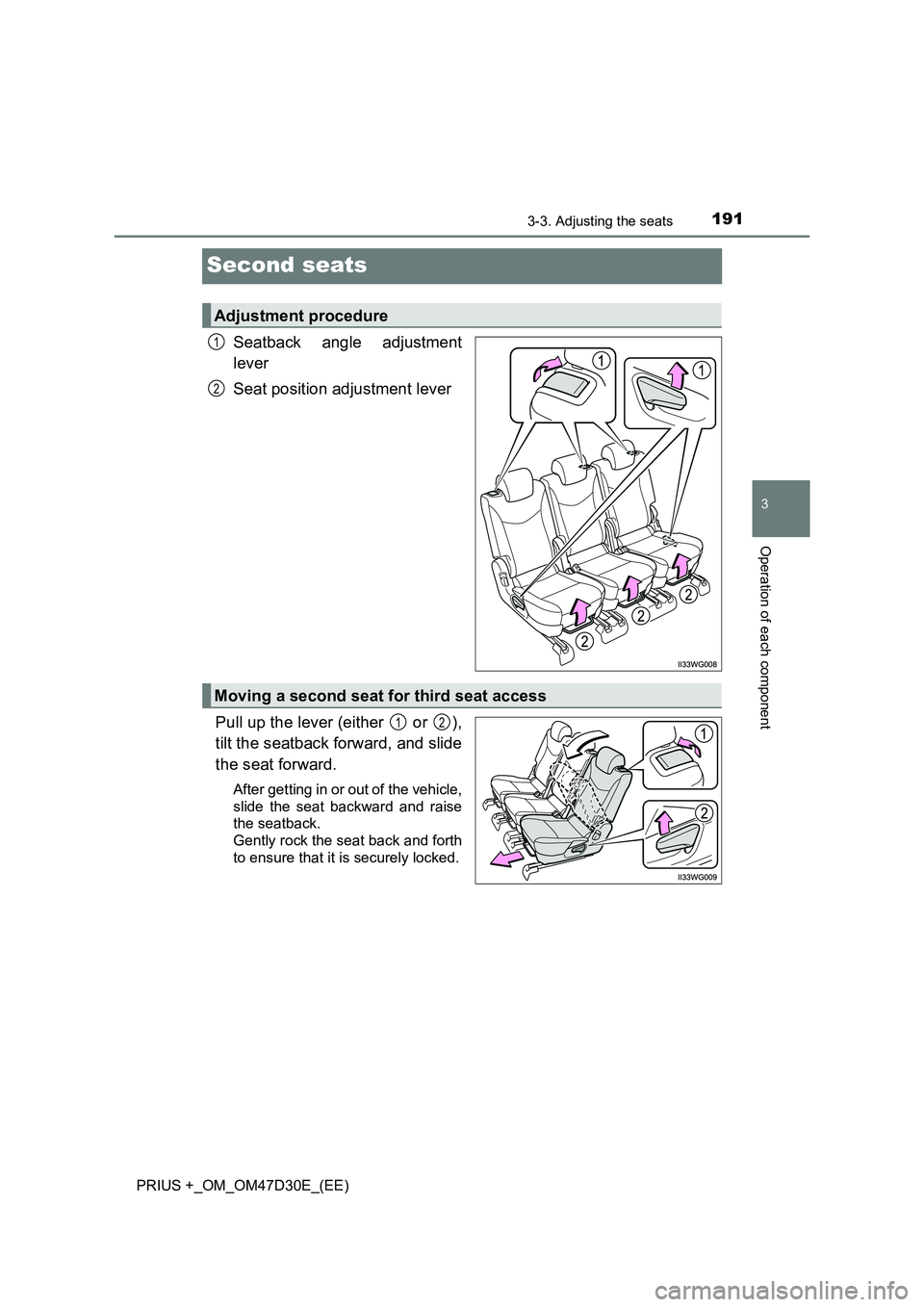
Second seats
Seatback angle adjustment
lever
Seat position adjustment lever
Pull up the lever (either or ),
tilt the seatback forward, and slide
the seat forward.
After getting in or out of the vehicle,
slide the seat backward and raise
the seatback.
Gently rock the seat back and forth
to ensure that it is securely locked.
Adjustment procedure
1
2
Moving a second seat for third seat access
12
Page 192 of 568
1923-3. Adjusting the seats
PRIUS +_OM_OM47D30E_(EE)
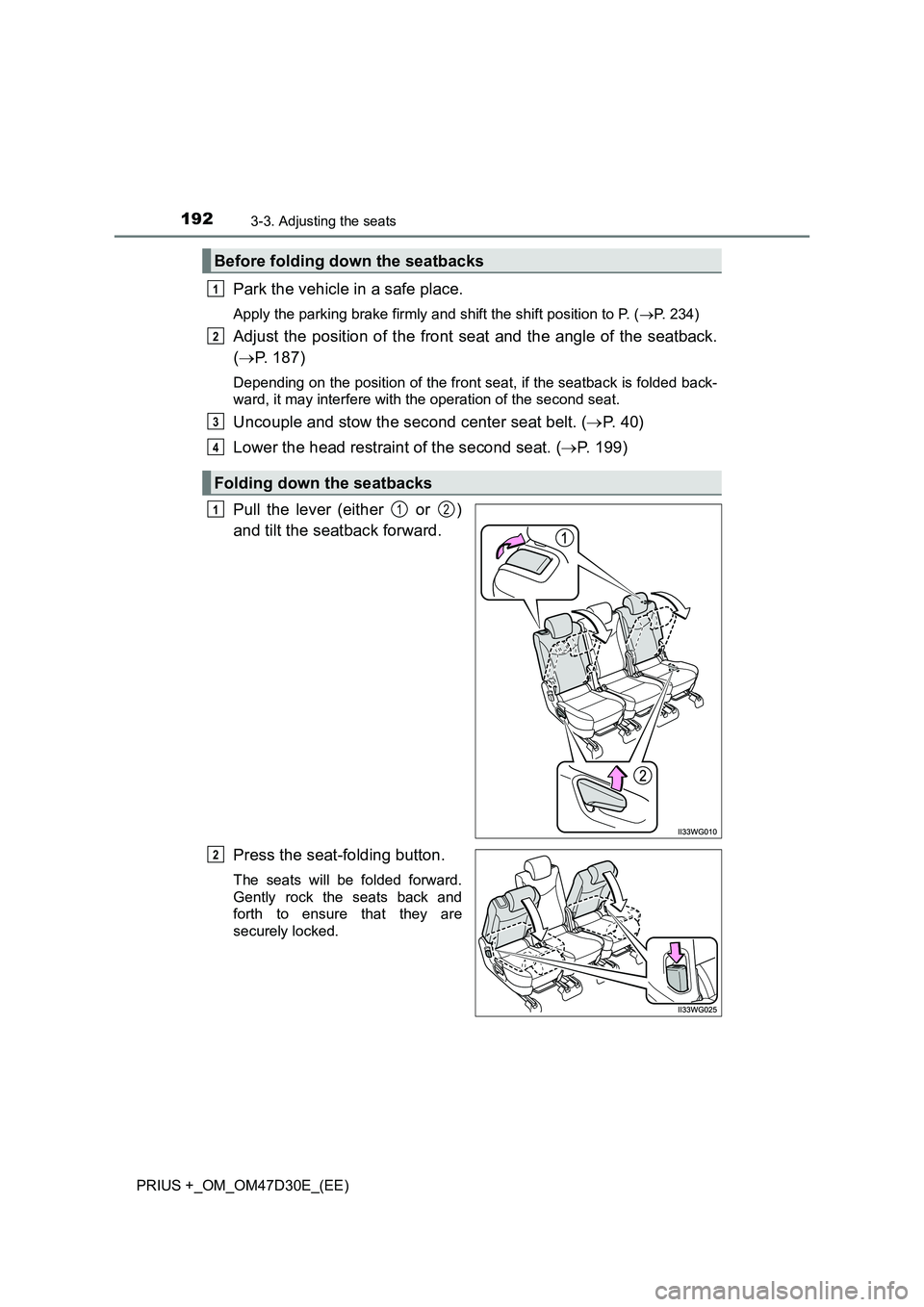
Park the vehicle in a safe place.
Apply the parking brake firmly and shift the shift position to P. (P. 234)
Adjust the position of the front seat and the angle of the seatback.
(P. 187)
Depending on the position of the front seat, if the seatback is folded back-
ward, it may interfere with the operation of the second seat.
Uncouple and stow the second center seat belt. (P. 4 0 )
Lower the head restraint of the second seat. (P. 199)
Pull the lever (either or )
and tilt the seatback forward.
Press the seat-folding button.
The seats will be folded forward.
Gently rock the seats back and
forth to ensure that they are
securely locked.
Before folding down the seatbacks
Folding down the seatbacks
1
2
3
4
112
2
Page 193 of 568
1933-3. Adjusting the seats
3
Operation of each component
PRIUS +_OM_OM47D30E_(EE)
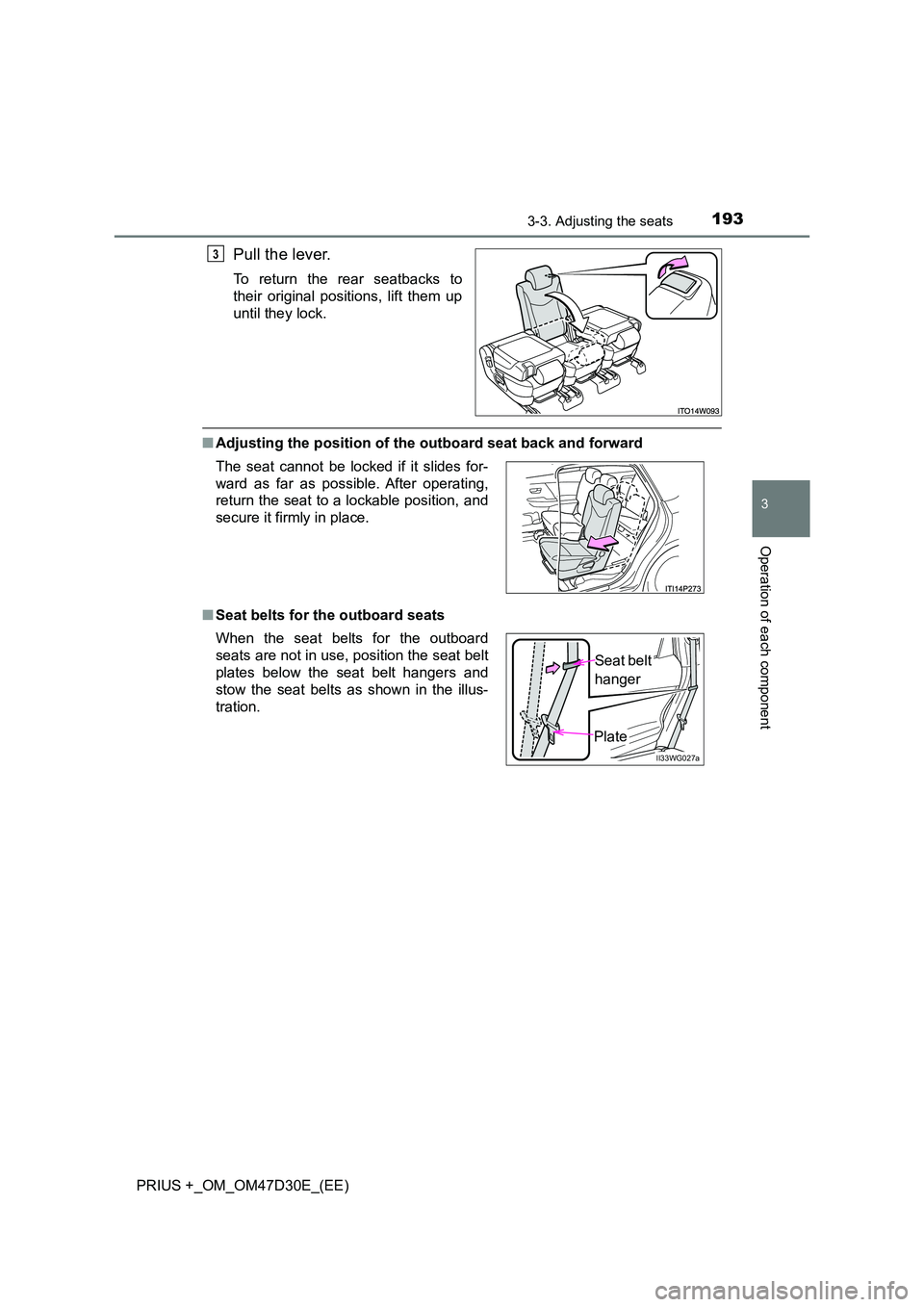
Pull the lever.
To return the rear seatbacks to
their original positions, lift them up
until they lock.
■ Adjusting the position of the outboard seat back and forward
■ Seat belts for the outboard seats
3
The seat cannot be locked if it slides for-
ward as far as possible. After operating,
return the seat to a lockable position, and
secure it firmly in place.
When the seat belts for the outboard
seats are not in use, position the seat belt
plates below the seat belt hangers and
stow the seat belts as shown in the illus-
tration.
II33WG027a
Plate
Seat belt
hanger