Page 391 of 532
5
When trouble arises
3915-1. Essential information
Towing with a wheel lift-type truck
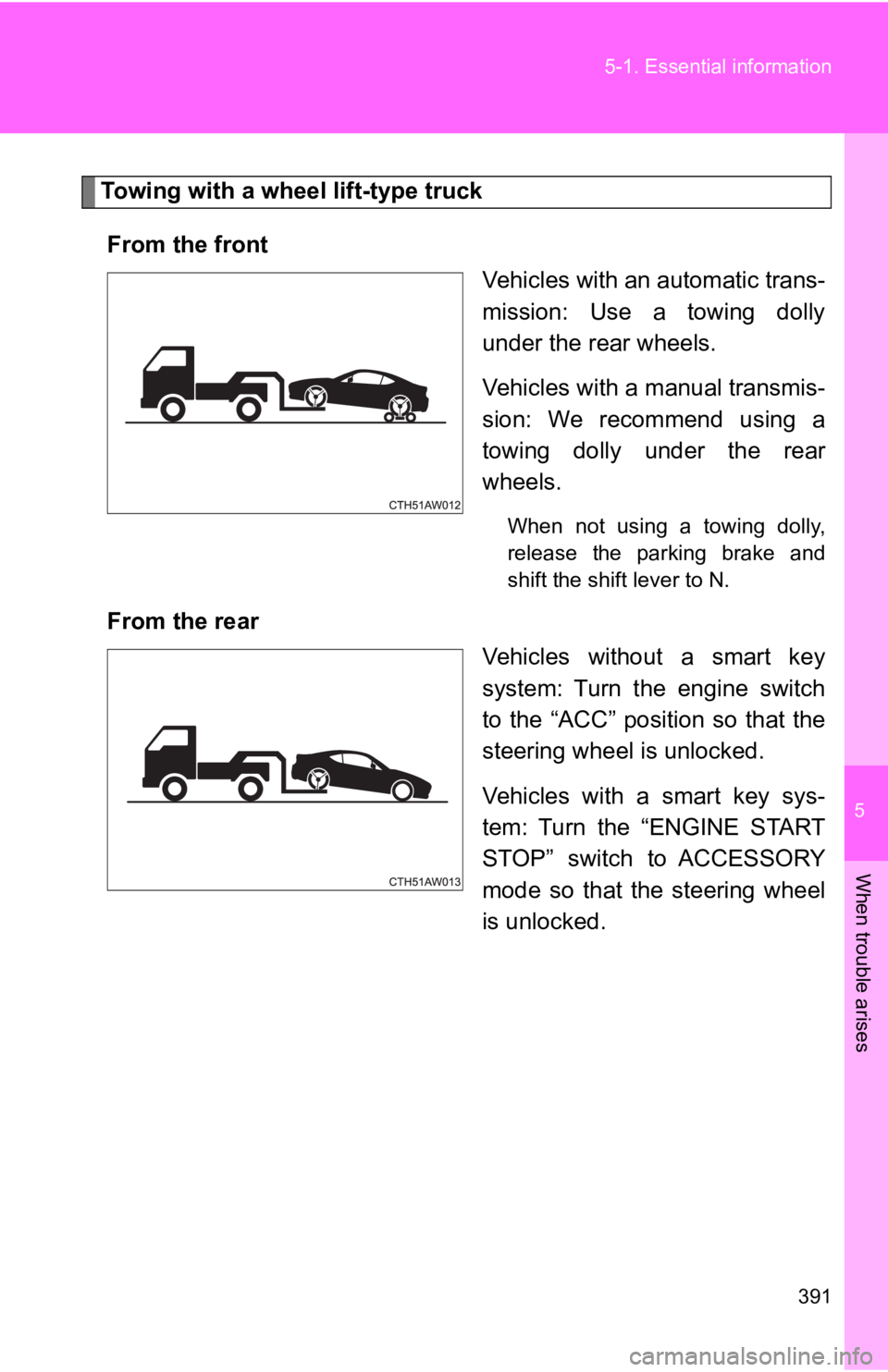
From the front
Vehicles with an automatic trans-
mission: Use a towing dolly
under the rear wheels.
Vehicles with a manual transmis-
sion: We recommend using a
towing dolly under the rear
wheels. When not using a towing dolly,
release the parking brake and
shift the shift lever to N.
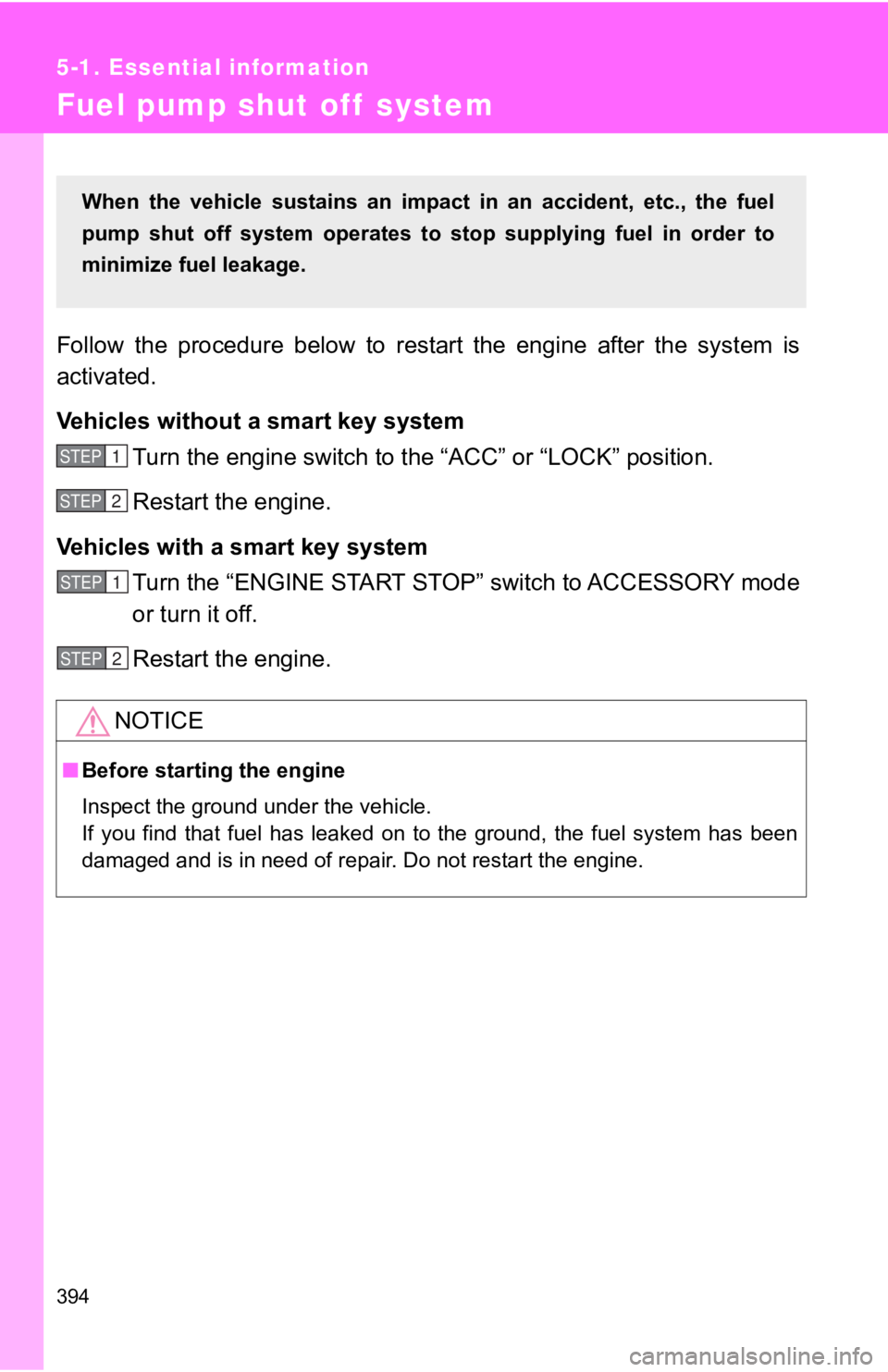
From the rear
Vehicles without a smart key
system: Turn the engine switch
to the “ACC” position so that the
steering wheel is unlocked.
Vehicles with a smart key sys-
tem: Turn the “ENGINE START
STOP” switch to ACCESSORY
mode so that the steering wheel
is unlocked.
Page 392 of 532
3925-1. Essential information
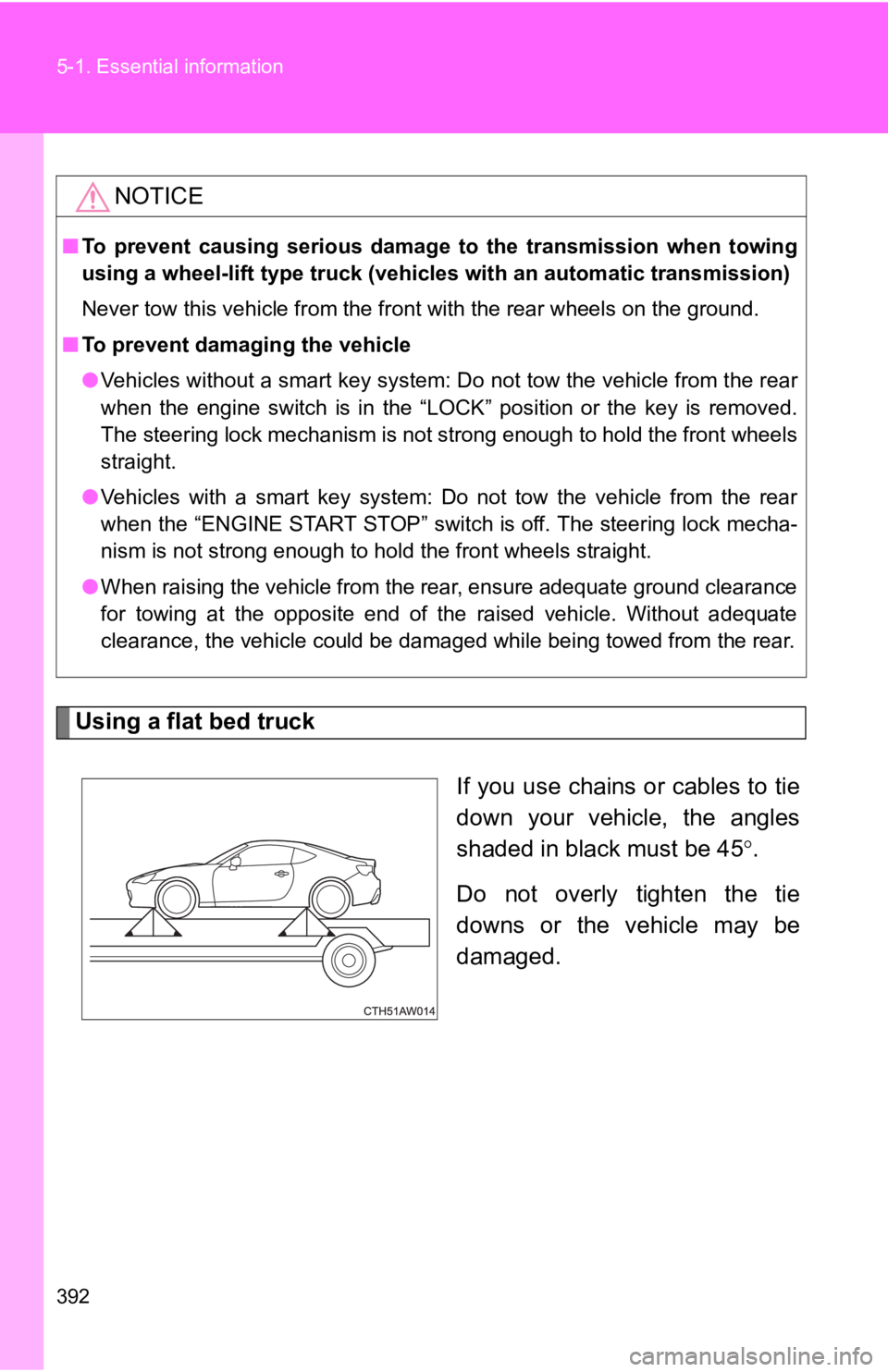
Using a flat bed truck
If you use chains or cables to tie
down your vehicle, the angles
shaded in black must be 45 .
Do not overly tighten the tie
downs or the vehicle may be
damaged.NOTICE■ To prevent causing serious damage to the transmission when towi ng
using a wheel-lift type truck (vehicles with an automatic trans mission)
Never tow this vehicle from the front with the rear wheels on t he ground.
■ To prevent damaging the vehicle
● Vehicles without a smart key system: Do not tow the vehicle fro m the rear
when the engine switch is in the “LOCK” position or the key is removed.
The steering lock mechanism is not strong enough to hold the fr ont wheels
straight.
● Vehicles with a smart key system: Do not tow the vehicle from t he rear
when the “ENGINE START STOP” switch is off. The steering lock m echa-
nism is not strong enough to hold the front wheels straight.
● When raising the vehicle from the rear, ensure adequate ground clearance
for towing at the opposite end of the raised vehicle. Without a dequate
clearance, the vehicle could be damaged while being towed from the rear.
Page 393 of 532
5
When trouble arises
3935-1. Essential information
If you think something is wrong If you notice any of the followi ng symptoms, your vehicle proba bly
needs adjustment or repair. Cont act your Toyota d ealer as soon as
possible.
■ Visible symptoms
● Fluid leaks under the vehicle
(Water dripping from t he air conditioning after use is normal.)
● Flat-looking tires or uneven tire wear
● Vehicles with a monochrome multi-information display: The
engine coolant temperature gauge needle continually points
higher than normal
● Vehicles with a color multi-information display: The high
engine coolant temperature wa rning light flashes or illumi-
nates
■ Audible symptoms
● Changes in exhaust sound
● Excessive tire squeal when cornering
● Strange noises related to the suspension system
● Pinging or other noises related to the engine
■ Operational symptoms
● Engine missing, stumbling or running rough
● Appreciable loss of power
● Vehicle pulls heavily to one side when braking
● Vehicle pulls heavily to one side when driving on a level road
● Loss of brake effectiveness, s pongy feeling, pedal almost
touches the floor
Page 394 of 532
3945-1. Essential information
Fuel pump shut off system Follow the procedure below to restart the engine after the syst em is
activated.
Vehicles without a smart key system
Turn the engine switch to t he “ACC” or “LOCK” position.
Restart the engine.
Vehicles with a smart key system
Turn the “ENGINE START STOP” switch to ACCESSORY mode
or turn it off.
Restart the engine.
NOTICE■ Before starting the engine
Inspect the ground under the vehicle.
If you find that fuel has leaked on to the ground, the fuel sys tem has been
damaged and is in need of repair. Do not restart the engine.When the vehicle sustains an impact in an accident, etc., the f uel
pump shut off system operates to stop supplying fuel in order t o
minimize fuel leakage.
STEP 1
STEP 2
STEP 1
STEP 2
Page 396 of 532
3965-2. Steps to take in an emergency
Stop the vehicle immediately.
The following warning indicates the possibility of damage to th e vehi-
cle that may lead to an acciden t. Immediately stop the vehicle in a
safe place and contact your Toyota dealer. Warning light Warning light/Details
Charging system warning light
Indicates a malfunction in the vehicle’s charging system.
Low engine oil pressure warning light
Indicates that the engine oil pressure is too low.
(Flashes or illu-
minates in red) High engine coolant temper ature warning light (if
equipped)
Indicates that the engine is almost overheating. ( P. 449)
As the engine coolant temperature increases, this warning
light will change from flashing to constantly illuminated.
Page 397 of 532
5
When trouble arises
3975-2. Steps to take in an emergency
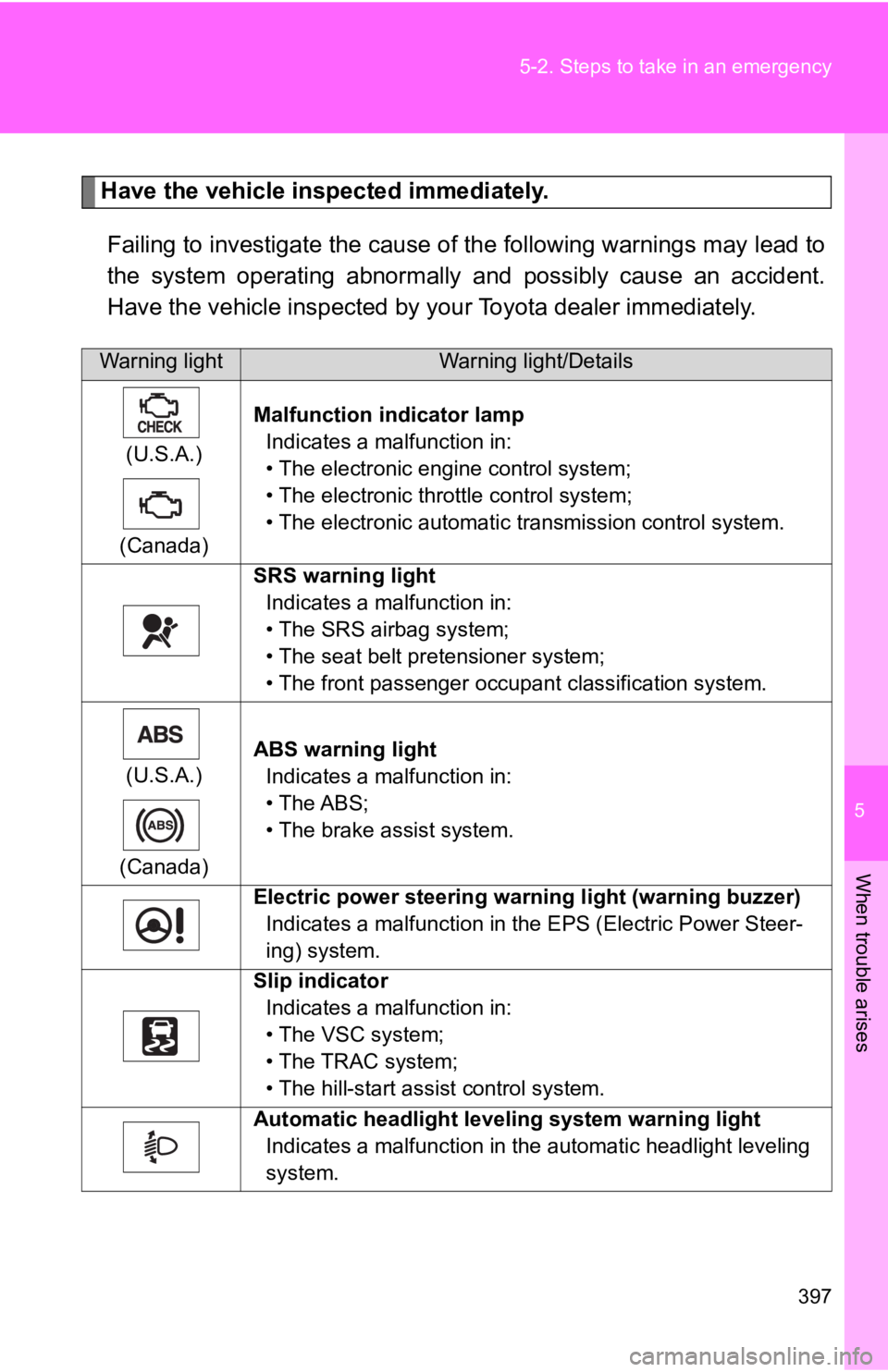
Have the vehicle ins pected immediately.
Failing to investigate the cause of the following warnings may lead to
the system operating abnormally and possibly cause an accident.
Have the vehicle ins pected by your Toyota dealer immediately.Warning light Warning light/Details
(U.S.A.)
(Canada) Malfunction indicator lamp
Indicates a malfunction in:
• The electronic engine control system;
• The electronic throttle control system;
• The electronic automatic transmission control system.
SRS warning light
Indicates a malfunction in:
• The SRS airbag system;
• The seat belt pretensioner system;
• The front passenger occupant classification system.
(U.S.A.)
(Canada) ABS warning light
Indicates a malfunction in:
• The ABS;
• The brake assist system.
Electric power steering warning light (warning buzzer)
Indicates a malfunction in the EPS (Electric Power Steer-
ing) system.
Slip indicator
Indicates a malfunction in:
• The VSC system;
• The TRAC system;
• The hill-start assist control system.
Automatic headlight leveling system warning light
Indicates a malfunction in the automatic headlight leveling
system.
Page 401 of 532

5
When trouble arises
4015-2. Steps to take in an emergency*1
: Driver’s seat belt buzzer:
Vehicles without a smart key system
The driver’s seat belt buzzer sounds to alert the driver that h is or her seat
belt is not fastened. Once the engine switch is turned to the “ ON” position,
the buzzer sounds for 6 seconds. If the vehicle reaches a speed of 12 mph
(20 km/h), the buzzer sounds once. If the seat belt is still un fastened after 24
seconds, the buzzer will sound intermittently for 10 seconds. Then, if the
seat belt is still unfastened, the buzzer will sound in a diffe rent tone for 20
more seconds.
Vehicles with a smart key system
The driver’s seat belt buzzer sounds to alert the driver that h is or her seat
belt is not fastened. Once the “ENGINE START STOP” switch is tu rned to
IGNITION ON mode, the buzzer sounds for 6 seconds. If the vehic le
reaches a speed of 12 mph (20 km/h), the buzzer sounds once. If the seat
belt is still unfastened after 24 seconds, the buzzer will soun d intermittently
for 10 seconds. Then, if the seat belt is still unfastened, the buzzer will
sound in a different tone for 20 more seconds.*2
: Front passenger’s seat belt buzzer:
The front passenger’s seat belt buzzer sounds to alert the front passenger
that his or her seat belt is not fastened. The buzzer sounds on ce if the vehi-
cle reaches a speed of 12 mph (20 km/h). If the seat belt is st ill unfastened
after 24 seconds, the buzzer will sound intermittently for 10 s econds. Then,
if the seat belt is still unfastened, the buzzer will sound in a different tone for
20 more seconds.
Page 403 of 532

5
When trouble arises
4035-2. Steps to take in an emergency
■
If the tire pressure warn ing system is inoperative
The tire pressure warning system will be disabled in the follow ing condi-
tions:
(When the condit ion becomes no rmal, the system will work proper ly.)●
If tires not equipped with tire pressure warning valves and tra nsmit-
ters are used.●
If the ID code on the tire pressure warning valves and transmit ters is
not registered in the tire pressure warning computer.●
If the tire inflation p ressure is 55 psi ( 380 kPa, 3.87 kgf/cm 2
or bar) or
higher.
The tire pressure warning system may be disabled in the followi ng condi-
tions:
(When the condit ion becomes no rmal, the system will work proper ly.)●
If electronic devices or facilities using similar radio wave fr equencies
are nearby.●
If a radio set at similar frequen cies is in use i n the vehicle.●
If a window tint that affects the radio wave signals is install ed.●
If there is a lot of snow or ice on the vehicle, in particular around the
wheels or wheel housings.
●
If non-genuine Toyota wheels are used. (Even if you use Toyota
wheels, the tire pressure warning system may not work properly with
some types of tires.)
●
If tire chains are used.
●
If a large metallic object which can interfere with signal rece ption is
put in the trunk.
■
If the tire pressure warning light frequently comes on after bl inking
for approximately one minute
If the tire pressure warning light frequently comes on after bl inking for
approximately one minute when the “ENGINE START STOP” switch is
turned to IGNITION ON mode (vehicles with a smart key system) o r the
engine switch is turned to the “ON” position (vehicles without a smart key
system), have it check ed your Toyota dealer.