Page 363 of 532
3634-3. Do-it-yourself maintenance
4
Maintenance and care
Wireless remote control/electronic key batter y Replace the battery with a new one if it is depleted.
■ You will need the following items:
● Flathead screwdriver
● Lithium battery CR2016 (vehicles without a smart key sys-
tem), or CR2032 (vehicles with a smart key system)
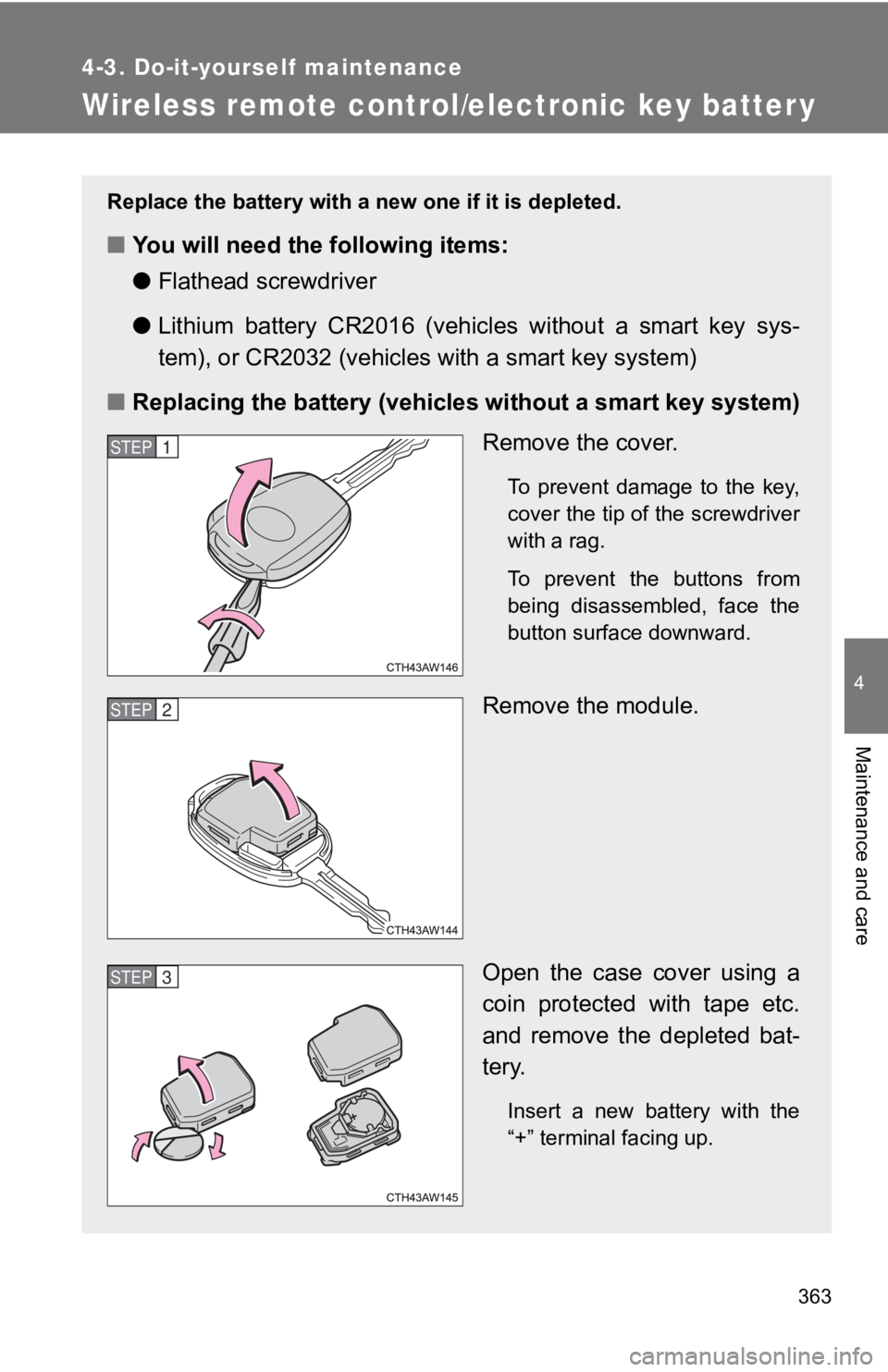
■ Replacing the battery (vehicles without a smart key system)
Remove the cover. To prevent damage to the key,
cover the tip of the screwdriver
with a rag.
To prevent the buttons from
being disassembled, face the
button surface downward.
Remove the module.
Open the case cover using a
coin protected with tape etc.
and remove the depleted bat-
tery.
Insert a new battery with the
“+” terminal facing up.STEP 1
STEP 2
STEP 3
Page 364 of 532
3644-3. Do-it-yourself maintenance
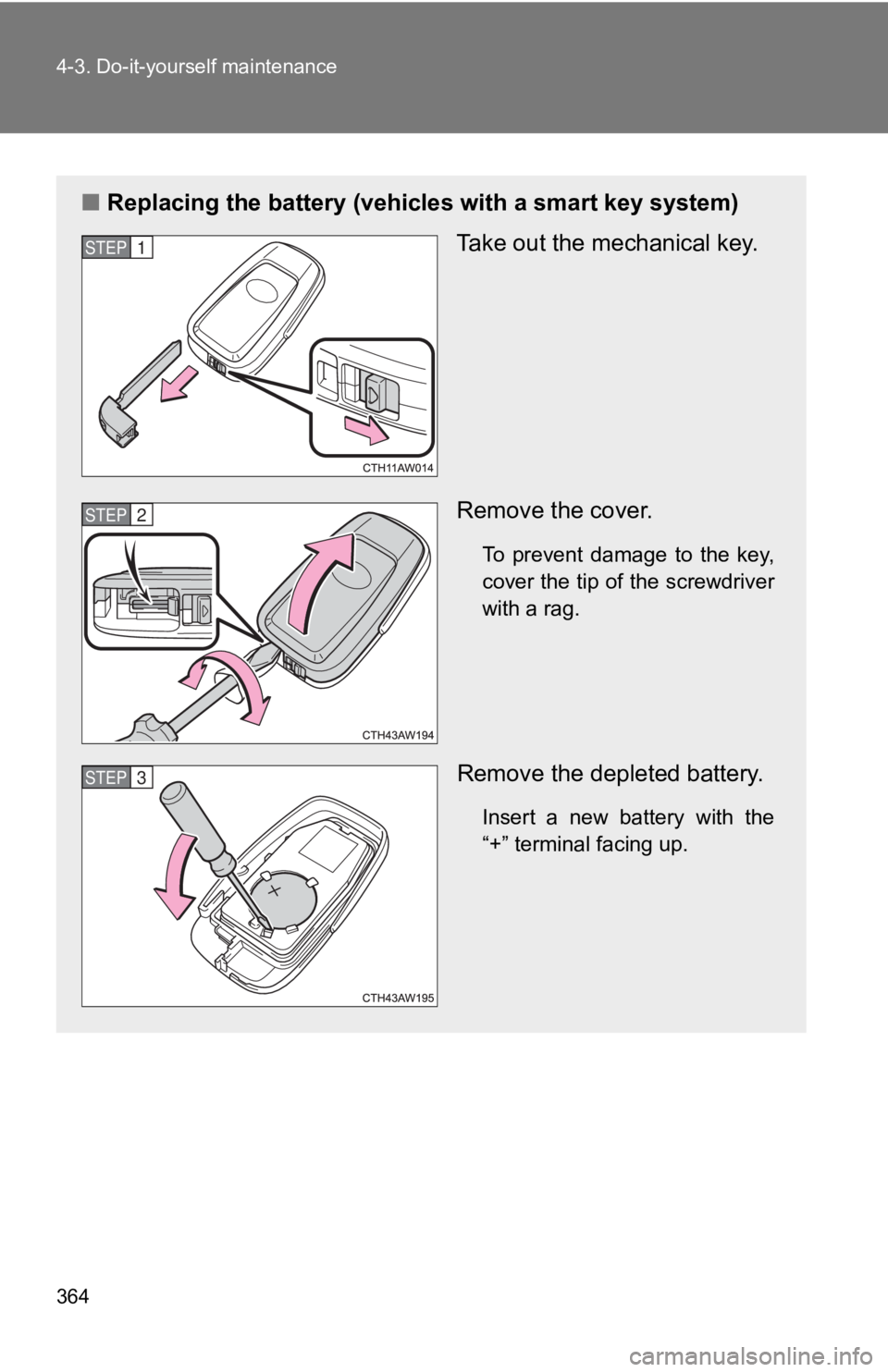
■ Replacing the battery (vehicl es with a smart key system)
Take out the mechanical key.
Remove the cover. To prevent damage to the key,
cover the tip of the screwdriver
with a rag.
Remove the depleted battery. Insert a new battery with the
“+” terminal facing up.STEP 1
STEP 2
STEP 3
Page 365 of 532
3654-3. Do-it-yourself maintenance
4
Maintenance and care ■ Use a CR2016 (vehicles without a smart key system) or CR2032 (v ehi-
cles with a smart key system) lithium battery
● Batteries can be purchased at your Toyota dealer, local electri cal appli-
ance shops or camera stores.
● Replace only with the same or equivalent type recommended by th e
manufacturer.
● Dispose of used batteries according to local laws.
■ If the key battery is depleted
The following symptoms may occur:
● The smart key system (if equipped) and wireless remote control will not
function properly.
● The operational range will be reduced.
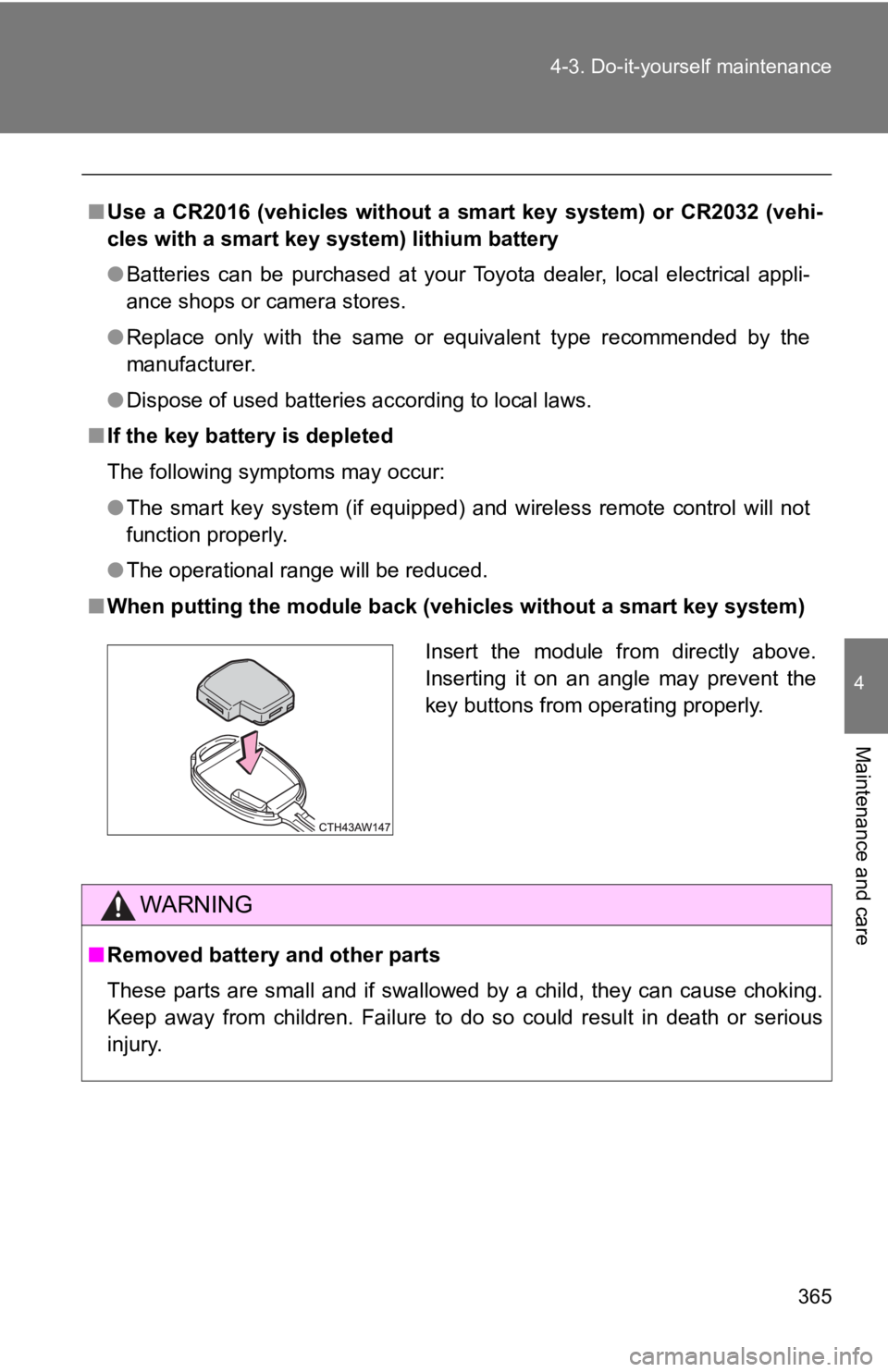
■ When putting the module back ( vehicles without a smart key syst em)
WARNING
■ Removed battery and other parts
These parts are small and if swallowed by a child, they can cau se choking.
Keep away from children. Failure to do so could result in death or serious
injury. Insert the module from directly above.
Inserting it on an angle may prevent the
key buttons from operating properly.
Page 367 of 532
3674-3. Do-it-yourself maintenance
4
Maintenance and care
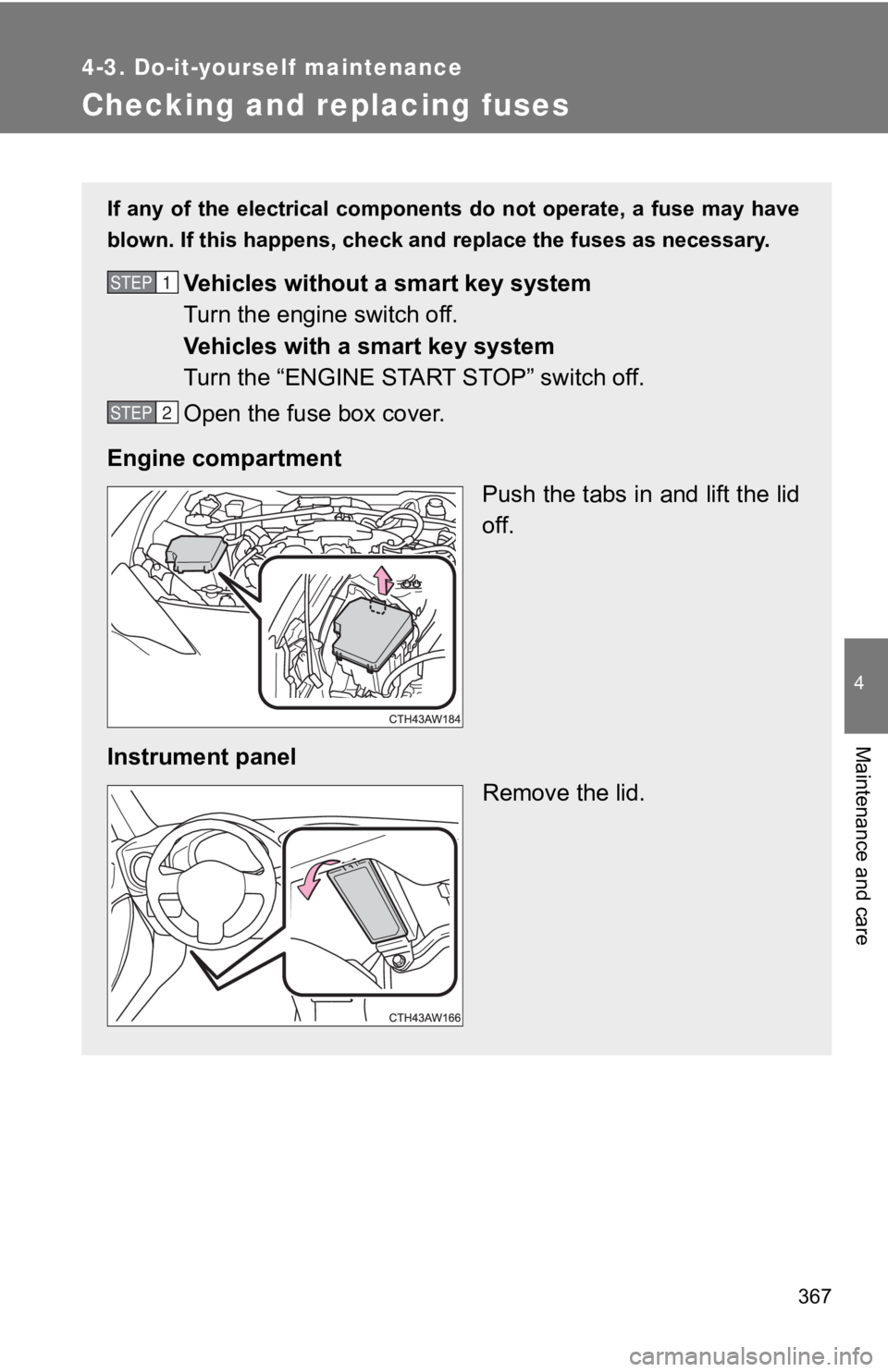
Checking and replacing fuses If any of the electrical compone nts do not operate, a fuse may have
blown. If this happens, check and replace the fuses as necessar y.
Vehicles without a smart key system
Turn the engine switch off.
Vehicles with a smart key system
Turn the “ENGINE START STOP” switch off.
Open the fuse box cover.
Engine compartment
Push the tabs in and lift the lid
off.
Instrument panel
Remove the lid.STEP 1
STEP 2
Page 371 of 532
3714-3. Do-it-yourself maintenance
4
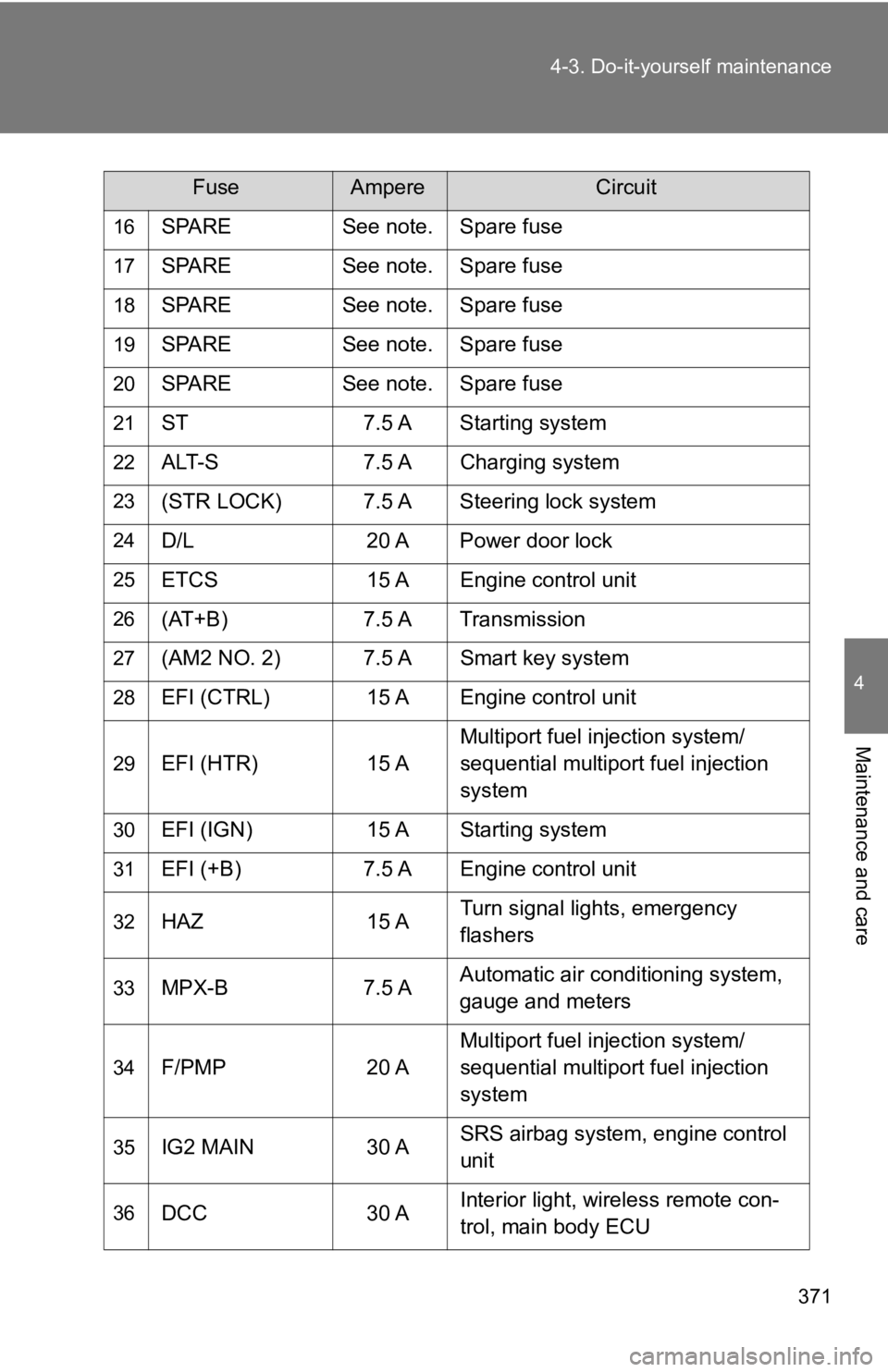
Maintenance and care 16
SPARE See note. Spare fuse17
SPARE See note. Spare fuse18
SPARE See note. Spare fuse19
SPARE See note. Spare fuse20
SPARE See note. Spare fuse21
ST 7.5 A Starting system22
ALT-S 7.5 A Charging system23
(STR LOCK) 7.5 A Steering lock system24
D/L 20 A Power door lock25
ETCS 15 A Engine control unit26
(AT+B) 7.5 A Transmission
27
(AM2 NO. 2) 7.5 A Smart key system
28
EFI (CTRL) 15 A Engine control unit
29
EFI (HTR) 15 A Multiport fuel injection system/
sequential multiport fuel injection
system
30
EFI (IGN) 15 A Starting system
31
EFI (+B) 7.5 A Engine control unit
32
HAZ 15 A Turn signal lights, emergency
flashers
33
MPX-B 7.5 A Automatic air conditioning system,
gauge and meters
34
F/PMP 20 A Multiport fuel injection system/
sequential multiport fuel injection
system
35
IG2 MAIN 30 A SRS airbag system, engine control
unit
36
DCC 30 A Interior light, wireless remote con-
trol, main body ECUFuse Ampere Circuit
Page 373 of 532
3734-3. Do-it-yourself maintenance
4
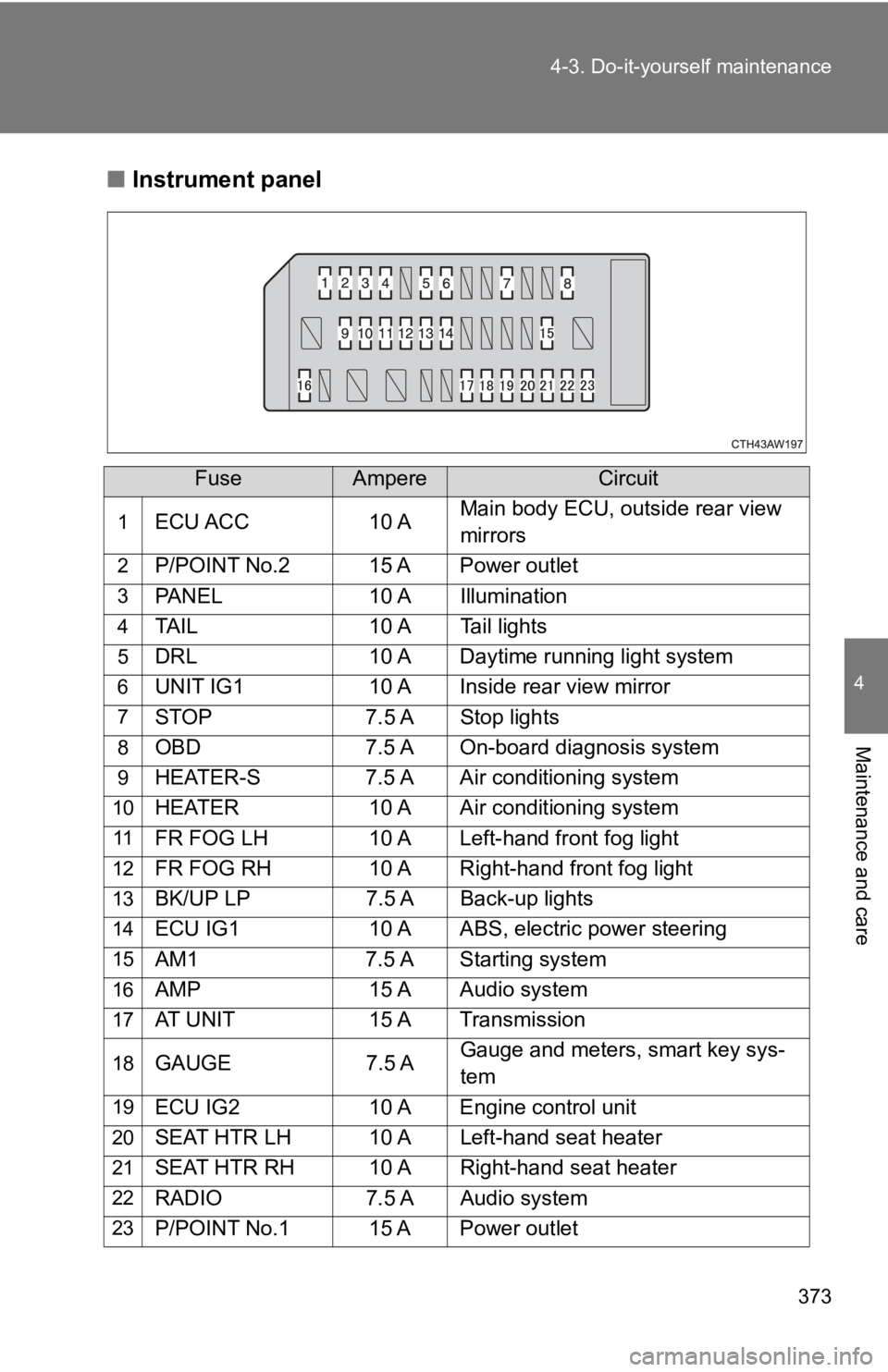
Maintenance and care ■ Instrument panel
Fuse Ampere Circuit1
ECU ACC 10 A Main body ECU, outside rear view
mirrors2
P/POINT No.2 15 A Power outlet3
PANEL 10 A Illumination4
TAIL 10 A Tail lights5
DRL 10 A Daytime running light system6
UNIT IG1 10 A Inside rear view mirror7
STOP 7.5 A Stop lights8
OBD 7.5 A On-board diagnosis system9
HEATER-S 7.5 A Air conditioning system
10
HEATER 10 A Air conditioning system
11
FR FOG LH 10 A Left-hand front fog light
12
FR FOG RH 10 A Right-hand front fog light
13
BK/UP LP 7.5 A Back-up lights
14
ECU IG1 10 A ABS, electric power steering
15
AM1 7.5 A Starting system
16
AMP 15 A Audio system
17
AT UNIT 15 A Transmission
18
GAUGE 7.5 A Gauge and meters, smart key sys-
tem
19
ECU IG2 10 A Engine control unit
20
SEAT HTR LH 10 A Left-hand seat heater
21
SEAT HTR RH 10 A Right-hand seat heater
22
RADIO 7.5 A Audio system
23
P/POINT No.1 15 A Power outlet
Page 383 of 532
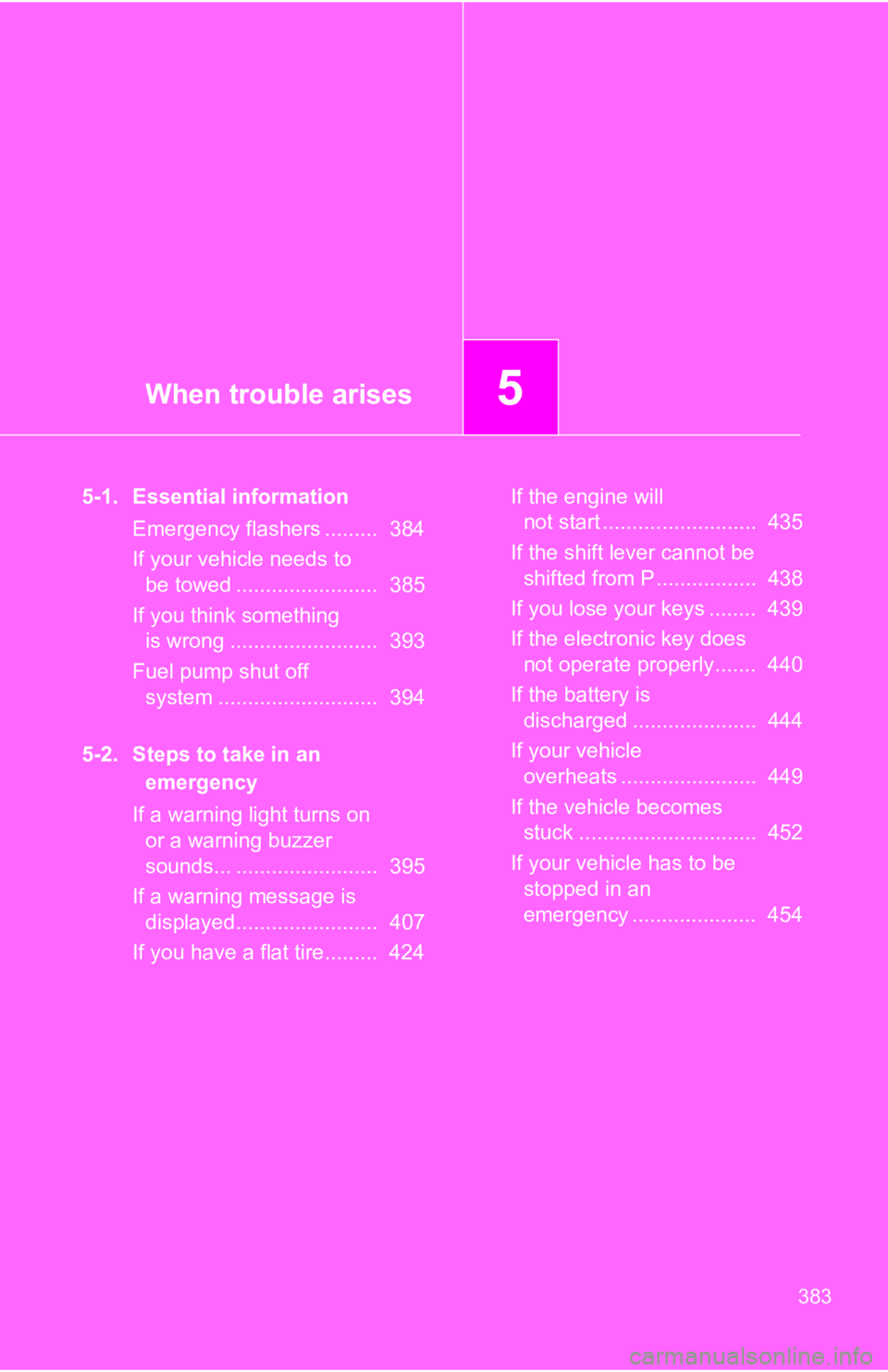
When trouble arises
5
3835-1. Essential information
Emergency flashers ......... 384
If your vehicle needs to
be towed ........................ 385
If you think something
is wrong ......................... 393
Fuel pump shut off
system ........................... 394
5-2. Steps to take in an
emergency
If a warning light turns on
or a warning buzzer
sounds... ........................ 395
If a warning message is
displayed........................ 407
If you have a flat tire......... 424 If the engine will
not start .......................... 435
If the shift lever cannot be
shifted from P................. 438
If you lose your keys ........ 439
If the electronic key does
not operate properly....... 440
If the battery is
discharged ..................... 444
If your vehicle
overheats ....................... 449
If the vehicle becomes
stuck .............................. 452
If your vehicle has to be
stopped in an
emergency ..................... 454
Page 386 of 532
3865-1. Essential information
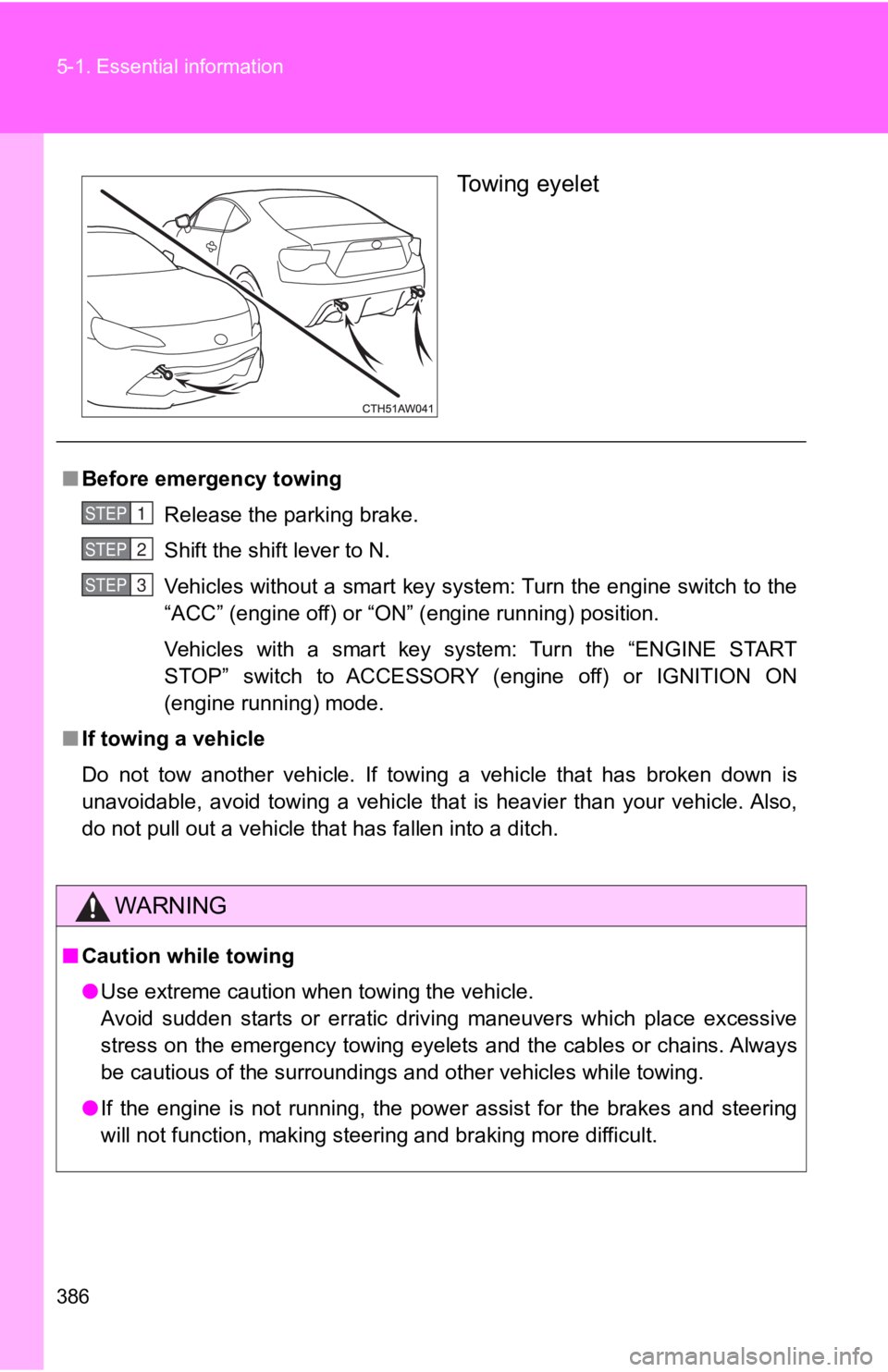
To w i n g e y e l e t
■ Before emergency towing
Release the parking brake.
Shift the shift lever to N.
Vehicles without a smart key system: Turn the engine switch to the
“ACC” (engine off) or “ON” (engine running) position.
Vehicles with a smart key system: Turn the “ENGINE START
STOP” switch to ACCESSORY (engine off) or IGNITION ON
(engine running) mode.
■ If towing a vehicle
Do not tow another vehicle. If towing a vehicle that has broken down is
unavoidable, avoid towing a vehicle that is heavier than your v ehicle. Also,
do not pull out a vehicle that has fallen into a ditch.
WARNING
■ Caution while towing
● Use extreme caution when towing the vehicle.
Avoid sudden starts or erratic driving maneuvers which place ex cessive
stress on the emergency towing eyelets and the cables or chains. Always
be cautious of the surroundings and other vehicles while towing .
● If the engine is not running, the power assist for the brakes a nd steering
will not function, making steering and braking more difficult. STEP 1
STEP 2
STEP 3