2019 SUZUKI JIMNY gear shifting
[x] Cancel search: gear shiftingPage 87 of 421

Speedometer
The speedometer indicates vehicle speed.
Tachometer
The tachometer indicates engine speed in revolutions per minute.
NOTICE
Never drive the vehicle with the engine revving in the red zone or severe engine damage can result. Keep the engine speed below the red zone even when downshifting to a lower gear position.
Refer to 11Downshifting maximum allowable speeds" in "OPERATING YOUR VEHICLE" section.
Fuel gauge
' (1)
"
~
I
)
ill•E-F
(2)
78RB02030
When the ignition switch is "ON", this gauge gives an approximate indication of the amount of fuel in the fuel tank. "F" stands for full and "E" stands for empty. If the indicator shows only one segment to "E", refill the tank as soon as possible.
BEFORE DRIVING
If the last segment blinks, it means that the fuel is almost empty. If the low fuel warning light (1) comes on, fill the fuel tank immediately. Refer to "Low fuel warning light" in "Warning and indicator lights" in this section for details. The mark (2) indicates that the fuel filler door is located on the right side of the vehicle.
2-16
Page 97 of 421

Speedometer
The speedometer indicates vehicle speed.
Tachometer
The tachometer indicates engine speed in revolutions per minute.
NOTICE
Never drive the vehicle with the engine revving in the red zone or severe engine damage can result. Keep the engine speed below the red zone even when downshifting to a lower gear position. Refer to 11Downshifting maximum allowable speeds" in "OPERATING YOUR VEHICLE" section.
Fuel gauge
(1) ' I
~
~
I
1
-'
(2)
78RB02036
When the ignition switch is "ON", this gauge gives an approximate indication of the amount of fuel in the fuel tank. "F" stands for full and "E" stands for empty. • If the indicator shows only one segment to "E", refill the tank as soon as possible.
If the last segment blinks, it means that the fuel is almost empty. If the low fuel warning light (1) comes on, fill the fuel tank immediately. Refer to "Low fuel warning light" in "Warning and indicator lights" in this section for details. The mark (2) indicates that the fuel filler door is located on the right side of the vehicle.
BEFORE DRIVING
Brightness control
Brightness
.11111
LO\"/ Hi
52RS20160
~ 10'·16□ MPH ~
(1)
78RB02037
2-26
Page 147 of 421
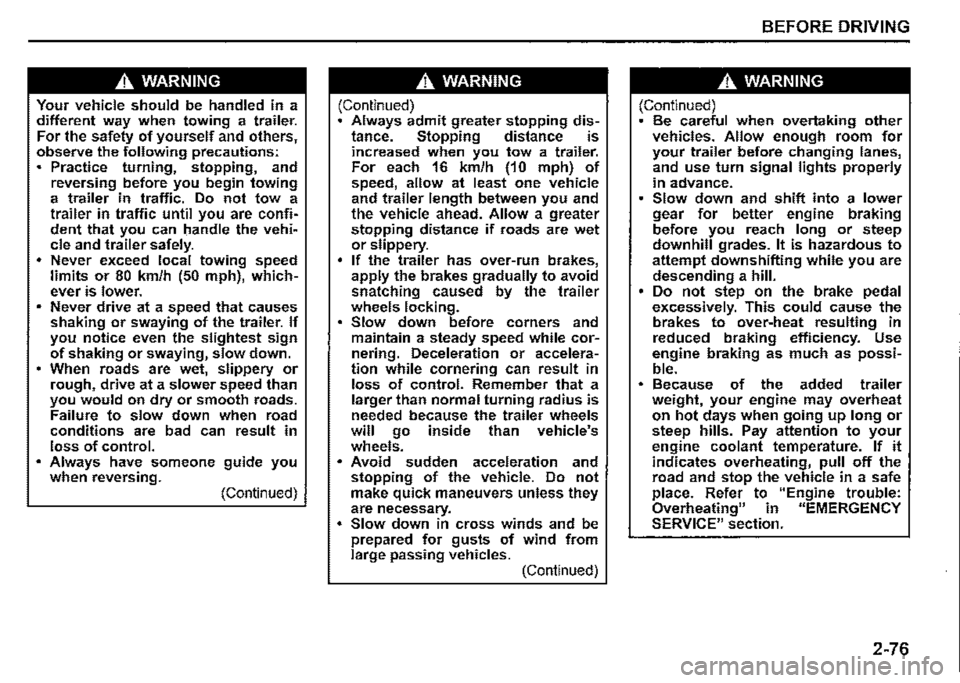
A WARNING
Your vehicle should be handled in a different way when towing a trailer. For the safety of yourself and others, observe the following precautions: Practice turning, stopping, and reversing before you begin towing a trailer in traffic. Do not tow a trailer in traffic until you are confident that you can handle the vehicle and trailer safely. Never exceed local towing speed limits or 80 km/h (50 mph), whichever is lower. Never drive at a speed that causes shaking or swaying of the trailer. If you notice even the slightest sign of shaking or swaying, slow down. • When roads are wet, slippery or rough, drive at a slower speed than you would on dry or smooth roads. Failure to slow down when road conditions are bad can result in loss of control. Always have someone guide you when reversing. (Continued)
A WARNING
(Continued) Always admit greater stopping distance. Stopping distance is increased when you tow a trailer. For each 16 km/h (10 mph) of speed, allow at least one vehicle and trailer length between you and the vehicle ahead. Allow a greater stopping distance if roads are wet or slippery. If the trailer has over-run brakes, apply the brakes gradually to avoid snatching caused by the trailer wheels locking. Slow down before corners and maintain a steady speed while cornering. Deceleration or acceleration while cornering can result in loss of control. Remember that a larger than normal turning radius is needed because the trailer wheels will go inside than vehicle's wheels. Avoid sudden acceleration and stopping of the vehicle. Do not make quick maneuvers unless they are necessary. Slow down in cross winds and be prepared for gusts of wind from large passing vehicles. (Continued)
BEFORE DRIVING
A WARNING
(Continued) Be careful when overtaking other vehicles. Allow enough room for your trailer before changing lanes, and use turn signal lights properly in advance. Slow down and shift into a lower gear for better engine braking before you reach long or steep downhill grades. It is hazardous to attempt downshifting while you are descending a hill. Do not step on the brake pedal excessively. This could cause the brakes to over-heat resulting in reduced braking efficiency. Use engine braking as much as possible. Because of the added trailer weight, your engine may overheat on hot days when going up long or steep hills. Pay attention to your engine coolant temperature. If it indicates overheating, pull off the road and stop the vehicle in a safe place. Refer to "Engine trouble: Overheating" in "EMERGENCY SERVICE" section.
2-76
Page 158 of 421

OPERATING YOUR VEHICLE
Clutch pedal (1)
A clutch pedal is used to disengage the driving force to the wheels when starting the engine, stopping, or shifting the gearshift lever. Depressing the pedal disengages the clutch.
A WARNING
Do not drive with your foot resting on the clutch pedal. It could result in excessive clutch wear, clutch damage, or unexpected loss of engine braking.
Brake pedal (2)
Your vehicle is equipped with either front and rear disc brakes or front disc brakes and rear drum brakes. Depressing a brake pedal applies both sets of brakes.
You may hear occasional brake squeal when you apply the brakes. This is a normal condition caused by environmental factors such as temperature, humidity or dust, etc.
A WARNING
If brake squeal is excessive and occurs each time the brakes are applied, you should have the brakes checked by a SUZUKI dealer.
3-7
A WARNING
Do not apply brakes continuously or rest your foot on the brake pedal. This will result in overheating of the brakes which could cause unpredictable braking action, longer stopping distances, or permanent brake dam
age.
Accelerator pedal (3)
An accelerator pedal controls the speed of the engine. Depressing the accelerator pedal increases power output and speed.
Starting engine
Before starting engine
~ 2 4 R
AT
NOTE: Your vehicle is equipped with Brake Over-fl..l""'"-i ® ride System. If you depress both the accelerator pedal and the brake pedal simultaneously, the engine power output may be suppressed.
78RB03001
1) Check that the parking brake is set fully. 2) Manual transmission -Shift into "N" (Neutral). Hold the clutch pedal and brake pedal fully depressed. Automatic transmission -If the gearshift lever is not in "P" (Park) position, shift into "P" (Park). (If you need to restart the engine while the vehicle is moving, shift into "N".)
Page 160 of 421

OPERATING YOUR VEHICLE
Starting off To start off, depress the clutch pedal all the way to the floor and shift into 1 st gear. After releasing the parking brake, gradually release the clutch. When you hear a change in the engine's sound, slowly press the accelerator while continuing to gradually release the clutch.
Shifting All forward gears are synchronized and provide quiet and easy shifting. Always depress the clutch pedal all the way to the floor before shifting gears. Keep the engine speed from rising into the red zone of the tachometer.
Downshifting maximum allowable speeds
Transfer lever in "2H" or "4H" position
Downshifting km/h (mph)
2nd to 1st 40 (25)
3rd to 2nd 75 (47)
4th to 3rd 105 (65)
5th to 4th 150 (93)*
3-9
Transfer lever in "4L" position
Downshifting km/h (mph)
2ndto1st 20 (12)
3rd to 2nd 35 (22)
4th to 3rd 50 (31)
5th to 4th 75 (47)*
*NOTE: You may not accelerate to the maximum allowable speed because of the driving situation and/or the vehicle condition.
NOTICE
Do not downshift to a lower gear at the speed faster than the maximum allowable speeds for the next lower speed) or severe damage to engine and transmission can result.
A WARNING
• Reduce your speed and downshift to a lower gear before going down a long or steep hill. A lower gear will allow the engine to provide braking. Avoid riding the brakes or they may overheat, resulting in brake failure. When driving on slippery roads, slow down before downshifting. Excessive and/or sudden changes in engine speed may cause loss of traction, which could cause you to lose control.
NOTICE
Check that the vehicle is completely stationary before you shift into reverse.
NOTICE
To help avoid clutch damage, do not use the clutch pedal as a footrest while driving or use the clutch to keep the vehicle stationary on a slope. Depress the clutch fully when shifting. • When shifting or starting off, do not race the engine. Racing the engine can shorten engine life and cause negative effect to smooth shifting.
Page 161 of 421

Automatic transmission
Gearshift lever
[eJ
R
[fj)
D
2 L
78RB03003
The gearshift lever is designed so that it cannot be shifted out of "P" position unless the ignition switch is in "ON" position and the brake pedal is depressed.
Use the gearshift lever positions as follows:
P (Park) Use this position to lock the transmission when the vehicle is parked or when starting the engine. Shift into Park only when the vehicle is completely stationary.
R (Reverse) Use this position to reverse the vehicle from stop. Make sure that vehicle is corn-
pletely stationary before shifting into Reverse.
N (Neutral) Use this position for starting the engine if the engine stalls and you need to restart it while the vehicle is moving. You may also shift into Neutral and depress the brake pedal to hold the vehicle stationary during
idling.
D (Drive) Use this position for all normal driving.
With the gearshift lever in "D" range you ?an get an automatic downshift by pressing the accelerator pedal. The higher the vehicle speed is, the more you need to press the accelerator pedal to get a downshift.
2 (Low2) Use this position to provide extra power when climbing hills, or to provide engine braking when going down hills.
L (Low 1) Use this position to provide maximum power when climbing steep hills or driving through deep snow or mud, or to provide maximum engine braking when going down steep hills.
OPERATING YOUR VEHICLE
A, WARNING
Always depress the brake pedal before shifting from "P" (Park) (or "N" (Neutral) if the vehicle is stationary) to a forward or reverse gear, to help prevent the vehicle from moving unexpectedly when you shift.
3-10
Page 162 of 421

OPERATING YOUR VEHICLE
The gearshift lever has a lock mechanism to help prevent accidental shifting. Shift the gearshift lever as follows:
•
®
t R D IN) it
D D D-,@, 2 D-
,@, L D-
78RB03004
( 1 ) knob button
Shift with the knob button (1)
•
pushed in and the brake pedal depressed.
-OD Shift with the knob button (1) pushed in.
D-D Shift without the knob button (1) pushed in.
3-11
NOTICE
• Do not shift the gearshifl lever into 11R" while moving forward, or the transmission may be damaged. If you shift into "R" when the vehicle speed is over 10 km/h (6 mph),_the transmission will not shift mto reverse. Be sure to take the following precautions to help avoid damage to the automatic transmission: -Make sure that the vehicle is completely stationary before shifting into 11P" or "R". -Do not shift from up" or "N" to "R" "D" or "L11 when the engine is r~nning above idle speed. -Do not rev the engine with the transmission in a drive position {uR", 11D" or 11~") and the front wheels not movmg. -Do not use the accelerator to hold the vehicle on a hill. Use the vehicle's brakes.
NOTE: • Always shift the gearshift lever without pushing in the knob button except when ou shift from "P" to "R", from "D" to "2", rrom "2" to "L ", from "N" to "R''. or from "R" to "P". If you always push m the knob button when shifting the gearsh1ft lever. Id h.ft · t "P" "R" "2" or "L" by youcou s1 mo , , mistake. If driver's or passenger's knee hits the gearshift lever while driving, the lever could move and the gear could be changed unexpectedly.
Overdrive off switch
ON ...
OFF c;>~
' / < .. 00---00-@ff ~-ow-,, I \" OFF ON
(1) Overdrive off switch
78RB03046
Page 163 of 421

The transmission is a 4-speed (3-speed plus overdrive) automatic transmission. By operating the overdrive off switch, the transmission can be converted to a 3-speed automatic transmission that will not move to the overdrive position. To convert the transmission to the 3-speed mode, push in the overdrive off switch and release it.
To return the transmission to the 4-speed mode, push in the overdrive off switch again:
When the ignition switch is turned to the "ACC" position, the transmission in the 3-speed mode is converted to the 4-speed mode automatically. The 3-speed mode is suitable for the following driving conditions: Driving on hilly, winding roads -You can drive more smoothly with less frequent gear changing Going down a steep hill -Some engine braking is provided
If you cannot shift automatic trans
mission gearshift lever out of "P"
(PARK)
Left hand drive vehicle
(1)
□
78RB03005
The automatic transmission vehicles have an electrically operated park-lock feature. If the vehicle's lead-acid battery is discharged, or there is some other electrical failure, the automatic transmission cannot be shifted out of Park in the normal way. Jump starting may correct the condition. If not, follow the procedure described below. This procedure will permit shifting the transmission out of Park.
OPERATING YOUR VEHICLE
1) Be sure the parking brake is firmly applied. 2) If the engine is running, stop the engine. 3) Make sure the key is in "ON" or "ACC" position. 4) Remove the cover (1) over the button. 5) With the knob button (1) pushed by the key or the flat end rod, push the knob button (2) and shift the gearshift lever to the desired position.
This procedure is for emergency use only. If repeated use of this procedure is necessary, or the procedure does not work as described, take your vehicle to a SUZUKI dealer for repair.
3-12