2019 SUZUKI JIMNY drive
[x] Cancel search: drivePage 58 of 421

FOR SAFE DRIVING
Front airbags
63J259
Front airbags are designed to infiate in severe frontal collisions when the ignition switch is in "ON" position.
NOTE: In a frontal angle collision, the side airbags and side cwtain airbags may inflate.
Front airbags are not designed to infiate in rear impacts, side impacts, rollovers or minor frontal collisions, since they would offer no protection in those types of accidents. Since an airbag deploys only one time during an accident, seat belts are needed to restrain occupants from further movements during the accident.
1-37
Therefore, an airbag is not a substitute for Front passenger's front airbag seat belts. To maximize your protection, always fasten your seat belts. Be aware that no system can prevent all possible injuries that may occur in an accident.
Driver's front airbag
D
SRS AIRBAG
78RB02023
SRS AIRBAG
78RB02024
The driver's front airbag is located behind the canter pad of the steering wheel and the front passenger's front airbag is located behind the passenger's side of the dashboard. The words "SRS AIRBAG" are melded into the airbag covers to identify the location of the airbags.
A WARNING
If the airbag stored place is damaged or cracked, the airbag system may not work properly, which could result in serious injury in the event of a collision. Have your vehicle inspected by a SUZUKI dealer.
Page 66 of 421

FOR SAFE DRIVING
A seat belt helps keep you in the proper po_sition for maximum protection when an airbag infiates. Adjust your seat as far back as possible while still maintaining control of the vehicle. Sit fully back in your seat; sit up straight; do not lean over the steering wheel or dashboard. Front occupants should not lean on or sleep against the door. Refer to "Seat adjustment" section and "Seat belts and child restraint systems" section in this section for details on proper seat and seat belt adjustments.
1-45
A WARNING
• The driver should not lean over the steering wheel. The front passenger should not rest his or her body against the dashboard, or otherwise get too close to the dashboard. For vehicles with side airbags and side curtain airbag, occupants should not lean on or sleep against the door. In these situations, the out-of-position occupant would be too close to an inflating airbag, and may suffer severe injury. • Do not attach any objects to, or place any objects over, the steering wheel or dashboard. Do not place any objects between the airbag and the driver or front passenger. These objects may interfere with airbag operation or may be propelled by the airbag in the event of a collision. Also, these objects may move when you start moving vehicle or while vehicle is moving, they may interfere with driver's view or safe driving. In each conditions may cause severe injury. (Continued)
Page 67 of 421

A WARNING
(Continued) For vehicles with side airbags, do not use non-genuine seat covers on the front seats, because nongenuine seat covers may obstruct the inflation of side airbags. Suzuki highly recommends Suzuki-genuine seat covers to be used when covering the front seats of such vehicles with side airbags. Also, near the door, do not place cup holders, hangers or any other objects and do not lean an umbrella, as these objects could be propelled by the airbag in the event of a collision. Either of these conditions may cause severe injury. Do not strike or apply significant levels of impact to the airbag component areas. It can cause the airbags to malfunction.
Even though your vehicle is moderately damaged by a collision, it may not be severe enough to trigger front, side or side curtain airbags to inflate. If your vehicle sustains any front-end or side damage, have the airbag system inspected by a SUZUKI dealer to ensure that ii works properly.
Your vehicle is equipped with a diagnostic module which records information about the airbag system if the airbags deploy in a collision. The module records information about overall system status, and which sensors activated the deployment, and for a certain vehicle only, whether the driver's seat belt was in use.
Servicing the airbag system If the airbags inflate, have the airbags and related components replaced by a SUZUKI dealer as soon as possible.
If your vehicle ever gets in deep water and the driver's floor is submerged, the airbag controller could be damaged. If this happens, ask a SUZUKI dealer to check the airbag system as soon as possible.
FOR SAFE DRIVING
Special procedures are required for servicing or replacing an airbag. For that reason, only a SUZUKI dealer should be allowed to service or replace your airbags. Remind anyone who services your SUZUKI vehicle that it has airbags.
Service on or around airbag components or wiring must be performed only by a SUZUKI dealer. Improper service could result in unintended airbag deployment or could render the airbag inoperative. Either of these two conditions may result in severe injury.
To prevent damage or unintended inflation of the airbag system, check that the leadacid battery is disconnected and the ignition switch has been in "LOCK" position for at least 90 seconds before performing any electrical service work on your SUZUKI vehicle. Do not touch airbag system components or wires. The wires are wrapped with yellow tape or yellow tubing, and the couplers are yellow for easy identification.
Scrapping a vehicle that has an uninflated airbag can be hazardous. Ask a SUZUKI dealer, body repair shop or scrap yard for help with disposal.
1-46
Page 73 of 421
NOTE: If you lose your immobilizer ignition key, ask a SUZUKI dealer as soon as possible to deactivate the lost one, and to make a new key. If you own other vehicles with immobilizer keys, keep those keys away from the ignition switch when using your SUZUKI vehicle. Otherwise, the engine may not be started because they may interfere with your SUZUKI vehicle's immobilizer system. If you attach any metal objects to the immobilizer key, it may not start the engine.
NOTICE
The immobilizer key is sensitive electronic instruments. To avoid damaging them: Do not expose them to impacts, moisture or high temperature such as on the dashboard under direct sunlight. Keep them away from magnetic objects.
Ignition key reminder
A buzzer sounds intermittently to remind you to remove the ignition key if it is in the ignition keyhole when the driver's door is opened.
Door locks
Side door locks
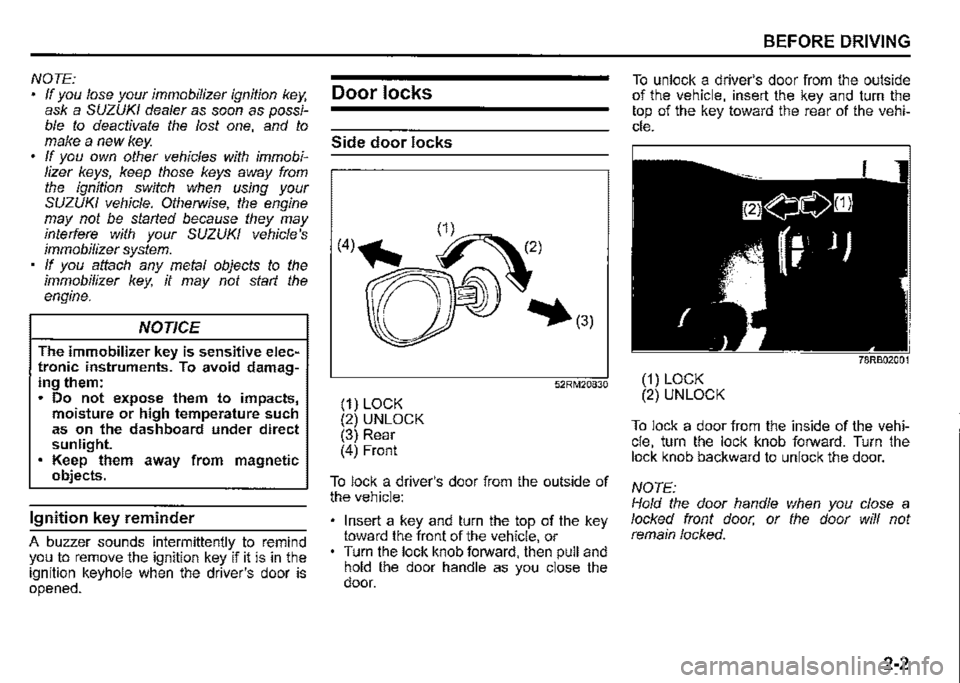
(1) LOCK (2) UNLOCK (3) Rear (4) Front
52RM20830
To lock a driver's door from the outside of the vehicle:
Insert a key and turn the top of the key toward the front of the vehicle, or Turn the lock knob forward, then pull and hold the door handle as you close the door.
BEFORE DRIVING
To unlock a driver's door from the outside of the vehicle, insert the key and turn the top of the key toward the rear of the vehicle.
78RB02001
(1) LOCK (2) UNLOCK
To lock a door from the inside of the vehicle, turn the lock knob forward. Turn the lock knob backward to unlock the door.
NOTE: Hold the door handle when you close a locked front door, or the door will not remain locked.
2-2
Page 74 of 421
BEFORE DRIVING
Central door locking system
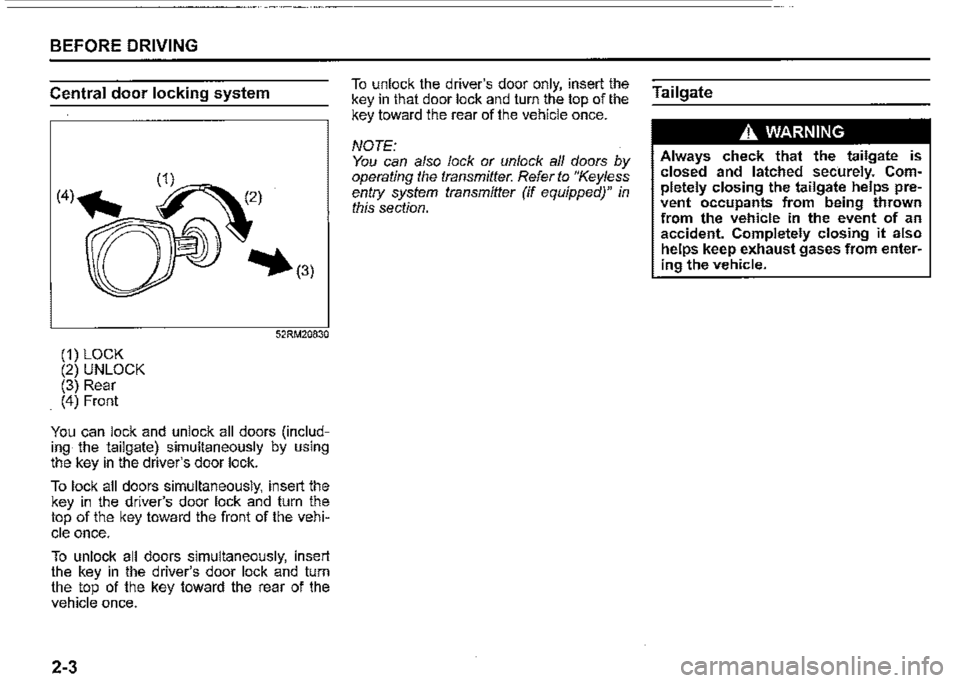
(1) LOCK (2) UNLOCK (3) Rear (4) Front
52RM20830
You can lock and unlock all doors (including the tailgate) simultaneously by using the key in the driver's door lock.
To lock all doors simultaneously, insert the key in the driver's door lock and turn the top of the key toward the front of the vehi
cle once.
To unlock all doors simultaneously, insert the key in the driver's door lock and turn the top of the key toward the rear of the vehicle once.
2-3
To unlock the driver's door only, insert the key in that door lock and turn the top of the key toward the rear of the vehicle once.
NOTE: You can also lock or unlock all doors by operating the transmitter. Refer to "Keyless entry system transmitter (if equipped)" in this section.
Tailgate
A WARNING
Always check that the tailgate is closed and latched sec·urely. Completely closing the tailgate helps prevent occupants from being thrown from the vehicle in the event of an accident. Completely closing it also helps keep exhaust gases from entering the vehicle.
Page 75 of 421
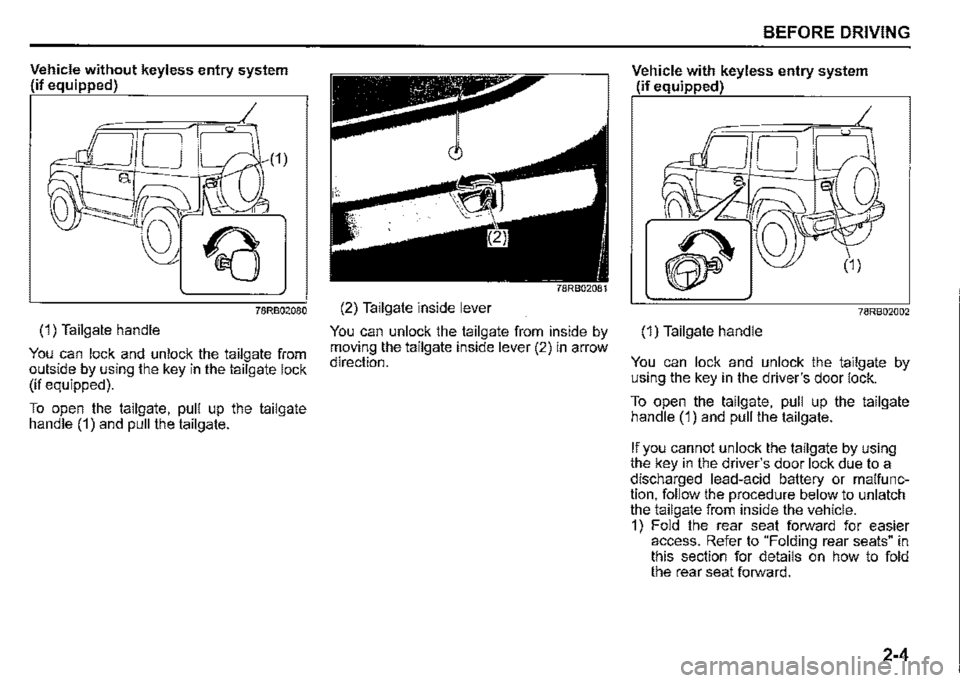
Vehicle without keyless entry system (if equipped)
78RB02080
(1) Tailgate handle
You can lock and unlock the tailgate from outside by using the key in the tailgate lock (if equipped).
To open the tailgate, pull up the tailgate handle (1) and pull the tailgate.
(2) Tailgate inside lever
You can unlock the tailgate from inside by moving the tailgate inside lever (2) in arrow direction.
BEFORE DRIVING
Vehicle with keyless entry system (if equipped)
(1)
78RB02002
(1) Tailgate handle
You can lock and unlock the tailgate by using the key in the driver's door lock.
To open the tailgate, pull up the tailgate handle (1) and pull the tailgate.
If you cannot unlock the tailgate by using the key in the driver's door lock due to a discharged lead-acid battery or malfunction, follow the procedure below to unlatch the tailgate from inside the vehicle. 1) Fold the rear seat forward for easier access. Refer to "Folding rear seats" in this section for details on how to fold the rear seat forward.
2-4
Page 76 of 421

BEFORE DRIVING
2) Remove the luggage box (1 ).
(2)
3) Remove the trim (2) of the tailgate. • Insert a flat-bladed screwdriver covered with a soft cloth between the trim and the tailgate to make a space for fingers, and then pull out the trim with your fingers.
2-5
4) Move the lever (3) in arrow direction to unlock the tailgate.
78RB02090
5) From outside the vehicle, pull up the tailgate handle (4) and open the tailgate.
If the tailgate cannot be unlatched by pulling up the tailgate handle, have the vehicle inspected by a SUZUKI dealer.
A CAUTION
Check that there is no one near the tailgate when pushing open the tailgate from inside the vehicle.
Page 78 of 421

BEFORE DRIVING
Battery replacement If the transmitter becomes unusable, replace the battery.
To replace the battery of the transmitter:
(2)
68LM248
1) Remove the screw (1), and open the transmitter cover. 2) Remove the transmitter (2).
2-7
68LM249
(3) Lithium disc type battery: CR1616 or equivalent
3) Put the edge of a flat-bladed screwdriver in the slot of the transmitter (2) and pry it open. 4) Replace the battery (3) so its+ terminal faces "+" mark of the transmitter. 5) Close the transmitter and install it into the transmitter holder. 6) Close the transmitter cover, install and tighten the screw (1 ). 7) Check that the door locks can be operated with the transmitter. 8) Dispose of the used battery properly according to applicable rules or regulations. Do not dispose of lithium batteries with ordinary household trash.
A WARNING
Swallowing a lithium battery may cause serious internal injury. Do not allow anyone to swallow a lithium battery. Keep lithium batteries away from children and pets. If swallowed, contact a physician immediately.
NOTICE
• The transmitter is a sensitive elec)ron!c instrument. To avoid damaging ,t, do not expose it to dust or moisture or tamper with internal parts. When replacing the battery by yourself, the transmitter controller could be damaged affected by static electricity. Discharge the static electricity built up in your body by touching metal before replacing the battery.
NOTE: Used batteries must be disposed of properly according to applicable rules or regulations and must not be disposed of with ordinary household trash.