2019 SUZUKI JIMNY gear
[x] Cancel search: gearPage 125 of 421

Master warning indicator light
(if equipped)
68PM00278
When the ignition switch is turned "ON", this light comes on briefiy so you can check that the light is working.
When the information display shows warning and indicator messages, this indicator light may also blink.
For details, refer to "Information display" in this section.
4WD indicator light
78RB02078
· This indicator light comes on when the transfer gear and the air locking hubs are switched to 4-wheel drive condition ("4H" or "4L").
When the ignition switch is turned "ON", this 4WD indicator light will come on for a while and then this light will turned on or off according to the drive condition.
If 4WD indicator light continues to blink, there may be a malfunction of the system. If so, have the system inspected by your SUZUKI dealer.
When you shift the transfer lever from "2H" position to "4H" position at a speed of 100 km/h (60 mph) or more, this indicator light blinks.
When you shift transfer lever again while changing the drive condition, this indicator blinks.
BEFORE DRIVING
NOTE: When the drive condition is 4-wheel drive condition and the engine is not running with the ignition switch turned "ON", this 4WD indicator light will come on for a while and then blink. In this situation, when you start the engine and this indicator light comes on, the system does not indicate a malfunction.
Cruise indicator light (if equipped)
81P40090
When the cruise control system is activated, this light comes on.
2-54
Page 147 of 421
A WARNING
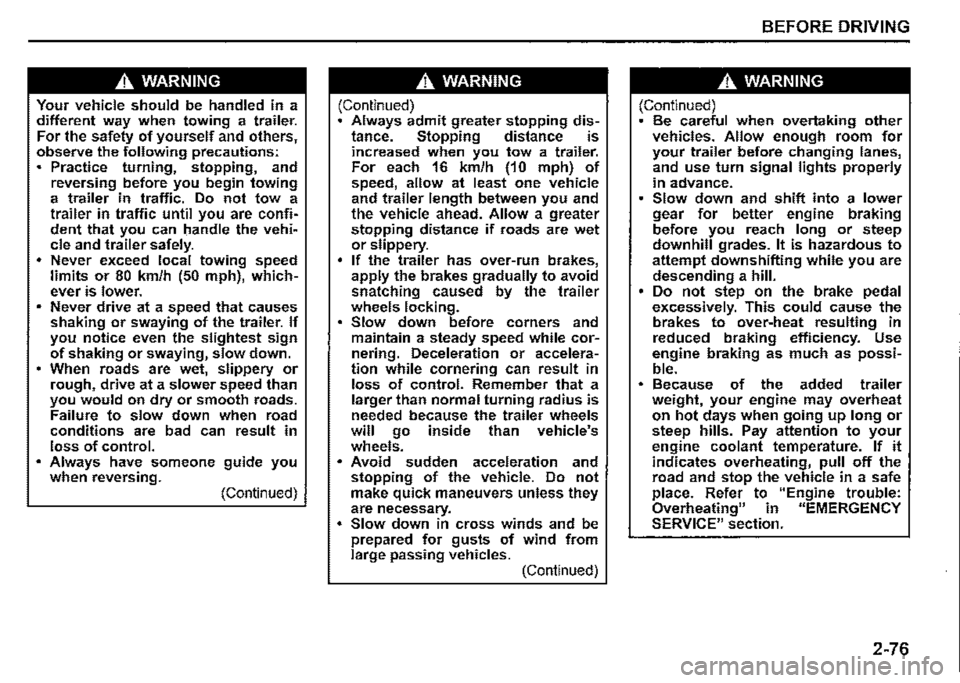
Your vehicle should be handled in a different way when towing a trailer. For the safety of yourself and others, observe the following precautions: Practice turning, stopping, and reversing before you begin towing a trailer in traffic. Do not tow a trailer in traffic until you are confident that you can handle the vehicle and trailer safely. Never exceed local towing speed limits or 80 km/h (50 mph), whichever is lower. Never drive at a speed that causes shaking or swaying of the trailer. If you notice even the slightest sign of shaking or swaying, slow down. • When roads are wet, slippery or rough, drive at a slower speed than you would on dry or smooth roads. Failure to slow down when road conditions are bad can result in loss of control. Always have someone guide you when reversing. (Continued)
A WARNING
(Continued) Always admit greater stopping distance. Stopping distance is increased when you tow a trailer. For each 16 km/h (10 mph) of speed, allow at least one vehicle and trailer length between you and the vehicle ahead. Allow a greater stopping distance if roads are wet or slippery. If the trailer has over-run brakes, apply the brakes gradually to avoid snatching caused by the trailer wheels locking. Slow down before corners and maintain a steady speed while cornering. Deceleration or acceleration while cornering can result in loss of control. Remember that a larger than normal turning radius is needed because the trailer wheels will go inside than vehicle's wheels. Avoid sudden acceleration and stopping of the vehicle. Do not make quick maneuvers unless they are necessary. Slow down in cross winds and be prepared for gusts of wind from large passing vehicles. (Continued)
BEFORE DRIVING
A WARNING
(Continued) Be careful when overtaking other vehicles. Allow enough room for your trailer before changing lanes, and use turn signal lights properly in advance. Slow down and shift into a lower gear for better engine braking before you reach long or steep downhill grades. It is hazardous to attempt downshifting while you are descending a hill. Do not step on the brake pedal excessively. This could cause the brakes to over-heat resulting in reduced braking efficiency. Use engine braking as much as possible. Because of the added trailer weight, your engine may overheat on hot days when going up long or steep hills. Pay attention to your engine coolant temperature. If it indicates overheating, pull off the road and stop the vehicle in a safe place. Refer to "Engine trouble: Overheating" in "EMERGENCY SERVICE" section.
2-76
Page 148 of 421

BEFORE DRIVING
60A186
A WARNING
When parking your vehicle and connected trailer, always use the following procedure: 1) Apply the vehicle's brakes firmly. 2) Have another person place wheel chocks under the wheels of the vehicle and the trailer while you are holding the brakes. 3) Slowly release the brakes until the · wheel chocks absorb the load.
4) Fully engage the parking brake. 5) Manual transmission -turn off the engine, then shift into reverse or first gear. Automatic transmission -shift into "P" (Park) and turn off the engine. (Continued)
2-77
A WARNING
(Continued) When starting out after parking: 1) Depress the clutch and start the engine. 2) Have another person remove the chocks. 3) Shift into gear, release the parking brake, and slowly pull away from the chocks. 4) Stop, apply the brakes firmly and hold them.
Trailer hitch (tow bar) installation points Each arrow shows fixing points for Suzuki's genuine tow bar kit. For details, follow the instruction provided with the tow bar kit.
Page 151 of 421

OPERATING YOUR VEHICLE
OPERATING YOUR VEHICLE
Daily inspection checklist .................................................. 3-1
Engine oil consumption ..................................................... 3-2
Ignition switch ..................................................................... 3-2 -
Parking brake lever ............................................................. 3-5
Pedal ..................................................................................... 3-6
Starting engine .................................................................... 3-7
Using transmission ............................................................. 3-8
Gearshift indicator (if equipped) ........................................ 3-13
Transfer lever ...................................................................... 3-16
Cruise control (if equipped) ............................................... 3-22
Speed limiter (if equipped) ................................................. 3-25
SUZUKI SAFETY SUPPORT (if equipped) ......................... 3-27
Emergency stop signal (ESS) (if equipped) ...................... 3-52
Braking ................................................................................. 3-53
Electronic stability program (ESP®) .................................. 3-55
Tyre pressure monitoring system
(TPMS) (if equipped) ........................................................... 3-63
Page 154 of 421

OPERATING YOUR VEHICLE
68PH00310
The ignition switch has the following four positions:
LOCK This is the normal parking position. It is the only position in which the key can be removed.
3-3
Manual transmission
Turn to "LOCK"
60G033
Manual transmission vehicles You must push in the key to turn it to "LOCK" position. It locks the ignition, and prevents normal use of the steering wheel after the key is removed.
Automatic transmission vehicles The gearshift lever must be in "P" (Park) position to turn the key to "LOCK" position. It locks the ignition and prevents normal use of the steering wheel and gearshift lever.
To release the steering lock, insert the key and turn it clockwise to one of the other positions. If you have trouble turning the key to unlock the steering wheel, try turning the steering wheel slightly to the right or left while turning the key.
ACC Accessories such as the radio can operate, but the engine is off.
ON This is the normal operating position. All electrical systems are on.
START This is the position for starting the engine using the starter motor. The key should be released from this position as soon as the engine starts.
Ignition key reminder A buzzer sounds intermittently to remind you to remove the ignition key if it is in the ignition switch when the driver's door is opened.
Page 156 of 421

OPERATING YOUR VEHICLE
Parking brake lever
(1) To set (2) To release (3) To release
The parking brake lever is located between the front seats. To set the parking brake, depress the brake pedal and pull the parking brake lever all the way up. To release the parking brake, depress the brake pedal and pull up slightly on the parking brake lever, push the button on the end of the lever with your thumb, and lower the lever to its original position.
3-5
For automatic transmission vehicles, always set the parking brake before moving the gearshift lever to "P" (PARK) position. If you park on an incline and shift into "P" before setting the parking brake, the weight of the vehicle may make it difficult to shift out of "P" when you are ready to drive the vehicle.
When preparing to drive the vehicle, move the gearshift lever out of "P" position before releasing the parking brake.
A WARNING
• Whenever parking, make sure the gearshift lever for manual transmission vehicles is in 1st gear or "R" (Reverse) and the gearshift lever for automatic transmission or automatic transmission vehicles is in 11P" {Park). Remember, even though the transmission is in gear or in Park, you must set the parking brake fully. • When parking on an uphill, turn the steering wheel so that the front wheels point to the center of the
road. • When parking on a downhill, turn the steering wheel so that the front wheels point to the curb. • Never drive your vehicle with the parking brake on: rear brake effectiveness can be reduced from overM heating, brake life may be shortened, or permanent brake damage may result. • If the parking brake does not hold the vehicle securely or does not fully release, have your vehicle inspected immediately by a SUZUKI dealer.
Page 157 of 421

A WARNING
Always set the parking brake fully before leaving your vehicle or it may move, causing injury or damage. When parking, make sure the gearshift lever for manual transmission vehicles is in 1st gear or "R" (Reverse) and the gearshift lever for automatic transmission vehicles is in "P" (Park). Remember, even though the transmission is in gear or in Park, you must set the parking brake fully.
A WARNING
When parking the vehicle in extremely cold weather, the following procedure should be used: 1) Set the parking brake. 2) Manual transmission -turn off the engine, then shift into reverse or first gear. Automatic transmission -shift into "P" (Park) and turn off the engine. 3) Get out of the vehicle and put chocks under the wheels. 4) Release the parking brake. When you return to your vehicle, first set the parking brake, and then remove the wheel chocks.
A WARNING
Do not leave cigarette lighters, spray cans, soft drink cans or plastic arti~ cles (such as glasses, CD case, etc.) in sun-heated vehicle. The temperature inside the vehicle may cause as follows: Gas may leak from a cigarette lighter or spray can and may lead to a fire. The glasses, plastic cards or CD cases, etc. may deform or crack. Soft drink cans may fracture.
Parking brake reminder buzzer
A buzzer sounds intermittently to remind you to release the parking brake if you start the vehicle without fully releasing the parking brake. Check that the parking brake is fully released and the brake system warning light turns off.
OPERATING YOUR VEHICLE
Pedal
Manual transmission
80J2121
Automatic transmission
80J2122
3-6
Page 158 of 421

OPERATING YOUR VEHICLE
Clutch pedal (1)
A clutch pedal is used to disengage the driving force to the wheels when starting the engine, stopping, or shifting the gearshift lever. Depressing the pedal disengages the clutch.
A WARNING
Do not drive with your foot resting on the clutch pedal. It could result in excessive clutch wear, clutch damage, or unexpected loss of engine braking.
Brake pedal (2)
Your vehicle is equipped with either front and rear disc brakes or front disc brakes and rear drum brakes. Depressing a brake pedal applies both sets of brakes.
You may hear occasional brake squeal when you apply the brakes. This is a normal condition caused by environmental factors such as temperature, humidity or dust, etc.
A WARNING
If brake squeal is excessive and occurs each time the brakes are applied, you should have the brakes checked by a SUZUKI dealer.
3-7
A WARNING
Do not apply brakes continuously or rest your foot on the brake pedal. This will result in overheating of the brakes which could cause unpredictable braking action, longer stopping distances, or permanent brake dam
age.
Accelerator pedal (3)
An accelerator pedal controls the speed of the engine. Depressing the accelerator pedal increases power output and speed.
Starting engine
Before starting engine
~ 2 4 R
AT
NOTE: Your vehicle is equipped with Brake Over-fl..l""'"-i ® ride System. If you depress both the accelerator pedal and the brake pedal simultaneously, the engine power output may be suppressed.
78RB03001
1) Check that the parking brake is set fully. 2) Manual transmission -Shift into "N" (Neutral). Hold the clutch pedal and brake pedal fully depressed. Automatic transmission -If the gearshift lever is not in "P" (Park) position, shift into "P" (Park). (If you need to restart the engine while the vehicle is moving, shift into "N".)