2019 SUZUKI IGNIS Drive
[x] Cancel search: DrivePage 420 of 505

8-11EMERGENCY SERVICE
75RM4-01E
54P000804
3) Connect jump leads as follows:1. Connect one end of the first jumplead to the positive (+) terminal of
the flat battery (1).
2. Connect the other end to the positive (+) terminal of the booster battery
(2).
3. Connect one end of the second jump lead to the negative (–) terminal of
the booster battery (2).
4. Make the final connection to an unpainted, heavy metal part (i.e.
engine mount bracket (3)) of the
engine of the vehicle with the flat
battery (1). 4) If the booster battery you are using is
fitted to another vehicle, start the
engine of the vehicle with the booster
battery. Run the engine at moderate
speed.
5) Start the engine of the vehicle with the flat battery.
6) Remove the jump leads in the exact reverse order in which you connected
them.
TowingIf you need to have your vehicle towed,
contact a professional service. Your dealer
can provide you with detailed towing
instructions.
(2)
(1)
(3)
EXAMPLE
WA R N I N G
Never connect the jump lead directly
to the negative (–) terminal of the dis-
charged battery, or an explosion may
occur.
CAUTION
Connect the jump l ead to the engine
mount bracket securely. If the jump
lead disconnects from the engine
mount bracket because of vibration
at the start of the engine, the jump
lead could be caught in the drive
belts.
WA R N I N G
For vehicles equipped with the dual
camera brake support, if your vehicle
is towed with the engine on, press
dual camera brake support OFF
switch and turn off the dual camera
brake support. If not, unexpected
accidents related to the system being
turned on may occur.
NOTICE
Observe the following instructions
when towing your vehicle.
• To help avoid damage to your vehi- cle during towing, proper equip-
ment and towing procedures must
be used.
• Using the frame hook, tow your
vehicle on paved roads for short
distances at low speed.
Page 421 of 505

8-12
EMERGENCY SERVICE
75RM4-01E
2-wheel drive (2WD) CVTCVT vehicles may be towed using either of
the following methods.
1) From the front, with the front wheelslifted and the rear wheels on the
ground. Before towing, make sure that
the parking brak e is released.
2) From the rear, with the rear wheels
lifted and a dolly under the front wheels.
2-wheel drive (2WD) manual tran-saxle or Auto Gear ShiftManual transaxle vehicles or Auto Gear
Shift vehicles may be towed using either of
the following methods.
1) From the front, with the front wheelslifted and the rear wheels on the
ground. Before towing, check that the
parking brake is released.
2) From the rear, with the rear wheels
lifted and the front wheels on the
ground, provided the steering and
drivetrain are in operational condition.
Before towing, check that transaxle is in
neutral, the steering wheel is unlocked
(vehicle without keyl ess push start sys-
tem - the ignition key should be in
“ACC” position) (vehicle with keyless
push start system - the ignition mode is
ACC), and the steering wheel is
secured with a clamping device
designed for towing service.
4-wheel drive (4WD)Your vehicle should be towed under one of
the following conditions:
1) With all four wheels on a flat-bed truck.
2) With the front or rear wheels lifted and a dolly under the other wheels.
NOTICE
Towing your vehicle with the front
wheels on the ground can result in
damage to the CVT.
NOTICE
The steering column is not strong
enough to withstand shocks trans-
mitted from the fr ont wheels during
towing. Always unlock the steering
wheel before towing.
NOTICE
After shifting the Auto Gear Shift
gearshift lever to the “N” position,
always check the gear position indi-
cator in the instrument cluster shows
the “N” position to make sure that the
transaxle is disengaged.
If the transaxle cannot be put in neu-
tral, turn the key from the “LOCK” to
the “ON” position or press the engine
switch to change the ignition mode to
ON, and move the Auto Gear Shift
gearshift lever from “N” to “D”, “M”
or “R”, then back to “N” again. Then
turn the key from the “ON” to the
“LOCK” position or press the engine
switch to change the ignition mode to
LOCK (OFF). These procedures may
help put the transaxle in neutral. If
the transaxle still cannot be put in
neutral, you cannot tow the vehicle
without using a towing dolly.
Page 426 of 505

9-1APPEARANCE CARE
75RM4-01E
Corrosion preventionIt is important to take good care of your
vehicle to protect it from corrosion. Listed
below are instructions for how to maintain
your vehicle to prevent corrosion. Please
read and follow these instructions carefully.Important information about corro-sionCommon causes of corrosion
1) Accumulation of road salt, dirt, moisture or chemicals in hard-to-reach areas of
the vehicle und erbody or frame.
2) Chipping, scratches and any damage to treated or painted metal surfaces
resulting from minor accidents or abra-
sion by stones and gravel.
Environmental conditions which accel-
erate corrosion
1) Road salt, dust control chemicals, sea air or industrial pollution will all acceler-
ate the corrosion of metal.
2) High humidity will increase the rate of
corrosion particularly when the tem-
perature range is just above the freez-
ing point.
3) Moisture in certain areas of a vehicle for an extended period of time may pro-
mote corrosion even though other body
sections may be completely dry. 4) High temperatures will cause an accel-
erated rate of corrosion to parts of the
vehicle which are not well-ventilated to
permit quick drying.
This information illustrates the necessity of
keeping your vehicle (particularly the
underbody) as clean and dry as possible. It
is equally important to repair any damage
to the paint or protective coatings as soon
as possible.
How to help prevent corrosionWash your vehicle frequently
The best way to preserve the finish on your
vehicle and to help avoid corrosion is to
keep it clean with frequent washing.
Wash your vehicle at least once during the
winter and once immediately after the win-
ter. Keep your vehicle, particularly the
underside, as clean and dry as possible.
If you frequently drive on salted roads,
your vehicle should be washed at least
once a month during the winter. If you live
near the ocean, your vehicle should be
washed at least once a month throughout
the year.
For washing instructi ons, refer to “Vehicle
cleaning” section. Remove foreign ma
terial deposits
Foreign material such as salts, chemicals,
road oil or tar, tree sap, bird droppings and
industrial fall-out may damage the finish of
your vehicle if it is left on painted surfaces.
Remove these types of deposits as quickly
as possible. If these deposits are difficult to
wash off, an additional cleaner may be
required. Check that any cleaner you use
is not harmful to painted surfaces and is
specifically intended for your purposes.
Follow the manufacturer’s directions when
using these special cleaners.
Repair finish damage
Carefully examine your vehicle for damage
to the painted surfaces. Should you find
any chips or scratches in the paint, touch
them up immediately to prevent corrosion
from starting. If the chips or scratches have
gone through to the bare metal, have a
qualified body shop make the repair.
Keep passenger and luggage compart-
ments clean
Moisture, dirt or mud can accumulate
under the floor mats and may cause corro-
sion. Occasionally, check under these
mats to ensure that this area is clean and
dry. More frequent checks are necessary if
the vehicle is used for off-road driving or in
wet weather.
Certain cargos such as chemicals, fertiliz-
ers, cleaners, salts, etc. are extremely cor-
rosive by nature. These products should
be transported in sealed containers. If they
Page 433 of 505

11-1
SPECIFICATIONS
75RM4-01E
11
SPECIFICATIONSNOTE:
Specifications are subject to change without notice.
M/T: Manual transaxle
CVT: Continuously variable transaxle 2WD: 2-wheel drive
4WD: 4-wheel drive
ITEM: Dimensions UNIT: mm (in.)
Overall length 3700 (145.7)
Overall width without wheel arch extensions 1660 (65.4)
with
wheel arch extensions 1690 (66.5)
Overall height 1595 (62.8)
Wheelbase 2435 (95.9)
Track Front 1460 (57.5)
Rear2WD 1470 (57.9)
4WD 1460 (57.5)
Ground clearance 180 (7.1)
ITEM: Mass (weight) UNIT: kg (lbs) K12C engine model K12M engine m odel
Curb mass (weight) M/T2WD 810 – 870 (1786 – 1918)
815 – 845 (1797 – 1863)
4WD 870 – 920 (1918 – 2028) –
CVT 2WD 865 – 895 ( 1907 – 1973) 860 – 880 (1896 – 1940)
Auto Gear Shift 2WD 8 30 – 865 (1830 – 1907) –
Gross vehicle mass (wei ght) rating 1330 (2932)
Permissible maximum axle weight Front 690 (1521) Rear 750 (1653)
Page 436 of 505

11-4SPECIFICATIONS
75RM4-01E
*1 If you cannot prepare tires with the specified load index rate and speed symbol, prepare tires with higher load index rate a nd speed
symbol.
*2 If you prepare snow tires;
• Check that they are tires of the same size, structure and load capacity as the originally installed tires.
• Mount the snow tires on all four wheels.
• Understand that the maximum pe rmissible speed of snow tires is generally less than the originally installed tires.
Consult your SUZUKI dealer or su pplier for further information.
ITEM: Wheels and tires
Tire size, front and rear
175/65R15 84H
*1, 175/60R16 82H
*1
Rim size 175/65R15 tire: 15X5J
175/60R16 tire: 16X5J
Tire pressures For the specified tire pressure, see the tire information label located
on the driver’s door lock pillar.
Recommended snow chain (for Euro pe) Radial thickness: 10 mm, axi al thickness: 10 mm
Recommended snow tire 175/65R15
*2 or 175/60R16
*2
Page 440 of 505

12-1SUPPLEMENT
75RM4-01E
For AustraliaBuilt dateBuilt date is located on Vehicle Identifica-
tion plate.
“Built date” means – the calendar month
and the year in which the body shell and
power train sub-assemblies are conjoined
and the vehicle is driven or moved from the
production line.Temporary-use spare tire (compact spare tire)Temporary Spare Tires fitted to this vehicle
must have a maximum load rating of not
less than 775 kg, or a load index of “99”
and a speed category symbol of not less
than “M” (130 km/h).
Drive with caution when the Temporary-
Use Spare Unit is fitted. Reinstall standard
unit as soon as possible.
Child restraint
Child restraint top tether anchorage brackets
75RM371
Some child restraint systems require the
use of a top tether strap. Top tether
anchorage brackets are provided in your
vehicle at the locations shown in the illus-
tration. The number of the top tether
anchorage brackets provided in your vehi-
cle depends on the v ehicle specification.
TIRE SIZE T135/70R15 99M
RIM SIZE 15 x 4T
COLD TIRE
PRESSURE 420 kPa (60 psi)
WA R N I N G
Child restraint anchorages are
designed to withstand only those
loads imposed by correctly fitted
child restraints. Under no circum-
stances are they to be used for adult
seat belts, harnesses or for attaching
other items or equipment to the vehi-
cle.
EXAMPLE
Front
Page 444 of 505
12-5SUPPLEMENT
75RM4-01E
For Chile and PanamaFuel recommendation
75RM172
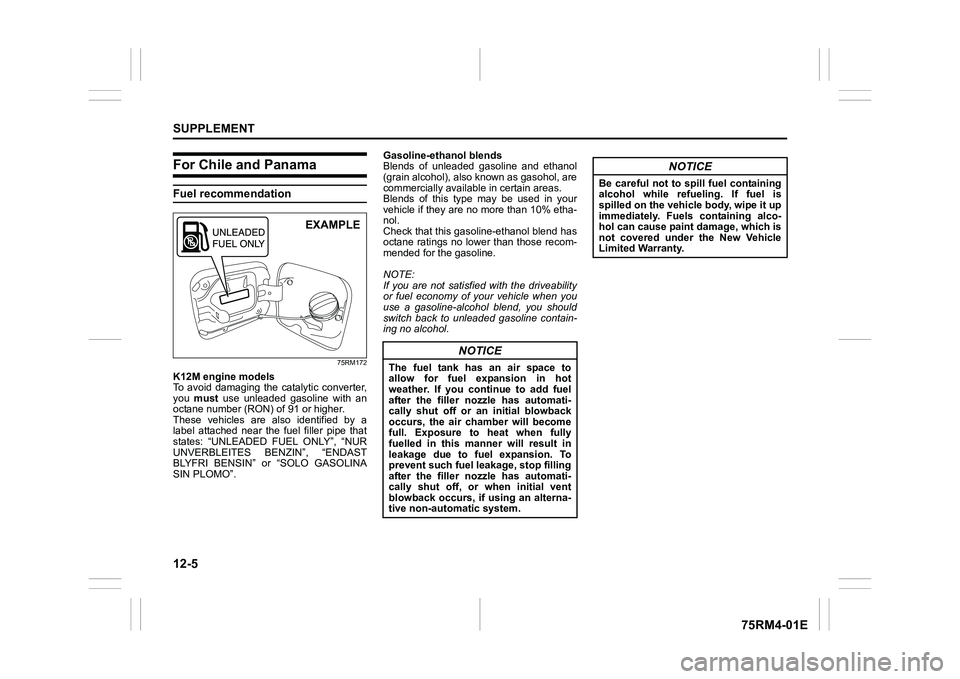
K12M engine models
To avoid damaging the catalytic converter,
you must use unleaded gasoline with an
octane number (RON) of 91 or higher.
These vehicles are also identified by a
label attached near the fuel filler pipe that
states: “UNLEADED FUEL ONLY”, “NUR
UNVERBLEITES BENZIN”, “ENDAST
BLYFRI BENSIN” or “SOLO GASOLINA
SIN PLOMO”. Gasoline-ethanol blends
Blends of unleaded gasoline and ethanol
(grain alcohol), also known as gasohol, are
commercially available in certain areas.
Blends of this type may be used in your
vehicle if they are no more than 10% etha-
nol.
Check that this gasoline-ethanol blend has
octane ratings no lower than those recom-
mended for the gasoline.
NOTE:
If you are not satisfied with the driveability
or fuel economy of your vehicle when you
use a gasoline-alcohol blend, you should
switch back to unleaded gasoline contain-
ing no alcohol.
EXAMPLE
NOTICE
The fuel tank has an air space to
allow for fuel expansion in hot
weather. If you continue to add fuel
after the filler nozzle has automati-
cally shut off or an initial blowback
occurs, the air chamber will become
full. Exposure to heat when fully
fuelled in this manner will result in
leakage due to fuel expansion. To
prevent such fuel leakage, stop filling
after the filler nozzle has automati-
cally shut off, or when initial vent
blowback occurs, if using an alterna-
tive non-automatic system.
NOTICE
Be careful not to spill fuel containing
alcohol while refueling. If fuel is
spilled on the vehicle body, wipe it up
immediately. Fuels containing alco-
hol can cause paint damage, which is
not covered under the New Vehicle
Limited Warranty.
Page 445 of 505

12-6
SUPPLEMENT
75RM4-01E
For MexicoFuel recommendation
75RM304
Your vehicle requires regular unleaded
gasoline with a minimum rating of 87 pump
octane ((R + M)/2 method). In some areas,
the only fuels that are available are oxy-
genated fuels.
Oxygenated fuels which meet the mini-
mum octane requirement and the require-
ments described below may be used in
your vehicle without jeopardizing the New
Vehicle Limited Warranty. NOTE:
Oxygenated fuels are fuels which contain
oxygen-carrying additives such as MTBE
or alcohol.
If the “RON 95” label is attached, you must
use unleaded gasoline with a minimum rat-
ing of 91 pump octane ((R + M)/2 method).
Gasoline/Ethanol blends
Blends of unleaded gasoline and ethanol
(grain alcohol), also known as gasohol,
may be used in your vehicle if the ethanol
content is not gr
eater than 10%.
Fuel pump labelingIn some states, pumps that dispense oxy-
genated fuels are required to be labeled
for the type and percentage of oxygenate
and whether important additives are pres-
ent. Such labels may provide enough infor-
mation for you to determine if a particular
blend of fuel meets the requirements listed
above. In other areas, pumps may not be
clearly labeled as to the content or type of
oxygenate and additives. If you are not
sure that the fuel you intend to use meets
these requirements, check with the service
station operator or the fuel supplier.
NOTE:
To help clean the air, SUZUKI recom-
mends you use the oxygenated fuels.
However, if you are not satisfied with the
driveability or fuel economy of your vehicle
when you are using an oxygenated fuel,
switch back to the regular unleaded gaso-
line.
or
EXAMPLE
NOTICE
Be careful not to spill fuel containing
alcohol while refueling. If fuel is
spilled on the vehicle body, wipe it up
immediately. Fuels containing alco-
hol can cause paint damage, which is
not covered under the New Vehicle
Limited Warranty.