2019 SUZUKI IGNIS Drive
[x] Cancel search: DrivePage 280 of 505

5-25OTHER CONTROLS AND EQUIPMENT
75RM4-01E
Models with ENG A-STOP System
(if equipped)
• If the heating performance can no longerperform at a sufficient level due to auto-
matically stopping the engine, press the
ENG A-STOP OFF switch to deactivate
the ENG A-STOP system. (The engine
will automatically restart and the air con-
ditioning performanc e will be restored.)
• If the windshield and/or the driver’s side/ passenger side door windows are
fogged during automatic ally stopping the
engine, stop the ENG A-STOP system
and restart the engine. Then, turn the air
flow selector (3) to change the air flow to
the HEAT & DEFROST or DEFROST
position to defog the windows.
MaintenanceIf you do not use the air conditioner for a
long period, such as during winter, it may
not give the best performance when you
start using it again. To help maintain opti-
mum performance and durability of your air
conditioner, it needs to be run periodically.
Operate the air conditioner at least once a
month for one minute with the engine
idling. This circulates the refrigerant and oil
and helps protect the internal components.
If your air conditioner is equipped with air
filters, clean or replace them as specified
in “Maintenance schedule” in the
“INSPECTION AND MAINTENANCE” sec-
tion.
(For vehicles using “HFO-1234yf” refrig-
erant)
NOTE:
Your vehicle uses the air conditioning
refrigerant HFO-1234yf, commonly called
R-1234yf. R-1234yf replaced R-134a for
automotive applications. Other refriger-
ants are available, but only R-1234yf
should be used in your vehicle.
NOTICE
Using the wrong refrigerant may
damage your air conditioning sys-
tem. Use R-1234yf only. Do not mix or
replace the R-1234yf with other refrig-
erants.
(Except for vehicles using “HFO-1234yf”
refrigerant)
NOTE:
Your vehicle uses the air conditioning
refrigerant HFC-134a, commonly called
R-134a. R-134a replaced R-12 around
1993 for automotive applications. Other
refrigerants are available, including recy-
cled R-12, but only R-134a should be used
in your vehicle.
NOTICE
Using the wrong refrigerant may
damage your air conditioning sys-
tem. Use R-134a only. Do not mix or
replace the R-134a with other refrig-
erants.
Page 285 of 505

5-30
OTHER CONTROLS AND EQUIPMENT
75RM4-01E
You can use the air conditioning switch (6)
to manually turn the air conditioner on or off
according to your preference. When you
turn the air conditioning switch off, the cli-
mate control system cannot lower the inside
temperature below outside temperature.
To turn the climate control system off, push
“OFF” switch (7).
NOTE:
If “AUTO” on the display blinks, there is a
problem in the heating system and/or air
conditioning system. Yo u should have the
system inspected by an authorized
SUZUKI dealer.
NOTE:
• To find the temperature at which you are
most comfortable, start with the 22°C
(72°F) or 25°C (75°F) setting. (the tem-
perature vary depending on vehicle
specifications.).
• If you push the temperature selector (1) until “HI” or “LO” appears on the display,
the climate control system will operate at
maximum heating or cooling and the
blower will run at full speed.
• To avoid blowing cold air in cold weather or hot air in hot weather, the system will
delay turning on the blower until warmed
or chilled air is available.
• If your vehicle has been left in the sun with the windows closed, it will cool
faster if you open the windows briefly.
• Even under the automat ic operation, you
can set individual selectors to the manual mode. The manually selected functions
are maintained, and the other functions
remain under automatic operation.
• If the windshield and/or the front door windows are fogged, push the defrost
switch (5) to turn on the defroster, or
push the air flow selector (4) to change
the air flow to HEAT & DEFROST posi-
tion to defog the windows.
• To return the blower speed selector (2), air intake selector (3 ), and air flow selec-
tor (4) to automatic operation, push
“AUTO” switch (8).
75RM148
Be careful not to cover the interior tem-
perature sensor (10) located between the
steering wheel and the climate control
panel, or the solar sensor (11) located at
the top of the driver’s side dashboard.
These sensors are used by the automatic
system to regula te temperature.
Manual operationYou can manually control the climate con-
trol system. Set the selectors to the
desired positions.
75RM357
NOTE:
If you need maximum defrosting:
• push the defrost switch (5) to turn on the
defroster (the air conditioning system will
come on and FRESH AIR mode will be
selected automatically),
• set the blower speed selector to high,
• adjust the temperature selector to “HI” indication on the display, and
• adjust the side outlets so the air blows on the side windows.
(10)
(11)
EXAMPLE
EXAMPLE
Page 286 of 505

5-31OTHER CONTROLS AND EQUIPMENT
75RM4-01E
Models with ENG A-STOP System
(if equipped)
• If the heating performance can no longerperform at a sufficient level due to auto-
matically stopping the engine, press the
ENG A-STOP OFF switch to deactivate
the ENG A-STOP system. (The engine
will automatically restart and the air con-
ditioning performanc e will be restored.)
• If the windshield and/or the driver’s side/ passenger side door windows are
fogged during automatic ally stopping the
engine, stop the ENG A-STOP system
and restart the engine. Then, turn the air
flow selector (4) to change the air flow to
the HEAT & DEFROST or DEFROST
position to defog the windows.
MaintenanceIf you do not use the air conditioner for a
long period, such as during winter, it may
not give the best performance when you
start using it again. To help maintain opti-
mum performance and durability of your air
conditioner, it needs to be run periodically.
Operate the air conditioner at least once a
month for one minute with the engine
idling. This circulates the refrigerant and oil
and helps protect the internal components.
If your air conditioner is equipped with air
filters, clean or replace them as specified
in “Maintenance schedule” in the
“INSPECTION AND MAINTENANCE” sec-
tion. Have this job done by your SUZUKI
dealer as the lower glove box must be low-
ered for this job.
(For vehicles using “HFO-1234yf” refrig-
erant)
NOTE:
Your vehicle uses the air conditioning
refrigerant HFO-1234yf, commonly called
R-1234yf. R-1234yf replaced R-134a for
automotive applications. Other refriger-
ants are available, but only R-1234yf
should be used in your vehicle. (Except for vehicles using “HFO-1234yf”
refrigerant)
NOTE:
Your vehicle uses the air conditioning
refrigerant HFC-134a, commonly called
R-134a. R-134a replaced R-12 around
1993 for automotive applications. Other
refrigerants are available, including recy-
cled R-12, but only R-134a should be used
in your vehicle.
NOTICE
Using the wrong refrigerant may
damage your air conditioning sys-
tem. Use R-1234yf only. Do not mix or
replace the R-1234yf with other refrig-
erants.
NOTICE
Using the wrong refrigerant may
damage your air conditioning sys-
tem. Use R-134a only. Do not mix or
replace the R-134a with other refrig-
erants.
Page 289 of 505
5-34
OTHER CONTROLS AND EQUIPMENT
75RM4-01E
Safety information
Notes on discsPrecautions
• When the inside of the vehicle is verycold and the player is used soon after
switching on the heater, condensation
may form on the disc or the optical
parts of the player and proper playback
may not be possible. If condensation
forms on the disc, wipe it off with a soft
cloth. If condensation forms on the opti-
cal parts of the player, do not use the
player for about one hour. This will
allow the condensation to disappear
normally.
• Driving on extremely bumpy roads which cause severe vibrations may
cause sound to skip.
• This unit uses a precision mechanism. Even in the event that trouble arises,
never open the case, disassemble the
unit, or lubricate the rotating parts.
Bring the unit to an authorized SUZUKI
dealer. Cautions on handling
52D274
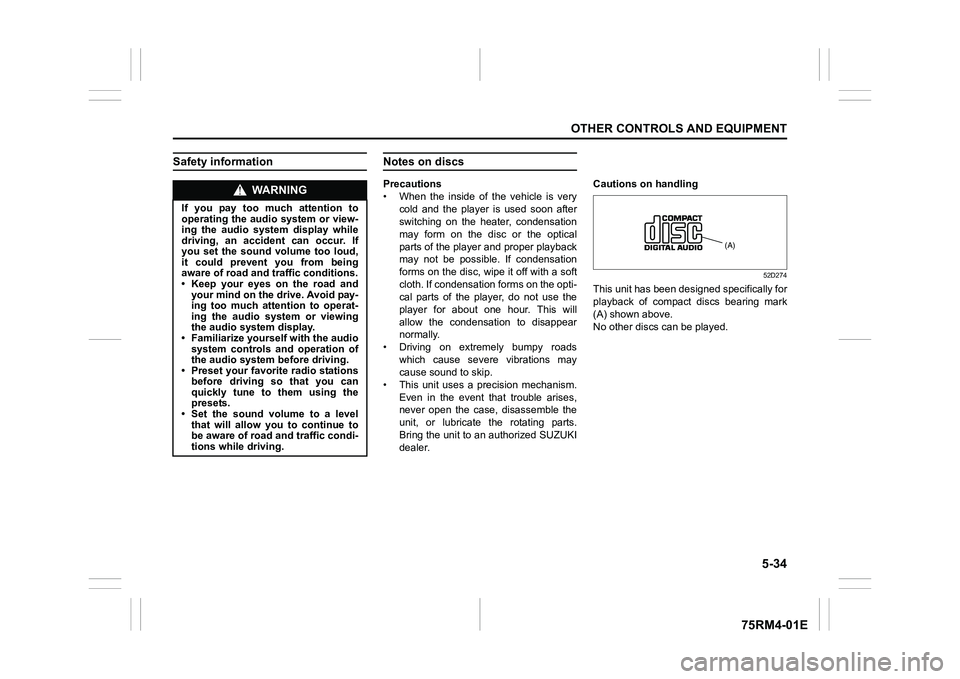
This unit has been designed specifically for
playback of compact discs bearing mark
(A) shown above.
No other discs
can be played.
WA R N I N G
If you pay too much attention to
operating the audio system or view-
ing the audio system display while
driving, an accident can occur. If
you set the sound volume too loud,
it could prevent you from being
aware of road and tr affic conditions.
• Keep your eyes on the road and your mind on the drive. Avoid pay-
ing too much attention to operat-
ing the audio system or viewing
the audio system display.
• Familiarize yourself with the audio
system controls and operation of
the audio system before driving.
• Preset your favorite radio stations
before driving so that you can
quickly tune to them using the
presets.
• Set the sound volume to a level that will allow you to continue to
be aware of road and traffic condi-
tions while driving.
(A)
Page 337 of 505

5-82
OTHER CONTROLS AND EQUIPMENT
75RM4-01E
MP3/WMA/AACNo playback The disc contains unsupported formatted
data.
Check the file format.
Sound skips or noise produced Sound skipping may occur when playing
VBR (Variable Bit Rate) files.It is not recommended
to play VBR files.
USB
Playback does not start when the USB
device is connected There is no supported format file to play
on this unit.
Check the file format.
The current consumption of the USB
device exce eds 1.0 A. Use a USB device with a current con-
sumption lower than 1.0 A.
Bluetooth
®
Pairing failed The distance between this unit and the
Bluetooth
® ready device is too far, or a
metallic object may be located between
the Bluetooth® ready device and this unit. Change the location of the Bluetooth
®
ready device.
The Bluetooth
® function of the Bluetooth
®
ready device is off. Refer to the manual of the Bluetooth
®
ready device. (Some devices have the
power saving function that automatically
activates after a certain time.)
Unable to receive a call Your current location may be out of ser-
vice area. Drive your vehicle to the service area of
the phone.
The voice quality of hands-free is low
(Distortion, noise etc.) Another wireless device may be located
near the unit.Switch off the wireless device or keep it
away from the unit.
Problem
Possible cause
Possible solution
Page 343 of 505

6-2
VEHICLE LOADING AND TOWING
75RM4-01E
To w b a r sOnly use a tow bar that is designed to
attach to the chassis of your vehicle, and a
hitch that is designed to bolt to this tow bar.
We recommend that you use a genuine
SUZUKI tow bar (available as option), or
equivalent.Safety chainsAlways attach safety chains between your
vehicle and trailer. Cross safety chains
under the nose of the trailer so that the
nose will not drop to the road if the trailer
becomes separated from the tow bar. Fol-
low the manufacturer’s recommendation
for attaching safety chains. Always leave
just enough slack to permit full turning.
Never allow safety chains to drag on the
road.
Trailer lightsCheck that your trailer is equipped with
lights which meet local requirements.
Always check for the proper operation of
all trailer lights before you start to tow.Brakes
WA R N I N G
For vehicles equipped with the dual
camera brake support, if your vehicle
is used to tow a trailer, press the dual
camera brake support OFF switch
and turn off the dual camera brake
support. If not, unexpected acci-
dents related to the system being
turned on may occur.
NOTICE
Trailer towing puts additional stress
on the engine, drive train and brakes
of your vehicle. Never tow a trailer
during the first 960 km (600 miles) of
vehicle operation.
NOTICE
When towing by a vehicle with CVT
on a long steep hill, try to take some
rest on the way to prevent overheat
or damage of the engine or transaxle.
WA R N I N G
Never use a tow bar which attaches
to the axle or the bumper of your
vehicle.
WA R N I N G
Never attach safety chains to the
bumper of your vehicle. Secure con-
nections so that they cannot come
loose.
WA R N I N G
Never connect trailer lights directly
into your vehicle’s electrical system,
or electrical system damage may
occur.
WA R N I N G
If trailer brakes are used, follow all
instructions provided by the manu-
facturer. Never connect to the brake
system of your vehicle and never
take an electrical supply directly from
the wiring harness.
Page 345 of 505

6-4
VEHICLE LOADING AND TOWING
75RM4-01E
Additional trailer towing warnings
WA R N I N G
Connect trailer lights and hook up
safety chains every time you tow.
NOTICE
Because towing a trailer puts addi-
tional stress on your vehicle, more
frequent maintenance will be
required than under normal driving
conditions. Follow the schedule in
“Maintenance recommended under
severe driving conditions”.
WA R N I N G
Your vehicle should be handled in a
different way when towing a trailer.
For the safety of yourself and others,
observe the following precautions:
• Practice turning, stopping, andreversing before you begin towing
a trailer in traffi c. Do not tow a
trailer in traffic until you are confi-
dent that you can handle the vehi-
cle and trailer safely.
• Never exceed towing speed limits
or 80 km/h (50 mph), whichever is
lower.
• Never drive at a speed that causes shaking or swaying of the trailer. If
you notice even the slightest sign
of shaking or sw aying, slow down.
• When roads are wet, slippery or rough, drive at a slower speed than
you would on dry or smooth roads.
Failure to slow down when road
conditions are bad can result in
loss of control.
• Always have someone guide you when reversing.
(Continued)
WA R N I N G
(Continued)
• Allow adequate stopping distance.Stopping distance is increased
when you tow a trailer. For each 16
km/h (10 mph) of speed, allow at
least one vehicle and trailer length
between you and the vehicle
ahead. Allow a greater stopping
distance if roads are wet or slip-
pery.
• If the trailer has over-run brakes,
apply the brakes gradually to avoid
snatching caused by the trailer
wheels locking.
• Slow down before corners and maintain a steady speed while cor-
nering. Deceleration or accelera-
tion while cornering can result in
loss of control. Remember that a
larger than normal turning radius is
needed because the trailer wheels
will be closer than vehicle wheels
to the inside of the turn.
• Avoid sudden acceleration and stopping of the vehicle. Do not
make quick maneuvers unless they
are necessary.
• Slow down in cross winds and be
prepared for gusts of wind from
large passing vehicles. (Continued)
Page 349 of 505

INSPECTION AND MAINTENANCE
7
75RM4-01E
60G410
INSPECTION AND MAINTENANCEMaintenance schedule ........................................................ 7-2
Periodic maintenance schedule
(except for EU countries and Israel) .......................... ........ 7-3
Maintenance recommended under severe driving
conditions (except for EU countries and Israel) .............. 7 -8
Periodic maintenance schedule
(for EU countries and Israel) ................................. ............. 7-13
Maintenance recommended under severe driving
conditions (for EU countries and Israel) ........................... 7-18
Drive belt .................................................... .......................... 7-23
Engine oil and filter ......................................... .................... 7-23
Engine coolant ................................................ .................... 7-28
Air cleaner ................................................... ......................... 7-29
Spark plugs ................................................... ....................... 7-31
Continuously variable transaxle (CVT) fluid ................... .. 7-32
Gear oil ...................................................... ........................... 7-34
Clutch pedal .................................................. ....................... 7-36
Brakes ............. ..................................................................... 7-36
Steering ...................................................... .......................... 7-38
Tires ......................................................... ............................. 7-39
Battery ....................................................... ........................... 7-42
Fuses ......................................................... ........................... 7-45
Headlight aiming .............................................. ................... 7-48
Bulb replacement .............................................. .................. 7-49
Wiper blades .................................................. ...................... 7-55
Windshield washer fluid ....................................... .............. 7-58
Air conditioning system ....................................... .............. 7-58