Page 249 of 360
Driver assistance systems
Critical warning
If the driv er f
ails t
o r
eact to the advance
warning, the system may actively intervene
in the brakes and generate a brief jolt to warn
the driver of the imminent danger of a colli-
sion.
Automatic braking
If the driver also fails to react to the critical
warning, the system may initiate independ-
ent emergency braking by progressively in-
creasing the braking in accordance with how
critical the situation is.
Driver emergency brake assistance sys-
tem
The system may detect that the driver is not
braking hard enough to avoid the collision. In
this case, it will increase the braking intensity.
The system cannot prevent a collision, al-
though it can significantly minimise the con-
sequences by reducing the speed and the
force of the impact. WARNING
Observe the safety warnings
Page 254 of 360
Driving
WARNING
Observe the safety warnings
Page 262 of 360
Driving
pressure on the brake pedal and allow for
l onger st
opping dist ances.
L o
w brake fluid level
Malfunctions can occur in the brake system if
the brake fluid level is too low. The brake fluid
level is monitored electronically.
Brake servo
The brake servo increases the pressure you
apply to the brake pedal. It works only when
the engine is running. WARNING
Any anomaly in the brake system can in-
crease the braking distance , with the r
e-
sulting risk of an accident.
�
Page 269 of 360
Help with parking and manoeuvring
0.60 m
1. 60 m
0. 60 m
As you appr oach the obst
acl
e, the frequency
of the audible signals will increase. The signal
will sound continuously at around 0.30 m:
Stop!
If separation is maintained, the warning vol-
ume reduces after about 4 seconds.
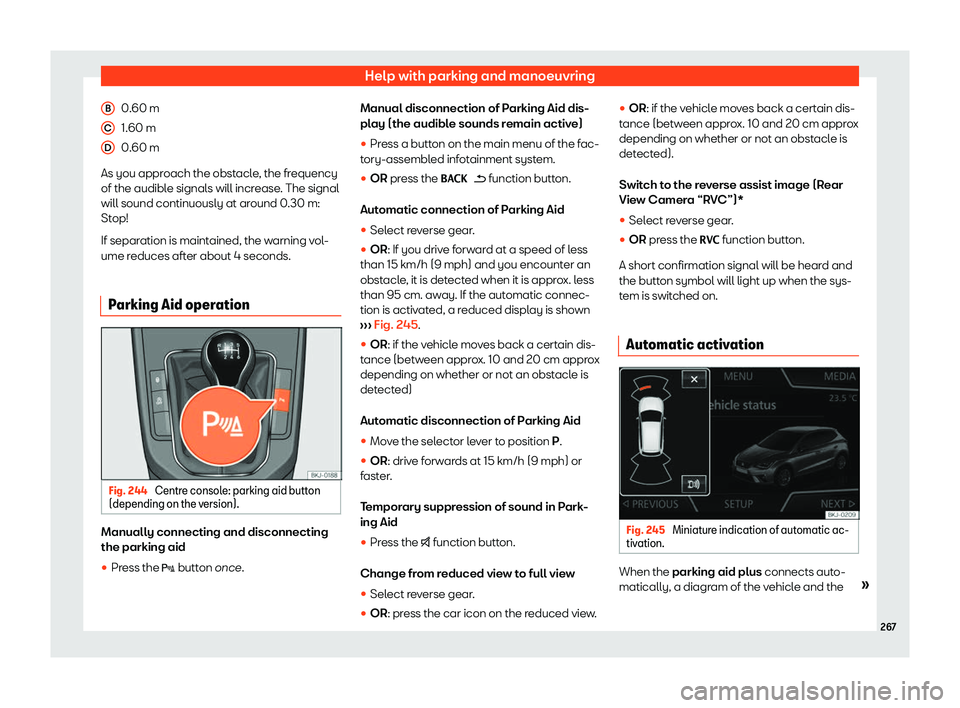
Parking Aid operation Fig. 244
Centre console: parking aid button
(depending on the v ersion).Manually connecting and disconnecting
the parking aid
�
Page 276 of 360
Driving
WARNING
Driving with a trailer and transporting
heavy or large objects can aff ect driving
pr
operties and even cause an accident.
�
Page 282 of 360
Driving
repeated automatic braking may occur in
extreme driving conditions.
Towing bracket device*
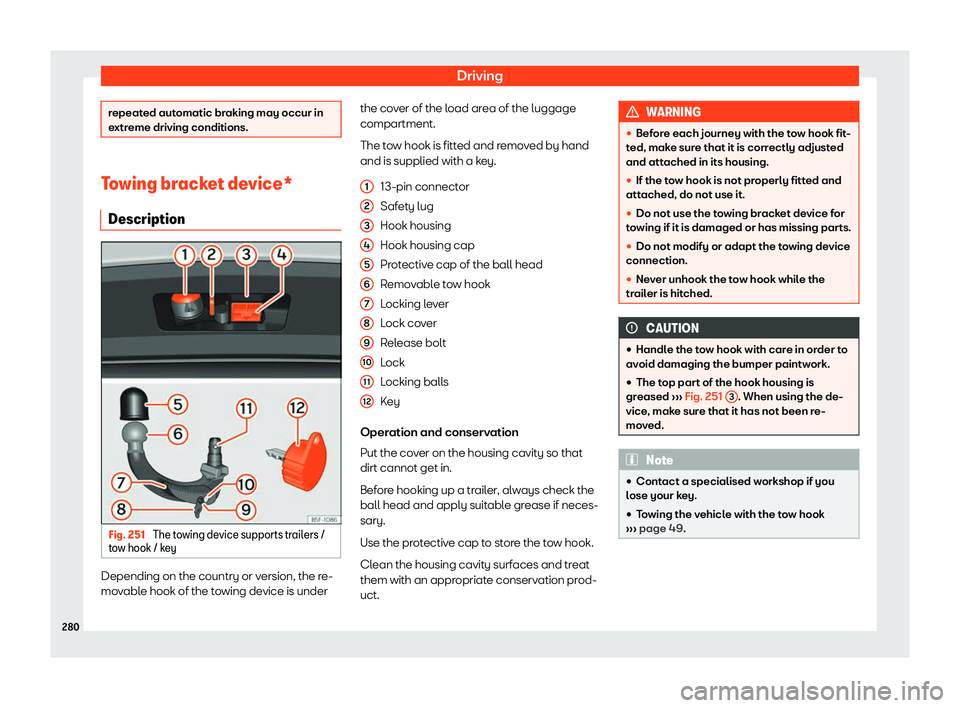
Description Fig. 251
The towing device supports trailers /
t o
w hook / k ey Depending on the country or version, the re-
mo
v
abl e hook of the t
o
wing device is under the cover of the load area of the luggage
compartment.
The tow hook is fitted and remo
ved by hand
and is supplied with a key.
13-pin connector
Safety lug
Hook housing
Hook housing cap
Protective cap of the ball head
Removable tow hook
Locking lever
Lock cover
Release bolt
Lock
Locking balls
Key
Operation and conservation
Put the cover on the housing cavity so that
dirt cannot get in.
Before hooking up a trailer, always check the
ball head and apply suitable grease if neces-
sary.
Use the protective cap to store the tow hook.
Clean the housing cavity surfaces and treat
them with an appropriate conservation prod-
uct. 1 2
3
4
5
6
7
8
9
10
11
12 WARNING
�
Page 291 of 360
Checking and refilling levels
WARNING
Natural gas is a highly explosive, easily
flammable substance . Incorr
ect handling
of the natural gas can cause accidents se-
rious burns and other injuries.
�
Page 295 of 360
Checking and refilling levels
Control and warning lamps b
It lights up red
The engine cannot be restarted! The AdBlue level
is too l ow.
Stop the vehicle in a suitable, safe and flat area then
top up with the minimum required quantity of AdBlue