2019 Ram ProMaster City octane
[x] Cancel search: octanePage 290 of 348

After 25 miles (40 km), check the lug nut/bolt torque to be
sure that all the lug nuts/bolts are properly seated against
the wheel.
WARNING!
To avoid the risk of forcing the vehicle off the jack, do
not tighten the lug nuts/bolts fully until the vehicle has
been lowered. Failure to follow this warning may
result in personal injury.
FUEL REQUIREMENTS
2.4L Engine
All available gasoline engines are de-
signed to meet all emissions regulations
and provide excellent fuel economy and
performance when using high quality
unleaded “regular” gasoline having a
octane rating of 87 using the (R+M)/2
method. The use of premium gasoline is
not recommended, as it will not provide any benefit over
regular gasoline in these engines.
While operating on gasoline with an octane number of 87,
hearing a light knocking sound from the engine is not a
cause for concern. However, if the engine is heard making
a heavy knocking sound, see your dealer immediately. Use
of gasoline with an octane number lower than 87 can cause
engine failure and may void or not be covered by the New
Vehicle Limited Warranty.
Poor quality gasoline can cause problems such as hard
starting, stalling, and hesitations. If you experience these
symptoms, try another brand of gasoline before consider-
ing service for the vehicle.
Torque Patterns
288 TECHNICAL SPECIFICATIONS
Page 292 of 348
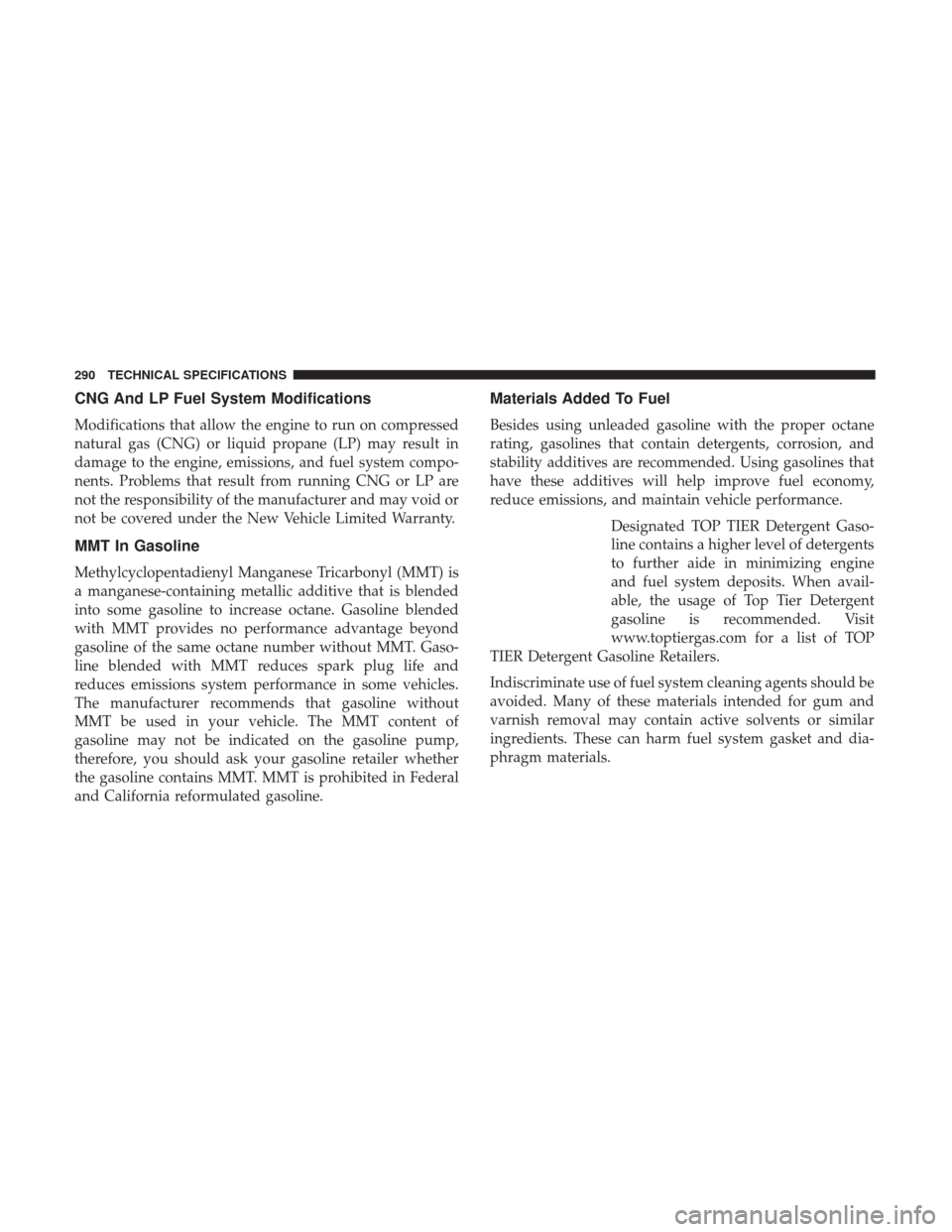
CNG And LP Fuel System Modifications
Modifications that allow the engine to run on compressed
natural gas (CNG) or liquid propane (LP) may result in
damage to the engine, emissions, and fuel system compo-
nents. Problems that result from running CNG or LP are
not the responsibility of the manufacturer and may void or
not be covered under the New Vehicle Limited Warranty.
MMT In Gasoline
Methylcyclopentadienyl Manganese Tricarbonyl (MMT) is
a manganese-containing metallic additive that is blended
into some gasoline to increase octane. Gasoline blended
with MMT provides no performance advantage beyond
gasoline of the same octane number without MMT. Gaso-
line blended with MMT reduces spark plug life and
reduces emissions system performance in some vehicles.
The manufacturer recommends that gasoline without
MMT be used in your vehicle. The MMT content of
gasoline may not be indicated on the gasoline pump,
therefore, you should ask your gasoline retailer whether
the gasoline contains MMT. MMT is prohibited in Federal
and California reformulated gasoline.
Materials Added To Fuel
Besides using unleaded gasoline with the proper octane
rating, gasolines that contain detergents, corrosion, and
stability additives are recommended. Using gasolines that
have these additives will help improve fuel economy,
reduce emissions, and maintain vehicle performance.Designated TOP TIER Detergent Gaso-
line contains a higher level of detergents
to further aide in minimizing engine
and fuel system deposits. When avail-
able, the usage of Top Tier Detergent
gasoline is recommended. Visit
www.toptiergas.com for a list of TOP
TIER Detergent Gasoline Retailers.
Indiscriminate use of fuel system cleaning agents should be
avoided. Many of these materials intended for gum and
varnish removal may contain active solvents or similar
ingredients. These can harm fuel system gasket and dia-
phragm materials.
290 TECHNICAL SPECIFICATIONS
Page 293 of 348
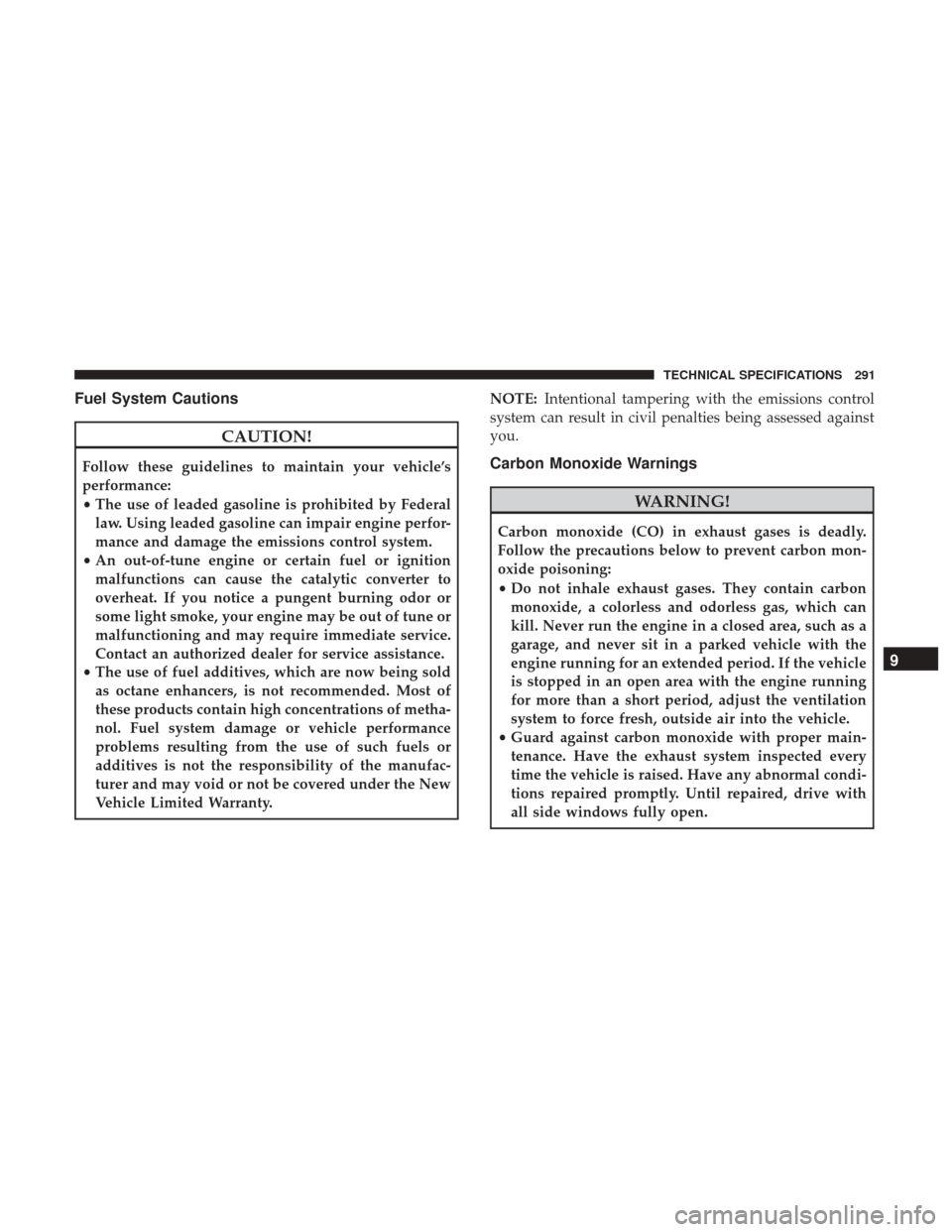
Fuel System Cautions
CAUTION!
Follow these guidelines to maintain your vehicle’s
performance:
•The use of leaded gasoline is prohibited by Federal
law. Using leaded gasoline can impair engine perfor-
mance and damage the emissions control system.
• An out-of-tune engine or certain fuel or ignition
malfunctions can cause the catalytic converter to
overheat. If you notice a pungent burning odor or
some light smoke, your engine may be out of tune or
malfunctioning and may require immediate service.
Contact an authorized dealer for service assistance.
• The use of fuel additives, which are now being sold
as octane enhancers, is not recommended. Most of
these products contain high concentrations of metha-
nol. Fuel system damage or vehicle performance
problems resulting from the use of such fuels or
additives is not the responsibility of the manufac-
turer and may void or not be covered under the New
Vehicle Limited Warranty. NOTE:
Intentional tampering with the emissions control
system can result in civil penalties being assessed against
you.Carbon Monoxide Warnings
WARNING!
Carbon monoxide (CO) in exhaust gases is deadly.
Follow the precautions below to prevent carbon mon-
oxide poisoning:
• Do not inhale exhaust gases. They contain carbon
monoxide, a colorless and odorless gas, which can
kill. Never run the engine in a closed area, such as a
garage, and never sit in a parked vehicle with the
engine running for an extended period. If the vehicle
is stopped in an open area with the engine running
for more than a short period, adjust the ventilation
system to force fresh, outside air into the vehicle.
• Guard against carbon monoxide with proper main-
tenance. Have the exhaust system inspected every
time the vehicle is raised. Have any abnormal condi-
tions repaired promptly. Until repaired, drive with
all side windows fully open.
9
TECHNICAL SPECIFICATIONS 291
Page 295 of 348
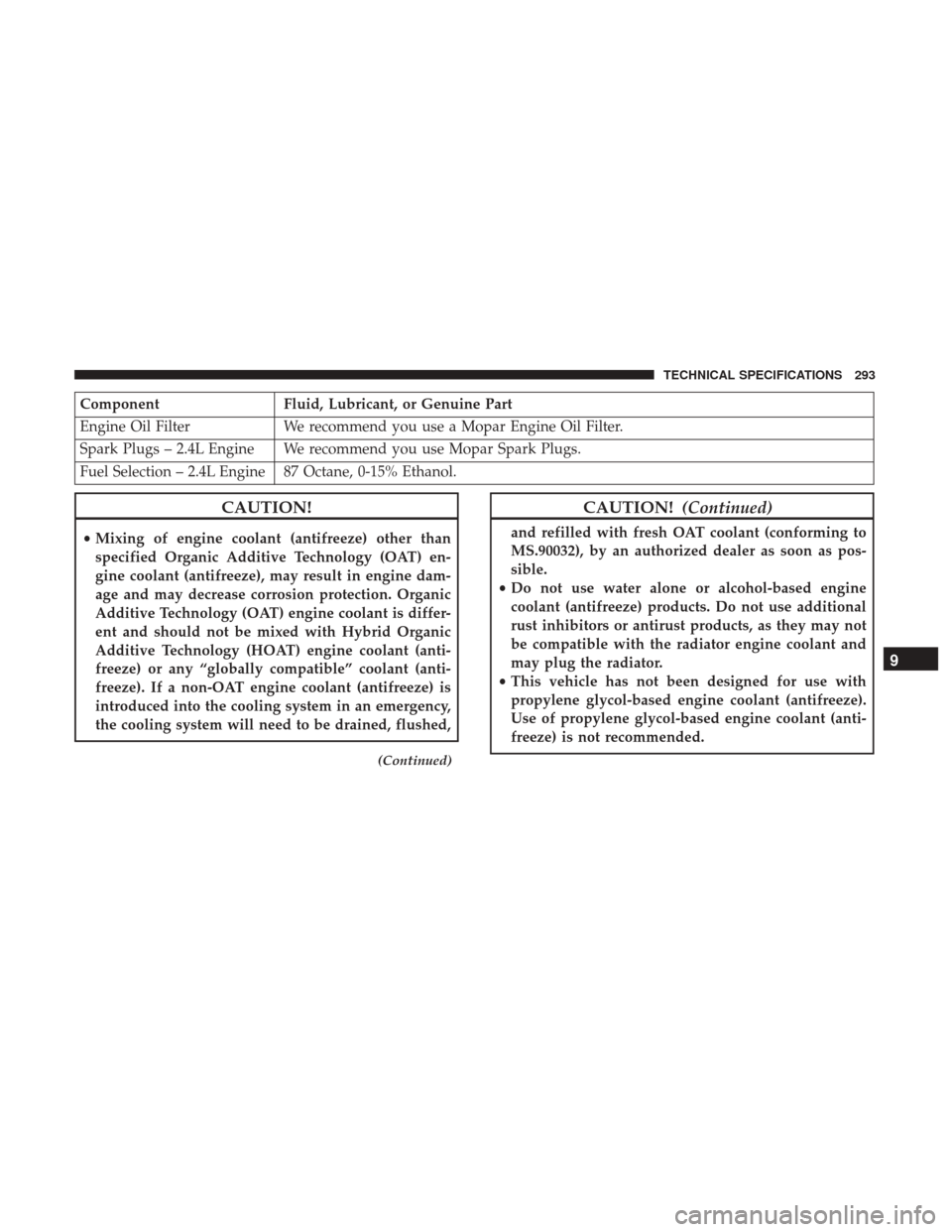
ComponentFluid, Lubricant, or Genuine Part
Engine Oil Filter We recommend you use a Mopar Engine Oil Filter.
Spark Plugs – 2.4L Engine We recommend you use Mopar Spark Plugs.
Fuel Selection – 2.4L Engine 87 Octane, 0-15% Ethanol.
CAUTION!
• Mixing of engine coolant (antifreeze) other than
specified Organic Additive Technology (OAT) en-
gine coolant (antifreeze), may result in engine dam-
age and may decrease corrosion protection. Organic
Additive Technology (OAT) engine coolant is differ-
ent and should not be mixed with Hybrid Organic
Additive Technology (HOAT) engine coolant (anti-
freeze) or any “globally compatible” coolant (anti-
freeze). If a non-OAT engine coolant (antifreeze) is
introduced into the cooling system in an emergency,
the cooling system will need to be drained, flushed,
(Continued)
CAUTION! (Continued)
and refilled with fresh OAT coolant (conforming to
MS.90032), by an authorized dealer as soon as pos-
sible.
• Do not use water alone or alcohol-based engine
coolant (antifreeze) products. Do not use additional
rust inhibitors or antirust products, as they may not
be compatible with the radiator engine coolant and
may plug the radiator.
• This vehicle has not been designed for use with
propylene glycol-based engine coolant (antifreeze).
Use of propylene glycol-based engine coolant (anti-
freeze) is not recommended.
9
TECHNICAL SPECIFICATIONS 293
Page 332 of 348
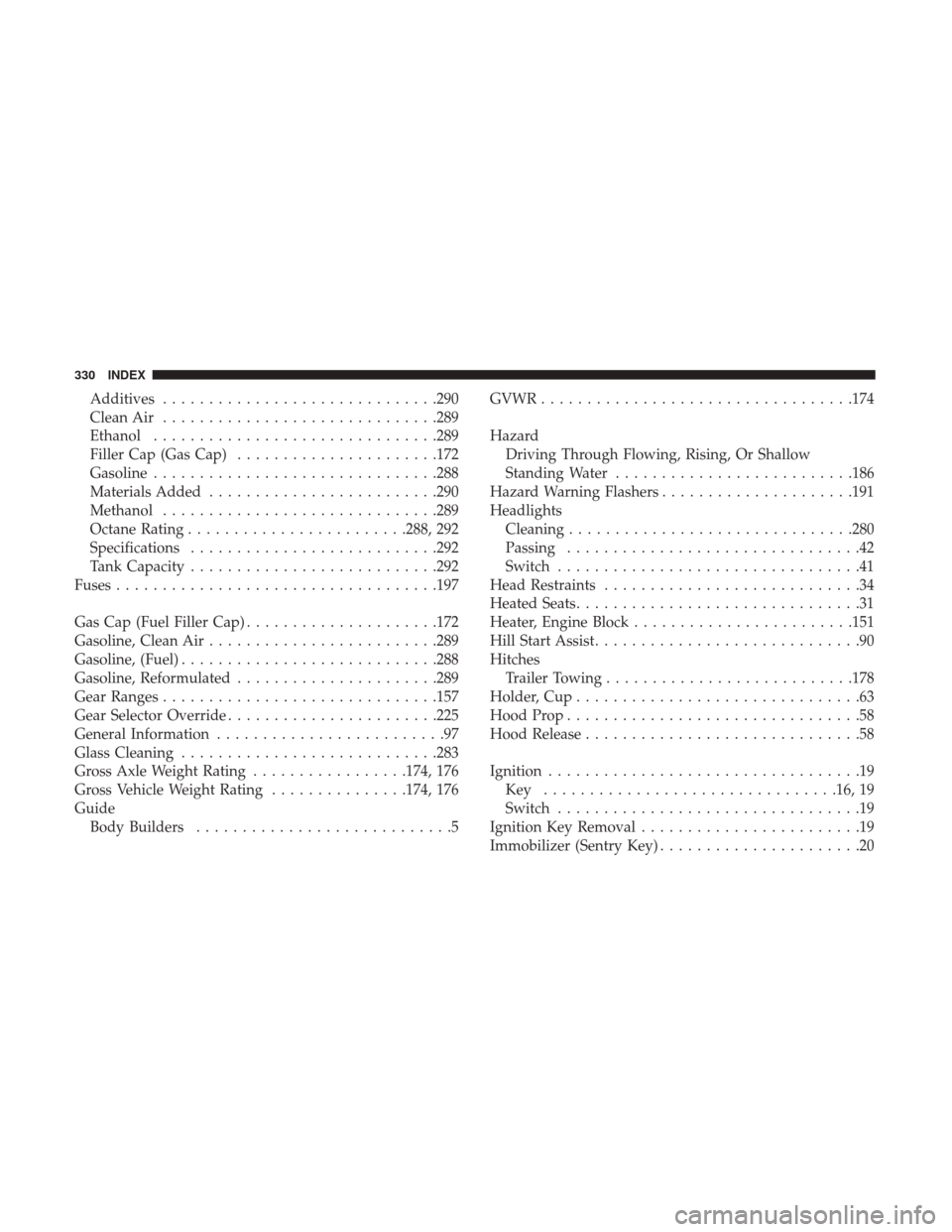
Additives............................. .290
Clean Air ............................. .289
Ethanol .............................. .289
Filler Cap (Gas Cap) ..................... .172
Gasoline .............................. .288
Materials Added ........................ .290
Methanol ............................. .289
Octane Rating ....................... .288, 292
Specifications .......................... .292
Tank Capacity .......................... .292
Fuses .................................. .197
Gas Cap (Fuel Filler Cap) .....................172
Gasoline, Clean Air ........................ .289
Gasoline, (Fuel) ........................... .288
Gasoline, Reformulated ..................... .289
Gear Ranges ............................. .157
Gear Selector Override ...................... .225
General Information .........................97
Glass Cleaning ........................... .283
Gross Axle Weight Rating .................174, 176
Gross Vehicle Weight Rating ...............174, 176
Guide Body Builders ............................5 GVWR
................................. .174
Hazard Driving Through Flowing, Rising, Or Shallow
Standing Water ......................... .186
Hazard Warning Flashers .....................191
Headlights Cleaning .............................. .280
Passing ................................42
Switch .................................41
Head Restraints ............................34
Heated Seats ...............................31
Heater, Engine Block ....................... .151
Hill Start Assist .............................90
Hitches Trailer Towing .......................... .178
Holder, Cup ...............................63
Hood Prop ................................58
Hood Release ..............................58
Ignition ..................................
19
Key ............................... .16, 19
Switch .................................19
Ignition Key Removal ........................19
Immobilizer (Sentry Key) ......................20
330 INDEX
Page 334 of 348

Service............................... .191
Tire Pressure Monitoring (TPMS) ..............93
Traction Control ..........................92
Turn Signals ......................... .82, 145
Warning Instrument Cluster Descriptions ......76, 82
Loading Vehicle ....................... .174, 175
Capacities ............................. .175
Tires................................. .262
Locks Power Door .............................23
Low Tire Pressure System .....................93
Lubrication, Body ......................... .243
Lug Nuts/Bolts ....................... .286, 287
Maintenance Free Battery .....................239
Maintenance Schedule ...................... .233
Malfunction Indicator Light (Check Engine) ......80, 84
Manual Service ............................... .324
Master Cylinder Brakes ............................... .251
Methanol ............................... .289
Mirrors ..................................38
Electric Powered ..........................39
Electric Remote ...........................39 Exterior Folding
..........................39
Outside ................................38
Rearview ...............................38
Modifications/Alterations Vehicle .................................6
Monitor, Tire Pressure System ..................93
Mopar Parts ............................. .323
New Vehicle Break-In Period ..................152
Occupant Restraints .........................98
Octane Rating, Gasoline (Fuel) ..............288, 292
Oil, Engine ........................... .240, 292
Capacity .............................. .292
Change Interval ........................ .240
Checking ............................. .238
Dipstick .............................. .238
Disposal .............................. .241
Filter ............................. .241, 292
Filter Disposal .......................... .241
Identification
Logo...................... .240
Materials Added To ...................... .241
Pressure Warning Light .....................77
Recommendation .....................240, 292
Synthetic ............................. .241
332 INDEX