2019 Ram ProMaster City engine oil
[x] Cancel search: engine oilPage 247 of 348
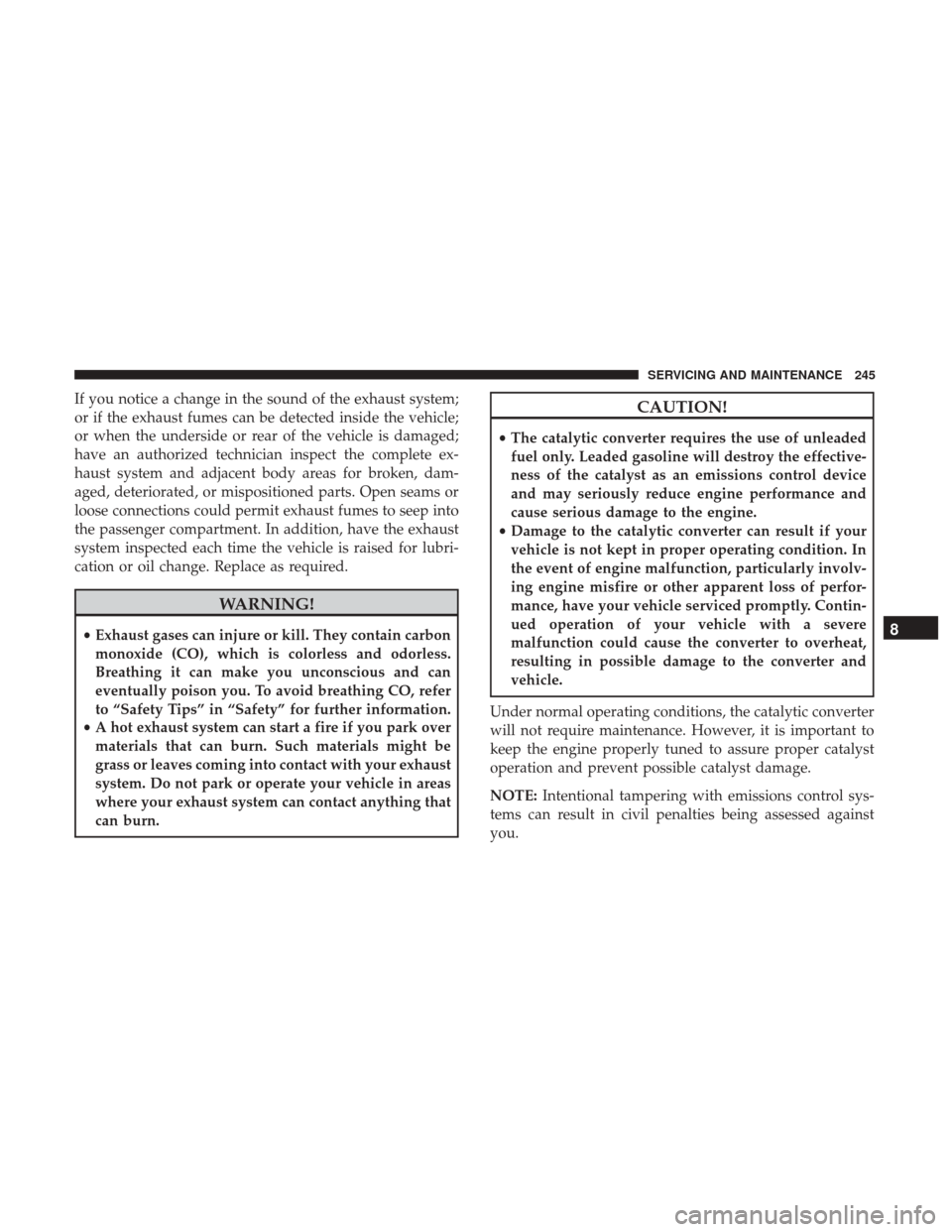
If you notice a change in the sound of the exhaust system;
or if the exhaust fumes can be detected inside the vehicle;
or when the underside or rear of the vehicle is damaged;
have an authorized technician inspect the complete ex-
haust system and adjacent body areas for broken, dam-
aged, deteriorated, or mispositioned parts. Open seams or
loose connections could permit exhaust fumes to seep into
the passenger compartment. In addition, have the exhaust
system inspected each time the vehicle is raised for lubri-
cation or oil change. Replace as required.
WARNING!
•Exhaust gases can injure or kill. They contain carbon
monoxide (CO), which is colorless and odorless.
Breathing it can make you unconscious and can
eventually poison you. To avoid breathing CO, refer
to “Safety Tips” in “Safety” for further information.
• A hot exhaust system can start a fire if you park over
materials that can burn. Such materials might be
grass or leaves coming into contact with your exhaust
system. Do not park or operate your vehicle in areas
where your exhaust system can contact anything that
can burn.
CAUTION!
• The catalytic converter requires the use of unleaded
fuel only. Leaded gasoline will destroy the effective-
ness of the catalyst as an emissions control device
and may seriously reduce engine performance and
cause serious damage to the engine.
• Damage to the catalytic converter can result if your
vehicle is not kept in proper operating condition. In
the event of engine malfunction, particularly involv-
ing engine misfire or other apparent loss of perfor-
mance, have your vehicle serviced promptly. Contin-
ued operation of your vehicle with a severe
malfunction could cause the converter to overheat,
resulting in possible damage to the converter and
vehicle.
Under normal operating conditions, the catalytic converter
will not require maintenance. However, it is important to
keep the engine properly tuned to assure proper catalyst
operation and prevent possible catalyst damage.
NOTE: Intentional tampering with emissions control sys-
tems can result in civil penalties being assessed against
you.
8
SERVICING AND MAINTENANCE 245
Page 253 of 348

WARNING!
Riding the brakes can lead to brake failure and possi-
bly a collision. Driving with your foot resting or riding
on the brake pedal can result in abnormally high brake
temperatures, excessive lining wear, and possible
brake damage. You would not have your full braking
capacity in an emergency.
Brake Master Cylinder
The fluid in the master cylinder should be checked when
performing under hood services or immediately if the
“Brake Warning Light” is illuminated.
Be sure to clean the top of the master cylinder area before
removing the cap. If necessary, add fluid to bring the fluid
level up to the requirements described on the brake fluid
reservoir. With disc brakes, fluid level can be expected to
fall as the brake pads wear. Brake fluid level should be
checked when pads are replaced. However, low fluid level
may be caused by a leak and a checkup may be needed.
Use only manufacturer’s recommended brake fluid. Refer
to “Fluids And Lubricants” in “Technical Specifications”
for further information.
WARNING!
•Use only manufacturer’s recommended brake fluid.
Refer to “Fluids And Lubricants” in “Technical
Specifications” for further information. Using the
wrong type of brake fluid can severely damage your
brake system and/or impair its performance. The
proper type of brake fluid for your vehicle is also
identified on the original factory installed hydraulic
master cylinder reservoir.
• To avoid contamination from foreign matter or mois-
ture, use only new brake fluid or fluid that has been
in a tightly closed container. Keep the master cylin-
der reservoir cap secured at all times. Brake fluid in
a open container absorbs moisture from the air
resulting in a lower boiling point. This may cause it
to boil unexpectedly during hard or prolonged brak-
ing, resulting in sudden brake failure. This could
result in a collision.
• Overfilling the brake fluid reservoir can result in
spilling brake fluid on hot engine parts, causing the
brake fluid to catch fire. Brake fluid can also damage
painted and vinyl surfaces, care should be taken to
avoid its contact with these surfaces.
(Continued)
8
SERVICING AND MAINTENANCE 251
Page 254 of 348
WARNING!(Continued)
•Do not allow petroleum based fluid to contaminate
the brake fluid. Brake seal components could be
damaged, causing partial or complete brake failure.
This could result in a collision.
Power Steering Fluid
Check the fluid level with the vehicle on flat ground and
engine cold. Fluid should be between MIN and MAX
references on the reservoir body.
The level may go over the MAX line when oil is hot.
If topping off is required, make sure the oil you use is
approved. Refer to “Fluids And Lubricants” in “Technical
Specifications” for further information.
WARNING!
Because it is flammable, do not allow the power
steering fluid to come into contact with hot engine
parts
NOTE: Power steering fluid consumption is very low. If
you need to top off your fluid often and multiple times
have your system inspected by your authorized dealer.
Automatic Transmission
Selection Of Lubricant
It is important to use the proper transmission fluid to
ensure optimum transmission performance and life. Use
only the manufacturer’s specified transmission fluid. Refer
to “Fluids And Lubricants” in “Technical Specifications”
for fluid specifications. It is important to maintain the
transmission fluid at the correct level using the recom-
mended fluid.
NOTE: No chemical flushes should be used in any trans-
mission; only the approved lubricant should be used.
CAUTION!
Using a transmission fluid other than the manufactur-
er ’s recommended fluid may cause deterioration in
transmission shift quality and/or torque converter
shudder. Refer to “Fluids And Lubricants” in “Techni-
cal Specifications” for fluid specifications.
252 SERVICING AND MAINTENANCE
Page 294 of 348
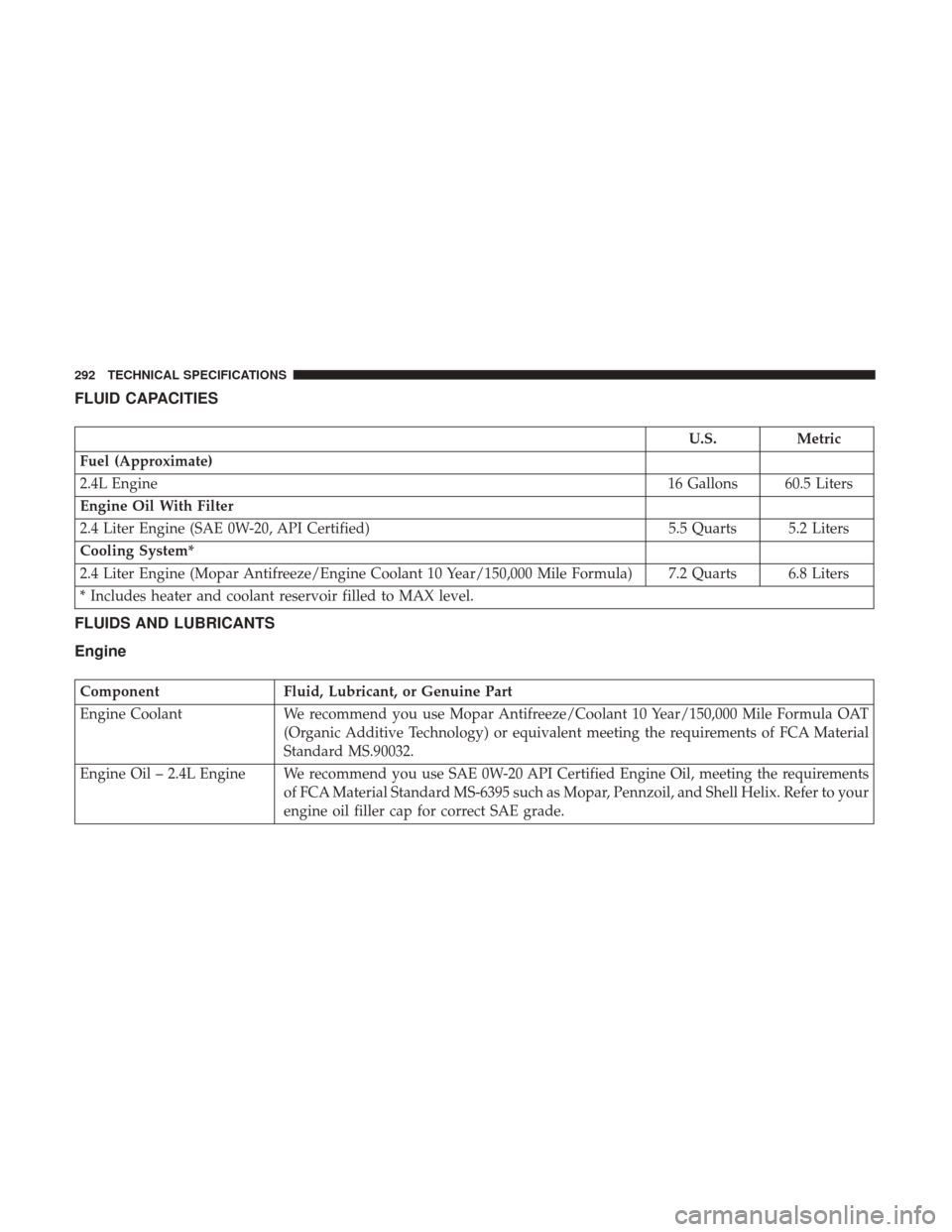
FLUID CAPACITIES
U.S.Metric
Fuel (Approximate)
2.4L Engine 16 Gallons 60.5 Liters
Engine Oil With Filter
2.4 Liter Engine (SAE 0W-20, API Certified) 5.5 Quarts 5.2 Liters
Cooling System*
2.4 Liter Engine (Mopar Antifreeze/Engine Coolant 10 Year/150,000 Mile Formula) 7.2 Quarts 6.8 Liters
* Includes heater and coolant reservoir filled to MAX level.
FLUIDS AND LUBRICANTS
Engine
Component Fluid, Lubricant, or Genuine Part
Engine Coolant We recommend you use Mopar Antifreeze/Coolant 10 Year/150,000 Mile Formula OAT
(Organic Additive Technology) or equivalent meeting the requirements of FCA Material
Standard MS.90032.
Engine Oil – 2.4L Engine We recommend you use SAE 0W-20 API Certified Engine Oil, meeting the requirements of FCA Material Standard MS-6395 such as Mopar, Pennzoil, and Shell Helix. Refer to your
engine oil filler cap for correct SAE grade.
292 TECHNICAL SPECIFICATIONS
Page 295 of 348
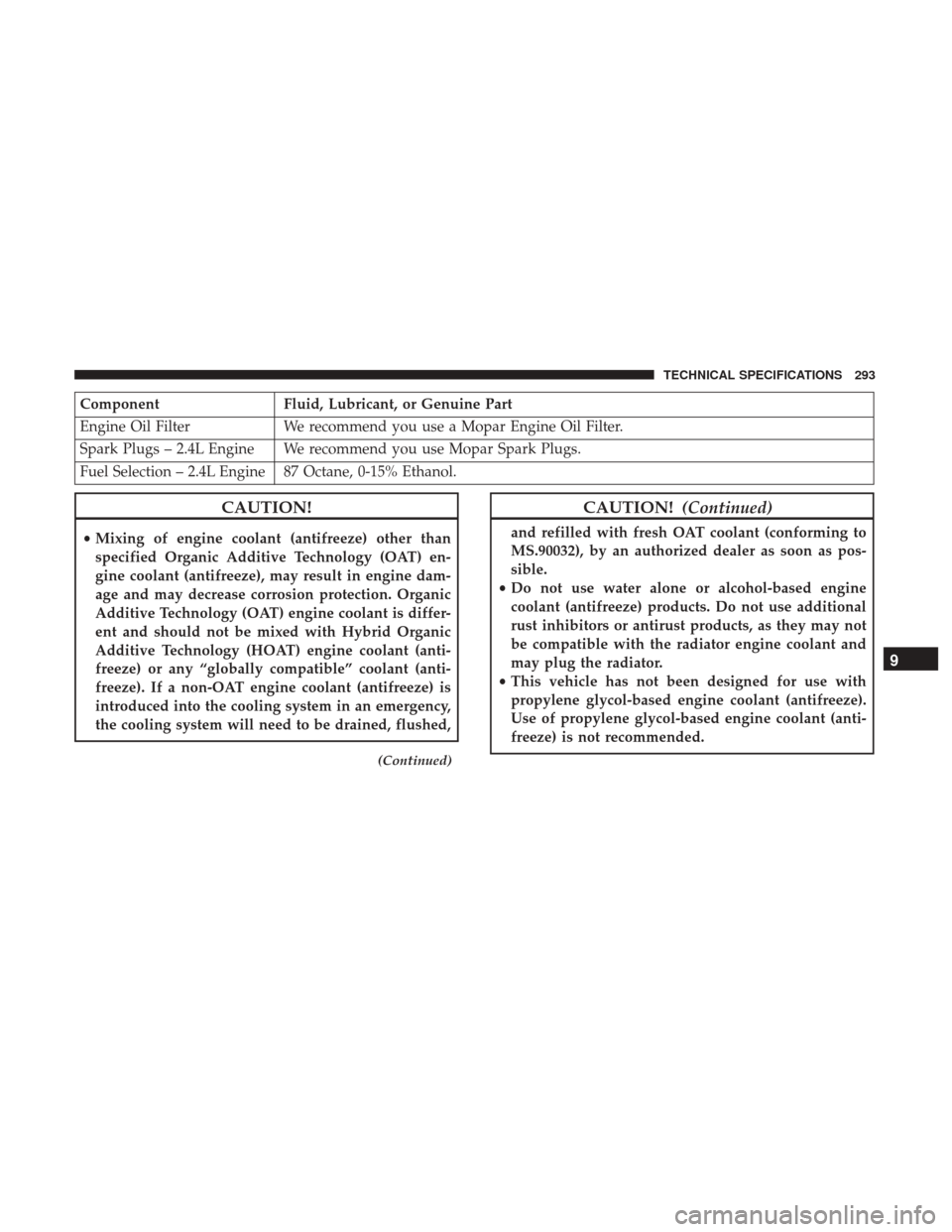
ComponentFluid, Lubricant, or Genuine Part
Engine Oil Filter We recommend you use a Mopar Engine Oil Filter.
Spark Plugs – 2.4L Engine We recommend you use Mopar Spark Plugs.
Fuel Selection – 2.4L Engine 87 Octane, 0-15% Ethanol.
CAUTION!
• Mixing of engine coolant (antifreeze) other than
specified Organic Additive Technology (OAT) en-
gine coolant (antifreeze), may result in engine dam-
age and may decrease corrosion protection. Organic
Additive Technology (OAT) engine coolant is differ-
ent and should not be mixed with Hybrid Organic
Additive Technology (HOAT) engine coolant (anti-
freeze) or any “globally compatible” coolant (anti-
freeze). If a non-OAT engine coolant (antifreeze) is
introduced into the cooling system in an emergency,
the cooling system will need to be drained, flushed,
(Continued)
CAUTION! (Continued)
and refilled with fresh OAT coolant (conforming to
MS.90032), by an authorized dealer as soon as pos-
sible.
• Do not use water alone or alcohol-based engine
coolant (antifreeze) products. Do not use additional
rust inhibitors or antirust products, as they may not
be compatible with the radiator engine coolant and
may plug the radiator.
• This vehicle has not been designed for use with
propylene glycol-based engine coolant (antifreeze).
Use of propylene glycol-based engine coolant (anti-
freeze) is not recommended.
9
TECHNICAL SPECIFICATIONS 293
Page 329 of 348

Body Mechanism Lubrication..................243
B-Pillar Location .......................... .262
Brake Assist System .........................89
Brake Fluid .............................. .294
Brake, Parking ............................ .152
Brake System ......................... .250, 286
Anti-Lock (ABS) ..........................88
Fluid Check ........................ .251, 294
Master Cylinder ........................ .251
Parking .............................. .152
Warning Light ...........................74
Brake/Transmission Interlock ..................155
Bulb Replacement ......................... .191
Bulbs, Light .......................... .145, 191
Camera, Rear ............................ .171
Capacities, Fluid .......................... .292
Caps, Filler Fuel ................................. .172
Oil (Engine) ........................ .237, 241
Power Steering ......................... .163
Radiator (Coolant Pressure) .................249
Carbon Monoxide Warning ................143, 291
Cargo Area Cover ...........................60
Cargo Compartment .........................60 Cargo Tie-Downs
...........................60
Car Washes .............................. .280
Cellular Phone ........................... .310
Certification Label ......................... .174
Chains, Tire ............................. .277
Changing A Flat Tire .....................204, 256
Chart, Tire Sizing .......................... .258
Check Engine Light (Malfunction Indicator Light) ....84
Checking Your Vehicle For Safety ...............142
Checks, Safety ............................ .142
Child Restraint ........................... .122
Child Restraints Booster Seats ........................... .126
Child Seat Installation ..................136,
140
How To Stow An unused ALR Seat Belt ........133
Infant And Child Restraints .................124
Locating The LATCH Anchorages .............131
Lower Anchors And Tethers For Children .......128
Older Children And Child Restraints ...........125
Seating Positions ........................ .127
Clean Air Gasoline ........................ .289
Cleaning Wheels ............................... .276
Climate Control ............................48
Cold Weather Operation ..................... .149
12
INDEX 327
Page 330 of 348

Compact Spare Tire........................ .274
Contract, Service .......................... .322
Cooling Pressure Cap (Radiator Cap) ............249
Cooling System ........................... .246
Adding Coolant (Antifreeze) .................248
Coolant Level .......................... .249
Cooling Capacity ........................ .292
Disposal Of Used Coolant ..................249
Drain, Flush, And Refill ....................247
Inspection ......................... .246, 249
Points To Remember ..................... .250
Pressure Cap ........................... .249
Radiator Cap .......................... .249
Selection Of Coolant (Antifreeze) ..........247, 292
Corrosion Protection ....................... .280
Cruise Light ...............................82
Cupholders ...............................63
Customer Assistance ....................... .320
Customer Programmable Features ...............297
Cybersecurity ............................ .296
Dealer Service ............................ .240
Defroster, Windshield ....................... .144
Diagnostic System, Onboard ....................83 Dipsticks
Oil (Engine) ........................... .238
Power Steering ......................... .163
Disable Vehicle Towing ..................... .228
Disposal Antifreeze (Engine Coolant) .................249
Door Ajar .................................76
Door Ajar Light ............................76
Door Locks ................................23
Doors ....................................23
Driver ’s Seat Back Tilt ........................29
Driving Through Flowing, Rising, Or Shallow Standing
Water ................................ .186
Electrical Outlet, Auxiliary (Power Outlet) ..........63
Electric Brake Control System ...................89
Electric Remote Mirrors .......................39
Electronic Range Select (ERS )..................162
Electr
onic Stability Control (ESC) ................91
Electronic Throttle Control Warning Light ..........76
Emergency, In Case Of Freeing Vehicle When Stuck .................226
Jacking ........................... .204, 256
Jump Starting .......................... .220
328 INDEX
Page 331 of 348

Towing............................... .228
Emission Control System Maintenance ............84
Engine ................................. .237
Air Cleaner ............................ .242
Block Heater ........................... .151
Break-In Recommendations .................152
Checking Oil Level ...................... .238
Coolant (Antifreeze) ..................... .292
Cooling .............................. .246
Exhaust Gas Caution ...................143, 291
Fails To Start ........................... .150
Flooded, Starting ........................ .150
Jump Starting .......................... .220
Oil .............................. .240, 292
Oil Filler Cap ....................... .237, 241
Oil Filter .............................. .241
Oil Selection ........................ .240, 292
Oil Synthetic ........................... .241
Overheating ........................... .223
Starting .............................. .149
Engine Oil Viscosity ........................ .241
Engine Oil Viscosity Chart ....................241
Enhanced Accident Response Feature .........120, 229
Ethanol ................................. .289
Exhaust Gas Cautions ....................143, 291 Exhaust System
....................... .143, 244
Exterior Lights ......................... .41, 145
Filters Air Cleaner ............................ .242
Air Conditioning ..........................53
Engine Oil ......................... .241, 292
Engine Oil Disposal ...................... .241
Flashers Hazard Warning ........................ .191
Turn Signals ......................... .82, 145
Flooded Engine Starting ..................... .150
Fluid, Brake ............................. .294
Fluid
Capacities ........................... .292
Fluid Leaks .............................. .146
Fluid Level Checks Brake ................................ .251
Engine Oil ............................ .238
Power Steering ......................... .163
Fluids And Lubricants ...................... .292
Fog Lights ................................42
Fold-Flat Seats .............................29
Four-Way Hazard Flasher .....................191
Freeing A Stuck Vehicle ..................... .226
Fuel ................................... .288
12
INDEX 329