Page 425 of 698
Air Suspension System
To aid in attaching/detaching the trailer from the vehicle,
the air suspension system can be used. Refer to “Air
Suspension System” in “Starting And Operating” for fur-
ther information.
NOTE:The vehicle must remain in the engine running
position while attaching a trailer for proper leveling of the
air suspension system.
SNOWPLOW
NOTE: Do not use this model vehicle for snowplow
applications.
WARNING!
Snowplows and other aftermarket equipment should
not be added to the front end of your vehicle. The
airbag crash sensors may be affected by the change in
the front end structure. The airbags could deploy
unexpectedly or could fail to deploy during a collision
resulting in serious injury or death.
WARNING!
Attaching a snowplow to this vehicle could adversely
affect performance of the airbag system in a collision.
Do not expect that the airbag will perform as described
earlier in this manual.
CAUTION!
Using this vehicle for snowplow applications can
cause damage to the vehicle.6
STARTING AND OPERATING 423
Page 426 of 698
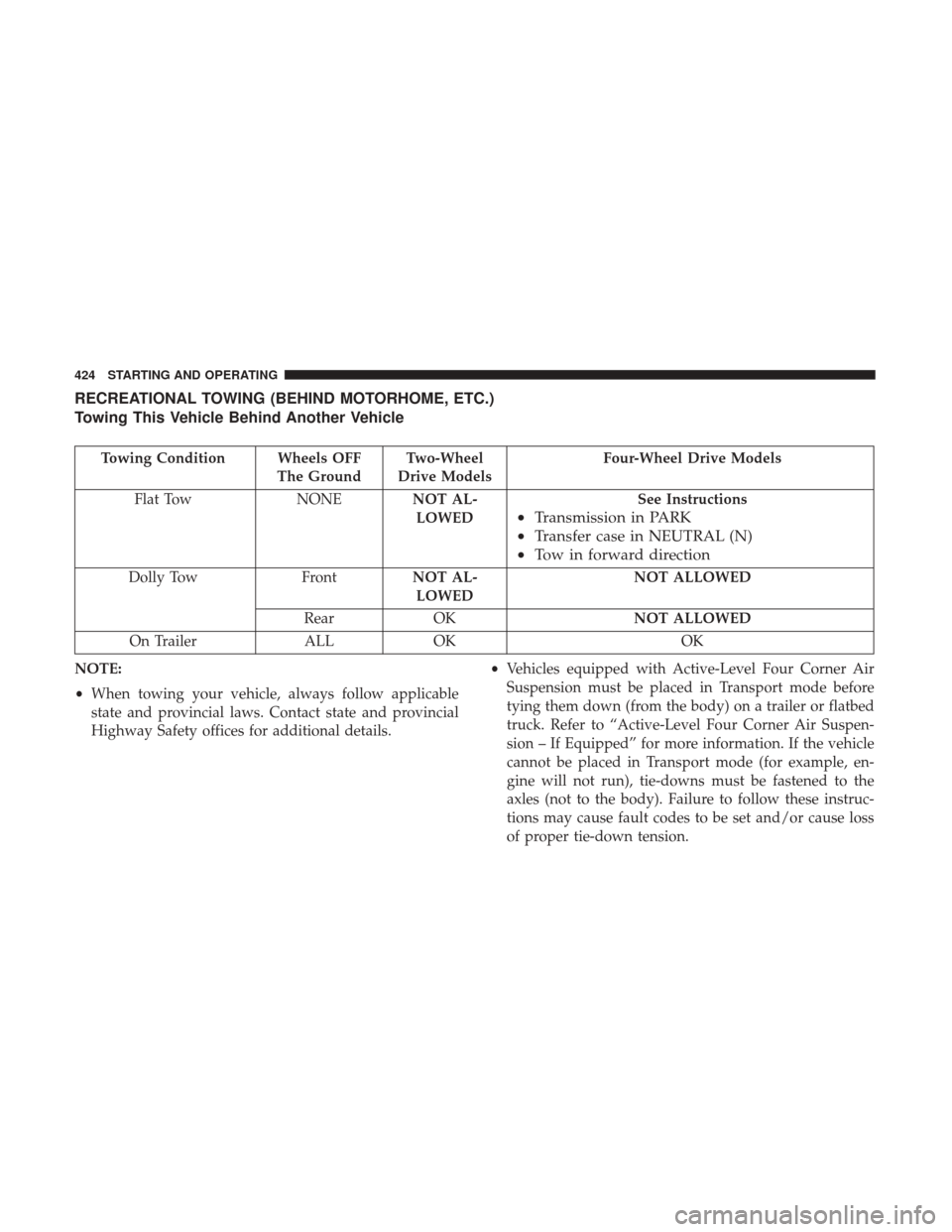
RECREATIONAL TOWING (BEHIND MOTORHOME, ETC.)
Towing This Vehicle Behind Another Vehicle
Towing Condition Wheels OFFThe GroundTwo-Wheel
Drive Models Four-Wheel Drive Models
Flat Tow NONE NOT AL-
LOWED See Instructions
•
Transmission in PARK
• Transfer case in NEUTRAL (N)
• Tow in forward direction
Dolly Tow FrontNOT AL-
LOWED NOT ALLOWED
Rear OK NOT ALLOWED
On Trailer ALLOK OK
NOTE:
• When towing your vehicle, always follow applicable
state and provincial laws. Contact state and provincial
Highway Safety offices for additional details. •
Vehicles equipped with Active-Level Four Corner Air
Suspension must be placed in Transport mode before
tying them down (from the body) on a trailer or flatbed
truck. Refer to “Active-Level Four Corner Air Suspen-
sion – If Equipped” for more information. If the vehicle
cannot be placed in Transport mode (for example, en-
gine will not run), tie-downs must be fastened to the
axles (not to the body). Failure to follow these instruc-
tions may cause fault codes to be set and/or cause loss
of proper tie-down tension.
424 STARTING AND OPERATING
Page 427 of 698
Recreational Towing — Two-Wheel Drive Models
DO NOT flat tow this vehicle. Damage to the drivetrain
will result.
Recreational towing (for two-wheel drive models) is al-
lowedONLY if the rear wheels are OFFthe ground. This
may be accomplished using a tow dolly or vehicle trailer. If
using a tow dolly, follow this procedure:
NOTE: If vehicle is equipped with air suspension, ensure
the vehicle is set to Normal Ride Height.
1. Properly secure the dolly to the tow vehicle, following the dolly manufacturer’s instructions.
2. Drive the rear wheels onto the tow dolly.
3. Apply the parking brake. Place the transmission in PARK.
4. Properly secure the rear wheels to the dolly, following the dolly manufacturer’s instructions.
5. Turn the ignition OFF.
6. Install a suitable clamping device, designed for towing, to secure the front wheels in the straight position.
CAUTION!
Towing with the rear wheels on the ground will cause
severe transmission damage. Damage from improper
towing is not covered under the New Vehicle Limited
Warranty.
Recreational Towing — Four-Wheel Drive Models
NOTE: The transfer case must be shifted into NEUTRAL
(N) for recreational towing. The transmission must be
shifted into PARK for recreational towing. Refer to the
following for the proper transfer case NEUTRAL (N)
shifting procedure for your vehicle.
CAUTION!
• DO NOT dolly tow any 4WD vehicle. Towing with
only one set of wheels on the ground (front or rear)
will cause severe transmission and/or transfer case
damage. Tow with all four wheels either ON the
ground, or OFF the ground (using a vehicle trailer).
• Tow only in the forward direction. Towing this
vehicle backwards can cause severe damage to the
transfer case.
(Continued)
6
STARTING AND OPERATING 425
Page 452 of 698
Power Distribution Center
The Power Distribution Center is located in the engine
compartment near the battery. This center contains car-
tridge fuses, micro fuses, relays, and circuit breakers. A
description of each fuse and component may be stampedon the inside cover, otherwise the cavity number of each
fuse is stamped on the inside cover that corresponds to the
following chart.
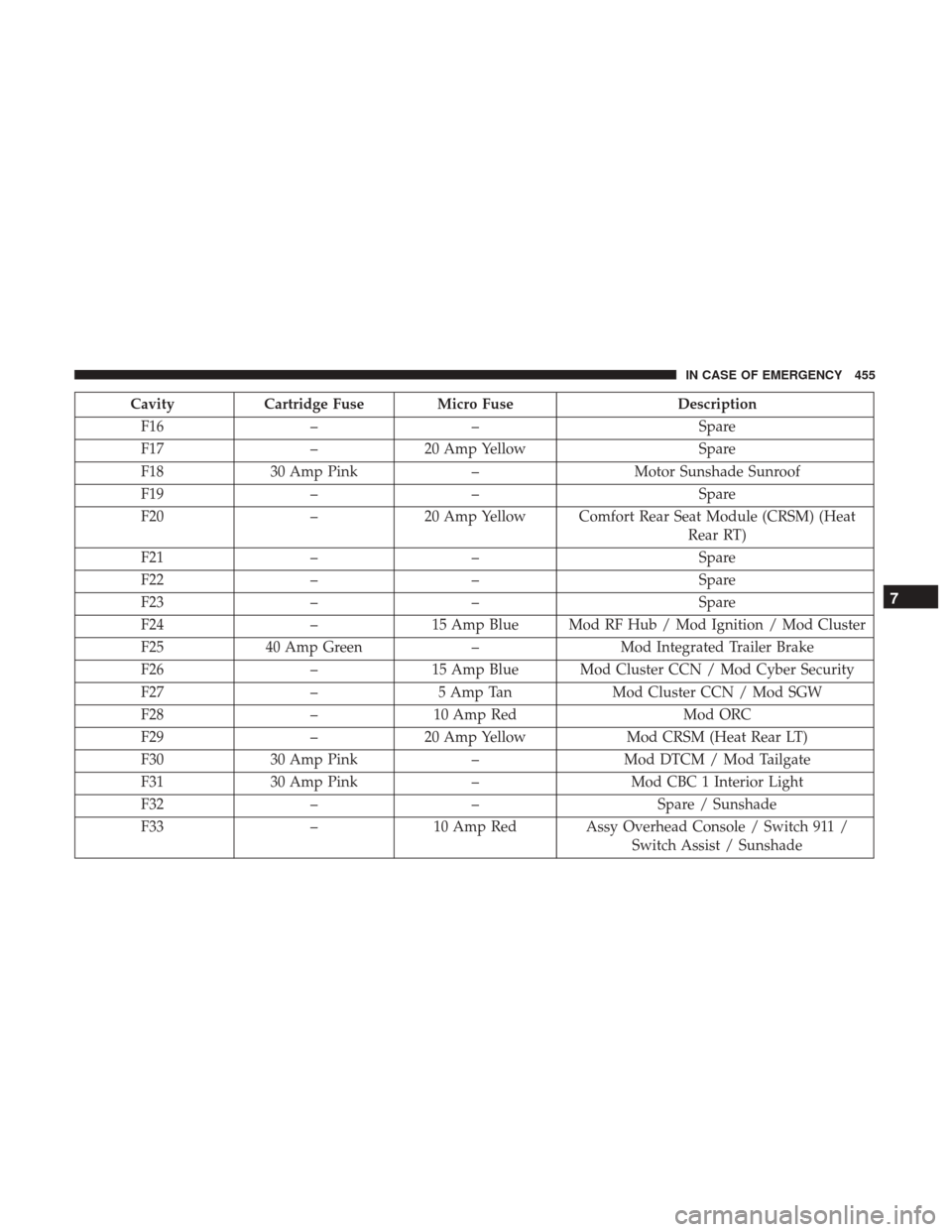
Cavity
Cartridge Fuse Micro Fuse Description
F01 –25 Amp Clear Fuel Pump Motor
F03 –5 Amp Tan MGU – If Equipped
F04 –– Spare
F05 –– Spare
F06 –– Spare
F07 –– Spare
F08 20 Amp Blue –Trailer Tow Backup
F09 –20 Amp Yellow Trailer Stop / Turn Lamp Left
F10 –20 Amp Yellow Trailer Stop / Turn Lamp Right
F11 –– Spare
F12 20 Amp Blue –Trailer Tow Park Lamp
F13 –– Spare
F14 –10 Amp Red AC Clutch
F15 –5 Amp Tan IBS
F16 –– Spare
450 IN CASE OF EMERGENCY
Page 456 of 698

Internal Power Distribution Center
The Power Distribution Center is located under the drivers
side instrument panel. This center contains cartridge fuses,
micro fuses, relays, and circuit breakers. A description ofeach fuse and component may be stamped on the inside
cover, otherwise the cavity number of each fuse is stamped
on the inside cover that corresponds to the following chart.
Cavity
Cartridge Fuse Micro Fuse Description
F01 30 Amp Pink –Trailer Tow Receptacle
F03 –15 Amp Blue Module Seat Heater Front (Pass)
F04 –– Spare
F05 –20 Amp Yellow Module PPU Cooling Fan
F06 40 Amp Green –Mod CBC 4 Exterior Light 2
F07 40 Amp Green –Mod CBC 3 PWR Locks
F08 –– Spare
F09 –– Spare
F10 40 Amp Green –HVAC Blower Motor
F11 –5 Amp Tan Output to Underhood Power Distribition
Center (UPDC) Run Coil
F12 –25 Amp Clear Mod Audio Amplifier / Active Noise Can-
cellation / SW Inverter
F13 –20 Amp Yellow Mod Seat Heater Front (Driver)
F14 –15 Amp Blue Mod Seat Heater Front (Steering Wheel)
F15 –– Spare
454 IN CASE OF EMERGENCY
Page 457 of 698
CavityCartridge Fuse Micro Fuse Description
F16 –– Spare
F17 –20 Amp Yellow Spare
F18 30 Amp Pink –Motor Sunshade Sunroof
F19 –– Spare
F20 –20 Amp Yellow Comfort Rear Seat Module (CRSM) (Heat
Rear RT)
F21 –– Spare
F22 –– Spare
F23 –– Spare
F24 –15 Amp Blue Mod RF Hub / Mod Ignition / Mod Cluster
F25 40 Amp Green –Mod Integrated Trailer Brake
F26 –15 Amp Blue Mod Cluster CCN / Mod Cyber Security
F27 –5 Amp Tan Mod Cluster CCN / Mod SGW
F28 –10 Amp Red Mod ORC
F29 –20 Amp Yellow Mod CRSM (Heat Rear LT)
F30 30 Amp Pink –Mod DTCM / Mod Tailgate
F31 30 Amp Pink –Mod CBC 1 Interior Light
F32 –– Spare / Sunshade
F33 –10 Amp Red Assy Overhead Console / Switch 911 /
Switch Assist / Sunshade
7
IN CASE OF EMERGENCY 455
Page 483 of 698

CAUTION!(Continued)
•Revving the engine or spinning the wheels too fast
may lead to transmission overheating and failure. It
can also damage the tires. Do not spin the wheels
above 30 mph (48 km/h) while in gear (no transmis-
sion shifting occurring).
TOWING A DISABLED VEHICLE
This section describes procedures for towing a disabled
vehicle using a commercial towing service.
If the transmission and drivetrain are operable, disabled
vehicles may also be towed as described under “Recre-
ational Towing” in the “Starting And Operating” section. NOTE:
Vehicles equipped with the Active-Level Four Cor-
ner Air Suspension System must be placed in Transport
mode, before tying them down (from the body) on a trailer
or flatbed truck. If the vehicle cannot be placed in Trans-
port mode (for example, engine will not run), tie-downs
must be fastened to the axles (not to the body). Failure to
follow these instructions may cause fault codes to be set
and/or cause loss of proper tie-down tension.
7
IN CASE OF EMERGENCY 481
Page 491 of 698

SCHEDULED SERVICING
Your vehicle is equipped with an automatic oil change
indicator system. The oil change indicator system will
remind you that it is time to take your vehicle in for
scheduled maintenance.
Based on engine operation conditions, the oil change
indicator message will illuminate. This means that service
is required for your vehicle. Operating conditions such as
frequent short-trips, trailer tow, and extremely hot or cold
ambient temperatures will influence when the “Oil Change
Required” message is displayed. Severe Operating Condi-
tions can cause the change oil message to illuminate as
early as 3,500 miles (5,600 km) since last reset. Have your
vehicle serviced as soon as possible, within the next 500
miles (805 km).
Your authorized dealer will reset the oil change indicator
message after completing the scheduled oil change. If a
scheduled oil change is performed by someone other than
your authorized dealer, the message can be reset by
referring to the steps described under “Instrument Cluster
Display” in “Getting To Know Your Instrument Panel”.NOTE:
Under no circumstances should oil change inter-
vals exceed 10,000 miles (16,000 km), twelve months or 350
hours of engine run time, whichever comes first. The 350
hours of engine run or idle time is generally only a concern
for fleet customers.
Severe Duty All Models
NOTE: Change Engine Oil at 4,000 miles (6,500 km) or 350
hours of engine run time if the vehicle is operated in a
dusty and off road environment or is operated predomi-
nantly at idle, or only very low engine RPM’s. This type of
vehicle use is considered Severe Duty.
Once A Month Or Before A Long Trip:
• Check engine oil level.
• Check windshield washer fluid level.
• Check tire pressure and look for unusual wear or
damage. Rotate tires at the first sign of irregular wear,
even if it occurs before the oil indicator system turns on.
• Check the fluid levels of the coolant reservoir, brake
master cylinder, and fill as needed.
• Check function of all interior and exterior lights.
8
SERVICING AND MAINTENANCE 489