2019 Peugeot Partner roof
[x] Cancel search: roofPage 110 of 312

108
Advice
For the airbags to be fully effective,
observe the safety recommendations
below.
Adopt a normal and upright sitting
position.
Wear a correctly adjusted seat belt.
Do not leave anything between the
occupants and the airbags (a child, pet,
object, etc.), nor fix or attach anything
close to or in the way of the airbag release
trajectory; this could cause injuries during
their deployment.
Do not place objects on the dashboard.
Never modify the original definition of your
vehicle, particularly in the area directly
around the airbags.
After an accident or if the vehicle has
been stolen, have the airbag systems
checked.
All work on the airbag systems must be
carried out by a PEUGEOT dealer or a
qualified workshop.
Even if all of the precautions mentioned
are obser ved, a risk of injury or of minor
burns to the head, chest or arms when an
airbag is deployed cannot be ruled out.
The airbag inflates almost instantly (within
a few milliseconds) then deflates within
the same time discharging the hot gas via
openings provided for this purpose.Front airbags
Do not drive holding the steering wheel
by its spokes or resting your hands on the
centre part of the wheel.
Passengers must not place their feet on
the dashboard.
Do not smoke as deployment of the
airbags can cause burns or the risk of
injury from a cigarette or pipe.
Never remove or pierce the steering wheel
or hit it violently.
Do not fix or attach anything to the
steering wheel or dashboard, as this
could cause injuries when the airbags are
deployed.
Curtain airbags
Do not fix or attach anything to the roof,
as this could cause head injuries when the
curtain airbag is deployed.
If fitted to your vehicle, do not remove the
grab handles installed on the roof, they
play a part in securing the curtain airbags.
Lateral airbags
Use only approved covers on the seats,
compatible with the deployment of the
lateral airbags. For information on the
product range of seat covers suitable for
your vehicle, contact a PEUGEOT dealer.
Do not fix or attach anything to the seat
backrests (clothes, etc.), as this could
cause injuries to the thorax or arm when
the lateral airbag is deployed.
Do not sit with the upper part of the body
any nearer to the door than necessary.
The vehicle's front door panels include
side impact sensors.
A damaged door or any unauthorised or
incorrectly executed work (modification or
repair) on the front doors or their interior
trim could compromise the operation of
these sensors – risk of malfunction of the
lateral airbags!
Such work must only be done by a
PEUGEOT dealer or a qualified workshop.
Safety
Page 150 of 312
148
Following braking of the vehicle bringing it to
a complete stop, the system holds the vehicle
stationary; the cruise control is paused.
The driver should press the accelerator
pedal to move off, then reactivate the system
by pressing one of the buttons 2, 3 or 4.
If the driver takes no action following this
immobilisation, the automatic electronic parking
brake is applied automatically after a while
(approximately 5
minutes).
Operating limits
The system cannot exceed the limits of the
laws of physics.
Certain situations cannot be managed by the
system and require the driver to take back
control of the vehicle.
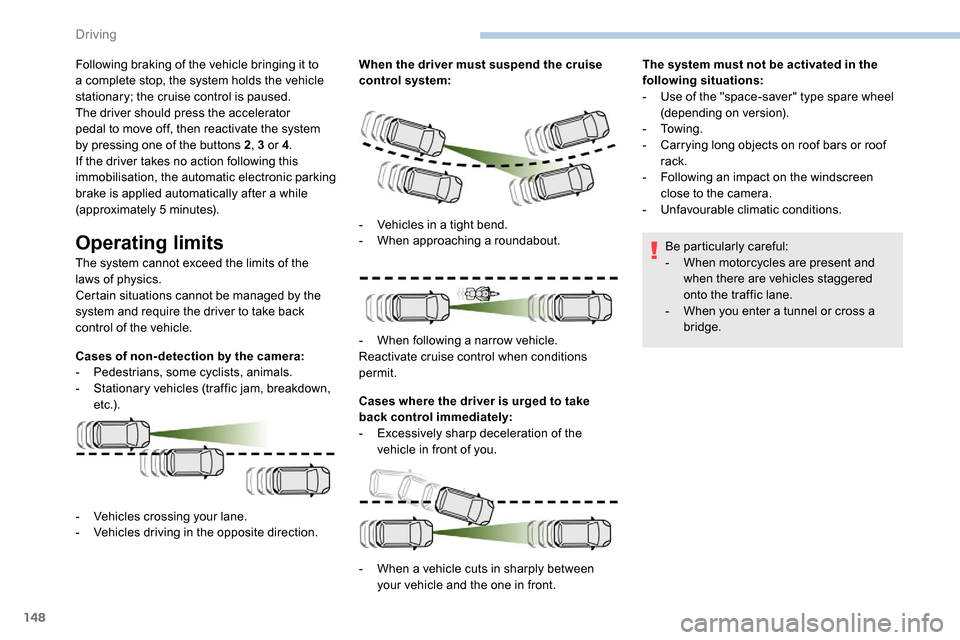
Cases of non- detection by the camera:
-
Pe
destrians, some cyclists, animals.
-
S
tationary vehicles (traffic jam, breakdown,
e t c .) . When the driver must suspend the cruise
control system:
Cases where the driver is urged to take
back control immediately:
-
E
xcessively sharp deceleration of the
vehicle in front of you. The system must not be activated in the
following situations:
-
U
se of the "space-saver" type spare wheel
(depending on version).
-
To w i n g .
-
C
arrying long objects on roof bars or roof
rack.
-
F
ollowing an impact on the windscreen
close to the camera.
-
Un
favourable climatic conditions.
Be particularly careful:
- W hen motorcycles are present and
when there are vehicles staggered
onto the traffic lane.
-
W
hen you enter a tunnel or cross a
bridge.
-
V
ehicles crossing your lane.
-
V
ehicles driving in the opposite direction. -
V
ehicles in a tight bend.
-
W
hen approaching a roundabout.
-
W
hen following a narrow vehicle.
Reactivate cruise control when conditions
permit.
-
W
hen a vehicle cuts in sharply between
your vehicle and the one in front.
Driving
Page 153 of 312

151
Operating conditions and
limits
The ESC system must not be faulty.
The DSC/ASR systems must not be
deactivated.
All passenger seat belts must be fastened.
Driving at a steady speed on roads with few
bends is required.The system is automatically deactivated
after the use of certain "space-saver"
type spare wheels is detected (smaller
diameter).
The system is automatically deactivated
after detection of a fault with the brake
pedal switch or with at least two brake
lamps. After an impact, the function automatically
stops operating. Contact a PEUGEOT
dealer or a qualified workshop to have the
system checked.
Distance Alert
It warns the driver if his vehicle is at risk of
collision with the vehicle in front or a pedestrian
present in his traffic lane.
In the following cases, deactivating the system
via the vehicle's configuration menu is advised:
-
t
owing a trailer,
-
c
arrying long objects on roof bars or roof
rack,
-
w
ith snow chains fitted,
-
b
efore using an automatic car wash, with
the engine running,
-
b
efore placing the vehicle on a rolling road
in a workshop,
-
t
owed vehicle, engine running,
-
f
ollowing an impact to the windscreen close
to the detection camera. It is possible that warnings are not given,
are given too late or seem unjustified.
Consequently, always stay in control of
your vehicle and be prepared to react at
any time to avoid an accident.
The current threshold can
be modified via the vehicle
configuration menu.
You can select one of three pre-defined
thresholds:
- "
Distant ",
- "
Normal ",
- "
Close ".
The last threshold selected is memorised when
the ignition is switched off.
Operation
Depending on the degree of risk of collision
detected by the system and the alert threshold
chosen by the driver, different levels of
alert can be triggered and displayed in the
instrument panel.
They take account of the vehicle dynamics, the
speed of your vehicle and the one in front, the
environmental conditions, the operation of the
vehicle (cornering, actions on the pedals, etc.)
to trigger the alert at the best moment.
Modifying the alert trigger
threshold
This threshold determines how you wish to be
warned of the presence of a vehicle moving
or stationary in front of you, or a pedestrian
present in your traffic lane. Level 1 (orange)
: visual alert only,
signalling to you that the vehicle in
front is very close.
The message " Vehicle close" is
displayed.
6
Driving
Page 162 of 312

160
After three first level alerts, the system triggers
a further alert with the message "Dangerous
driving: take a break ", accompanied by a
more pronounced audible signal.
In certain driving conditions (poor road
sur face or strong winds), the system may
give alerts irrespective of the driver's level
of vigilance.
The following situations may interfere with
the operation of the system or prevent it
from working:
-
p
oor visibility (inadequate lighting of
the roadway, falling snow, heavy rain,
dense fog, etc.),
-
d
azzle (headlamps of an oncoming
vehicle, low sun, reflections on a damp
road, leaving a tunnel, alternating
shade and light, etc.),
-
w
indscreen area located in front of the
camera: dirty, misted, frost-covered,
snow-covered, damaged or covered by
a s t i c ke r,
-
lan
e markings absent, worn, concealed
(snow, mud) or multiple (roadworks,
e t c .),
-
c
lose to the vehicle ahead (lane
markings not detected),
-
r
oads that are narrow, winding, etc. Clean the windscreen regularly,
particularly the area in front of the camera.
The internal sur face of the windscreen can
also become misted around the camera.
In humid and cold weather, demist the
windscreen regularly.
Do not allow snow to accumulate on the
bonnet or roof of the vehicle as this could
obstruct the detection camera.
Parking sensors
This function is a manoeuvring aid which
cannot, in any circumstances, replace the
need for vigilance on the part of the driver.
The driver must remain attentive and stay
in control of their vehicle.
They must always check the vehicle’s
surroundings before undertaking a
manoeuvre.
During the entire manoeuvre, the driver
must ensure that the space remains clear.
Using sensors located in the bumper, this
function warns of the proximity of obstacles
(e.g. pedestrian, vehicle, tree, barrier) entering
their field of detection.
Rear parking sensors
The system is switched on by engaging reverse
g e a r.
This is confirmed by an audible signal.
The system is switched off when you come out
of reverse gear.
Audible assistance
The function signals the presence of obstacles
present both within the sensors’ detection
zone and in the vehicle path defined by the
orientation of the steering wheel.
Driving
Page 179 of 312
177
Load reduction mode
System which manages the use of certain
functions according to the level of charge
remaining in the battery.
When the vehicle is being driven, the load
reduction function temporarily deactivates
certain functions, such as air conditioning,
heated rear screen, etc.
The deactivated functions are reactivated
automatically as soon as conditions permit.
Roof bars/Roof rack
Recommendations
Distribute the load uniformly, taking care
to avoid overloading one of the sides.
Arrange the heaviest part of the load as
close as possible to the roof.
Secure the load firmly.
Drive gently: the vehicle will be more
susceptible to the effects of side winds
and its stability may be affected.
Regularly check the security and tight
fastening of the roof bars and racks, at
least before each trip.As a safety measure and to avoid
damaging the roof, it is essential to use
the roof bars and racks approved for your
vehicle.
Obser ve the instructions on fitting and use
contained in the guide supplied with the
roof bars and racks. In the event of loading (
not exceeding
40 cm in height) on the roof, do not
exceed the following loads:
-
T
ransverse bars on longitudinal bars:
80 kg
.
-
T
wo transverse bars bolted to the roof:
100
kg
.
-
T
hree transverse bars bolted to the
roof: 15 0
kg
.
-
A
n aluminium rack: 120
kg
.
-
A s
teel rack: 115
k g
.
If the height exceeds 40 cm, adapt the
speed of the vehicle to the profile of the
road to avoid damaging the roof bars
or the roof rack and the fixings on the
vehicle.
Be sure to refer to national legislation in
order to comply with the regulations for
transporting objects which are longer than
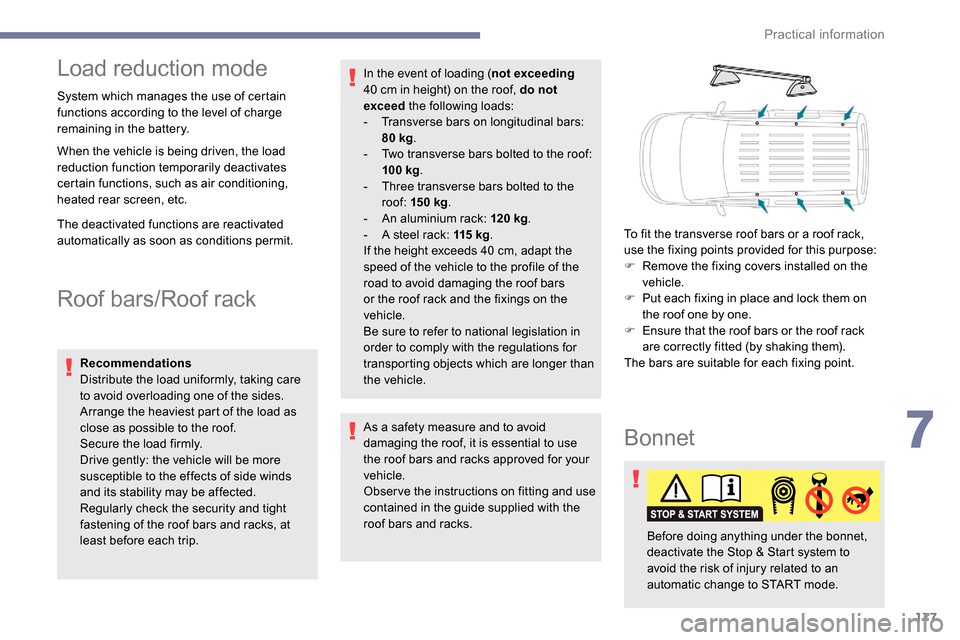
the vehicle. To fit the transverse roof bars or a roof rack,
use the fixing points provided for this purpose:
F
R
emove the fixing covers installed on the
vehicle.
F
P
ut each fixing in place and lock them on
the roof one by one.
F
E
nsure that the roof bars or the roof rack
are correctly fitted (by shaking them).
The bars are suitable for each fixing point.
Bonnet
Before doing anything under the bonnet,
deactivate the Stop & Start system to
avoid the risk of injury related to an
automatic change to START mode.
7
Practical information
Page 211 of 312

209
Vehicle length
Standard (L1) Long (L2)
M Useable height of the opening 1,072
N Interior load height
(varies depending on the angle of the floor and the cur ve of
the roof) 1, 20 0 to 1, 270
O Loading sill height Standard version
548 to 588 X
Standard version with increased
payload 568 to 578 561 to 565
Commercial vehicle version 602 to 610 605 to 610
P Useable width of
the opening Without Multi-Flex bench seat
675
With Multi-Flex bench seat 6 41
Q Loading sill height Standard version
534 to 558
Standard version with increased
payload 551 to 558 543 to 552
Commercial vehicle version 574 to 581 575 to 587Vehicle length
Standard (L1) Long (L2)
I Interior width between wheel arches 1, 2 2 9
J Maximum interior
width Without sliding side door
1,73 3
With 1 sliding side door 1,6 3 0
With 2 sliding side doors 1,527
K Useable height of
the opening With side-hinged doors
1,13 7
With tailgate 1,1 9 7
L Useable width of the opening 1, 242
9
Technical data
Page 265 of 312

5
21,518,5Vehicle
Depending on equipment/Depending on version.
Activate, deactivate or configure
certain vehicle functions.
Air conditioning
Depending on equipment/Depending on version.
Manage various temperature and air
flow settings.
Voice commands
Steering mounted controls
Voice commands:
This control is located on the
steering wheel or at the end of the
lighting control stalk (depending on
equipment).
Pressing this button activates the
voice commands function. To ensure that voice commands are
always recognised by the system, please
observe the following recommendations:
-
s
peak natural language in a normal
tone without breaking up words or
raising your voice.
-
a
lways wait for the "beep" (audible
signal) before speaking.
-
f
or best operation, it is recommended
that the windows and sunroof
be closed to avoid extraneous
interference (depending on version).
-
b
efore making a voice command, ask
other passengers not to speak.
First steps
Example of a "voice command" for
navigation:
" Navigate to address 11 Regent
Street, London "
Example of a "voice command" for
the radio and media:
" Play ar tist Madonna "
Example of a "voice command" for
the telephone:
" Call David Miller "
.
PEUGEOT Connect Nav
Page 302 of 312

220
Cruise control, dynamic with Stop function ................................ 13 6, 142-145 , 148
Cup holder
....................................................... 64
DDAB (Digital Audio Broadcasting) -
Digital radio ........................................ 6 -7, 8, 24
Date (setting)
....................................... 35, 17 , 32
Daytime running lamps
.....................85, 87 , 198
Deactivating the passenger airbag
.......10 6, 11 0
Deactivation of DSC (ESC)
.............................99
Deadlocking
.................................................... 43
Defrosting
.................................................. 58, 78
Demisting
........................................................ 78
Demisting, rear
.......................................... 57, 79
Demisting, rear screen
.............................57, 79
Diesel
..................................................... 213 -216
Dimensions
..............................
.....................208
Dipstick
................
............................30, 179 -18 0
Direction indicators
...................86 - 87, 198, 19 9
Display screen, instrument panel
...........29, 13 0
Distance Alert
.................................. 18, 15 0 -151
Doors, side-hinged
................................... 42
- 43
Driver’s attention warning
.............................159
Driving
........................................................... 115
Driving abroad ................................................. 86
Dynamic stability control (DSC)
................................. 20, 97- 9 9 , 101-102
EEarth point, remote ....................................... 17 8
EBFD ................ ............................................... 98
Economy mode
............................................. 17
6
Electric windows
............................................. 55
Electronic brake force distribution (EBFD) .....9 7- 9 8Emergency braking assistance (EBA) .......9 7- 9 8
Emergency call ............................................... 96
Emergency warning lamps
.............................97
Emissions control system, SCR
...................183
Energy economy mode
................................. 17
6
Engine
.................................................... 211-216
Engine compartment
.................................... 17
8
Engine, Diesel
..................18, 170 , 187, 213 -216
Engine, petrol
......................... 17
0, 178 , 211-212
Engines
.................................................. 210 -216
Engine self-diagnosis
..................................... 17
E
nvironment
.............................................. 46, 82
ESC (electronic stability control)
....................97
E
xtended traffic sign recognition
..................13 6
FFatigue detection .......................................... 159
Filling the AdBlue® tank ................................ 185
Filling the fuel tank ................................. 170 -172
Filter, air
........................................................ 181
Filter, Diesel fuel
........................................... 179
Filter, oil
................
......................................... 182
Filter, particle
................................... 19, 181-182
Filter, passenger compartment
..................... 181
Finisher
......................................................... 195
Fitting a wheel
........................................ 193 -195
Fitting roof bars
............................................. 17 7
Fittings, interior
............................................... 64
F
lap, fuel filler
......................................... 171-172
Flap, removable
..............................
...........70 -71
Flashing indicators
............................ 86 - 87, 19 9
Foglamp, rear
................................... 25, 85 , 19 9
Foglamps, front
........................... 85, 90 -91 , 19 9
Foglamps, rear
................................................ 85
F
olding the rear seats
............................... 63-64
Frequency (radio)
...................................... 23 -24
Fuel................................................................ 170
Fuel tank ........................................................ 171
Fusebox, engine compartment
.....................203
Fuses
..................................................... 20
1-203
GGauge, fuel............................................. 171-172
Gearbox, automatic ...............11 6, 125-132 , 182
Gearbox, electronic
...............................13 0 -132
Gearbox, manual
...........125 -126 , 13 0 -132 , 182
Gear lever, automatic gearbox
..............126 -12 9
Gear lever, manual gearbox
..................125 -126
Gear shift indicator ~ Gear efficiency indicator
...................................................... 13 0
Glove box
........................................................ 64
G . P. S .
.............................................................. 14
HHazard warning lamps ....................................97Hazard warning lamps, automatic operation ......97headlamp adjustment ..................................... 91
Headlamp adjustment ..................................... 91
Headlamp beam height
................................... 91
H
eadlamps, automatic illumination
..........86-88
Headlamps, dipped beam
.................27, 85 , 197
Headlamps, halogen
..................................... 19 6
Headlamps, intelligent beam
......27, 88-90 , 15 8
Headlamps, main beam
....................27, 85 , 198
Head restraints ................................................ 60
Head restraints, front
...................................... 64
Head restraints, rear
.................................63-64
Heating
.......................................... 75,
79 - 81, 83
Heating, additional
..............................53, 79 - 81
Heating, programmable
......................53, 79 - 81
Alphabetical index