2019 Peugeot Partner Wiper
[x] Cancel search: WiperPage 96 of 312

94
Switching on
Give a short downwards push to the control
stalk.
A wiping cycle confirms that the instruction has
been accepted.Depending on version, this symbol
appears in the display screen or
this indicator lamp comes on in the
instrument panel and a message is
displayed.
Switching off
Give the control stalk a brief push
downwards or shift the control stalk
to a different position (Int, 1 or 2).
This indicator lamp goes off in the
instrument panel and a message is
displayed.
The automatic rain sensitive windscreen
wipers must be reactivated by pushing the
control stalk downwards, if the ignition has
been off for more than one minute.
Malfunction
If a fault occurs with the automatic windscreen
wipers, the wipers will operate in intermittent
mode.
Have it checked by a PEUGEOT dealer or a
qualified workshop.
Do not cover the rain sensor, located at
the top of the windscreen behind the rear
view mirror (depending on equipment); the
associated functions would no longer be
controlled.
Switch off the automatic windscreen
wipers when using an automatic car wash.
In winter, it is advisable to wait until
the windscreen is completely clear of
ice before activating the automatic rain
sensitive wipers.
Automatic windscreen
wipers
The windscreen wipers operate automatically
once rain is detected (sensor behind the
rear view mirror), adapting their speed to the
intensity of the rain without any action on the
part of the driver.
Lighting and visibility
Page 136 of 312

134
- Certain road sign qualifier plates detected by the camera (e.g. the speed limit if towing).Qualifier plate detected Displaying the speed associated with
the qualifier plate
Speed limit in rain
Examples: If the wiper control stalk is in the
"intermittent wiping" or "automatic
wiping" position (so that the rain sensor is
activated):
68
mph (110 km/h) (for example)
Speed limit if towing If an approved towing device is fixed to
the vehicle:
56
mph (90 km/h) (for example)
Speed limit applicable over a cer tain distance
Example: 43
mph (70 km/h) (for example)
Speed limit for vehicles whose gross vehicle
weight or gross train weight is less than
3.5 tonnes 56
mph (90 km/h) (for example)
Speed limit in snow
Example: If the exterior temperature is below 3°C:
19
mph (30 km/h) (for example)
with a "snowflake" symbol
Speed limit at cer tain times
Example: 19
mph (30 km/h) (for example)
with a "clock" symbol The units for the speed limits (mph or
km/h) depend on the country you are
driving in.
It should be taken into account so that you
obser ve the speed limit.
For the system to operate correctly when
you change country, the units for speed in
the instrument panel must be those for the
country you are driving in.
The automatic reading of road signs is a
driving aid system and does not always
display speed limits correctly.
The speed limit signs present on the road
always take priority over the display by the
system.
The system cannot, in any circumstances,
replace the need for vigilance on the part
of the driver.
The driver must observe the driving
regulations and must adapt the speed of
the vehicle to suit the weather and traffic
conditions.
It is possible for the system to not display
the speed limit if it does not detect a
speed limit sign within a preset period.
The system is designed to detect signs
that conform to the Vienna Convention on
road signs.
Driving
Page 178 of 312
176
ON
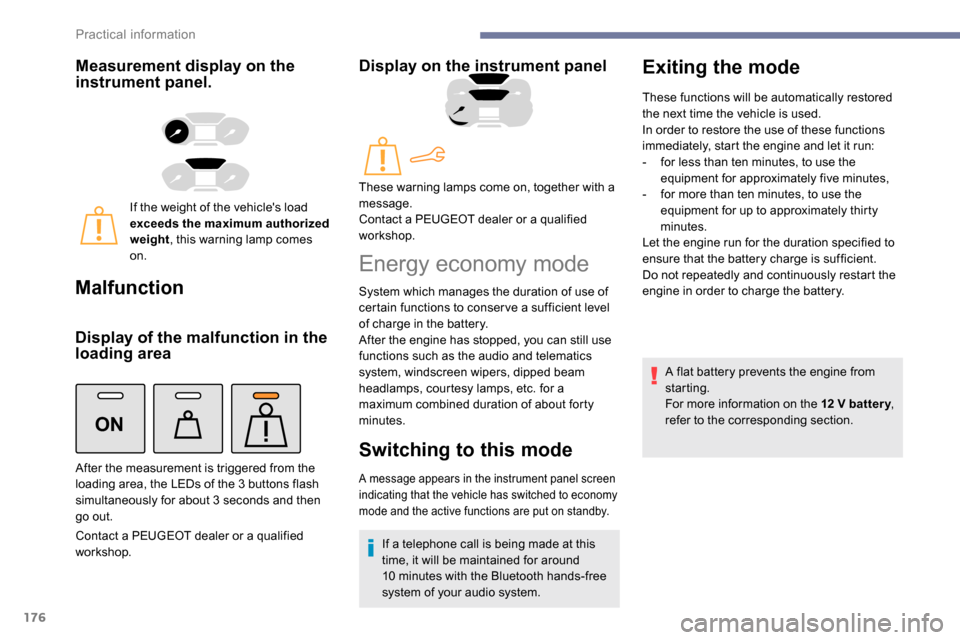
Measurement display on the
instrument panel.
If the weight of the vehicle's load
exceeds the maximum authorized
weight, this warning lamp comes
on.
Malfunction
Display of the malfunction in the
loading area
Contact a PEUGEOT dealer or a qualified
workshop.
Display on the instrument panel
After the measurement is triggered from the
loading area, the LEDs of the 3 buttons flash
simultaneously for about 3
seconds and then
go out. These warning lamps come on, together with a
message.
Contact a PEUGEOT dealer or a qualified
workshop.
Energy economy mode
System which manages the duration of use of
certain functions to conser ve a sufficient level
of charge in the battery.
After the engine has stopped, you can still use
functions such as the audio and telematics
system,
windscreen wipers, dipped beam
headlamps,
courtesy lamps, etc. for a
maximum combined duration of about forty
minutes.
Switching to this mode
A message appears in the instrument panel screen
indicating that the vehicle has switched to economy
mode and the active functions are put on standby.
If a telephone call is being made at this
time, it will be maintained for around
10
minutes with the Bluetooth hands-free
system of your audio system.
Exiting the mode
These functions will be automatically restored
the next time the vehicle is used.
In order to restore the use of these functions
immediately, start the engine and let it run:
-
f
or less than ten minutes, to use the
equipment for approximately five minutes,
-
f
or more than ten minutes, to use the
equipment for up to approximately thirty
minutes.
Let the engine run for the duration specified to
ensure that the battery charge is sufficient.
Do not repeatedly and continuously restart the
engine in order to charge the battery.
A flat battery prevents the engine from
starting.
For more information on the 12
V batter y,
refer to the corresponding section.
Practical information
Page 205 of 312

203
Engine compartment fuses
The fusebox is placed in the engine
compartment near the battery.
Access to the fuses
F Release the two latches A.
F R emove the cover.
F
C
hange the fuse.
F
W
hen you have finished, close the cover
carefully then engage the two latches A , to
ensure correct sealing of the fusebox. Fuse
No. Rating
(A) Functions
F16 15Front foglamp.
F18 10
Right-hand main beam headlamp.
F19 10Left-hand main
beam headlamp.
F29 40Windscreen wipers.
12 V battery
Procedure for starting the engine using another
battery or charging a discharged battery.
Lead-acid starter
batteries
Batteries contain harmful substances
such as sulphuric acid and lead.
They must be disposed of in accordance
with regulations and must not, in any
circumstances, be discarded with
household waste.
Take used remote control batteries and
vehicle batteries to a special collection
point.
Protect your eyes and face before
handling the battery.
All operations on the battery must be
carried out in a well ventilated area and
away from naked flames and sources of
sparks, so as to avoid the risk of explosion
or fire.
Wash your hands afterwards.
Versions equipped with Stop & Start are
fitted with a 12
V lead-acid battery of
specific technology and specification.
Its replacement should be carried out
only by a PEUGEOT dealer or a qualified
workshop.
8
In the event of a breakdown
Page 206 of 312

204
Access to the battery
The battery is located under the bonnet.
F O pen the bonnet using the interior release
lever, then the exterior safety catch.
F
S
ecure the bonnet stay.
For more information on the Bonnet and
the Engine , refer to the corresponding
sections.
Starting using another
battery
When your vehicle's battery is flat, the engine
can be started using a backup battery (external
or from another vehicle) and jump leads or a
battery booster. Never try to start the engine by connecting
a battery charger.
Never use a 24
V or higher battery
b o o s t e r.
First check that the backup battery has
a nominal voltage of 12 V and a capacity
at least equal to that of the discharged
battery.
The two vehicles must not be in contact
with each other.
Switch off all the electrical consumers
on both vehicles (audio system, wipers,
lighting, etc.).
Make sure that the jump leads are not
close to moving parts of the engine (fan,
belts, etc.).
Do not disconnect the (+) terminal while
the engine is running. F
S
tart the engine of the vehicle with the
good battery and leave it running for a few
minutes.
F
O
perate the starter on the broken down
vehicle and let the engine run.
If the engine does not start straight away,
switch off the ignition and wait a few moments
before trying again.
F
W
ait for it to return to idle.
F
D
isconnect the jump lead cables in reverse
order .
F
A
llow the engine to run for at least
30 minutes, by driving or with the vehicle
stationary, so that the battery reaches an
adequate state of charge.
Some functions, including Stop & Start,
are not available if the battery is not
sufficiently charged.
The battery (-) terminal is not accessible.
A remote earth point is provided at the front of
the vehicle.
F
C
onnect the red cable to the (+) terminal of
flat battery A (at the metal elbow), then to
the (+) terminal of backup battery B or the
b o o s t e r. F
C
onnect one end of the green or black
cable to the (-) terminal of backup battery
B or the booster (or an earth point on the
other vehicle).
F
C
onnect the other end of the green or black
cable to earth point C on the broken down
vehicle.
In the event of a breakdown
Page 207 of 312

205
Charging the battery using
a battery charger
For optimum ser vice life of the battery, it is
essential to maintain an adequate state of
charge.
In some circumstances it may be necessary to
charge the battery:
-
i
f you only use your vehicle for short
journeys,
-
i
f the vehicle is to be taken off the road for
several weeks.
Contact a PEUGEOT dealer or a qualified
workshop.
If you plan to charge your vehicle's battery
yourself, use only a charger compatible
with lead-acid batteries with a nominal
voltage of 12
V.
Follow the instructions provided by the
manufacturer of the charger.
Never reverse polarities.
It is not necessary to disconnect the
battery.
F
S
witch off the ignition.
F
S
witch off all electrical consumers (audio
system, lamps, wipers, etc.). Never try to charge a frozen battery – risk
of explosion!
If the battery has frozen, have it checked
by a PEUGEOT dealer or by a qualified
workshop who will check that the internal
components have not been damaged and
that the container has not cracked, which
would mean a risk of toxic and corrosive
acid leaking.
F
S
witch off the charger B before connecting
the cables to the battery, so as to avoid any
dangerous sparks.
F
E
nsure that the charger cables are in good
condition.
F
R
aise the plastic cover, if your vehicle has
one, on the (+) terminal.
F
C
onnect the cables of charger B as follows:
-
t
he positive (+) red cable to the (+)
terminal of battery A ,
-
t
he negative (-) black cable to earth point
C on the vehicle.
F
A
t the end of the charging operation, switch
off charger B before disconnecting the
cables from battery A . If this label is present, it is essential to
use only a 12
V charger to avoid causing
irreversible damage to the electrical
components related to the Stop & Start
system.
Disconnecting the battery
In order to maintain an adequate state
of charge for starting the engine, it is
recommended that the battery be disconnected
if the vehicle is taken out of ser vice for a long
period.
Before disconnecting the battery:
F
c
lose the windows and the doors before
disconnecting the battery,
8
In the event of a breakdown
Page 208 of 312

206
Quick-release terminal clamp
Disconnecting the (+) terminalReconnecting the (+) terminal
Do not force the lever as locking will be
impossible if the clamp is not positioned
correctly; start the procedure again.
Following reconnection of the battery
Following reconnection of the battery, turn on
the ignition and wait 1 minute before starting
the engine, in order to enable the electronic
systems to initialise.
However, if minor problems persist following
this operation, contact a PEUGEOT dealer or a
qualified workshop. The Stop & Start system may not be
operational during the trip following the
first engine start.
In this case, the system will only be
available again after a continuous
period of immobilisation of the vehicle,
a period which depends on the exterior
temperature and the state of charge of the
battery (up to about 8
hours).
F
s
witch off all electrical consumers (audio
system, wipers, lighting, etc.).
F
s
witch off the ignition and wait for four
minutes.
At the battery, detach the (+) terminal only.
F
Ra
ise the lever A fully to release the
clamp B .
F
R
emove the clamp B by lifting it off. F
Ra
ise the lever A fully.
F
R
eplace the open clamp B on the (+)
terminal.
F
P
ush the clamp B fully down.
F
L
ower the lever A to lock the clamp B
.Referring to the corresponding section, you
must reset certain systems yourself, such as:
-
t
he remote control or electronic key
(depending on version),
-
t
he electric windows,
-
t
he electric doors,
-
t
he date and time,
-
t
he radio preset stations.
To w i n g
Procedure for having your vehicle towed or
for towing another vehicle using a removable
mechanical device.
Access to the eye
For more information on the Tool kit
, refer
to the corresponding section.
In the event of a breakdown
Page 301 of 312

219
AABS .................................................................98
Accessories ............................................ 95, 120
Access to the spare wheel
............................192
Active Safety Brake.................... 18 -19, 15 0 -152
AdBlue
® ...................................... 23, 31, 183 -18 4
AdBlue® tank ................................................. 18 5
Additive, Diesel ....................................... 21, 182
Adjusting headlamp beam height
................... 91
A
djusting headlamps
...................................... 91
Adjusting head restraints
................................ 64
Adjusting seat
................................................. 59
Adjusting the air distribution
.....................75 -76
Adjusting the air flow
................................. 7
5 -76
Adjusting the date
............................... 35, 17 , 32
Adjusting the height and reach of the steering wheel
.............................................. 57
Adjusting the lumbar support
.......................... 60
A
djusting the temperature
........................75 -76
Adjusting the time
............................... 35, 17 , 33
Advanced Grip Control
.......................... 101-102
Advice on driving
................................... 115 -11 6
Airbags
...............................
.....19, 10 6 , 108, 11 0
Airbags, curtain
.............................. 107-108, 11 0
Airbags, front ................................. 10 6, 108 , 11 0
Airbags, lateral
....................................... 107-108
Air conditioning
................................... 76, 76 -77
Air conditioning, automatic
.............................83
Air conditioning, digital
................................... 78
Air conditioning, dual-zone automatic
......75 -76
Air conditioning, manual
..................... 75,
78, 83
Air intake
................................................... 75 -77
Alarm
......................................................... 53, 55
Alarm, volumetric
............................................ 53
Anti-lock braking system (ABS)
.................97- 9 8
Antitheft / Immobiliser
................................... 12
0
Apple CarPlay connection
........................12, 18
Area, loading
........................... 3
8-39, 48-49 , 68
Armrest
................
............................................ 60
Armrest, front
.................................................. 64
Assistance call
...............................
.................96
Assistance, emergency braking .......97- 9 8 , 152
Audible warning .............................................. 97
A
udio streaming (Bluetooth) .............9, 9 , 25 -26
BBattery ................................... 176, 181 , 203-206
Battery, 12 V ............................... ...................203
Battery, charging
........................................... 205
Battery, remote control
.......................45 - 47, 82
Blind spot monitoring system
.................157-15 8
Blind spot sensors
........................................ 15 8
BlueHDi
................................................... 31, 187
Bluetooth (hands-free)
.........1
0 -11, 13 -14 , 27-2 8
Bluetooth (telephone)
...................... 1
3 -15, 27-2 8
Bonnet
.................................................... 17 7-178
Boot lid
...................................................... 42, 45
Bottle holder
.................................................... 64
B
rake discs
............................................. 182-183
Brake lamps
...............................
...................19 9
Brakes
.............................................. 14, 182-183
Braking assistance system
........................97- 9 8
Braking, automatic emergency
..18 -19 , 15 0 -152
Braking, dynamic emergency
................121-124
Brightness
....................................................... 16
Bulbs
............................................................. 19 6
Bulbs (changing)
.................................... 195 -197
Bulbs (changing, type)
..................................19 6
C
Cable, audio .................................................... 25
Cable, Jack ..................................................... 25
Capacity, fuel tank
................................. 171-172
Cap, fuel filler
...............................
..........171-172
CD
........................................................... 9, 9 , 25 CD, MP3
..................................................
9, 9 , 25
Central locking
.......................................... 38,
42
Changing a bulb
.................................... 19
5 -19 9
Changing a fuse
.................................... 20
1-203
Changing a wheel
.......................... 18
8
, 191-192
Changing a wiper blade
............................ 9
2-93
Changing the remote control battery
..............
45
Charger, induction
.....................................
66- 67
Charger, wireless
...................................... 6
6- 67
Checking the engine oil level
..........................
30
Checking the levels
................................
179 -181
Checking tyre pressures (using the kit) .....18 9, 191Checks ........................................... 178, 181-183
Checks, routine ...................................... 181-183
Child lock
....................................................... 114
Child lock, electric
......................................... 114
Children
......................................................... 112
Children (safety)
............................................ 114
Child seats
............................ 10
5, 109 , 111 -113
Child seats, conventional
..............................111
Closing the doors
...................................... 38, 42
Configuration, vehicle
..................................... 29
C
onnection, Bluetooth
... 11 ,
13 -15, 21-22 , 27-2 8
Connection, MirrorLink
........................11 -12, 19
Connection, Wi-Fi network
.............................22
Control, emergency boot release
...................45
Control, emergency door
................................ 44
C
ontrol, heated seats
...................................... 61
Control stalk, lighting
................................85, 87
Control stalk, wipers
...........................91
-92, 94
Courtesy lamp
................................................. 84
Courtesy lamp, front
....................................... 84
Courtesy lamp, rear
........................................ 84
Courtesy lamps
............................................... 84
Cruise control
.................13 6, 13 9 -14 5 , 14 8 -15 0
Cruise control, adaptive
................................14 4
Cruise control by speed limit recognition
.....13 6
.
Alphabetical index