2019 NISSAN TITAN towing
[x] Cancel search: towingPage 370 of 682
ENGINE PROTECTION MODE
The engine has an engine protection mode
to reduce the chance of damage if the
coolant temperature becomes too high
(for example, when climbing steep grades
in high temperatures with heavy loads,
such as when towing a trailer). When the
engine temperature reaches a certain
level:∙ The engine coolant temperature gauge will move toward the H position.
∙ Engine power may be reduced.
∙ The air conditioning cooling function may be automatically turned off for a
short time (the blower will continue to
operate).
Engine power and, under some conditions,
vehicle speed will decrease. Vehicle speed
can be controlled with the accelerator
pedal, but the vehicle may not accelerate at
the desired speed. The transmission will
downshif t or upshif t as it reaches pre-
scribed shif t points. You can also shif t
manually.
As driving conditions change and engine
coolant temperature is reduced, vehicle
speed can be increased using the accel- erator pedal, and the air conditioning cool-
ing function will automatically be turned
back on.
The Malfunction Indicator Light (MIL) may
also come on if the engine coolant tem-
perature is not reduced or the air condi-
tioning cooling function does not turn back
on. If
only it remains on, you do not need to
have your vehicle towed, but have it in-
spected soon. It is recommended that you
visit a NISSAN dealer for this service. For
additional information, refer to “Malfunc-
tion Indicator Light (MIL)” in the “Instru-
ments and controls” section of this manual.
WARNING
Overheating can result in reduced en-
gine power and vehicle speed. The re-
duced speed may be lower than other
traffic, which could increase the chance
of a collision. Be especially careful when
driving. If the vehicle cannot maintain a
safe driving speed, pull to the side of the
road in a safe area. Allow the engine to
cool and return to normal operation. For
additional information, refer to “If your
vehicle overheats” in the “In case of
emergency ” section of this manual.
CAUTION
Running the engine with the engine oil
pressure warning light on could cause
serious damage to the engine almost
immediately. Such damage is not cov-
ered by warranty. Turn off the engine as
soon as it is safe to do so.
AUTOMATIC TRANSMISSION (A/T)
WARNING
∙ Do not depress the accelerator pedal while shif ting from P (Park) or N (Neu-
tral) to R (Reverse) or D (Drive). Always
depress the brake pedal until shif ting
is completed. Failure to do so could
cause you to lose control and have an
accident.
∙ Cold engine idle speed is high, so use caution when shif ting into a forward
or reverse gear before the engine has
warmed up.
∙ Never shif t to either the P (Park) or R (Reverse) position while the vehicle is
moving forward and P (Park) or D
(Drive) position while the vehicle is re-
versing. This could cause an accident
or damage the transmission.
DRIVING THE VEHICLE
Starting and driving5-17
Page 426 of 682
6 In case of emergency
Hazard warning flasher switch..................6-2
Emergency engine shut off ......................6-2
Flat tire ..........................................6-3
Tire Pressure Monitoring System
(TPMS)........................................6-3
Changing a flat tire ...........................6-4
Jump starting .................................. 6-14Push starting
................................... 6-16
If your vehicle overheats ........................6-16
Towing your vehicle ............................ 6-17
Towing recommended by NISSAN ...........6-17
Vehicle recovery
(freeing a stuck vehicle) ......................6-19
Page 442 of 682
WARNING
Be careful not to allow your hands, hair,
jewelry or clothing to come into contact
with, or get caught in, engine belts or
the engine cooling fan. The engine cool-
ing fan can start at any time.7. Af ter the engine cools down, check the coolant level in the engine coolant res-
ervoir tank with the engine running. Add
coolant to the engine coolant reservoir
tank if necessary. It is recommended
that you visit a NISSAN dealer for this
service. When towing your vehicle, all jurisdictional
and local regulations for towing must be
followed. Incorrect towing equipment
could damage your vehicle. Towing in-
structions are available from a NISSAN
dealer. Local service operators are gener-
ally familiar with the applicable laws and
procedures for towing. To assure proper
towing and to prevent accidental damage
to your vehicle, NISSAN recommends hav-
ing a service operator tow your vehicle. It is
advisable to have the service operator
carefully read the following precautions:
WARNING
∙ Never ride in a vehicle that is being
towed.
∙ Never get under your vehicle af ter it has been lif ted by a tow truck.
∙ If your vehicle has front recovery hooks as original factory equipment,
do not remove or modif y them. If it
was not equipped with front recovery
hooks, do not install them. Either ac-
tion could affect proper operation of
the front air bag system resulting in
injury or death.
CAUTION
∙ When towing, make sure that thetransmission, axles, steering system
and powertrain are in working condi-
tion. If any of these conditions apply,
dollies or a flatbed tow truck must be
used.
∙ Always attach safety chains before towing.
For additional information, refer to "Flat
towing for 2-Wheel Drive (2WD) vehicle" or
"Flat towing for 4-Wheel Drive (4WD) ve-
hicle" in the "Technical and consumer infor-
mation" section of this manual.
TOWING RECOMMENDED BY
NISSAN
NISSAN recommends towing your vehicle
based upon the type of drivetrain. For addi-
tional information, refer to the diagrams in
this section to ensure that your vehicle is
properly towed.
TOWING YOUR VEHICLE
In case of emergency6-17
Page 443 of 682
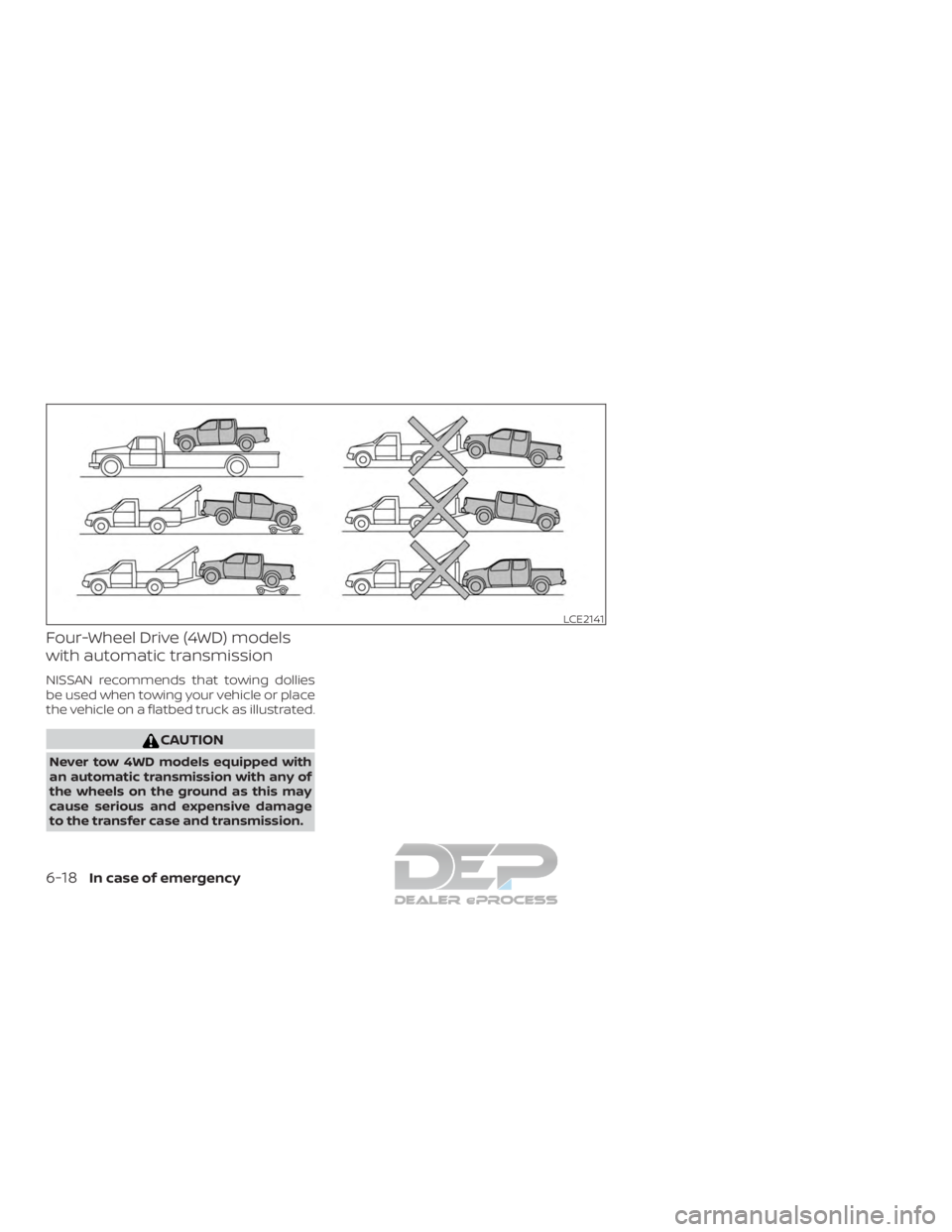
Four-Wheel Drive (4WD) models
with automatic transmission
NISSAN recommends that towing dollies
be used when towing your vehicle or place
the vehicle on a flatbed truck as illustrated.
CAUTION
Never tow 4WD models equipped with
an automatic transmission with any of
the wheels on the ground as this may
cause serious and expensive damage
to the transfer case and transmission.
LCE2141
6-18In case of emergency
Page 444 of 682
Two-Wheel Drive models with
automatic transmission
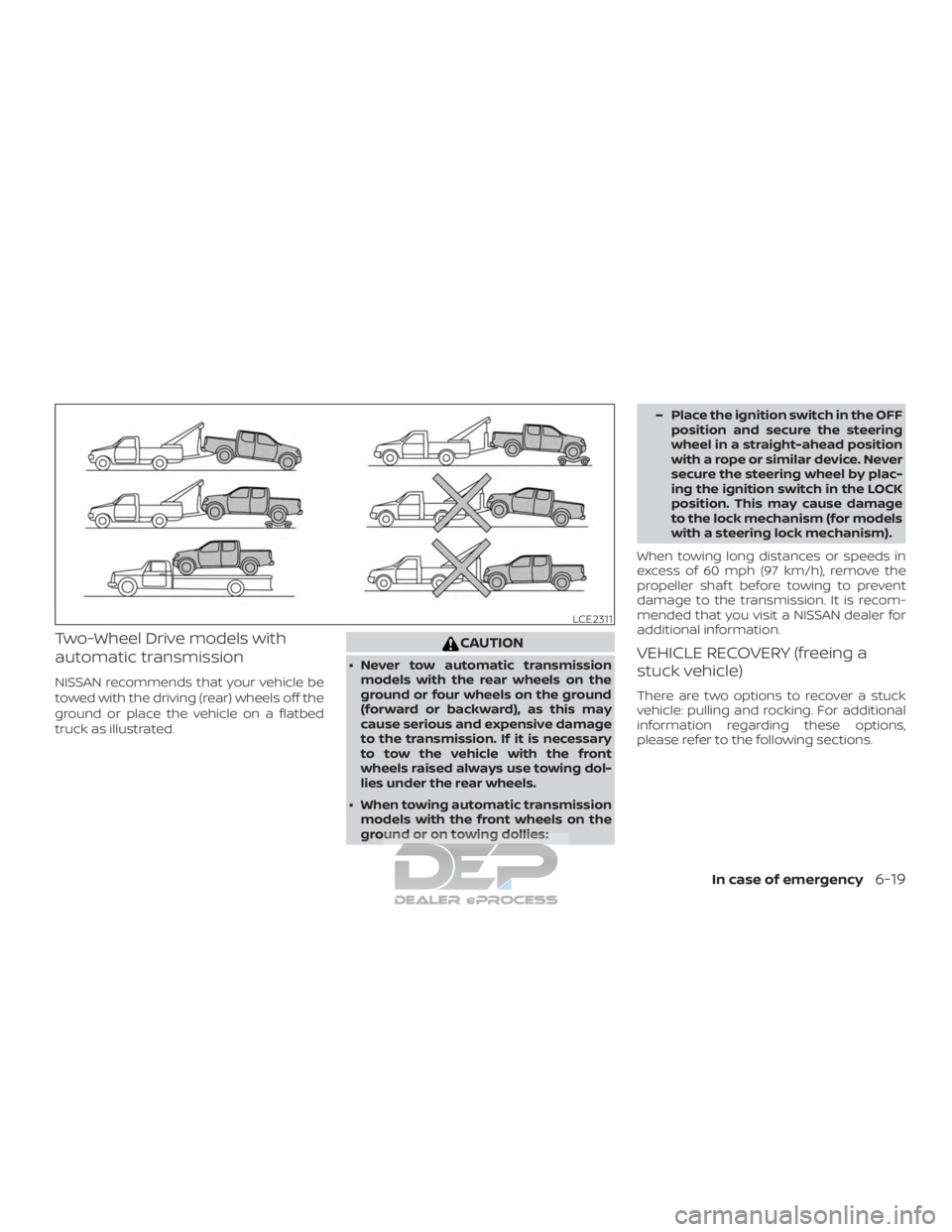
NISSAN recommends that your vehicle be
towed with the driving (rear) wheels off the
ground or place the vehicle on a flatbed
truck as illustrated.
CAUTION
∙ Never tow automatic transmissionmodels with the rear wheels on the
ground or four wheels on the ground
(forward or backward), as this may
cause serious and expensive damage
to the transmission. If it is necessary
to tow the vehicle with the front
wheels raised always use towing dol-
lies under the rear wheels.
∙ When towing automatic transmission models with the front wheels on the
ground or on towing dollies: – Place the ignition switch in the OFF
position and secure the steering
wheel in a straight-ahead position
with a rope or similar device. Never
secure the steering wheel by plac-
ing the ignition switch in the LOCK
position. This may cause damage
to the lock mechanism (for models
with a steering lock mechanism).
When towing long distances or speeds in
excess of 60 mph (97 km/h), remove the
propeller shaf t before towing to prevent
damage to the transmission. It is recom-
mended that you visit a NISSAN dealer for
additional information.VEHICLE RECOVERY (freeing a
stuck vehicle)
There are two options to recover a stuck
vehicle: pulling and rocking. For additional
information regarding these options,
please refer to the following sections.
LCE2311
In case of emergency6-19
Page 445 of 682
Pulling a stuck vehicle
WARNING
To avoid vehicle damage, serious per-
sonal injury or death when recovering a
stuck vehicle:
∙ Contact a professional towing serviceto recover the vehicle if you have any
questions regarding the recovery
procedure.
∙ Attach recovery devices only to main structural members of the vehicle or
the recovery hooks (if so equipped).
∙ Do not use the vehicle tie-downs to tow or free a stuck vehicle.
∙ Only use devices specifically designed for vehicle recovery and follow the
manufacturer’s instructions.
∙ Always pull the recovery device straight out from the front of the ve-
hicle. Never pull at an angle.
∙ Route recovery devices so they do not touch any part of the vehicle except
the attachment point. If your vehicle is stuck in sand, snow, mud,
etc., use a tow strap or other device de-
signed specifically for vehicle recovery. Al-
ways follow the manufacturer’s instruc-
tions for the recovery device.
Rocking a stuck vehicle
WARNING
∙ Stand clear of a stuck vehicle.
∙ Do not spin your tires at high speed.
This could cause them to explode and
result in serious injury. Parts of your
vehicle could also overheat and be
damaged.
If your vehicle is stuck in sand, snow, mud,
etc., use the following procedure: 1. Turn off the Vehicle Dynamic Control (VDC) system.
2. Activate the Electronic Locking Rear Differential (E-Lock) system (if so
equipped). For additional information,
refer to “Electronic Locking Rear Differ-
ential (E-Lock) system” in the “Starting
and driving” section of this manual.
3. Make sure the area in front and behind the vehicle is clear of obstructions. 4. Turn the steering wheel right and lef t to
clear an area around the front tires.
5. Slowly rock the vehicle forward and backward.
∙ Shif t back and forth between R (Re- verse) and D (Drive).
∙ Apply the accelerator as little as pos- sible to maintain the rocking motion.
∙ Release the accelerator pedal before shif ting between R (Reverse) and D
(Drive).
∙ Do not spin the tires above 34 mph (55 km/h) or above 12 mph (20 km/h)
if the E–Lock system (if so equipped)
is engaged.
6. If the vehicle cannot be freed af ter a few tries, contact a professional towing
service to remove the vehicle.
6-20In case of emergency
Page 507 of 682
Engine Oil and Oil Filter:Replace engine
oil and oil filter at the specified intervals. For
recommended oil grade and viscosity refer
to “Recommended fluids/lubricants and
capacities” in the “Technical and consumer
information” section of this manual.
Engine Valve Clearance* (gasoline en-
gine only):
Inspect only if valve noise in-
creases. Adjust valve clearance if necessary.
Evaporative Emissions Control Vapor
Lines* (gasoline engine only): Check va-
por lines for leaks or looseness. Tighten
connections or replace parts as necessary.
Fuel Filter (diesel engine only): Replace
the fuel filter and drain the water at the
specified intervals.
Fuel Lines*: Check the fuel hoses, piping
and connections for leaks, looseness, or
deterioration. Tighten connections or re-
place parts as necessary.
CHASSIS AND BODY
MAINTENANCE:
Brake Lines and Cables: Visually inspect
for proper installation. Check for chafing,
cracks, deterioration, and signs of leaking.
Replace any deteriorated or damaged
parts immediately. Brake Pads and Rotors:
Check for wear,
deterioration and fluid leaks. Replace any
deteriorated or damaged parts immedi-
ately.
Exhaust System: Visually inspect the ex-
haust pipes, muffler and hangers for leaks,
cracks, deterioration, and damage. Tighten
connections or replace parts as necessary.
In-Cabin Microfilter: Replace at specified
intervals. When driving for prolonged peri-
ods in dusty conditions, replace the filter
more frequently.
Propeller Shaf t(s): Check for damage,
looseness, and grease leakage.
(4WD/AWD/RWD).
Steering Gear and Linkage, Axle and Sus-
pension Parts, Drive Shaf t Boots: Check
for damage, looseness, and leakage of oil
or grease. Under severe driving conditions,
inspect more frequently.
Tire Rotation: Tires should be rotated ev-
ery 5,000 miles (8,000 km) according to the
instructions under “General maintenance”
in this section. When rotating tires, check
for damage and uneven wear. Replace if
necessary. Transmission Fluid/Oil, Differential Oil,
Transfer Case Oil:
Visually inspect for signs
of leakage at specified intervals.
Replace automatic transmission fluid at
specified intervals. (For diesel engine models)
If towing a trailer, using a camper or car-top
carrier, or driving on rough or muddy roads:
∙ Replace the differential oil every 20,000 miles (32,000 km) or 24 months.
∙
Replace the automatic transmission fluid
ever 30,000 miles (48,000 km) or
24 months. (For gasoline engine models)
Off-Road Maintenance: Check the follow-
ing items frequently whenever you drive
off-road through deep sand, mud or water:
∙ Brake pads and rotors
∙ Brake lines and hoses
∙ Differential, transmission and transfer case oil
∙ Steering linkage
∙ Propeller shaf t(s) and front drive shaf ts
∙ Engine air filter
∙ Clutch housing drain (4WD only)
9-6Maintenance and schedules
Page 508 of 682

To help ensure smooth, safe and economi-
cal driving, NISSAN provides two mainte-
nance schedules that may be used, de-
pending upon the conditions in which you
usually drive. These schedules contain
both distance and time intervals, up to
120,000 miles (192,000 km)/144 months. For
most people, the odometer reading will in-
dicate when service is needed. However, if
you drive very little, your vehicle should be
serviced at the regular time intervals
shown in the schedule.
Af ter 120,000 miles (192,000 km)/
144 months, continue maintenance at
the same mileage/time intervals.ADDITIONAL MAINTENANCE ITEMS
FOR SEVERE OPERATING
CONDITIONS
Additional maintenance items for severe
operating conditionsshould be per-
formed on vehicles that are driven under
especially demanding conditions. Addi-
tional maintenance items should be per-
formed if you primarily operate your vehicle
under the following conditions:
∙ Repeated short trips of less than 5 miles in normal temperatures or less than
10 miles in freezing temperatures.
∙ Stop-and-go traffic in hot weather or low speed driving for long distances.
∙ Driving in dusty conditions or on rough, muddy or salt-spread roads.
∙ Towing a trailer, or using a camper or car-top carrier.
OIL CHANGE MONITOR (diesel
engine only)
This vehicle is equipped with oil change
monitor. It calculates engine oil and filter
change interval base on driving conditions.
Driving in severe conditions will shorten the
engine oil and filter change interval. When
the Engine Oil – Service Due Now warning
appears in the vehicle information display,
the engine oil and filter need to be replaced.
NOTE:
For vehicles operated in Canada, both
standard and severe maintenance items
should be performed at every interval.
MAINTENANCE SCHEDULES
Maintenance and schedules9-7