2019 NISSAN SENTRA odometer
[x] Cancel search: odometerPage 398 of 461
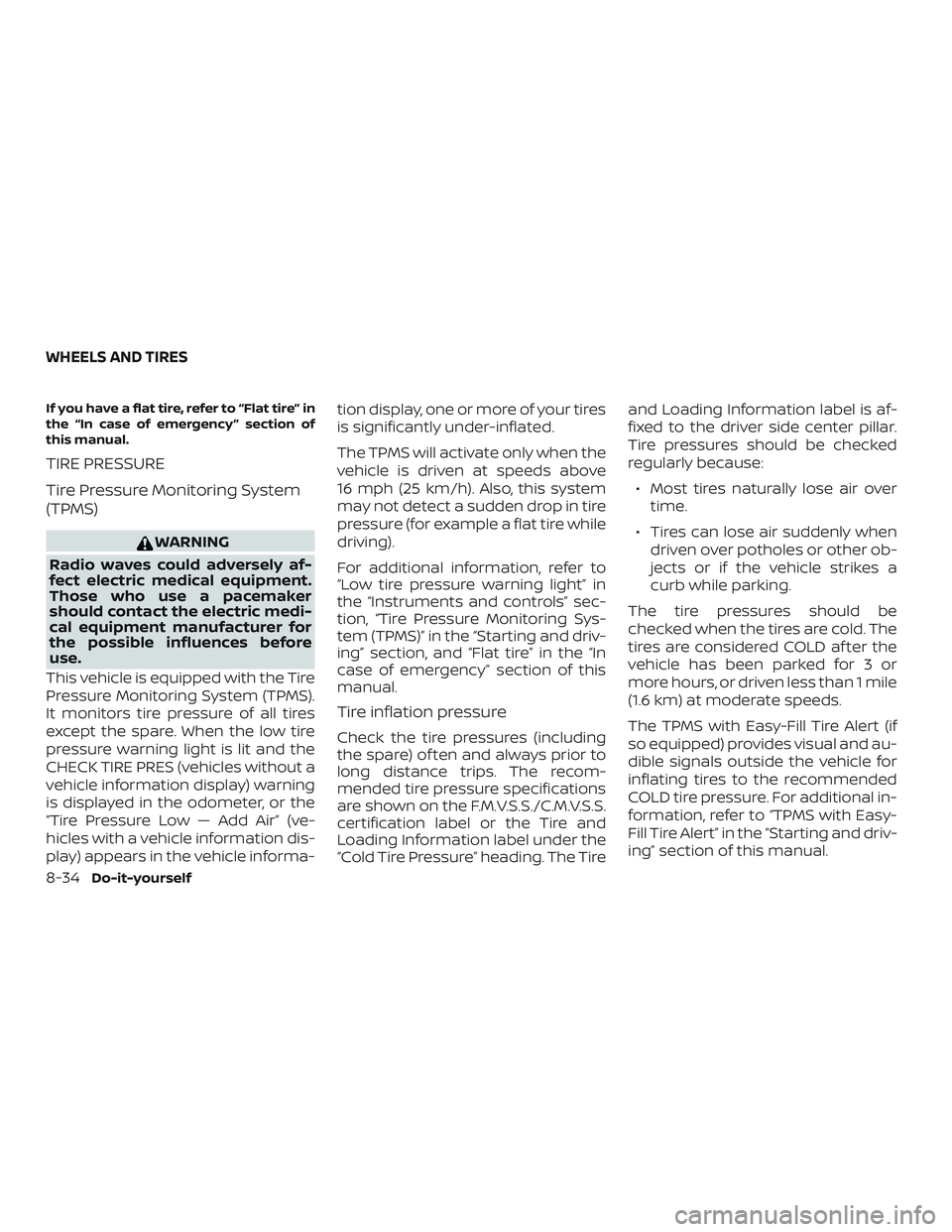
If you have a flat tire, refer to “Flat tire” in
the “In case of emergency ” section of
this manual.
TIRE PRESSURE
Tire Pressure Monitoring System
(TPMS)
WARNING
Radio waves could adversely af-
fect electric medical equipment.
Those who use a pacemaker
should contact the electric medi-
cal equipment manufacturer for
the possible influences before
use.
This vehicle is equipped with the Tire
Pressure Monitoring System (TPMS).
It monitors tire pressure of all tires
except the spare. When the low tire
pressure warning light is lit and the
CHECK TIRE PRES (vehicles without a
vehicle information display) warning
is displayed in the odometer, or the
“Tire Pressure Low — Add Air” (ve-
hicles with a vehicle information dis-
play) appears in the vehicle informa- tion display, one or more of your tires
is significantly under-inflated.
The TPMS will activate only when the
vehicle is driven at speeds above
16 mph (25 km/h). Also, this system
may not detect a sudden drop in tire
pressure (for example a flat tire while
driving).
For additional information, refer to
“Low tire pressure warning light” in
the “Instruments and controls” sec-
tion, “Tire Pressure Monitoring Sys-
tem (TPMS)” in the “Starting and driv-
ing” section, and “Flat tire” in the “In
case of emergency” section of this
manual.
Tire inflation pressure
Check the tire pressures (including
the spare) of ten and always prior to
long distance trips. The recom-
mended tire pressure specifications
are shown on the F.M.V.S.S./C.M.V.S.S.
certification label or the Tire and
Loading Information label under the
“Cold Tire Pressure” heading. The Tireand Loading Information label is af-
fixed to the driver side center pillar.
Tire pressures should be checked
regularly because:
∙ Most tires naturally lose air over time.
∙ Tires can lose air suddenly when driven over potholes or other ob-
jects or if the vehicle strikes a
curb while parking.
The tire pressures should be
checked when the tires are cold. The
tires are considered COLD af ter the
vehicle has been parked for 3 or
more hours, or driven less than 1 mile
(1.6 km) at moderate speeds.
The TPMS with Easy-Fill Tire Alert (if
so equipped) provides visual and au-
dible signals outside the vehicle for
inflating tires to the recommended
COLD tire pressure. For additional in-
formation, refer to “TPMS with Easy-
Fill Tire Alert” in the “Starting and driv-
ing” section of this manual.
WHEELS AND TIRES
8-34Do-it-yourself
Page 417 of 461
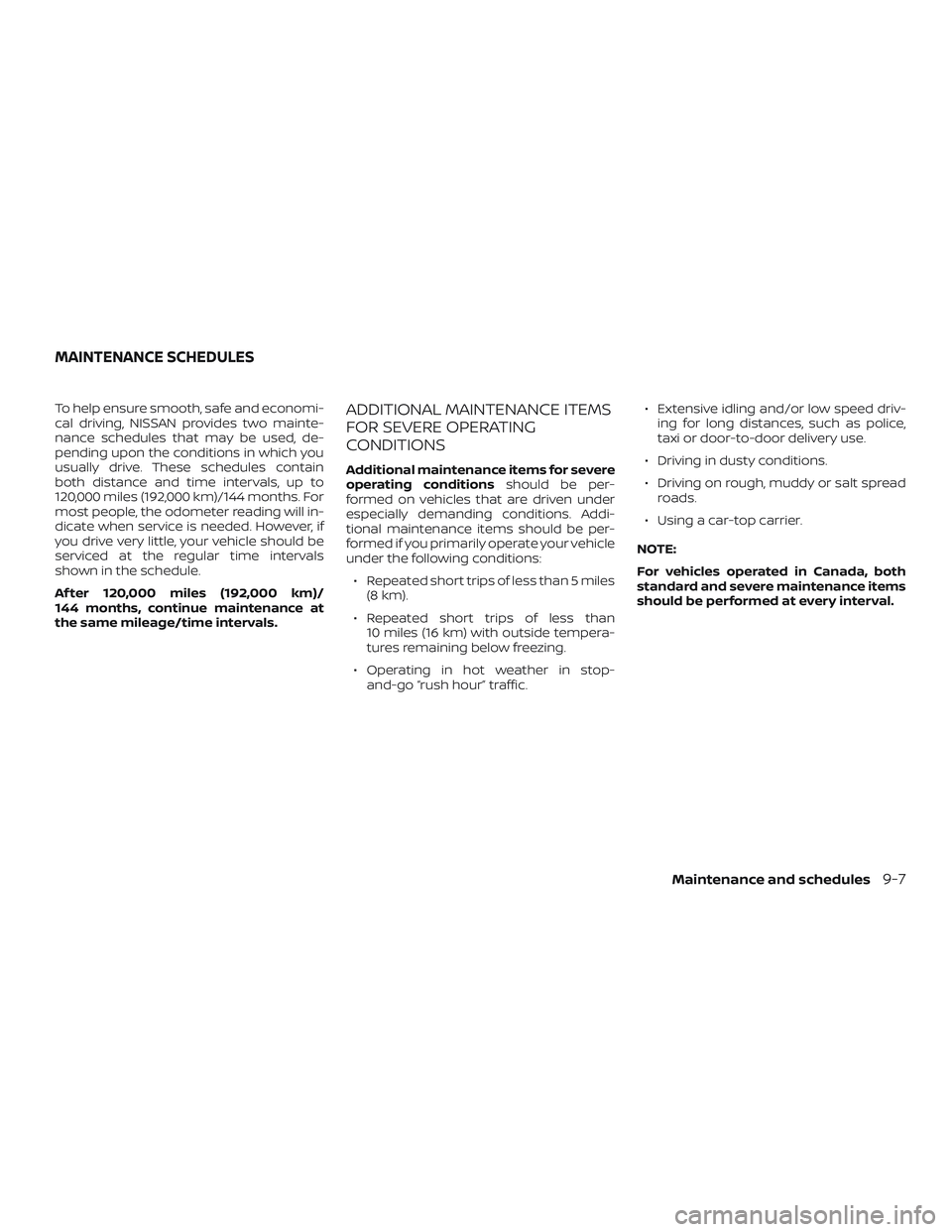
To help ensure smooth, safe and economi-
cal driving, NISSAN provides two mainte-
nance schedules that may be used, de-
pending upon the conditions in which you
usually drive. These schedules contain
both distance and time intervals, up to
120,000 miles (192,000 km)/144 months. For
most people, the odometer reading will in-
dicate when service is needed. However, if
you drive very little, your vehicle should be
serviced at the regular time intervals
shown in the schedule.
Af ter 120,000 miles (192,000 km)/
144 months, continue maintenance at
the same mileage/time intervals.ADDITIONAL MAINTENANCE ITEMS
FOR SEVERE OPERATING
CONDITIONS
Additional maintenance items for severe
operating conditionsshould be per-
formed on vehicles that are driven under
especially demanding conditions. Addi-
tional maintenance items should be per-
formed if you primarily operate your vehicle
under the following conditions:
∙ Repeated short trips of less than 5 miles (8 km).
∙ Repeated short trips of less than 10 miles (16 km) with outside tempera-
tures remaining below freezing.
∙ Operating in hot weather in stop- and-go “rush hour” traffic. ∙ Extensive idling and/or low speed driv-
ing for long distances, such as police,
taxi or door-to-door delivery use.
∙ Driving in dusty conditions.
∙ Driving on rough, muddy or salt spread roads.
∙ Using a car-top carrier.
NOTE:
For vehicles operated in Canada, both
standard and severe maintenance items
should be performed at every interval.
MAINTENANCE SCHEDULES
Maintenance and schedules9-7
Page 451 of 461
Engine oil viscosity.............10-7
Engine serial number ..........10-12
Engine specifications ...........10-9
Starting the engine ............5-14
Engine Block Heater .............5-78
Engine coolant temperature gauge .....2-7
EventDatarecorders............10-22
Exhaust gas (Carbon monoxide) .......5-2
Explanation of maintenance items .....9-2
Explanation of scheduled maintenance
items .......................9-5
Extended storage switch ..........8-25
Eyeglasscase .................2-53
F
Flashers
(See hazard warning flasher switch) ....6-2
Flattire....................6-3,6-3
Floormatpositioningaid...........7-7
Fluid Brakefluid..................8-12
Capacities and recommended
fuel/lubricants...............10-2
Clutchfluid.................8-12
Continuously Variable Transmission
(CVT) fluid ..................8-11
Engine coolant ...............8-5
Engine oil ...................8-7
F.M.V.S.S. certification label .........10-12
Foglightswitch................2-45
Front air bag system
(See supplemental restraint system) . . .1-50
Front-door pocket ..............2-49
Front power seat adjustment ........1-5Frontseats....................1-2
Fuel
Capacities and recommended
fuel/lubricants...............10-2
Fuel economy ...............5-70
Fuel-filler cap ................3-28
Fuel-filler door lock opener lever ....3-27
Fuel-filler lid .................3-28
Fuel gauge ..................2-8
Fueloctanerating.............10-6
Fuel recommendation ..........10-4
Loose fuel cap warning .......2-6,2-33
Fuel efficient driving tips ...........5-68
Fuel-filler door .................3-27
Fuel gauge ....................2-8
Fuses .......................8-22
Fusiblelinks...................8-23
G
Garage door opener, HomeLink® Universal
Transceiver . .2-62, 2-63, 2-64, 2-65, 2-65, 2-66
Gascap.....................3-28
Gauge Engine coolant temperature gauge. . .2-7
Fuel gauge ..................2-8
Odometer ..................2-5
Speedometer ..............2-4,2-5
Tachometer .................2-7
Trip computer ................2-9
Trip odometer .............2-4,2-5
General maintenance .............9-2
Glovebox....................2-52 H
Hands-free phone system, Bluetooth® . .4-54
Hazardwarningflasherswitch........6-2
Headlight and turn signal switch ......2-40
Headlightcontrolswitch...........2-40
Headlights ...................8-29
Headrestraints..................1-7
Heatedseats..................2-46
Heated seat switches ............2-46
Heater Heater and air conditioner (automatic)
(if so equipped) ..............4-28
Heater and air conditioner controls . .4-21,
4-29
Heater and air conditioner
(manual) ...................4-20
Heater operation ....4-15,4-17,4-22,4-30
Heater and air conditioner (automatic) . .4-28
HomeLink® Universal Transceiver . .2-62, 2-63, 2-64, 2-65, 2-65, 2-66
Hood .......................
3-25
Horn...................... .2-46
I
Ignition switch ..................5-9
Push-button ignition switch .......5-11
Immobilizer system ........2-37,5-10,5-14
Important vehicle information label . . .10-12
In-cabinmicrofilter ..............8-19
Increasing fuel economy ...........5-70
Indicator NISSAN Intelligent Key® battery
discharge indicator ............5-13
11-3
Page 453 of 461
Seat belt maintenance..........1-20
Under the hood and vehicle .......9-4
Maintenance log ................9-13
Maintenance requirements ..........9-2
Maintenance schedules ............9-7
Maintenance under severe operation
conditions....................9-12
Malfunctionindicatorlight..........2-21
Manual front seat adjustment ........1-3
Maplights....................2-60
Map pocket ...................2-49
Menu button ...................4-5
Meters and gauges ...............2-3
Instrument brightness control .....2-44
Mirror Automatic anti-glare inside mirror . . .3-31
Outsidemirrorcontrol..........3-32
Outsidemirrors..............3-32
Rearview...................3-31
Vanitymirror................3-31
Mirrors......................3-31
Moonroof .................2-58,2-58
N
NissanConnect® Owner's Manual ......4-2
NISSAN Intelligent Key® ..........3-2,3-11
NISSAN Intelligent Key® battery discharge
indicator.....................5-13
NISSAN Vehicle Immobilizer
System ...............2-37,5-10,5-14 O
Octane rating (See fuel octane rating) . .10-6
Odometer ....................2-5
Oil Capacities and recommended
fuel/lubricants...............10-2
Changing engine oil ............8-8
Changing engine oil filter .........8-10
Checking engine oil level .........8-7
Engine oil ...................8-7
Engine oil and oil filter
recommendation .............10-7
Engine oil viscosity .............10-7
Outsidemirrorcontrol............3-32
Outsidemirrors................3-32
Overhead sunglasses holder ........2-53
Overheat Ifyourvehicleoverheats.........6-11
Owner's manual order form ........10-22
Owner's manual/service manual order
information..................10-22
P
Parking Parking/parkingonhills.........5-70
Parkingbrake .................5-25
Phone, Bluetooth® hands-free system . .4-54
Power Power door locks ..............3-6
Poweroutlet................2-48
Powerrearwindows...........2-56
Power steering system ..........5-71
Powerwindows..............2-55 Rearpowerwindows...........2-56
Poweroutlet..................2-48
Powersteering.................5-71
Precautions Maintenance precautions .........8-2
Precautions on booster
seats............1-23, 1-29, 1-35, 1-40
Precautions on child
restraints.........1-23, 1-29, 1-35, 1-40
Precautionsonseatbeltusage.....1-12
Precautions on supplemental
restraintsystem..............1-43
Precautions when starting and
driving .....................5-2
Programmable features ............4-5
Push starting ..................6-11
R
Radio Car phone or CB radio ..........4-54
FM/AMradio................4-36
Steering wheel audio control
switch....................4-49
Readiness for inspection maintenance
(I/M) test ....................10-21
RearCrossTrafficAlert(RCTA)........5-37
Rearpowerwindows.............2-56
Rearseat.................... .1-6
Rearviewmirror ................3-31
RearViewMonitor................4-8
Rear window and outside mirror
d
efrosterswitch................2-40
Recommended Fluids ............10-2
11-5
Page 455 of 461
Headlight and turn signal switch....2-40
Headlightcontrolswitch.........2-40
Ignition switch ................5-9
Instrument brightness control .....2-44
Power door lock switch ..........3-6
Rear window and outside mirror
defrosterswitch..............2-40
Turn signal switch .............2-44
T
Tachometer ...................2-7
Temperature gauge Engine coolant temperature gauge. . .2-7
Thef t (NISSAN Vehicle Immobilizer System),
engine start.............2-37,5-10,5-14
Three-waycatalyst...............5-2
Tilt Telescopicsteering............3-30
Tire Flattire..................6-3,6-3
Spare tire ...............6-4,8-45
Tire and Loading Information label . .10-13
Tire chains .................8-41
Tire pressure ................8-34
Tirerotation ................8-42
Types of tires ................8-40
Uniform tire quality grading ......10-19
Wheels and tires ..............8-34
Wheel/tire size ...............10-10
Tire pressure Low tire pressure warning light .....2-16
Tire Pressure Monitoring System
(TPMS)....................2-6,5-3 Towing
2-wheel drive models ...........6-14
4-wheel drive models ...........6-13
Flattowing.................10-18
Trailertowing...............10-18
Towingatrailer................10-18
Towingyourvehicle..............6-12
Transceiver HomeLink® Universal Transceiver . . .2-62, 2-63, 2-64, 2-65, 2-65, 2-66
Transmission Continuously Variable Transmission
(CVT) fluid ..................8-11
Driving with Continuously Variable
Transmission (CVT) ..........5-9,5-17
Driving with manual
transmission .............5-10,5-23
Travel (See registering a vehicle in
another country) ...............10-11
Trip computer ..................2-9
Trip odometer ...............2-4,2-5
Trunk access through the rear seat ....3-27
Trunklid.....................3-26
Trunk lid lock opener lever ..........3-26
Trunklight....................2-62
Turn signal switch ...............2-44
U
Uniform tire quality grading ........10-19
USBinterface..................4-40 V
Vanitymirror..................3-31
Variablevoltagecontrolsystem......8-16
Vehicle dimensions and weights .....10-10
Vehicle Dynamic Control (VDC) OFF
switch......................2-47
Vehicle Dynamic Control (VDC) system . .5-74
Vehicle identification .............10-11
Vehicle identification number (VIN) . . . .10-11
Vehicle identification number (VIN)
(Chassis number) ...............10-11
Vehicle identification number (VIN)
plate.......................10-11
Vehicle immobilizer system . . .2-37, 5-10, 5-14
Vehicleinformationdisplay........ .2-24
Vehicle loading information ........10-14
Vehiclerecovery................6-14
Vehicle security system ........2-35,2-35
Vehicle security system
(NISSAN Vehicle Immobilizer System),
engine start.............2-37,5-10,5-14
Vents.......................4-15
Visors ......................3-30
Voice Prompt Interrupt ........4-57,4-58
W
Warning Airbagwarninglight........1-62, 2-19
Anti-lock brake warning light ......2-14
Battery charge warning light ......2-15
Brakewarninglight............2-14
Door
open warning light .........2-15
Engine oil pressure warning light ....2-15
11-7