Page 9 of 372
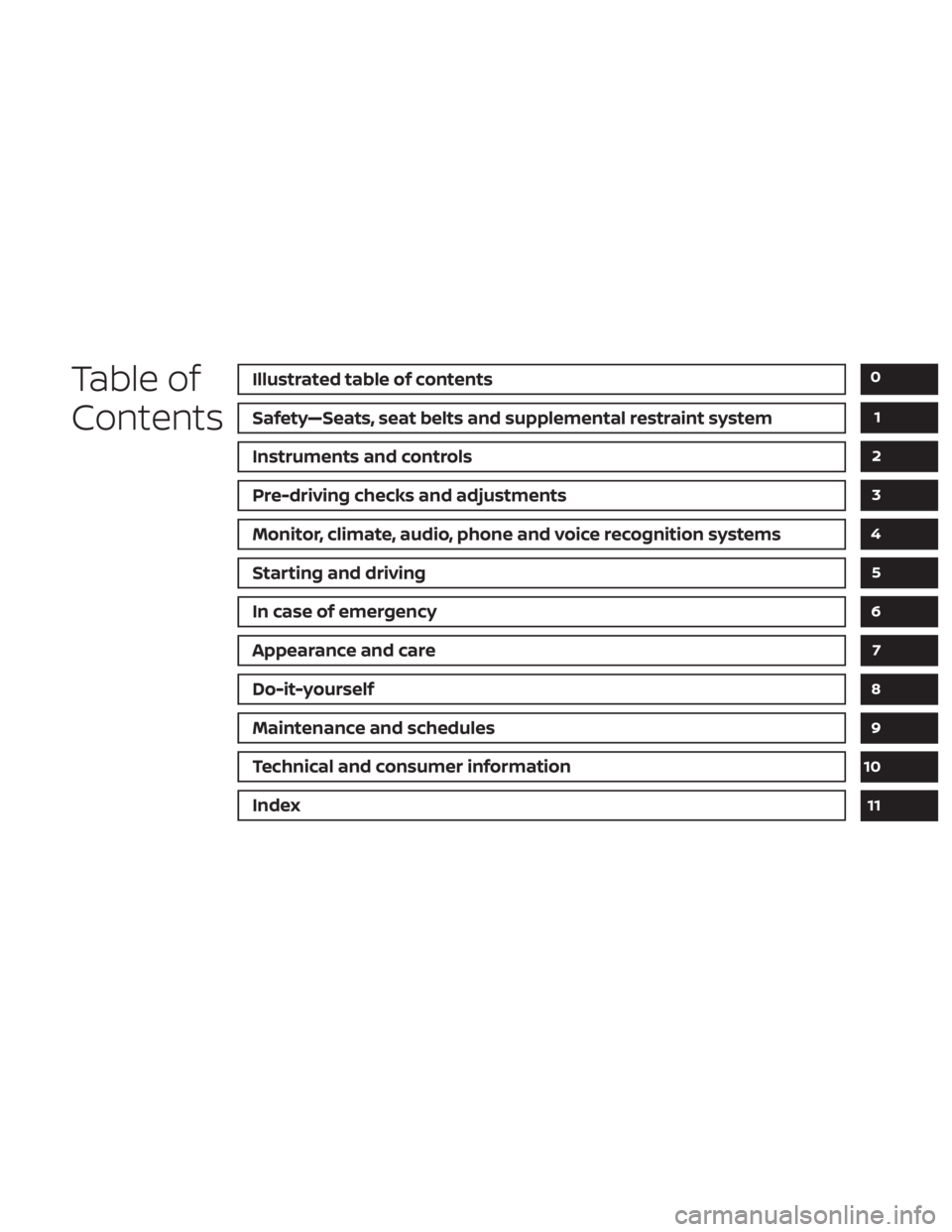
Safety„Seats, seat belts and supplemental restraint system
Instruments and controls
Pre-driving checks and adjustments
Monitor, climate, audio, phone and voice recognition systems
Starting and driving
In case of emergency
Appearance and care
Do-it-yourself
Maintenance and schedules
Technical and consumer information
Index
0
1
2
3
4
5
6
7
8
9
10
11
Page 87 of 372
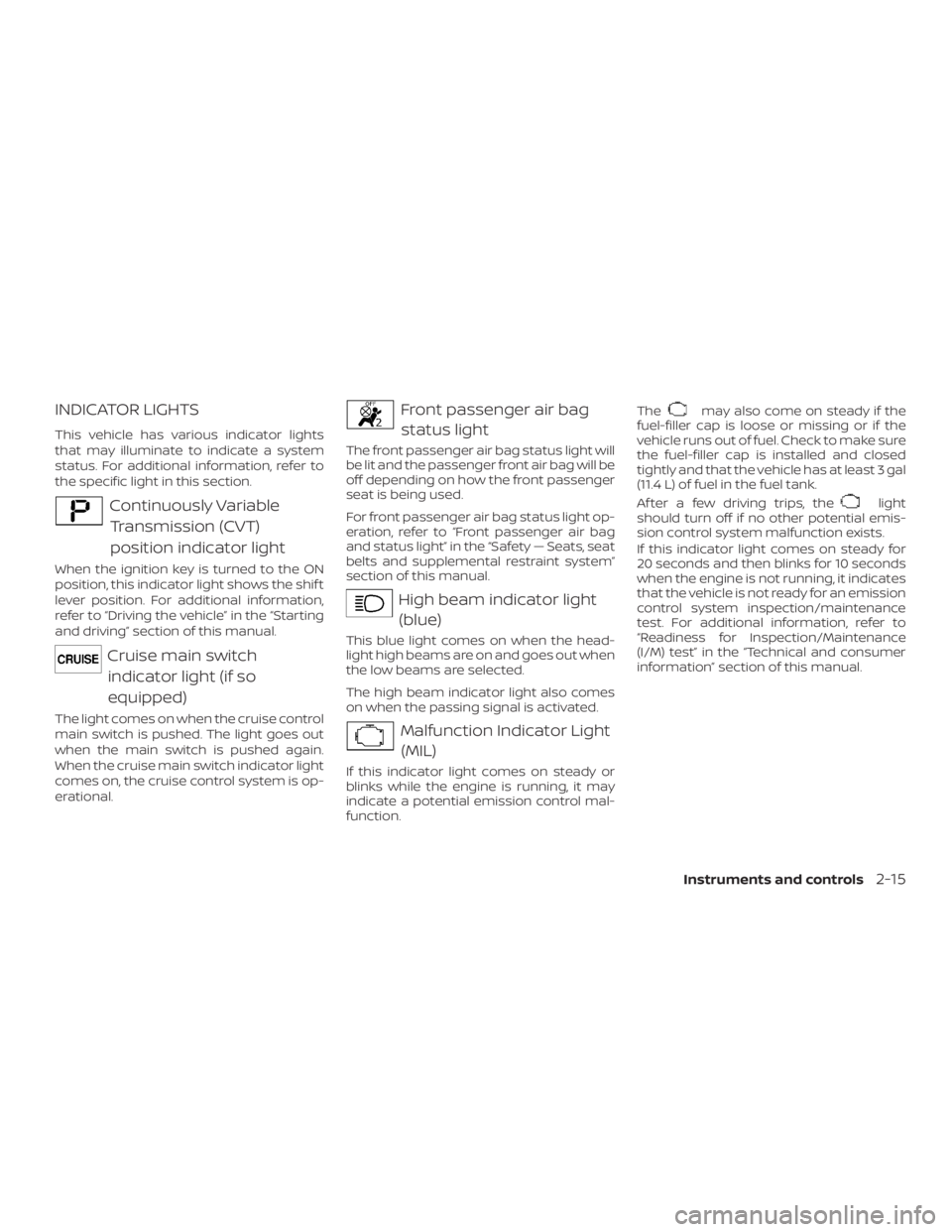
Continuously Variable
Transmission (CVT)
position indicator light
When the ignition key is turned to the ON
position, this indicator light shows the shif t
lever position. For additional information,
refer to the vehicleŽ in the
and drivingŽ section of this manual.
Cruise main switch
indicator light (if so
equipped)
The light comes on when the cruise control
main switch is pushed. The light goes out
when the main switch is pushed again.
When the cruise main switch indicator light
comes on, the cruise control system is op-
erational.
Front passenger air bag
status light
The front passenger air bag status light will
be lit and the passenger front air bag will be
off depending on how the front passenger
seat is being used.
For front passenger air bag status light op-
eration, refer to passenger air bag
and status lightŽ in the „ Seats, seat
belts and supplemental restraint systemŽ
section of this manual.
High beam indicator light
(blue)
This blue light comes on when the head-
light high beams are on and goes out when
the low beams are selected.
The high beam indicator light also comes
on when the passing signal is activated.
Malfunction Indicator Light
(MIL)
If this indicator light comes on steady or
blinks while the engine is running, it may
indicate a potential emission control mal-
function.The
may also come on steady if the
fuel-filler cap is loose or missing or if the
vehicle runs out of fuel. Check to make sure
the fuel-filler cap is installed and closed
tightly and that the vehicle has at least 3 gal
(11.4 L) of fuel in the fuel tank.
Af ter a few driving trips, the
light
should turn off if no other potential emis-
sion control system malfunction exists.
If this indicator light comes on steady for
20 seconds and then blinks for 10 seconds
when the engine is not running, it indicates
that the vehicle is not ready for an emission
control system inspection/maintenance
test. For additional information, refer to
for Inspection/Maintenance
(I/M) testŽ in the and consumer
informationŽ section of this manual.
Instruments and controls2-15
Page 127 of 372

button.................4-7
button..................................4-9
How to use the ON€OFF button/VOL
(volume) control knob........................4-9
How to use the CAMERA button..............4-9
RearView Monitor..............................4-10
RearView Monitor system operation..........4-11
How to read the displayed lines..............4-12
Difference between predicted and
actual distances.............................4-12
How to park with predicted course
lines (if so equipped).........................4-14
Adjusting the screen........................4-15
How to turn on and off predicted
course lines (models with Navigation
System).....................................4-16
RearView Monitor system limitations........4-16
System maintenance........................4-18
Vents...........................................4-18Heater and air conditioner (manual)............4-19
Controls.....................................4-20
Heater operation............................4-21
Air conditioner operation....................4-22
Air flow charts...............................4-23
Servicing air conditioner........................4-27
Audio system...................................4-27
Radio........................................4-27
FM radio reception..........................4-27
AM radio reception..........................4-28
Satellite radio reception (if so equipped).....4-28
Audio operation precautions................4-29
FM/AM radio with compact disc (CD)
player (if so equipped).......................4-37
FM/AM/SAT radio with compact disc
(CD) player (if so equipped)..................4-42
USB (Universal Serial Bus) Connection
Port (models without Navigation
System) (if so equipped).....................4-49
USB (Universal Serial Bus) Connection
Port (models with Navigation System)
(if so equipped)..............................4-51
Page 280 of 372
CAUTION
� Do not work under the hood while the
engine is hot. Turn the engine off and
wait until it cools down.
� Avoid contact with used engine oil
and coolant. Improperly disposed en-
gine oil, engine coolant and/or other
vehicle fluids can damage the envi-
ronment. Always conform to local
regulations for disposal of vehicle
fluid.
� Never leave the engine or the Con-
tinuously Variable Transmission (CVT)
related component harness connec-
tor disconnected while the ignition
switch is in the ON position.
� Never connect or disconnect the bat-
tery or any transistorized component
while the ignition switch is in the ON
position.
� DO NOT power wash any interior por-
tion of this vehicle to help minimize
liquid intrusion and potential elec-
tronic component damage.
This “Do-it-yourself ” section gives instruc-
tions regarding only those items which are
relatively easy for an owner to perform.
MAINTENANCE PRECAUTIONS
8-2Do-it-yourself
Page 285 of 372
CAUTION
Oil level should be checked regularly.
Operating the engine with an insuffi-
cient amount of oil can damage the en-
gine, and such damage is not covered
by warranty.
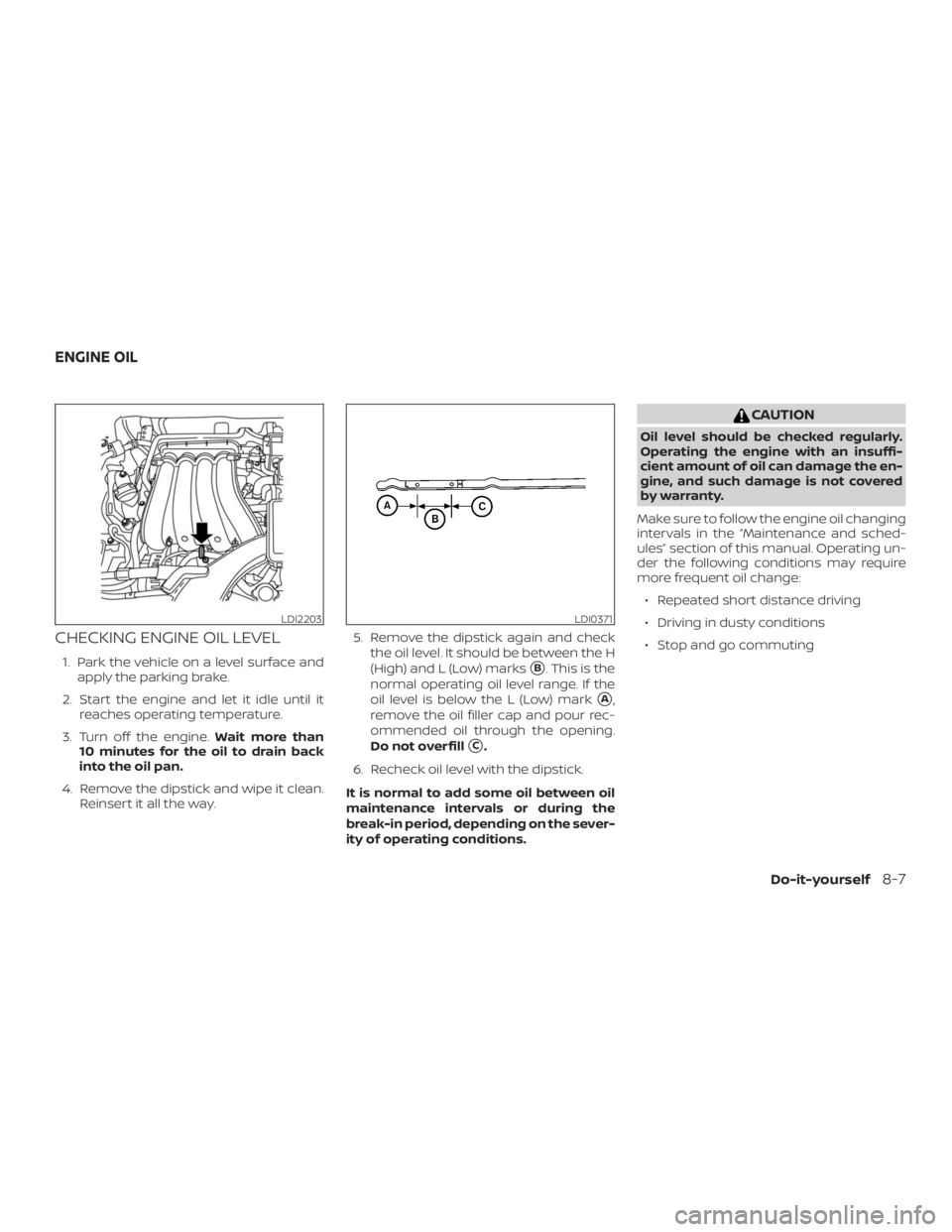
Make sure to follow the engine oil changing
intervals in the “Maintenance and sched-
ules” section of this manual. Operating un-
der the following conditions may require
more frequent oil change:
∙ Repeated short distance driving
∙ Driving in dusty conditions
∙ Stop and go commuting
LDI2203LDI0371
ENGINE OIL
Do-it-yourself8-7
Page 294 of 372

CAUTION
Be sure to use the correct socket to re-
move the spark plugs. An incorrect
socket can damage the spark plugs.
If replacement is required, it is recom-
mended that you visit a NISSAN dealer for
this service.
The air cleaner filter should not be cleaned
and reused. Replace it according to the
maintenance log shown in the “Mainte-
nance and schedules” section of this
manual.
To remove the air cleaner filter:
1. Push in the tabs
�1and move the air
cleaner cover upward.
2. Remove the air cleaner filter.
3. Wipe the inside of the air cleaner filter
housing and the cover with a damp
cloth.NOTE:
Af ter installing a new air cleaner, make
sure the air cleaner cover is seated in the
housing and latch the clips.
WARNING
∙ Operating the engine with the air
cleaner removed can cause you or
others to be burned. The air cleaner
not only cleans the air, it stops the
flame if the engine backfires. If it isn’t
there, and the engine backfires, you
could be burned. Do not drive with the
air cleaner removed, and be careful
when working on the engine with the
air cleaner removed.
∙ Never pour fuel into the throttle body
or attempt to start the engine with
the air cleaner removed. Doing so
could result in serious injury.
Page 330 of 372
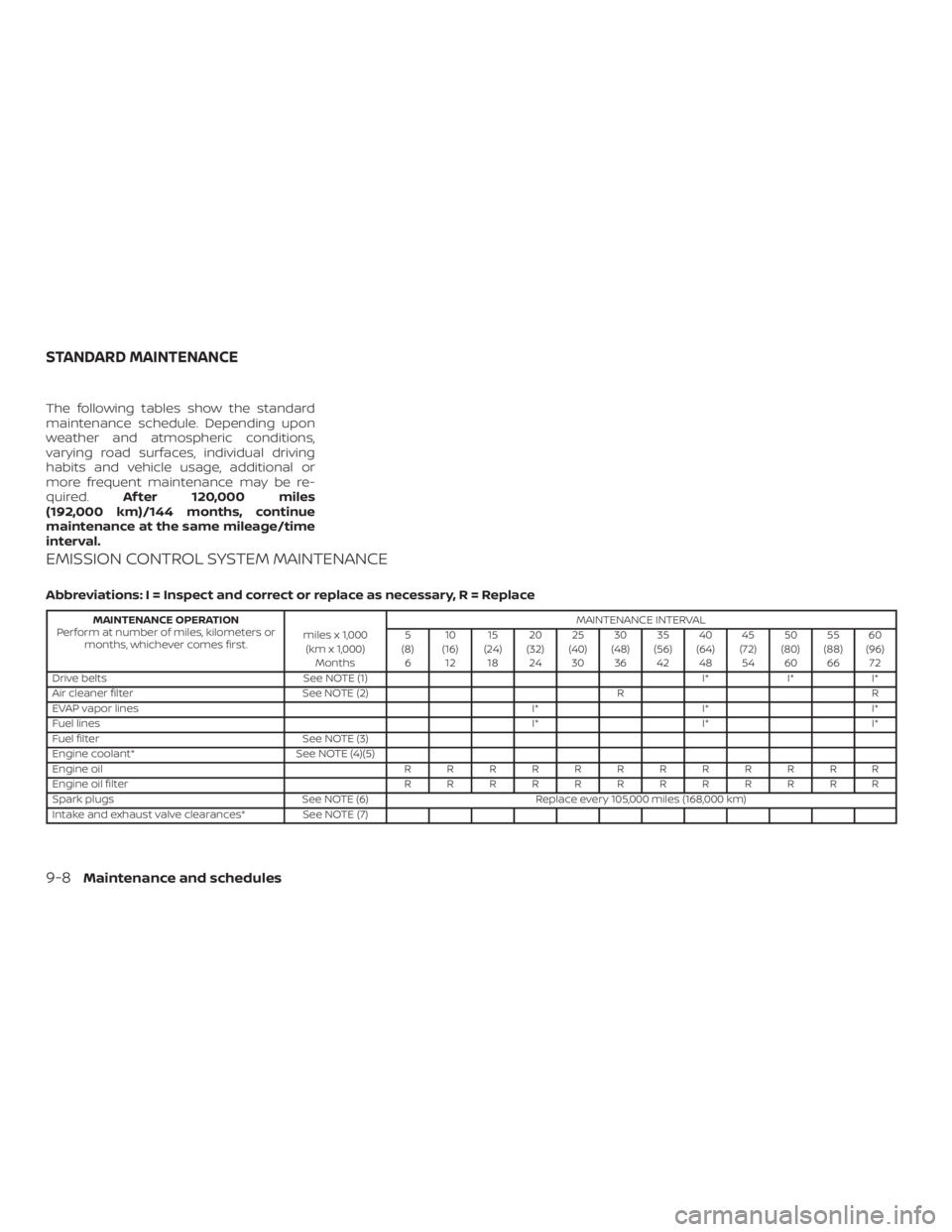
MAINTENANCE OPERATION
Perform at number of miles, kilometers or
months, whichever comes first.miles x 1,000
(km x 1,000)
MonthsMAINTENANCE INTERVAL
5
(8)
610
(16)
1215
(24)
1820
(32)
2425
(40)
3030
(48)
3635
(56)
4240
(64)
4845
(72)
5450
(80)
6055
(88)
6660
(96)
72
Drive belts See NOTE (1) I* I* I*
Air cleaner filter See NOTE (2) R R
EVAP vapor linesI* I* I*
Fuel linesI* I* I*
Fuel filter See NOTE (3)
Engine coolant* See NOTE (4)(5)
Engine oilRRRRRRRRRRRR
Engine oil filterRRRRRRRRRRRR
Spark plugs See NOTE (6) Replace every 105,000 miles (168,000 km)
Intake and exhaust valve clearances* See NOTE (7)
STANDARD MAINTENANCE
9-8Maintenance and schedules
Page 332 of 372
MAINTENANCE OPERATION
Perform at number of miles, kilometers or months,
whichever comes first.miles x 1,000
(km x 1,000)
MonthsMAINTENANCE INTERVAL
5
(8)
610
(16)
1215
(24)
1820
(32)
2425
(40)
3030
(48)
3635
(56)
4240
(64)
4845
(72)
5450
(80)
6055
(88)
6660
(96)
72
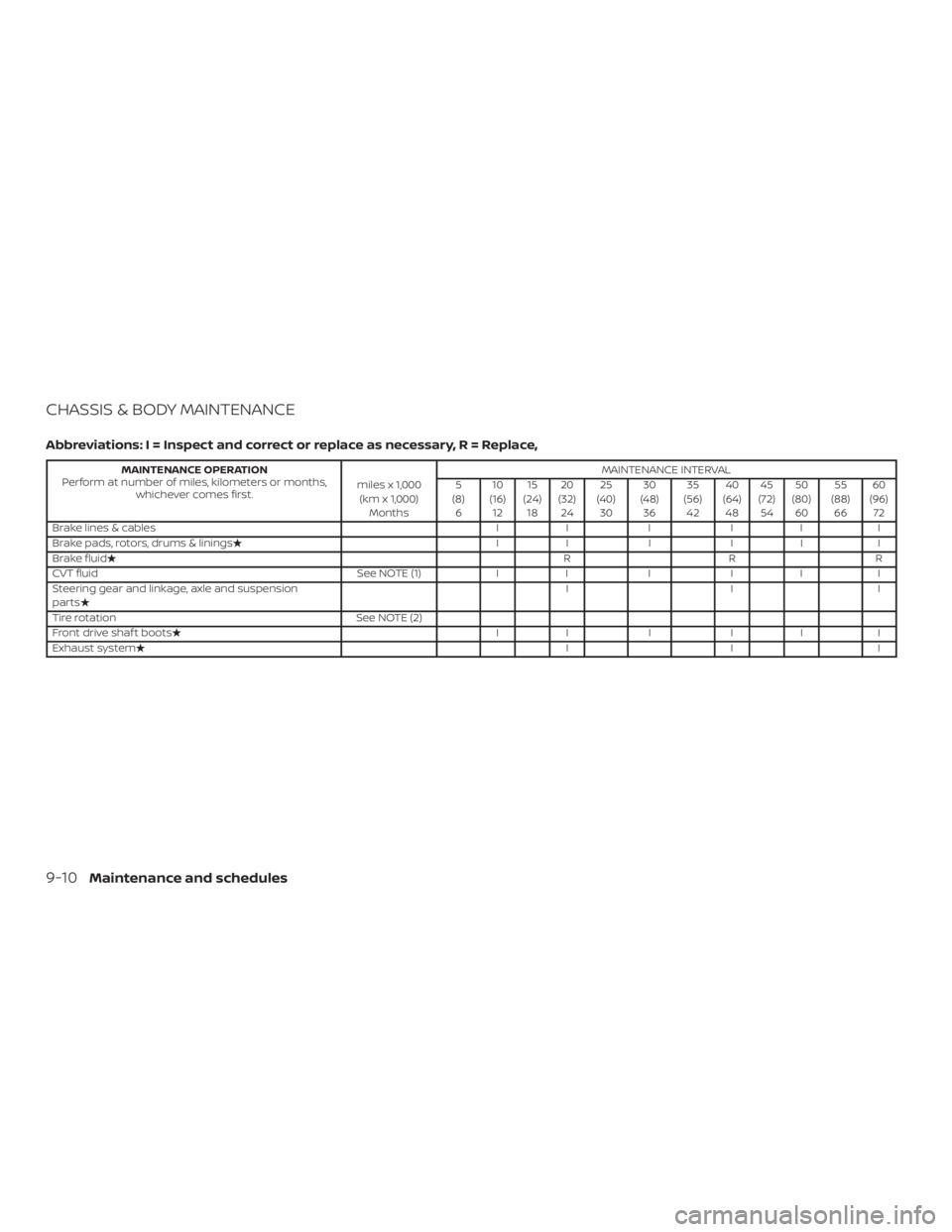
Brake lines & cables I I I I I I
Brake pads, rotors, drums & linings�II I II I
Brake fluid�RRR
CVT fluid See NOTE (1) I I I I I I
Steering gear and linkage, axle and suspension
parts�III
Tire rotation See NOTE (2)
Front drive shaf t boots�II I II I
Exhaust system�III
9-10Maintenance and schedules