2019 NISSAN KICKS headrest
[x] Cancel search: headrestPage 135 of 444
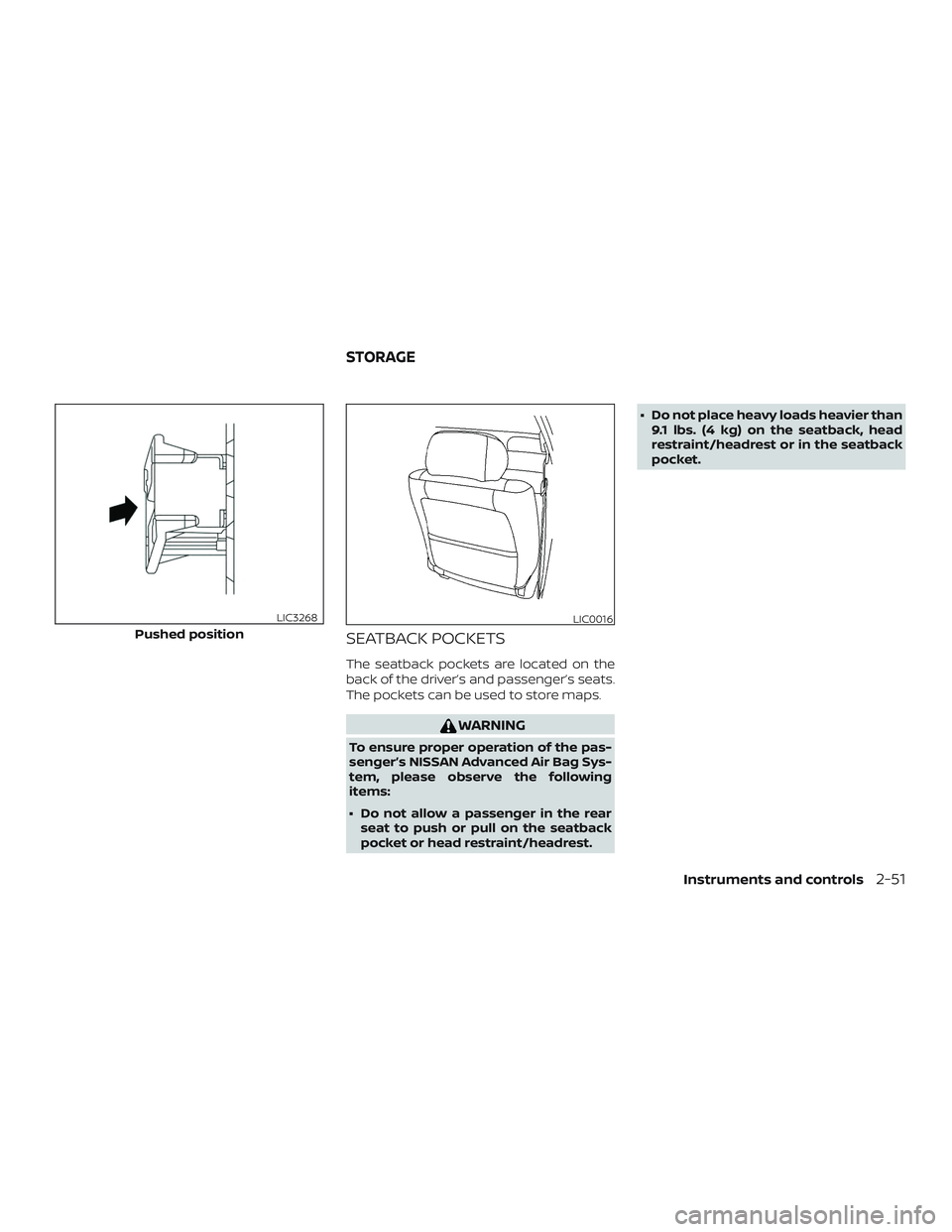
SEATBACK POCKETS
The seatback pockets are located on the
back of the driver’s and passenger’s seats.
The pockets can be used to store maps.
WARNING
To ensure proper operation of the pas-
senger’s NISSAN Advanced Air Bag Sys-
tem, please observe the following
items:
∙ Do not allow a passenger in the rearseat to push or pull on the seatback
pocket or head restraint/headrest. ∙ Do not place heavy loads heavier than
9.1 lbs. (4 kg) on the seatback, head
restraint/headrest or in the seatback
pocket.
Pushed position
LIC3268LIC0016
STORAGE
Instruments and controls2-51
Page 280 of 444
∙ Make sure the area around the vehicle isclear.
∙ Check fluid levels such as engine oil, coolant, brake fluid, and windshield-
washer fluid as frequently as possible,
or at least whenever you refuel.
∙ Check that all windows and lights are clean.
∙ Visually inspect tires for their appear- ance and condition. Also check tires for
proper inflation.
∙ Lock all doors.
∙ Position seat and adjust headrests/head restraints.
∙ Adjust inside and outside mirrors.
∙ Fasten seat belts and ask all passen- gers to do likewise.
∙ Check the operation of warning lights when the ignition switch is pushed to
the ON position. For additional informa-
tion, refer to “Warning lights, indicator
lights and audible reminders” in the “In-
struments and controls” section of this
manual. 1. Apply the parking brake.
2. Move the shif t lever to P (Park) or N
(Neutral). P (Park) is recommended.
The shif t lever cannot be moved out
of P (Park) and into any of the other
gear positions if the ignition switch
is placed in the OFF position.
The starter is designed not to oper-
ate if the shif t lever is in any of the
driving positions.
3. Push the ignition switch to the ON po- sition. Depress the brake pedal and
push the ignition switch to start the
engine.
To start the engine immediately, push
and release the ignition switch while
depressing the brake pedal with the
ignition switch in any position.
∙ If the engine is very hard to start in extremely cold weather or when re-
starting, depress the accelerator
pedal a little (approximately 1/3 to the
floor) and while holding, crank the en-
gine. Release the accelerator pedal
when the engine starts. ∙ If the engine is very hard to start be-
cause it is flooded, depress the accel-
erator pedal all the way to the floor
and hold it. Push the ignition switch
to the ON position to start cranking
the engine. Af ter 5 or 6 seconds, stop
cranking by pushing the ignition
switch to LOCK. Af ter cranking the
engine, release the accelerator pedal.
Crank the engine with your foot off
the accelerator pedal by depressing
the brake pedal and pushing the igni-
tion switch to start the engine. If the
engine starts, but fails to run, repeat
the above procedure.
CAUTION
Do not operate the starter for more
than 15 seconds at a time. If the engine
does not start, push the ignition switch
to the OFF position and wait 10 seconds
before cranking again, otherwise the
starter could be damaged.
BEFORE STARTING THE ENGINE STARTING THE ENGINE
5-14Starting and driving
Page 394 of 444
brake needs adjustment, it is recom-
mended that you visit a NISSAN dealer for
this service.
Seats:Check seat position controls such
as seat adjusters, seatback recliner, etc., to
ensure they operate smoothly and all
latches lock securely in every position.
Check that the head restraints/headrests
move up and down smoothly and the locks
(if so equipped) hold securely in all latched
positions.
Seat belts: Check that all parts of the seat
belt system (for example, buckles, anchors,
adjusters and retractors) operate properly
and smoothly, and are installed securely.
Check the belt webbing for cuts, fraying,
wear or damage.
Steering wheel: Check for changes in the
steering system, such as excessive free
play, hard steering or strange noises.
Warning lights and chimes: Make sure all
warning lights and chimes are operating
properly.
Windshield defroster: Check that the air
comes out of the defroster outlets properly
and in sufficient quantity when operating
the heater or air conditioner. Windshield wiper and washer*:
Check
that the wipers and washer operate prop-
erly and that the wipers do not streak.
Under the hood and vehicle
The maintenance items listed here should
be checked periodically (for example, each
time you check the engine oil or refuel).
Battery*:This vehicle is equipped with a
sealed maintenance free battery. It is rec-
ommended that you visit a NISSAN dealer
for service.
NOTE:
Care should be taken to avoid situations
that can lead to potential battery dis-
charge and potential no-start conditions
such as:
1. Installation or extended use of elec-
tronic accessories that consume bat-
tery power when the engine is not
running (Phone chargers, GPS, DVD
players, etc.).
2. Vehicle is not driven regularly and/or
only driven short distances.
In these cases, the battery may need to
be charged to maintain battery health. Brake fluid level*:
Make sure that the brake
fluid level is between the MIN and MAX lines
on the reservoir.
Engine coolant level*: Check the coolant
level when the engine is cold.
Engine drive belt*: Make sure the drive belt
is not frayed, worn, cracked or oily.
Engine oil level*: Check the level af ter
parking the vehicle on a level surface with
the engine off. Wait more than 15 minutes
for the oil to drain back into the oil pan.
Exhaust system: Make sure there are no
loose supports, cracks or holes. If the
sound of the exhaust seems unusual or
there is a smell of exhaust fumes, immedi-
ately have the exhaust system inspected. It
is recommended that you visit a NISSAN
dealer for this service. For additional infor-
mation, refer to “Exhaust gas (carbon mon-
oxide)” in the “Starting and driving” section
of this manual.
Fluid leaks: Check under the vehicle for
fuel, oil, water or other fluid leaks af ter the
vehicle has been parked for a while. Water
dripping from the air conditioner af ter use
is normal. If you should notice any leaks or if
fuel fumes are evident, check for the cause
and have it corrected immediately.
9-4Maintenance and schedules
Page 431 of 444
Extended storage switch..........2-50
F
Flashers
(See hazard warning flasher switch) ....6-2
Flattire....................6-3,6-4
Floormatpositioningaid...........7-5
Fluid Brakefluid..................8-9
Capacities and recommended
fuel/lubricants...............10-2
Continuously Variable Transmission (CVT)
fluid......................8-9
Engine coolant ...............8-4
Engine oil ...................8-5
F.M.V.S.S. certification label ..........10-11
Foglightswitch................2-46
Front air bag system
(See supplemental restraint system) . . .1-53
Frontseats................... .1-2
Fuel Capacities and recommended
fuel/lubricants...............10-2
Fuel economy ...............5-51
Fuel-filler door lock opener lever ....3-24
Fuel gauge ..................2-8
Fueloctanerating.............10-5
Fuel recommendation ..........10-3
Fuelefficientdrivingtips...........5-50
Fuel-filler door .................3-24
Fuel gauge ....................2-8
Fuses .......................8-18
Fusiblelinks...................8-19 G
Gauge Fuel gauge ..................2-8
Odometer ..................2-6
Speedometer ..............2-5,2-6
Tachometer .................2-7
Trip odometer .............2-5,2-6
General maintenance .............9-2
Glovebox....................2-53
Grocery hooks .................2-55
H
Hands-free phone system, Bluetooth® . .4-67
Hazard warning flasher switch ........6-2
Headlight and turn signal switch ......2-42
Headlightcontrolswitch...........2-42
Headlights ...................8-23
Headrestraints ................ .1-5
Heated seat switches .............2-47
Heater Heater and air conditioner .......4-39
Heater and air conditioner (manual) . .4-31
Heater operation ..........4-33,4-41
Hill start assist system ............5-60
Hood ...................... .3-21
Hook Luggage hook ...............2-54
Horn.......................2-47 I
Ignition switch Push-button ignition switch .......5-9
Immobilizer system ...........2-37, 5-13
Important vehicle information label . . . .10-11
In-cabinmicrofilter ..............8-15
Increasing fuel economy ...........5-51
Indicator NISSAN Intelligent Key® battery discharge
indicator...................5-12
Indicator lights and audible reminders
(See warning/indicator lights and audible
reminders) ....................2-18
Informationdisplay..............2-22
Instrument brightness control .......2-45
Instrument panel .............0-6,2-2
Instrument panel dimmer switch .....2-45
Integrated Dynamics-control Module . . .5-59
Intelligent Around View Monitor ......4-15
Intelligent Engine Brake (I-EB) ........5-59
Intelligent Key system Key operating range ............3-8
Mechanic
al key...............3-3
Remote keyless entry operation ....3-12
Troubleshooting guide ..........3-16
Warning signals ..............3-16
Intelligent Trace Control (I-TC) ........5-59
Interiorlight...................2-63
iPod®Player...................4-55
ISOFIX child restraints .............1-23
J
Jumpstarting...............6-9,8-12
11-3