2019 NISSAN KICKS TPMS
[x] Cancel search: TPMSPage 379 of 444
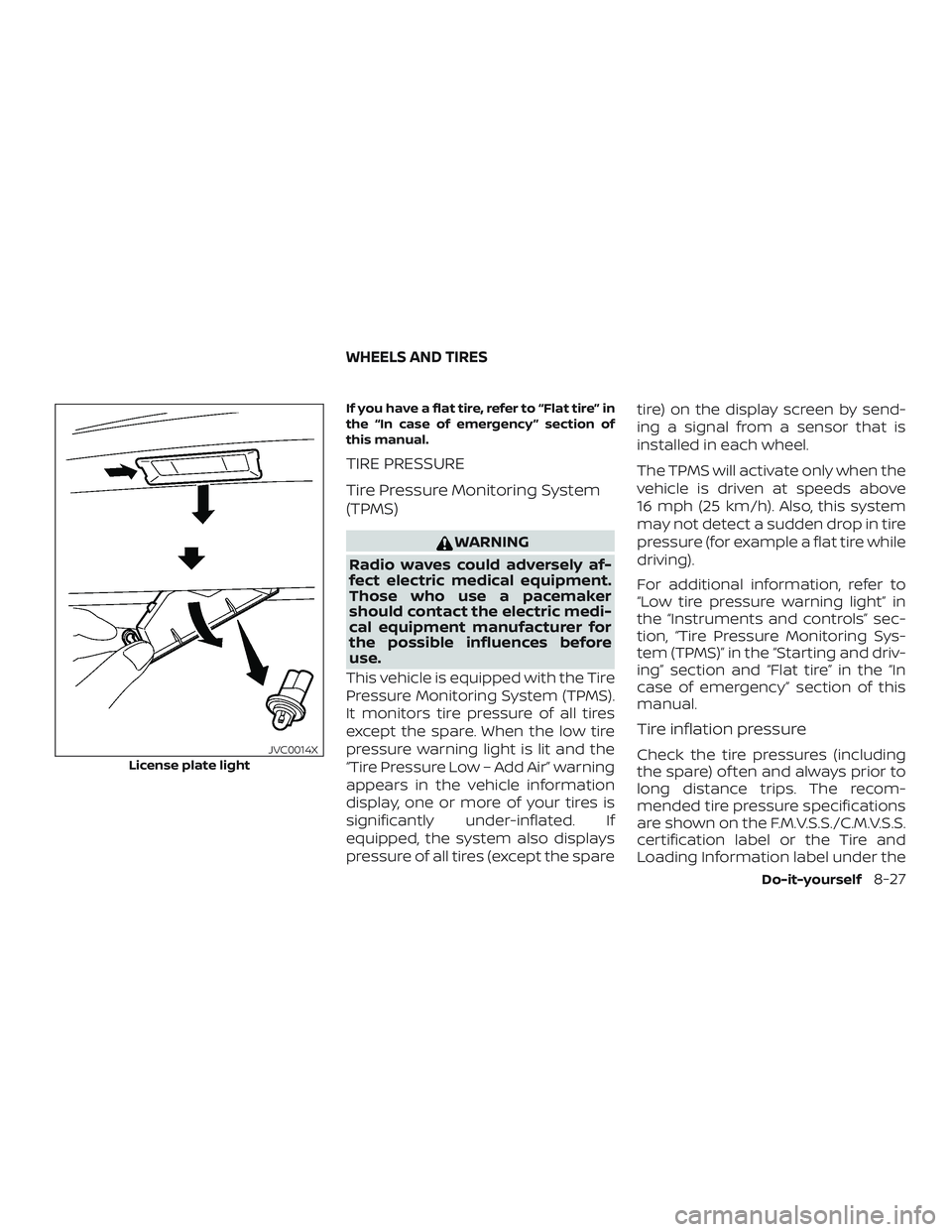
If you have a flat tire, refer to “Flat tire” in
the “In case of emergency ” section of
this manual.
TIRE PRESSURE
Tire Pressure Monitoring System
(TPMS)
WARNING
Radio waves could adversely af-
fect electric medical equipment.
Those who use a pacemaker
should contact the electric medi-
cal equipment manufacturer for
the possible influences before
use.
This vehicle is equipped with the Tire
Pressure Monitoring System (TPMS).
It monitors tire pressure of all tires
except the spare. When the low tire
pressure warning light is lit and the
“Tire Pressure Low – Add Air” warning
appears in the vehicle information
display, one or more of your tires is
significantly under-inflated. If
equipped, the system also displays
pressure of all tires (except the spare tire) on the display screen by send-
ing a signal from a sensor that is
installed in each wheel.
The TPMS will activate only when the
vehicle is driven at speeds above
16 mph (25 km/h). Also, this system
may not detect a sudden drop in tire
pressure (for example a flat tire while
driving).
For additional information, refer to
“Low tire pressure warning light” in
the “Instruments and controls” sec-
tion, “Tire Pressure Monitoring Sys-
tem (TPMS)” in the “Starting and driv-
ing” section and “Flat tire” in the “In
case of emergency” section of this
manual.
Tire inflation pressure
Check the tire pressures (including
the spare) of ten and always prior to
long distance trips. The recom-
mended tire pressure specifications
are shown on the F.M.V.S.S./C.M.V.S.S.
certification label or the Tire and
Loading Information label under theLicense plate light
JVC0014X
WHEELS AND TIRES
Do-it-yourself8-27
Page 380 of 444
“Cold Tire Pressure” heading. The Tire
and Loading Information label is af-
fixed to the driver side center pillar.
Tire pressures should be checked
regularly because:∙ Most tires naturally lose air over time.
∙ Tires can lose air suddenly when driven over potholes or other ob-
jects or if the vehicle strikes a
curb while parking.
The tire pressures should be
checked when the tires are cold. The
tires are considered COLD af ter the
vehicle has been parked for 3 or
more hours, or driven less than 1 mile
(1.6 km) at moderate speeds.
The TPMS with Easy-Fill Tire Alert
provides visual and audible signals
outside the vehicle for inflating tires
to the recommended COLD tire
pressure. For additional information,
refer to “TPMS with Easy-Fill Tire
Alert” in the “Starting and driving”
section of this manual. Incorrect tire pressure, including
under inflation, may adversely af-
fect tire life and vehicle handling.
WARNING
∙ Improperly inflated tires can fail suddenly and cause an
accident.
∙ The Gross Vehicle Weight Rating (GVWR) is located on the
F.M.V.S.S./C.M.V.S.S. certifica-
tion label. The vehicle weight
capacity is indicated on the Tire
and Loading Information label.
Do not load your vehicle beyond
this capacity. Overloading your
vehicle may result in reduced
tire life, unsafe operating condi-
tions due to premature tire fail-
ure, or unfavorable handling
characteristics and could also
lead to a serious accident. Load-
ing beyond the specified capac-
ity may also result in failure of
other vehicle components. ∙ Before taking a long trip, or
whenever you heavily load your
vehicle, use a tire pressure
gauge to ensure that the tire
pressures are at the specified
level.
∙ For additional information re- garding tires, refer to “Impor-
tant Tire Safety Information”
(US) or “Tire Safety Information”
(Canada) in the Warranty Infor-
mation Booklet.
8-28
Do-it-yourself
Page 389 of 444
∙ When replacing a wheel without theTPMS such as the spare tire, the TPMS
will not function and the low tire pres-
sure warning light will flash for ap-
proximately 1 minute. The light will re-
main on af ter 1 minute. Have your
tires replaced and/or TPMS system
reset as soon as possible. It is recom-
mended that you visit a NISSAN dealer
for this service.
∙ Replacing tires with those not origi- nally specified by NISSAN could affect
the proper operation of the TPMS.
∙ The TPMS sensor may be damaged if it is not handled correctly. Be careful
when handling the TPMS sensor.
∙ When replacing the TPMS sensor, the ID registration may be required. It is
recommended that you visit a NISSAN
dealer for ID registration.
∙ Do not use a valve stem cap that is not specified by NISSAN. The valve stem
cap may become stuck.
∙ Be sure that the valve stem caps are correctly fitted. Otherwise the valve
may be clogged up with dirt and
cause a malfunction or loss of
pressure. ∙ Do not install a damaged or deformed
wheel or tire even if it has been re-
paired. Such wheels or tires could
have structural damage and could fail
without warning.
∙ The use of retread tires is not recommended.
∙ For additional information regarding tires, refer to “Important Tire Safety
Information” (US) or “Tire Safety Infor-
mation” (Canada) in the Warranty In-
formation Booklet.
Wheel balance
Unbalanced wheels may affect vehicle
handling and tire life. Even with regular use,
wheels can get out of balance. Therefore,
they should be balanced as required.
Wheel balance service should be per-
formed with the wheels off the vehicle.
Spin balancing the wheels on the vehicle
could lead to mechanical damage.
Care of wheels
∙ Wash the wheels when washing the ve- hicle to maintain their appearance.
∙ Clean the inner side of the wheels when the wheel is changed or the underside
of the vehicle is washed.
∙ Do not use abrasive cleaners when washing the wheels.
∙ Inspect wheel rims regularly for dents or corrosion. Such damage may cause
loss of pressure or poor seal at the tire
bead.
∙ NISSAN recommends waxing the road wheels to protect against road salt in
areas where it is used during winter.
Do-it-yourself8-37
Page 390 of 444
Spare tire (TEMPORARY USE ONLY
spare tire)
When replacing a wheel without the TPMS
such as the spare tire, the TPMS will not
function.
Observe the following precautions if the
TEMPORARY USE ONLY spare tire must be
used. Otherwise, your vehicle could be
damaged or involved in an accident:
WARNING
∙ The spare tire should be used foremergency use only. It should be re-
placed with the standard tire at the
first opportunity to avoid possible tire
or differential damage.
∙ Drive carefully while the TEMPORARY USE ONLY spare tire is installed. Avoid
sharp turns and abrupt braking while
driving.
∙ Periodically check spare tire inflation pressure. Always keep the pressure of
the TEMPORARY USE ONLY spare tire
at 420 kPa, 4.2 bar (60 psi). ∙ With the TEMPORARY USE ONLY spare
tire installed do not drive the vehicle
at speeds faster than 50 mph
(80 km/h).
∙ When driving on roads covered with snow or ice, the TEMPORARY USE
ONLY spare tire should be used on the
rear wheels and the original tire used
on the front wheels (drive wheels).
∙ Tire tread of the TEMPORARY USE ONLY spare tire will wear at a faster
rate than the standard tire. Replace
the spare tire as soon as the tread
wear indicators appear.
∙ Do not use the spare tire on other vehicles.
∙ Do not use more than one spare tire at the same time.
∙ Do not tow a trailer when the TEMPO- RARY USE ONLY spare tire is installed.
CAUTION
∙ Do not use tire chains on a TEMPO-RARY USE ONLY spare tire. Tire chains
will not fit properly and may cause
damage to the vehicle.
∙ Because the TEMPORARY USE ONLY spare tire is smaller than the original
tire, ground clearance is reduced. To
avoid damage to the vehicle, do not
drive over obstacles. Also, do not drive
the vehicle through an automatic car
wash since it may get caught.
8-38Do-it-yourself
Page 393 of 444
Doors and engine hood:Check that the
doors and engine hood operate properly.
Also ensure that all latches lock securely.
Lubricate hinges, latches, latch pins, rollers
and links if necessary. Make sure that the
secondary latch keeps the hood from
opening when the primary latch is re-
leased.
When driving in areas using road salt or
other corrosive materials, check lubrica-
tion frequently.
Lights*: Clean the headlights on a regular
basis. Make sure that the headlights, stop
lights, tail lights, turn signal lights, and other
lights are all operating properly and in-
stalled securely. Also check headlight aim.
Road wheel nuts (lug nuts)*: When check-
ing the tires, make sure no wheel nuts are
missing, and check for any loose wheel
nuts. Tighten if necessary.
Tire rotation*: Tires should be rotated ev-
ery 5,000 miles (8,000 km).
Tires*: Check the pressure with a gauge
of ten and always prior to long distance
trips. If necessary, adjust the pressure in all
tires, including the spare, to the pressure
specified. Check carefully for damage, cuts
or excessive wear. Tire Pressure Monitoring System (TPMS)
transmitter components:
Replace the
TPMS transmitter grommet seal, valve core
and cap when the tires are replaced due to
wear or age.
Wheel alignment and balance: If the ve-
hicle should pull to either side while driving
on a straight and level road, or if you detect
uneven or abnormal tire wear, there may
be a need for wheel alignment. If the steer-
ing wheel or seat vibrates at normal high-
way speeds, wheel balancing may be
needed.
For additional information regarding tires,
refer to “Important Tire Safety Information”
(US) or “Tire Safety Information” (Canada) in
the Warranty Information Booklet.
Windshield: Clean the windshield on a
regular basis. Check the windshield at least
every six months for cracks or other dam-
age. Have a damaged windshield repaired
by a qualified repair facility.
Windshield wiper blades*: Check for
cracks or wear if they do not wipe properly.
Inside the vehicle
The maintenance items listed here should
be checked on a regular basis, such as when performing scheduled maintenance,
cleaning the vehicle, etc.
Accelerator pedal:
Check the pedal for
smooth operation and make sure the
pedal does not catch or require uneven
effort. Keep the floor mat away from the
pedal.
Brake pedal: Check the pedal for smooth
operation. If the brake pedal suddenly goes
down further than normal, the pedal feels
spongy or the vehicle seems to take longer
to stop, have your vehicle checked imme-
diately. It is recommended that you visit a
NISSAN dealer for this service. Keep the
floor mat away from the pedal.
Brakes: Check that the brakes do not pull
the vehicle to one side when applied.
Continuously Variable Transmission
(CVT) P (Park) position mechanism: On a
fairly steep hill check that the vehicle is held
securely with the shif t lever in the P (Park)
position without applying any brakes.
Parking brake: Check the parking brake
operation regularly. The vehicle should be
securely held on a fairly steep hill with only
the parking brake applied. If the parking
Maintenance and schedules9-3
Page 434 of 444
Seat belt extenders............1-17
Seat belt maintenance ..........1-17
Seatbelts................1-10, 7-6
Shoulder belt height adjustment . . . .1-16
Three-pointtypewithretractor.....1-13
Seat belt extenders ..............1-17
Seatbeltwarninglight .........1-13, 2-17
Seats Adjustment ..................1-2
Frontseats..................1-2
Manual front seat adjustment ......1-3
Rearseat.................. .1-4
Security indicator light ............2-20
Security system (NISSAN Anti-Thef t System),
engine start ................2-37,5-13
Security system (NISSAN Vehicle Immobilizer
System), engine start ..........2-37,5-13
Security systems Vehicle security system .........2-35
Self-adjustingbrakes.............8-17
Service manual order form .........10-21
Servicing air conditioner ...........4-42
Shif ting Continuously Variable Transmission
(CVT) .....................5-17
Shoulder belt height adjustment ......1-16
Side air bag system (See supplemental
side air bag, curtain and rollover air bag
systems) .................... .1-59
Siri® Eyes-Free .................4-64
Spark plug replacement ...........8-14
Spark plugs ...................8-14
Specifications .................10-8
Speedometer ................2-5,2-6
SRS warning label ...............1-63
Stability control ................5-56 Standard maintenance
............9-8
Starting Before starting the engine ........5-14
Jumpstarting.............6-9,8-12
Precautions when starting and
driving.....................5-2
Push starting ................6-11
Starting the engine ............5-14
Starting the engine ..............5-14
Steering Powersteeringsystem..........5-53
Steering wheel .................3-26
Steering wheel audio control switch . . .4-62
Stoplight....................8-25
Storage .....................2-51
Storagetray ..................2-52
Sunvisors....................3-27
Supplemental air bag warning labels . . .1-63
Supplemental air bag warning
light.................... .1-63, 2-17
Supplemental front impact air bag
system ..................... .1-53
Supplemental restraint system Information and warning labels . . . .1-63
Precautions on supplemental restraint
system ................... .1-42
Supplemental restraint system
(Supplemental air bag system) .......1-42
Switch Autolightswitch..............2-43
Automatic power window switch . . .2-61
Foglightswitch..............2-46
Hazard warning flasher switch ......6-2
Headlight and turn signal switch ....2-42
Headlightcontrolswitch.........2-42
Instrument brightness control .....2-45Power door lock switch
........3-5 , 3-6
Rear window and outside mirror
defrosterswitch...........2-41,4-41
Rear window defroster switch . .2-41, 4-33
Rear window wiper and washer
switches ...................2-40
Turn signal switch .............2-46
T
Tachometer ...................2-7
Thef t (NISSAN Anti-Thef t System), engine
start ....................2-37,5-13
Thef t (NISSAN Vehicle Immobilizer System),
engine start ................2-37,5-13
Three-waycatalyst...............5-3
Tire Flattire..................6-3,6-4
Spare tire ...............6-5,8-38
Tire and Loading Information label . .10-12
Tire chains .................8-34
Tire pressure ................8-27
Tirerotation ................8-35
Types of tires ................8-33
Uniform tire quality grading ......10-18
Wheels and tires ...........8-27,10-9
Wheel/tire size ...............10-9
Tire pressure Low tire pressure warning light .....2-14
Tire Pressure Monitoring System (TPMS) . .5-3
Toptetherstrapchildrestraint.......1-25
Towing 4-wheel drive models ...........6-13
Flattowing.................10-17
Trailertowing ...............10-17
11-6