2019 NISSAN KICKS remote control
[x] Cancel search: remote controlPage 220 of 444
NOTE:∙ Odors from inside and outside the ve-
hicle can build up in the air condi-
tioner unit. Odor can enter the pas-
senger compartment through the
vents.
∙ When parking, set the heater and air
conditioner controls to turn off air re-
circulation to allow fresh air into the
passenger compartment. This should
help reduce odors inside the vehicle.
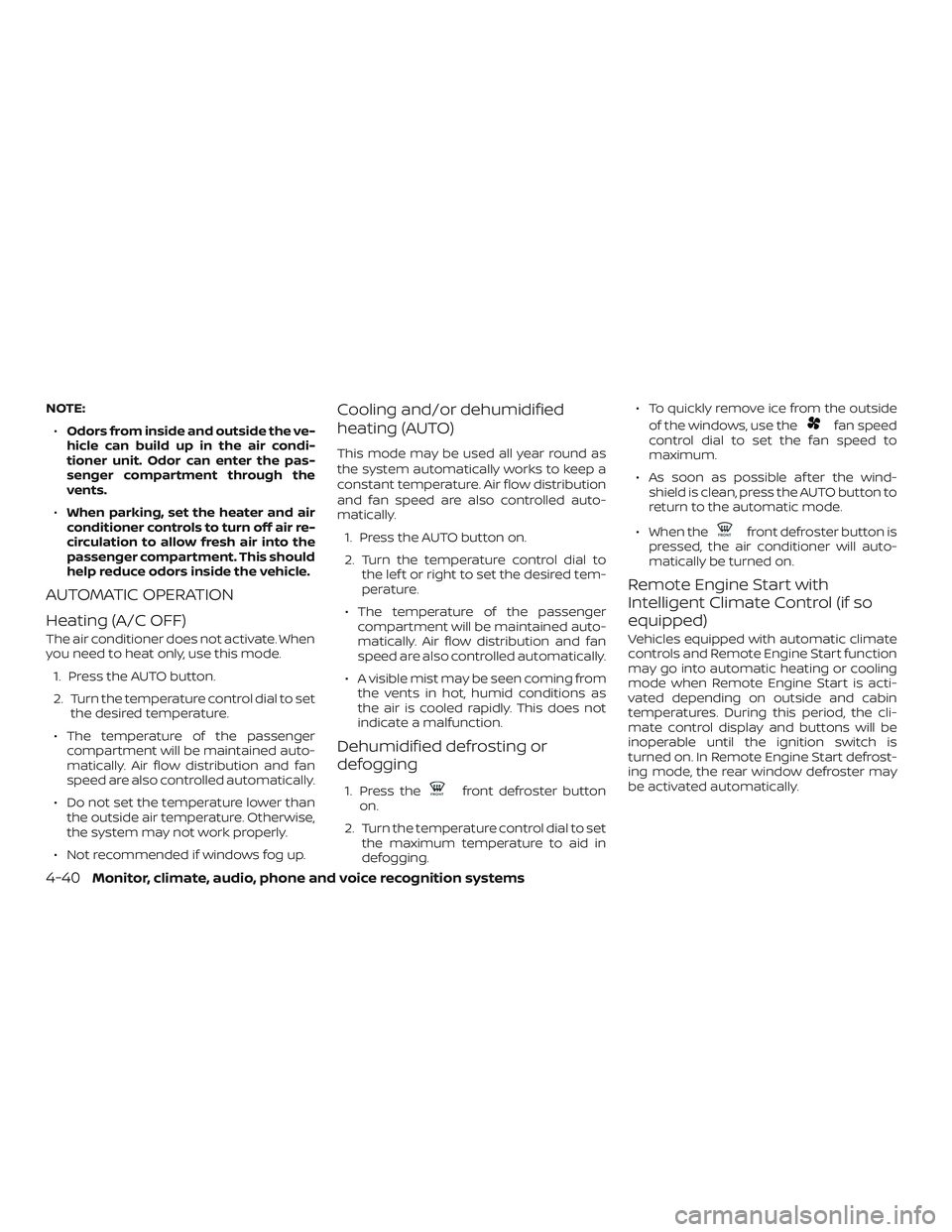
AUTOMATIC OPERATION
Heating (A/C OFF)
The air conditioner does not activate. When
you need to heat only, use this mode.
1. Press the AUTO button.
2. Turn the temperature control dial to set the desired temperature.
∙ The temperature of the passenger compartment will be maintained auto-
matically. Air flow distribution and fan
speed are also controlled automatically.
∙ Do not set the temperature lower than the outside air temperature. Otherwise,
the system may not work properly.
∙ Not recommended if windows fog up.
Cooling and/or dehumidified
heating (AUTO)
This mode may be used all year round as
the system automatically works to keep a
constant temperature. Air flow distribution
and fan speed are also controlled auto-
matically. 1. Press the AUTO button on.
2. Turn the temperature control dial to the lef t or right to set the desired tem-
perature.
∙ The temperature of the passenger compartment will be maintained auto-
matically. Air flow distribution and fan
speed are also controlled automatically.
∙ A visible mist may be seen coming from the vents in hot, humid conditions as
the air is cooled rapidly. This does not
indicate a malfunction.
Dehumidified defrosting or
defogging
1. Press thefront defroster button
on.
2. Turn the temperature control dial to set the maximum temperature to aid in
defogging. ∙ To quickly remove ice from the outside
of the windows, use the
fan speed
control dial to set the fan speed to
maximum.
∙ As soon as possible af ter the wind- shield is clean, press the AUTO button to
return to the automatic mode.
∙ When the
front defroster button is
pressed, the air conditioner will auto-
matically be turned on.
Remote Engine Start with
Intelligent Climate Control (if so
equipped)
Vehicles equipped with automatic climate
controls and Remote Engine Start function
may go into automatic heating or cooling
mode when Remote Engine Start is acti-
vated depending on outside and cabin
temperatures. During this period, the cli-
mate control display and buttons will be
inoperable until the ignition switch is
turned on. In Remote Engine Start defrost-
ing mode, the rear window defroster may
be activated automatically.
4-40Monitor, climate, audio, phone and voice recognition systems
Page 266 of 444
5 Starting and driving
Precautions when starting and driving..........5-2
Exhaust gas (carbon monoxide) ..............5-2
Three-way catalyst ...........................5-3
Tire Pressure Monitoring System
(TPMS)........................................5-3
On-pavement and off-road driving
precautions ..................................5-7
Avoiding collision and rollover ................5-7
Off-roadrecovery ............................5-7
Rapid air pressure loss .......................5-8
Drinking alcohol/drugs and driving ...........5-9
Push-button ignition switch .....................5-9
Operating range ............................. 5-10
Push-button ignition switch positions ........5-11
Emergency engine shut off ..................5-12
NISSAN Intelligent Key® battery
discharge ................................... 5-12
NISSAN Anti-Thef t System (NATS)
(if so equipped) .............................. 5-13
NISSAN Vehicle Immobilizer System
(if so equipped) .............................. 5-13
Before starting the engine ......................5-14
Starting the engine ............................. 5-14
Remote Engine Start (if so equipped) ........5-15 Driving the vehicle
.............................. 5-15
Continuously Variable Transmission
(CVT) ........................................ 5-15
Parking brake .................................. 5-21
Blind Spot Warning (BSW) (if so equipped) .......5-22
BSW system operation ......................5-23
How to enable/disable the BSW system .....5-24
BSW system limitations ......................5-25
BSW driving situations .......................5-26
System temporarily unavailable .............5-29
System maintenance ........................ 5-30
Rear Cross Traffic Alert (RCTA) (if so equipped) . . 5-31 RCTA system operation ......................5-32
How to enable/disable the RCTA
system ...................................... 5-34
RCTA system limitations .....................5-35
System temporarily unavailable .............5-37
System maintenance ........................ 5-38
Cruise control .................................. 5-39
Precautions on cruise control ................5-39
Cruise
control operations .................... 5-40
Automatic Emergency Braking (AEB)
(if so equipped) ................................. 5-41
AEB system operation .......................5-43
Page 281 of 444
4.Warm-up:
Allow the engine to idle for at least
30 seconds af ter starting. Do not race
the engine while warming it up. Drive at
a moderate speed for a short distance
first, especially in cold weather. In cold
weather, keep the engine running for a
minimum of2-3minutes before shut-
ting it off. Starting and stopping the
engine over a short period of time may
make the vehicle more difficult to start.
5. To stop the engine, move the shif t lever to the P (Park) position and push the
ignition switch to the OFF position.
NOTE:
Care should be taken to avoid situations
that can lead to potential battery dis-
charge and potential no-start conditions
such as: 1. Installation or extended use of elec-
tronic accessories that consume bat-
tery power when the engine is not
running (phone chargers, GPS, DVD
players, etc.).
2. The vehicle is not driven regularly
and/or only driven short distances. In these cases, the battery may need to
be charged to maintain battery health.
REMOTE ENGINE START (if so
equipped)
Vehicles started with the Remote Engine
Start require the ignition switch to be
placed in the ON position before the shif t
lever can be moved from the P (Park) posi-
tion. To place the ignition switch in the ON
position, follow these steps:
1. Make sure that the Intelligent Key is on you.
2. Apply the brake.
3. Push the ignition switch once to the ON position.
For additional information, refer to “NISSAN
Intelligent Key®” in the “Pre-driving checks
and adjustments” section of this manual.
CONTINUOUSLY VARIABLE
TRANSMISSION (CVT)
WARNING
∙ Do not depress the accelerator pedal while shif ting from P (Park) or N (Neu-
tral) to R (Reverse), D (Drive) or L (Low).
Always depress the brake pedal until
shif ting is completed. Failure to do so
could cause you to lose control and
have an accident.
∙ Cold engine idle speed is high, so use caution when shif ting into a forward
or reverse gear before the engine has
warmed up.
∙ Do not downshif t abruptly on slippery roads. This may cause a loss of
control.
∙ Never shif t to either the P (Park) or R (Reverse) position while the vehicle is
moving forward and P (Park) or D
(Drive) position while the vehicle is re-
versing. This could cause an accident
or damage the transmission.
DRIVING THE VEHICLE
Starting and driving5-15
Page 431 of 444
Extended storage switch..........2-50
F
Flashers
(See hazard warning flasher switch) ....6-2
Flattire....................6-3,6-4
Floormatpositioningaid...........7-5
Fluid Brakefluid..................8-9
Capacities and recommended
fuel/lubricants...............10-2
Continuously Variable Transmission (CVT)
fluid......................8-9
Engine coolant ...............8-4
Engine oil ...................8-5
F.M.V.S.S. certification label ..........10-11
Foglightswitch................2-46
Front air bag system
(See supplemental restraint system) . . .1-53
Frontseats................... .1-2
Fuel Capacities and recommended
fuel/lubricants...............10-2
Fuel economy ...............5-51
Fuel-filler door lock opener lever ....3-24
Fuel gauge ..................2-8
Fueloctanerating.............10-5
Fuel recommendation ..........10-3
Fuelefficientdrivingtips...........5-50
Fuel-filler door .................3-24
Fuel gauge ....................2-8
Fuses .......................8-18
Fusiblelinks...................8-19 G
Gauge Fuel gauge ..................2-8
Odometer ..................2-6
Speedometer ..............2-5,2-6
Tachometer .................2-7
Trip odometer .............2-5,2-6
General maintenance .............9-2
Glovebox....................2-53
Grocery hooks .................2-55
H
Hands-free phone system, Bluetooth® . .4-67
Hazard warning flasher switch ........6-2
Headlight and turn signal switch ......2-42
Headlightcontrolswitch...........2-42
Headlights ...................8-23
Headrestraints ................ .1-5
Heated seat switches .............2-47
Heater Heater and air conditioner .......4-39
Heater and air conditioner (manual) . .4-31
Heater operation ..........4-33,4-41
Hill start assist system ............5-60
Hood ...................... .3-21
Hook Luggage hook ...............2-54
Horn.......................2-47 I
Ignition switch Push-button ignition switch .......5-9
Immobilizer system ...........2-37, 5-13
Important vehicle information label . . . .10-11
In-cabinmicrofilter ..............8-15
Increasing fuel economy ...........5-51
Indicator NISSAN Intelligent Key® battery discharge
indicator...................5-12
Indicator lights and audible reminders
(See warning/indicator lights and audible
reminders) ....................2-18
Informationdisplay..............2-22
Instrument brightness control .......2-45
Instrument panel .............0-6,2-2
Instrument panel dimmer switch .....2-45
Integrated Dynamics-control Module . . .5-59
Intelligent Around View Monitor ......4-15
Intelligent Engine Brake (I-EB) ........5-59
Intelligent Key system Key operating range ............3-8
Mechanic
al key...............3-3
Remote keyless entry operation ....3-12
Troubleshooting guide ..........3-16
Warning signals ..............3-16
Intelligent Trace Control (I-TC) ........5-59
Interiorlight...................2-63
iPod®Player...................4-55
ISOFIX child restraints .............1-23
J
Jumpstarting...............6-9,8-12
11-3
Page 433 of 444
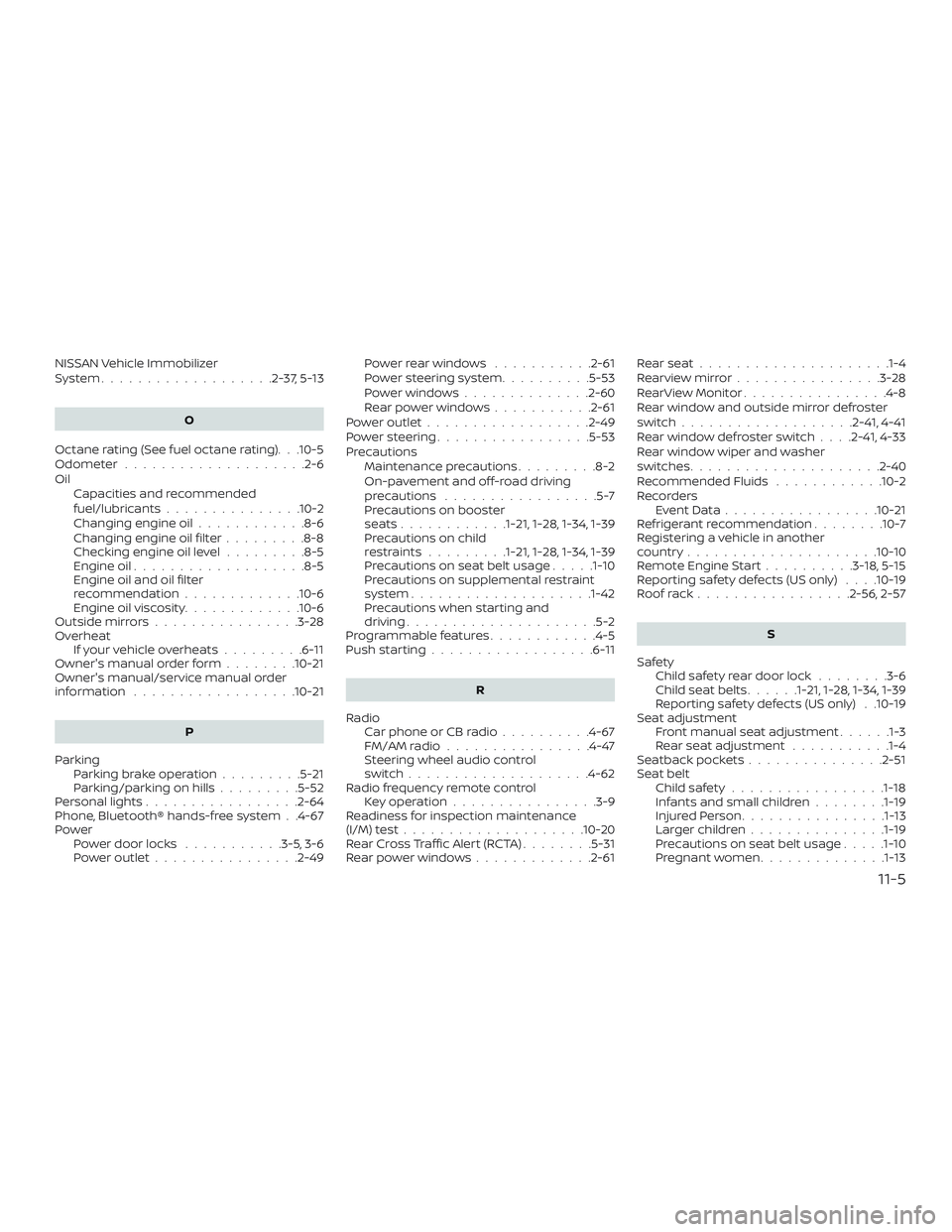
NISSAN Vehicle Immobilizer
System...................2-37,5-13O
Octane rating (See fuel octane rating). . .10-5
Odometer ....................2-6
Oil Capacities and recommended
fuel/lubricants...............10-2
Changing engine oil ............8-6
Changing engine oil filter .........8-8
Checking engine oil level .........8-5
Engine oil ...................8-5
Engine oil and oil filter
recommendation .............10-6
Engine oil viscosity .............10-6
Outsidemirrors................3-28
Overheat Ifyourvehicleoverheats.........6-11
Owner's manual order form ........10-21
Owner's manual/service manual order
information ..................10-21
P
Parking Parking brake operation .........5-21
Parking/parkingonhills.........5-52
Personal lights .................2-64
Phone, Bluetooth® hands-free system . .4-67
Power Power door locks ...........3-5,3-6
Poweroutlet................2-49 Powerrearwindows ...........2-61
Power steering system
..........5-53
Powerwindows..............2-60
Rearpowerwindows...........2-61
Poweroutlet..................2-49
Powersteering.................5-53
Precautions Maintenance precautions .........8-2
On-pavement and off-road driving
precautions .................5-7
Precautions on booster
seats............1-21, 1-28, 1-34, 1-39
Precautions on child
restraints.........1-21, 1-28, 1-34, 1-39
Precautions on seat belt usage .....1-10
Precautions on supplemental restraint
system ................... .1-42
Precautions when starting and
driving.....................5-2
Programmable features ............4-5
Push starting ..................6-11
R
Radio Car phone or CB radio ..........4-67
FM/AMradio................4-47
Steering wheel audio control
switch....................4-62
Radio frequency remote control Key operation ................3-9
Readiness for inspection maintenance
(I/M) test ....................10-20
RearCrossTrafficAlert(RCTA)........5-31
Rearpowerwindows.............2-61 Rearseat.....................1-4
Rearviewmirror................3-28
RearViewMonitor................4-8
Rear window and outside mirror defroster
switch...................2-41,4-41
Rear window defroster switch . . . .2-41, 4-33
Rear window wiper and washer
switches
.....................2-40
Recommended Fluids ............10-2
Recorders EventData.................10-21
Refrigerant recommendation ........10-7
Registering a vehicle in another
country .....................10-10
Remote Engine Start ..........3-18,5-15
Reporting safety defects (US only) . . . .10-19
Roofrack.................2-56,2-57
S
Safety Child safety rear door lock ........3-6
Childseatbelts......1-21, 1-28, 1-34, 1-39
Reporting safety defects (US only) . .10-19
Seat adjustment Front manual seat adjustment ......1-3
Rear seat adjustment ...........1-4
Seatback pockets ...............2-51
Seat belt C
hildsafety................ .1-18
Infants and small children ........1-19
InjuredPerson............... .1-13
Largerchildren.............. .1-19
Precautionsonseatbeltusage.....1-10
Pregnant women ..............1-13
11-5