2019 MITSUBISHI MIRAGE G4 to pair
[x] Cancel search: to pairPage 60 of 267

Supplemental Restraint System (SRS) - airbag
Seat and restraint systems 4-33
4
N00408100421
The side airbags (A) are contained in the driver and front passenger seatbacks. The side airbag is de
signed to inflate only on
the side of the vehicle that is impacted, even with no passenger in the front seat. A label is attached to the seatbacks in vehi- cles equipped with side airbags.
N00419201357
The curtain airbags are contained in the frontpillars and roof side rail. The curtain airbag is designed to inflate onlyon the side of the ve
hicle that is impacted,
even with no passenger in the seat. Also, when the airbag control unit detectsrollover of the vehicle, the curtain airbags will deploy.
WA R N I N G Do not attempt to remove, install, disas- semble or repair the SRS airbags. Do not place objects,
such as packages or
pets, between the airbags and the driveror the front passenger. Such objects can adversely affect ai
rbag performance, or
cause serious injury or death when theairbag deploys. Immediately after airbag inflation, some parts of the airbag syst
em will be hot. Do
not touch them. You could otherwise be burned. The airbag system is designed to work only once. After the
airbags deploy, they
will not work again. They must promptly be replaced and the entire airbag system must be inspected by an authorizedMitsubishi Motors dealer.
Side airbag system
Curtain airbag system
WA R N I N G The side airbags and curtain airbags can cause serious injury
or death to anyone
too close to the airb
ag when it deploys. To
reduce the risk of in
jury from a deploying
side airbag and curtai
n airbag, all occu-
pants must be properly restrained and seated well back, upright, and in the mid- dle of the seat. Do
not lean against the
door.
BK0267800US.book 33 ページ 2018年5月30日 水曜日 午後4時24分
Page 63 of 267
Supplemental Restraint System (SRS) - airbag 4-36 Seat and restraint systems
4
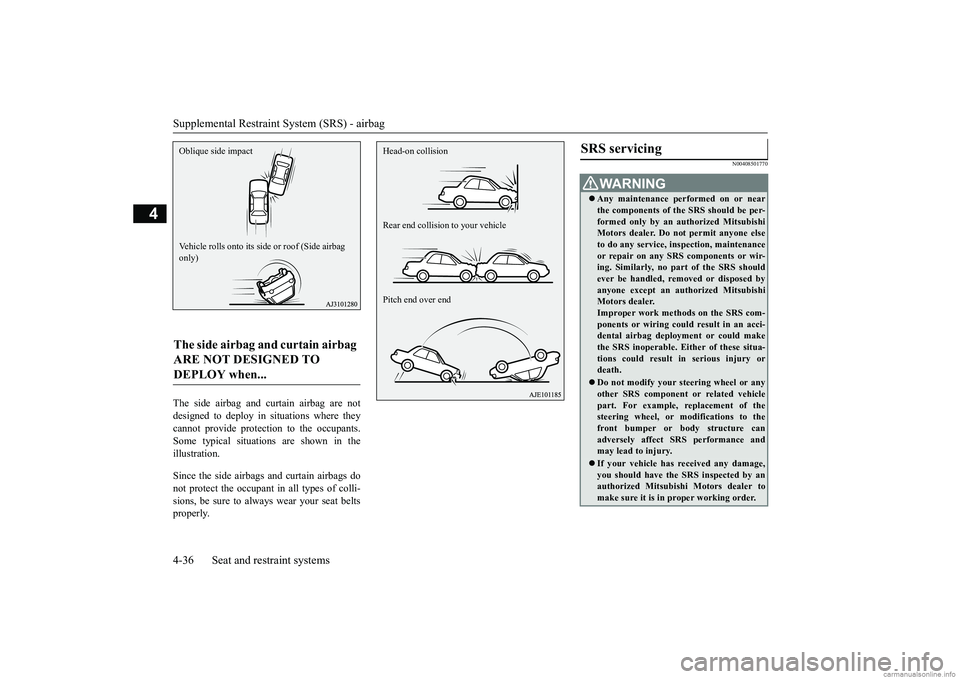
The side airbag and curtain airbag are not designed to deploy in situations where theycannot provide protecti
on to the occupants.
Some typical situations are shown in the illustration. Since the side airbags and curtain airbags do not protect the occupant
in all types of colli-
sions, be sure to always
wear your seat belts
properly.
N00408501770
The side airbag and curtain airbag ARE NOT DESIGNED TO DEPLOY when... Oblique side impact Vehicle rolls onto its side or roof (Side airbag only)
Head-on collision Rear end collision to your vehiclePitch end over end
SRS servicing
WA R N I N G Any maintenance performed on or near the components of the SRS should be per-formed only by an
authorized Mitsubishi
Motors dealer. Do not permit anyone else to do any service, in
spection, maintenance
or repair on any SRS components or wir- ing. Similarly, no part of the SRS should ever be handled, removed or disposed byanyone except an au
thorized Mitsubishi
Motors dealer. Improper work methods on the SRS com-ponents or wiring could result in an acci- dental airbag deployment or could make the SRS inoperable. Ei
ther of these situa-
tions could result in serious injury or death. Do not modify your steering wheel or any other SRS component
or related vehicle
part. For example, replacement of thesteering wheel, or modifications to the front bumper or body structure can adversely affect SRS performance andmay lead to injury. If your vehicle has re
ceived any damage,
you should have the
SRS inspected by an
authorized Mitsubish
i Motors dealer to
make sure it is in proper working order.
BK0267800US.book 36 ページ 2018年5月30日 水曜日 午後4時24分
Page 79 of 267

Free-hand Advanced
Security Transmitter (F.A.S
.T.-key) (if so equipped)
5-14 Features and controls
5
The indicator light on th
e engine switch turns
off.On vehicles equipped
with continuously vari-
able transmission (CVT), the operation mode cannot be put in OFF wh
en the selector lever
is in any position other than the “P” (PARK) position. Allows operation of some electrical accesso- ries.
The indicator light on th
e engine switch illu-
minates orange. All electrical accessories can be used. The indicator light on th
e engine switch illu-
minates green. The indicator light turns off when the engineis running.
N00568001110
If you press the engine
switch without press-
ing the brake pedal {continuously variable transmission (CVT)} or the clutch pedal (manual transaxle) while the vehicle is sta-tionary, you can change the operation mode in the order of OFF, ACC, ON, OFF.
When the battery in the F.A.S.T.-key has worn out, or the F.A.S.T.-key is out of thevehicle, a warning lamp
will blink for 5 sec-
onds.
Operation mode of the engine switch and its function
OFF ACC
NOTE
ON
NOTE
Your vehicle is equippe
d with an electronic
immobilizer. To start the engine, the ID codewhich the F.A.S.T.-key sends must match the one registered to the immobilizer computer. (Refer to “Electronic immobilizer (Anti-theftstarting system)” on page 5-20)
Changing the operation mode
CAUTION When the engine is not running, put the oper- ation mode in OFF. Leaving the operationmode in ON or ACC for a long time when the engine is not r
unning may cause the bat-
tery to be discharged, making it impossibleto start the engine. When the battery is disconnected, the current operation mode is memorized. After recon- necting the battery, the memorized mode is selected auto
matically. Before disconnect-
ing the battery for repair or replacement, make sure to put the
operation mode in OFF.
Be careful if you are not sure which opera-tion mode the vehicle is
in when the battery
is run down. The operation mode cannot be changed from OFF to ACC or ON if the F.A.S.T.-key is not detected to be in the
vehicle. Refer to “Oper-
ating range for starting the engine and changing the operation mode” on page 5-11.
BK0267800US.book 14 ページ 2018年5月30日 水曜日 午後4時24分
Page 83 of 267

Free-hand Advanced
Security Transmitter (F.A.S
.T.-key) (if so equipped)
5-18 Features and controls
5
6. Press the engine switch. 7. Confirm that all warning lights and warn-ing displays are functioning properly.
After several attempts
, you may experience
that the engine still does not start. 1. Make sure that all electric devices, such as lights, air conditi
oning blower and rear
window defogger, are turned off.
2. While depressing the brake pedal {contin- uously variable transmission (CVT)} orthe clutch pedal (ma
nual transaxle), press
the accelerator peda
l halfway and hold it
there, then crank th
e engine. Release the
accelerator pedal, immediately after the engine starts. 3. If the engine still wi
ll not start, the engine
could be flooded with too much gasoline. While depressing the brake pedal (CVT) or the clutch pedal (manual transaxle), push the accelerator pedal all the way down and hold it there, then press theengine switch to crank the engine. If the engine does not start after 5 to 6 seconds, push the engine switch to stop crankingthe engine, and release the accelerator pedal. Put the opera
tion mode in OFF.
Wait a few seconds, and then press theengine switch to cr
ank the engine again
while depressing the brake pedal (CVT) or the clutch pedal (manual transaxle), butdo not push the accelerator pedal. If the engine fails to start, repeat these proce- dures. If the engine sti
ll will not start, con-
tact your local Mitsubishi Motors dealer or a repair facility of your choice for assistance.
Startability of conti
nuously variable trans-
mission (CVT) vehicles with an ambient temperature of -4 °F (-20 °C) or lower
When the ambient temperature is -4 °F (-20 °C) or lower, it may not be possible to startfrom a standstill even with the selector lever in the “D” (DRIVE) or “R” (REVERSE) position.This phenomenon occurs
because the trans-
axle has not warmed up sufficiently; it does not indicate a problem.
If this occurs, place
the selector lever in the “P” (PARK) position and let the engine idle
for at least 10 minutes.
The transaxle will wa
rm up, and you will be
able to start normally. Do not leave the vehicle during warm-upoperation.
N00568200014
NOTE
On vehicles equipped with continuously variable transmission (C
VT), the engine can
only be started when the selector lever is inthe “P” (PARK) or “N” (NEUTRAL) posi- tion. For safety reasons,
the engine should be
started when the selector lever is in the “P” (PARK) position in which the driving wheels lock.NOTE
Minor noises may be he
ard on engine start-
up. These will disappear
as the engine warms
up.
When the engine is hard to start
Stopping the engine
WA R N I N G Do not operate the en
gine switch while
driving except in an emergency. If the engine is stopped whil
e driving, the brake
servomechanism will ce
ase to function and
braking efficiency will deteriorate. Also, the power steering system will not func-tion and it will require greater manual effort to operate the steering. This could result in a serious accident.
BK0267800US.book 18 ページ 2018年5月30日 水曜日 午後4時24分
Page 105 of 267

Manual transaxle (if so equipped) 5-40 Features and controls
5
3. If the engine still will
not start, the engine
could be flooded with too much gasoline.While depressing the brake pedal (CVT) or the clutch pedal (manual transaxle), push the accelerator pedal all the waydown and hold it there, then crank the engine for 5 to 6 sec
onds. Return the igni-
tion switch to the “OFF” position andrelease the accelerator pedal. Wait a few seconds, and then crank the engine again for 5 to 6 seconds while depressing the brake pedal (CVT) or the clutch pedal (manual transaxle), but do not push theaccelerator pedal. Release the ignition switch if the engine starts. If the engine fails to start, repeat
these procedures. If
the engine still will
not start, contact your
local Mitsubishi Motors dealer or a repair facility of your choi
ce for assistance.
When the ambient temperature is -4 °F (-20 °C) or lower, it may not be possible to start from a standstill even with the selector lever in the “D” (DRIVE) or “R” (REVERSE)position. This phenomenon occurs
because the trans-
axle has not warmed up sufficiently; it does
not indicate a problem.
If this occurs, place
the selector lever in the “P” (PARK) positionand let the engine idle
for at least 10 minutes.
The transaxle will wa
rm up, and you will be
able to start normally.Do not leave the vehicle during warm-up operation.
N00512701237
The shift pattern below is shown on the gear- shift lever. Press the clutch pedal all the way down while shifting gears.
Press the clutch pedal all the way down and shift into 1st or “R” (Reverse) position, oper- ating the gearshift lever slowly. Then gradu- ally release the clutch
pedal while depressing
the accelerator pedal.
Startability of CVT vehicle with ambient temperature of -4 °F (-20 °C) or lower
Manual transaxle
(if so
equipped)
NOTE
During cold weather, shifting may be diffi- cult until the transaxle
lubricant has warmed
up. This is normal and not harmful to thetransaxle.
To start
CAUTION Do not move the gearshift lever into reverse while the vehicle is
moving forward; doing
so will damage the transaxle. Do not rest your foot on the clutch pedal because this will ca
use premature clutch
wear or damage. Do not coast in the “N” (Neutral) position (illegal in many states). Do not use the gearshift lever as a handrest, because this can result in premature wear of the transaxle shift forks.
BK0267800US.book 40 ページ 2018年5月30日 水曜日 午後4時24分
Page 108 of 267

Continuously variable transmission (CVT) (if so equipped)
Features and controls 5-43
5
N00563300049
When the selector lever cannot be shifted from the “P” (PARK) position to another position while the brake pedal is pressed and held down with the ignition switch or theoperation mode in ON, th
e battery may be flat
or the shift-lock mechanism may be malfunc- tioning.Immediately have your
vehicle checked by an
authorized Mitsubishi Motors dealer or a repair facility of your choice.
If you need to move the vehicle, shift the selector lever as follows. 1. Make sure the parking brake is fully applied. 2. Stop the engine if it is running. 3. Insert a screwdrive
r with a cloth over its
tip into the notch (A) of the cover. Pry gently as shown to remove the cover. 4. Depress the brake
pedal with the right
foot. 5. Insert a screwdriver in the shift-lock release hole (B). Shift the selector lever tothe “N” (NEUTRAL) position while pressing the screwdriver down.
Set the selector lever in the gate to operate while the brake pedal is depressed. Set the selector lever in the gate to operate.
WA R N I N G Always press the brake pedal when shift- ing the selector lever into a selector posi- tion from the “N” (NEUTRAL) position. When beginning to drive, do not shift theselector lever from
the “N” (NEUTRAL)
position while pressing the accelerator pedal. This will cause the vehicle to“jump” forward or backward.
NOTE
To prevent mistakes in operating the lever, make sure you stop brie
fly at each position.
After operating, check
the position in the
multi-information display. If the brake pedal is not depressed and held, the shift-lock device activates to prevent the selector lever from being moved from the “P” (PARK) position. For a shift indicated by in the illustra- tion, depress the brake pedal before moving the selector lever. If you attempt to move the selector lever before
depressing the brake
pedal, the selector
lever may not move.
When the selector lever cannot be shifted from the “P” (PARK) posi-tion
BK0267800US.book 43 ページ 2018年5月30日 水曜日 午後4時24分
Page 110 of 267

Continuously variable transmission (CVT) (if so equipped)
Features and controls 5-45
5
Use when engine braking is needed, or for high-power sport drive. This position is for dr
iving up very steep hills
and for engine braking at low speeds when driving down steep hills.
N00549500018 N00574601049
When the selector lever position indicator blinks while you are driving, there could be a malfunction in the automatic transaxle system or CVT fluid temperature becomes abnor- mally high.
“Ds” DOWNSHIFT & SPORTY DRIVING
“L” LOW
WA R N I N G This position can be
used for maximum
engine braking. Be very careful not to shift into “L”(LOW) suddenly. Sudden engine braking may cause the tires to skid.Select this position according to the road conditions and vehicle speed.
When a malfunction occurs in the automatic transaxle
When the selector lever position indicator blinks
NOTE
The “A” indicator blinks only if the CVT selector lever switch is broken.It is not seen during normal driving.
CAUTION If a malfunction occurs in the CVT while driving, the indicator will blink.In this case, immediat
ely park your vehicle
in a safe place and follow these procedures: [If the indicator blinks
rapidly (once per sec-
ond), the CVT fluid is overheating.]Park your vehicle in
a safe place but do not
turn off the engine. M
ove the selector lever
to the “P” (PARK) position and open theengine hood. Keep the engine, idling. After a while, move the selector lever into any position other than
“P” (PARK) position
and confirm that the in
dicator stops blinking.
It is safe to continue driving if the indicator no longer blinks.If the indicator conti
nues blinking, contact
an authorized Mitsubi
shi Motors dealer or
repair facility of your
choice immediately.
[If the indicator blinks slowly (once per 2 seconds), the CVT may
be operating in fail-
safe mode due to a malfunction.]Have the vehicle inspec
ted at an authorized
Mitsubishi Motors dealer
or repair facility of
your choice immediately.
BK0267800US.book 45 ページ 2018年5月30日 水曜日 午後4時24分
Page 112 of 267

Service brake
Features and controls 5-47
5
and then move the sele
ctor lever to the “P”
(PARK) position. If the CVT does not shift while driving, or your vehicle does not pick up enough speed when starting on an uphill slope, it may bethat there is something unusual happening in the transmission. Have your vehicle checked at an authorized Mitsubishi Motors dealer or a repair facility of
your choice immediately.
N00517501328
Overuse of the brake can cause weakening, resulting in poor brake response and prema- ture wear of the brake pads.When driving down a long or steep hill, use engine braking by movi
ng the selector lever
to “Ds” (DOWNSHIFT & SPORTY DRIV-ING) or “L” (LOW) position.
N00517600436
Your vehicle is equipped with power brakesfor more braking force with less brake pedaleffort. Your brakes are designed to operate at full capacity, even if the power assist is not beingused. If the power assist is not being used, the effort needed to press the br
ake pedal is greater.
If you should lose the power assist for some reason, the brakes will still work.
If the power brake unit or either of the two brake hydraulic systems stops working prop-erly, the rest of the brake system will still work, but the vehicle will not slow down as quickly.You will know this has happened if you find you need to press the brake down farther, or harder when slowing down or stopping, or ifthe brake warning light and the warning dis- play in the multi-information display come on. Have the brake system repaired at an authorized Mitsubishi Motors dealer or a repair facility of your
choice immediately.
When the CVT makes no speed change
Service brake Brake pedal
WA R N I N G Do not leave any obje
cts near the brake
pedal or let a floor
mat slide under it;
doing so could prevent the full pedalstroke that would be necessary in an emergency. Make sure that the pedal can be operated freely at
all times. Make sure
the floor mat is securely held in place.CAUTION It is important not to
drive the vehicle with
your foot resting on the brake pedal when braking is not required.
This practice can
result in very high brake temperatures, pre- mature lining wear, a
nd possible damage to
the brakes.
Power brakes
WA R N I N G Never coast downhill
with the engine OFF.
Keep the engine running whenever your vehicle is in motion. If you turn off theengine while driving, the power brake booster will stop wo
rking and your brakes
will not work as well. If the power assist is lost or if either brake hydraulic system stop
s working properly,
take your vehicle
to an authorized
Mitsubishi Motors dealer
or a repair facil-
ity of your choice immediately.
BK0267800US.book 47 ページ 2018年5月30日 水曜日 午後4時24分