2019 MERCEDES-BENZ SLC headrest
[x] Cancel search: headrestPage 48 of 306
Occupant Classification System
(OCS)
Introduction
The Occupant Classification System (OCS) cat-egorizes the person in the front-passengerseat. Depending on that result, the front-passenger front air bag and front-passengerknee bag are either enabled or deactivated.
The system does not deactivate:
Rthe side impact air bag
Rthe headbag
Rthe Emergency Tensioning Devices
Requirements
To be classified correctly, the front passengermust sit:
Rwith the seat belt fastened correctly
Rin an almost upright position with their backagainst the seat backrest
Rwith their feet resting on the floor, if possi-ble
If the front passenger does not observe theseconditions, OCS may produce a false classifi-cation, e.g. because the front passenger:
Rtransfers their weight by supporting them-selves on a vehicle armrest
Rsits in such a way that their weight is raisedfrom the seat cushion
If you install a child restraint system on thefront-passenger seat, be sure to observe thecorrect positioning of the child restraint sys-tem. Never place objects under or behind thechild restraint system, e.g. a cushion. Theentire base of the child restraint system mustalways rest on the seat cushion of the front-passenger seat. The backrest of the forward-facing child restraint system must lie as flat aspossible against the backrest of the front-passenger seat.
The child restraint system must not touch theroof or be subjected to a load by the headrestraint. Adjust the angle of the seat backrestand the head restraint position accordingly.
Only then can OCS be guaranteed to functioncorrectly. Always observe the child restraintsystem manufacturer's installation and operat-ing instructions.
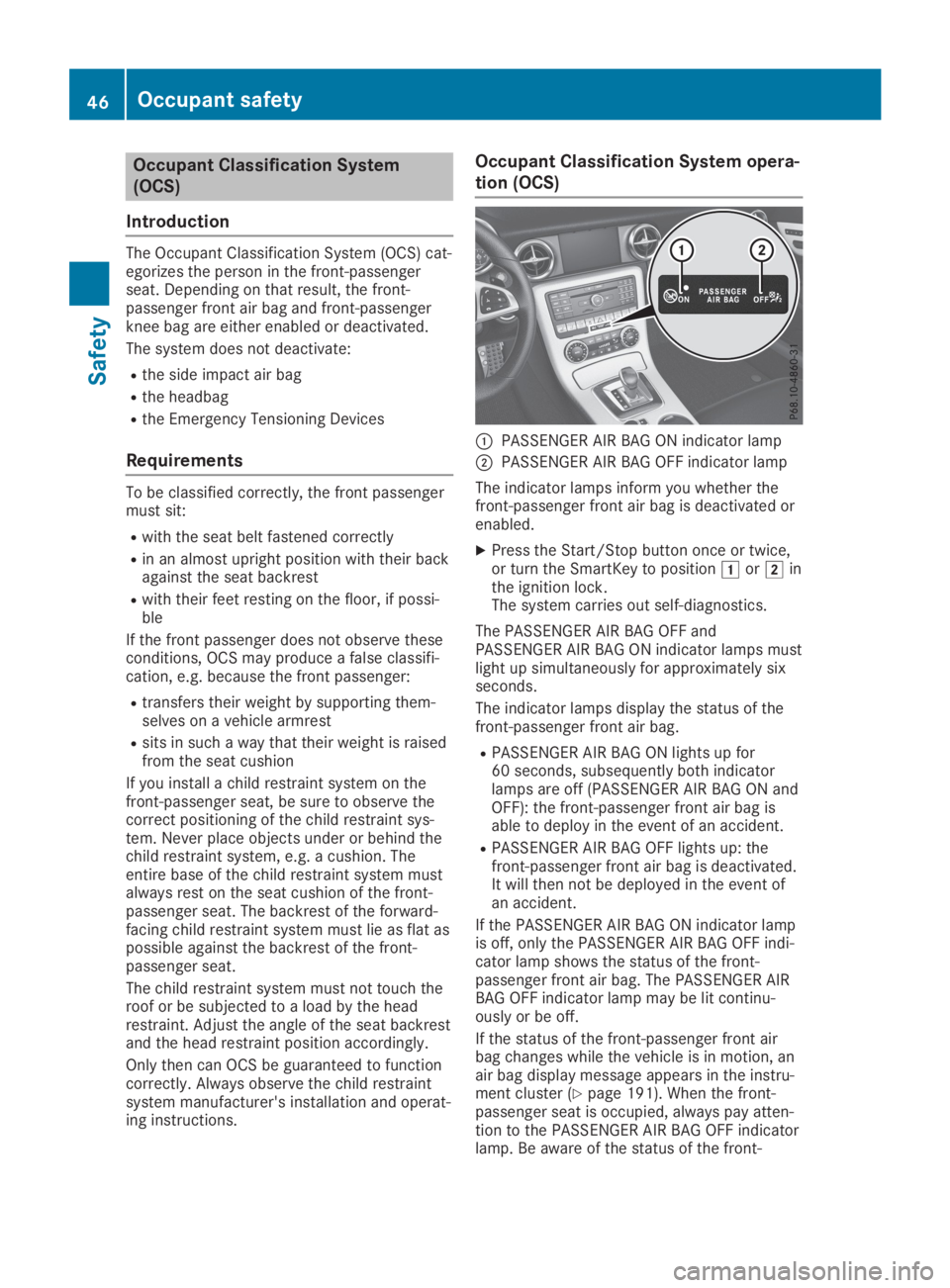
Occupant Classification System opera-
tion (OCS)
CPASSENGER AIR BAG ON indicator lamp
DPASSENGER AIR BAG OFF indicator lamp
The indicator lamps inform you whether thefront-passenger front air bag is deactivated orenabled.
XPress the Start/Stop button once or twice,or turn the SmartKey to positionGorHinthe ignition lock.The system carries out self-diagnostics.
The PASSENGER AIR BAG OFF andPASSENGER AIR BAG ON indicator lamps mustlight up simultaneously for approximately sixseconds.
The indicator lamps display the status of thefront-passenger front air bag.
RPASSENGER AIR BAG ON lights up for60 seconds, subsequently both indicatorlamps are off (PASSENGER AIR BAG ON andOFF): the front-passenger front air bag isable to deploy in the event of an accident.
RPASSENGER AIR BAG OFF lights up: thefront-passenger front air bag is deactivated.It will then not be deployed in the event ofan accident.
If the PASSENGER AIR BAG ON indicator lampis off, only the PASSENGER AIR BAG OFF indi-cator lamp shows the status of the front-passenger front air bag. The PASSENGER AIRBAG OFF indicator lamp may be lit continu-ously or be off.
If the status of the front-passenger front airbag changes while the vehicle is in motion, anair bag display message appears in the instru-ment cluster (Ypage 191). When the front-passenger seat is occupied, always pay atten-tion to the PASSENGER AIR BAG OFF indicatorlamp. Be aware of the status of the front-
46Occupant safety
Safety
Page 54 of 306
minor deformation. This is the case if, forexample, very rigid vehicle parts such as longi-tudinal body members are hit, and sufficientdeceleration occurs as a result.
If the restraint system control unit detects aside impact or if the vehicle rolls over, theapplicable components of the restraint systemare deployed independently of each otherdepending on the apparent type of accident.
RSide impact air bag on the side of impact,independently of the Emergency TensioningDevice and the use of the seat belt on thedriver's seat
The side impact air bag on the frontpassenger side deploys under the followingconditions:
-the OCS system detects that the frontpassenger seat is occupied or
-the seat belt buckle tongue is engaged inthe belt buckle of the front passengerseat
RHead bag on the side of impact, independ-ently of the use of the seat belt and inde-pendently of whether the front-passengerseat is occupied
REmergency Tensioning Devices, if the sys-tem determines that deployment can offeradditional protection in this situation
RHead bags on the driver's and front-passenger side in certain situations whenthe vehicle rolls over, if the system deter-mines that deployment can offer additionalprotection to that provided by the seat belt
iNot all air bags are deployed in an acci-dent. The different air bag systems workindependently of each other.
How the air bag system works is determinedby the severity of the accident detected,especially the vehicle deceleration or accel-eration and the apparent type of accident:
RHead-on collision
RSide impact
RRollover
NECK-PRO head restraints
Important safety notes
GWARNING
The function of the head restraint may be
impaired if you:
Rattach objects such as coat hangers to
the head restraints, for example
Ruse head restraint covers
If you do so, the head restraints cannot fulfill
their intended protective function in the
event of an accident. In addition, objects
attached to the head restraints could endan-
ger other vehicle occupants. There is an
increased risk of injury.
Do not attach any objects to the head
restraints and do not use head restraint cov-
ers.
Method of operation
NECK-PRO head restraints reduce the likeli-hood of head and chest injuries. The NECK-PRO head restraints on the driver's and front-passenger seats are moved forwards andupwards in the event of a rear-end collision ofa certain severity. This provides better headsupport.
If the NECK-PRO head restraints have beentriggered in an accident, you must reset theNECK-PRO head restraints on the driver’s andfront-passenger seat (Ypage 53). Other-wise, the additional protection will not beavailable in the event of another rear-end colli-sion. You can recognize when NECK-PRO headrestraints have been triggered by the fact thatthey have moved forwards and can no longerbe adjusted.
Mercedes-Benz recommends that you havethe NECK-PRO head restraints checked forfunctionality at a qualified specialist workshopafter a rear-end collision.
52Occupant safety
Safety
Page 89 of 306
e.g. blankets, coats, bags, protective cov-ers, child seats or booster seats.
RWhen the seat heating is switched on, theseat surface can be damaged as a resultof objects being placed on the seats, forexample, seat cushions, child seats andprotective covers not approved byMercedes-Benz.
!Make sure that there are no objects in thefootwell under or behind the seats whenmoving the seats back. There is a risk thatthe seats and/or the objects could be dam-aged.
iThe head restraints are equipped with theNECK-PRO system (Ypage 52). For this rea-son, it is not possible to remove the headrestraints from the seats.
For more information, contact a qualifiedspecialist workshop.
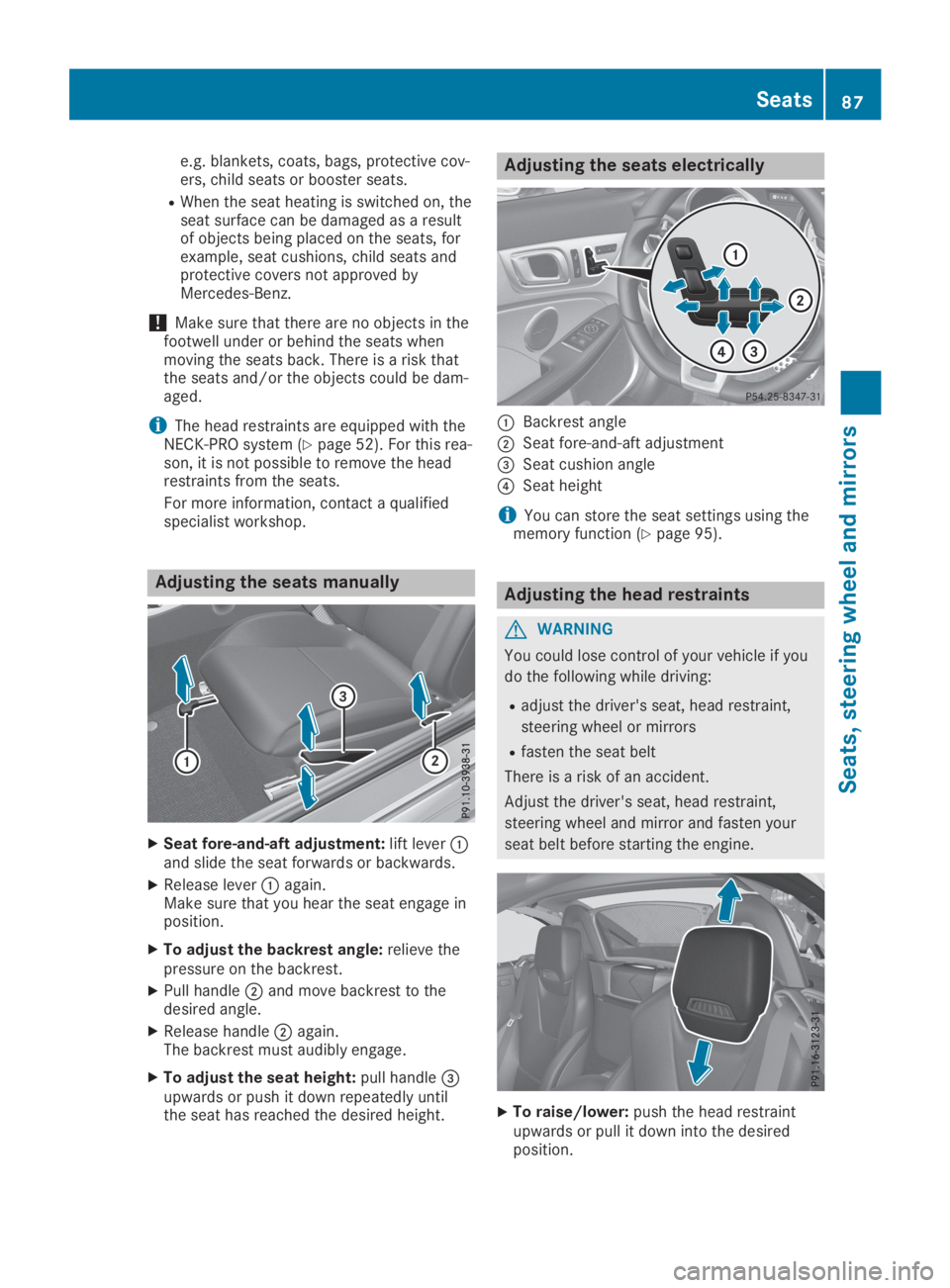
Adjusting the seats manually
XSeat fore-and-aft adjustment:lift leverCand slide the seat forwards or backwards.
XRelease leverCagain.Make sure that you hear the seat engage inposition.
XTo adjust the backrest angle:relieve thepressure on the backrest.
XPull handleDand move backrest to thedesired angle.
XRelease handleDagain.The backrest must audibly engage.
XTo adjust the seat height:pull handle
Page 91 of 306
Problems with the seat heating
ProblemPossible causes/consequences andPPSolutions
The seat heating hasswitched off prema-turely or cannot beswitched on. The vehi-cle's electrical systemvoltage is too lowbecause too many elec-trical consumers areswitched on.
Switch off electrical consumers that you do not need, such as therear window defroster or interior lighting.
Once the battery is sufficiently charged, switch on the seat heatingagain.
AIRSCARF
Setting head level heating (AIRSCARF)
GWARNING
When AIRSCARF is switched on, very hot air
can flow from the vents in the head
restraints. This could result in burns in the
immediate vicinity of the air vents. There is a
risk of injury.
Reduce the heater output before it becomes
too hot.
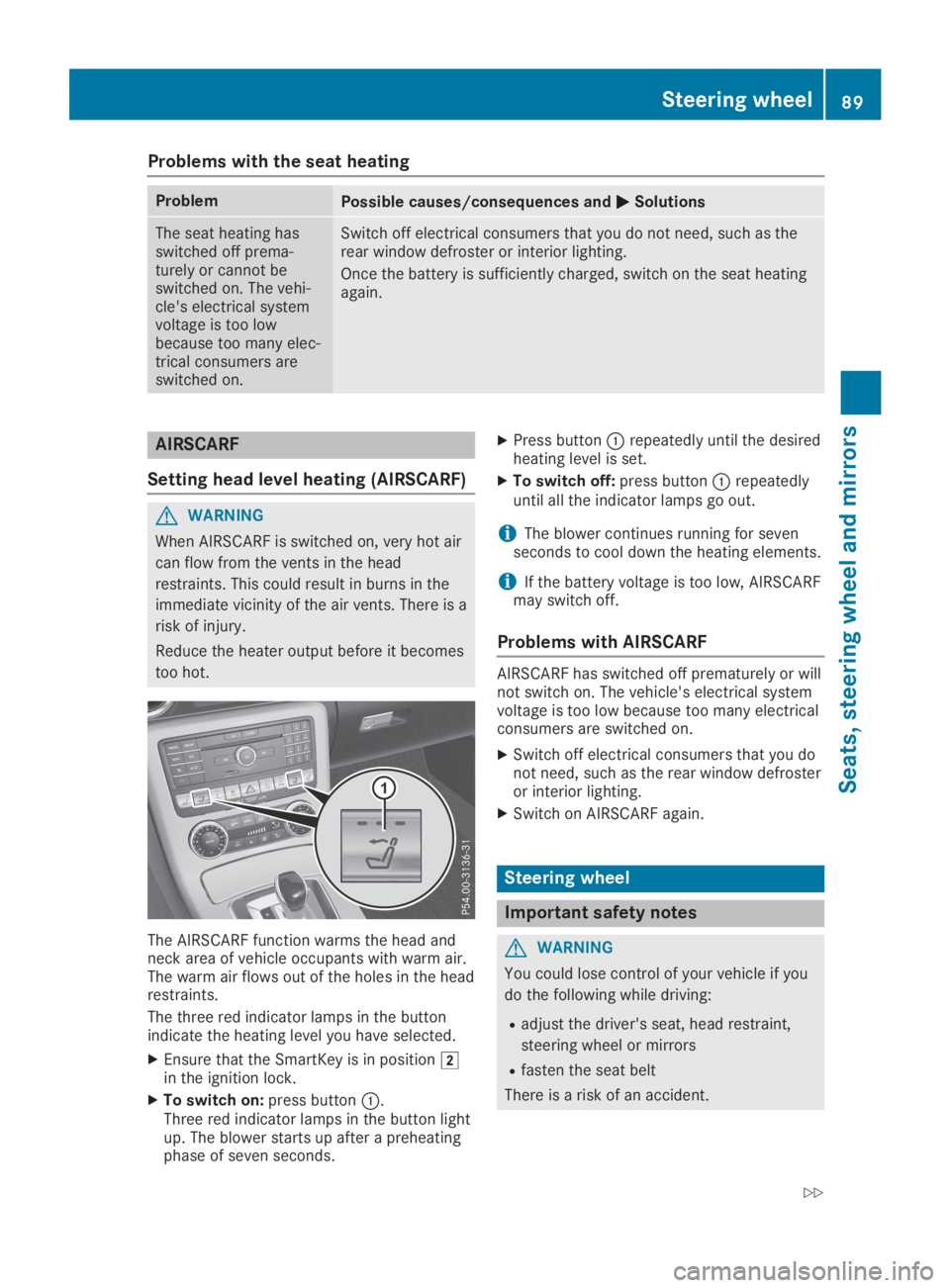
The AIRSCARF function warms the head andneck area of vehicle occupants with warm air.The warm air flows out of the holes in the headrestraints.
The three red indicator lamps in the buttonindicate the heating level you have selected.
XEnsure that the SmartKey is in positionHin the ignition lock.
XTo switch on:press buttonC.Three red indicator lamps in the button lightup. The blower starts up after a preheatingphase of seven seconds.
XPress buttonCrepeatedly until the desiredheating level is set.
XTo switch off:press buttonCrepeatedlyuntil all the indicator lamps go out.
iThe blower continues running for sevenseconds to cool down the heating elements.
iIf the battery voltage is too low, AIRSCARFmay switch off.
Problems with AIRSCARF
AIRSCARF has switched off prematurely or willnot switch on. The vehicle's electrical systemvoltage is too low because too many electricalconsumers are switched on.
XSwitch off electrical consumers that you donot need, such as the rear window defrosteror interior lighting.
XSwitch on AIRSCARF again.
Steering wheel
Important safety notes
GWARNING
You could lose control of your vehicle if you
do the following while driving:
Radjust the driver's seat, head restraint,
steering wheel or mirrors
Rfasten the seat belt
There is a risk of an accident.
Steering wheel89
Seats, steering wheel and mirrors
Z
Page 97 of 306
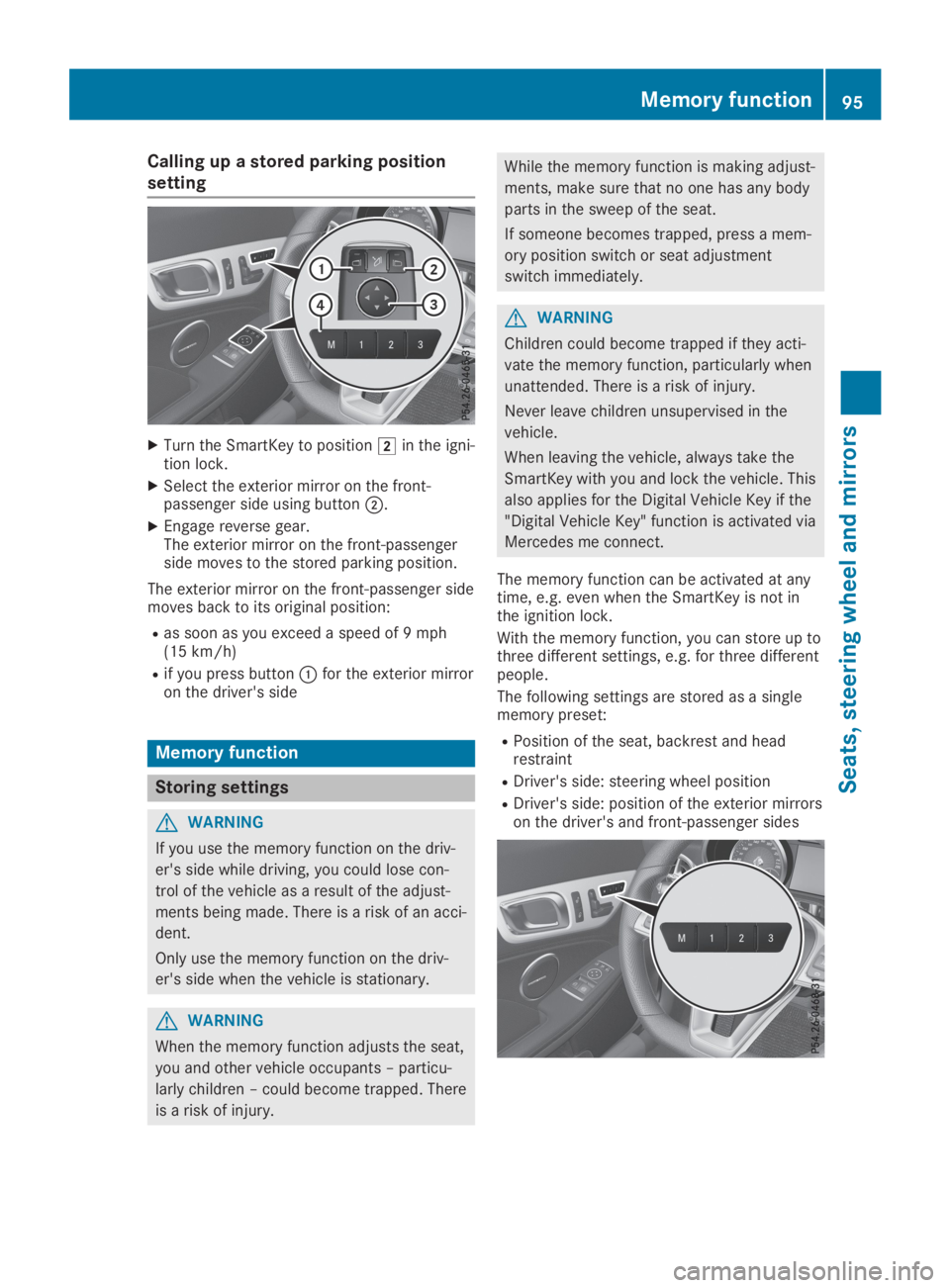
Calling up a stored parking position
setting
XTurn the SmartKey to positionHin the igni-tion lock.
XSelect the exterior mirror on the front-passenger side using buttonD.
XEngage reverse gear.The exterior mirror on the front-passengerside moves to the stored parking position.
The exterior mirror on the front-passenger sidemoves back to its original position:
Ras soon as you exceed a speed of 9 mph(15 km/h)
Rif you press buttonCfor the exterior mirroron the driver's side
Memory function
Storing settings
GWARNING
If you use the memory function on the driv-
er's side while driving, you could lose con-
trol of the vehicle as a result of the adjust-
ments being made. There is a risk of an acci-
dent.
Only use the memory function on the driv-
er's side when the vehicle is stationary.
GWARNING
When the memory function adjusts the seat,
you and other vehicle occupants – particu-
larly children – could become trapped. There
is a risk of injury.
While the memory function is making adjust-
ments, make sure that no one has any body
parts in the sweep of the seat.
If someone becomes trapped, press a mem-
ory position switch or seat adjustment
switch immediately.
GWARNING
Children could become trapped if they acti-
vate the memory function, particularly when
unattended. There is a risk of injury.
Never leave children unsupervised in the
vehicle.
When leaving the vehicle, always take the
SmartKey with you and lock the vehicle. This
also applies for the Digital Vehicle Key if the
"Digital Vehicle Key" function is activated via
Mercedes me connect.
The memory function can be activated at anytime, e.g. even when the SmartKey is not inthe ignition lock.
With the memory function, you can store up tothree different settings, e.g. for three differentpeople.
The following settings are stored as a singlememory preset:
RPosition of the seat, backrest and headrestraint
RDriver's side: steering wheel position
RDriver's side: position of the exterior mirrorson the driver's and front-passenger sides
Memory function95
Seats, steering wheel and mirrors
Z