2019 MERCEDES-BENZ S CLASS check engine
[x] Cancel search: check enginePage 401 of 578
Engine oil
Checkingthe engine oil level usingthe oildipstick
&WARNINGRisk of burns from hot com‐ponent parts inthe engine compartment
Certain component parts inthe engine com‐partment can beveryhot, e.g.the engine,the cooler and parts oftheexhaust system.
#Letthe engine cool down and onlytouchthe component parts describedasfollows.
Plug-inhybrid:observethe notes inthe Supple‐ment. Otherwise,you mayfailtorecognize dan‐gers.
Requirements:RThe engine must havean oil dipstick.If not,the engine oil level can bechecked only withthe on-board computer (→page 399).
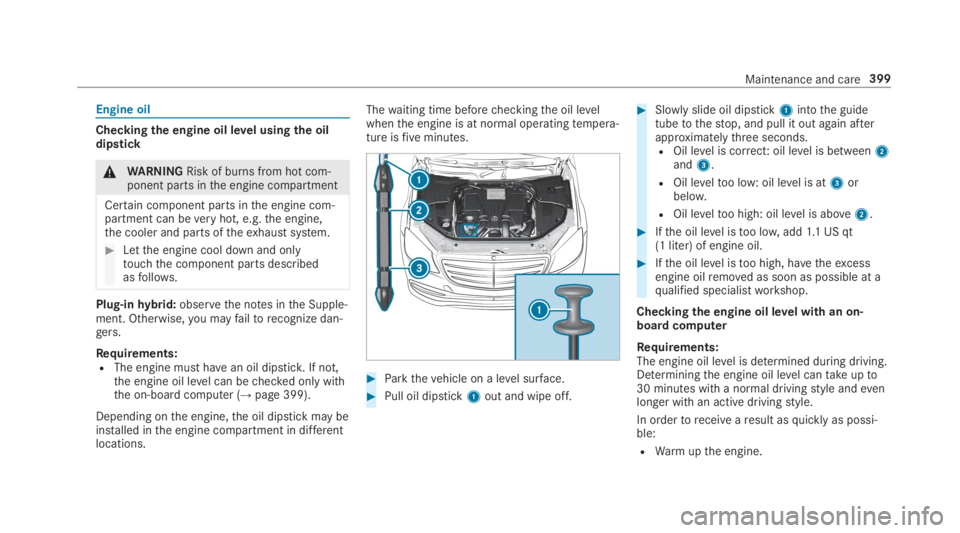
Depending onthe engine,the oil dipstick may beinstalled inthe engine compartment in differentlocations.
Thewaiting time beforecheckingthe oil levelwhenthe engine is at normal operatingtempera‐ture isfiveminutes.
#Parkthevehicle on a level surface.
#Pull oil dipstick1out and wipe off.
#Slowly slide oil dipstick1intothe guidetubetothestop, and pull it out again afterapproximatelythree seconds.ROil level is correct: oil level is between2and3.
ROil leveltoo low: oil level is at3orbelow.
ROil leveltoo high: oil level is above2.
#Ifthe oil level istoo low,add1.1 US qt(1 liter) of engine oil.
#Ifthe oil level istoo high, havetheexcessengine oilremoved as soon as possible at aqualified specialistworkshop.
Checkingthe engine oil level with an on-board computer
Requirements:The engine oil level is determined during driving.Determiningthe engine oil level cantakeupto30 minutes with a normal drivingstyle andevenlonger with an active drivingstyle.
In ordertoreceivearesult asquickly as possi‐ble:
RWarmupthe engine.
Maintenance and care399
Page 402 of 578

RParkthevehicle on a level surface.
RLeavethe enginerunning at idle speed.
On-board computer:
,Service.Engine Oil Level
You will see one ofthefollowing messages inthe multifunction display:
#Measuring Engine Oil Level...: measurementofthe oil level is notyet possible.Repeattherequest after a maximum of 30 minutes' driv‐ing.
#Engine Oil Level OKandthe bar displayforindicatingthe oil level inthe multifunctiondisplay is green and is between "min" and"max":the oil level is correct.
#Engine Oil Level Add 1.0 landthe bar displayfor indicatingthe oil level inthe multifunctiondisplay is orange and is below "min": add1.1 US qt (1 liter) of engine oil.
#Reduce Engine Oil Levelandthe bar displayfor indicatingthe oil level inthe multifunctiondisplay is orange and is above"max": drain
offtheexcess engine oil. Consult aqualifiedspecialistworkshop.
#For Engine Oil Level Switch Ignition On:switch onthe ignitiontocheckthe engine oillevel.
#Engine Oil Level System Inoperative: sensordefective or not inserted. Consult aqualifiedspecialistworkshop.
#Engine Oil Level System Currently Unavail.:closethe hood.
Adding engine oil
&WARNINGRisk of burns from hot com‐ponent parts inthe engine compartment
Certain components inthe engine compart‐ment can beveryhot, e.g.the engine,theradiator and parts oftheexhaust system.
#Allowthe enginetocool down and onlytouch component parts described inthefollowing.
&WARNINGRisk offireand injury fromengine oil
If engine oil comes into contact withhotcomponent parts inthe engine compart‐ment, it may ignite.
#Make surethat no engine oil is spillednexttothefiller opening.
#Allowthe enginetocool off andthor‐oughly cleanthe engine oil from compo‐nent parts beforestartingthevehicle.
*NOTEEngine damagecausedbyanincorrect oilfilter, incorrect oil or addi‐tives
#Do not use engine oils or oilfilterswhich do not correspondtothe specifi‐cationsexplicitly prescribedfortheservice intervals.
#Do not alterthe engine oil or oilfilter inordertoachievelongerchange intervalsthan prescribed.
#Do not use additives.
400Maintenance and care
Page 403 of 578

#Followthe instructions inthe serviceinterval displayregardingthe oilchange.
*NOTEDamagecausedbyaddingtoomuch engine oil
Too much engine oil can damagethe engineorthe catalytic converter.
#Haveexcess engine oilremoved at aqualified specialistworkshop.
#Turncap1counter-clockwise andremoveit.
#Add engine oil.
#Replace cap1and turn it clockwise asfaras it will go.
#Checkthe oil level again (→page 399).
Checking coolant level
&WARNINGRisk of burns from hot com‐ponent parts inthe engine compartment
Certain components inthe engine compart‐ment can beveryhot, e.g.the engine,theradiator and parts oftheexhaust system.
#Allowthe enginetocool down and onlytouch component parts described inthefollowing.
&WARNINGRisk of scalding from hotcoolant
The engine cooling system is pressurized,particularly whenthe engine iswarm. Ifyouopenthe cap,you could be scaldedbyhotcoolant spraying out.
#Letthe engine cool down before open‐ingthe cap.
#When openingthe cap,wear protectivegloves and safetyglasses.
#Openthe cap slowlytorelease pres‐sure.
Maintenance and care401
Page 404 of 578
#Parkthevehicle on a level surface.
#Checkthe coolanttemperature display intheinstrument cluster.The coolanttemperature must be below158 °F (70 °C).
#If necessary,removethe cover.
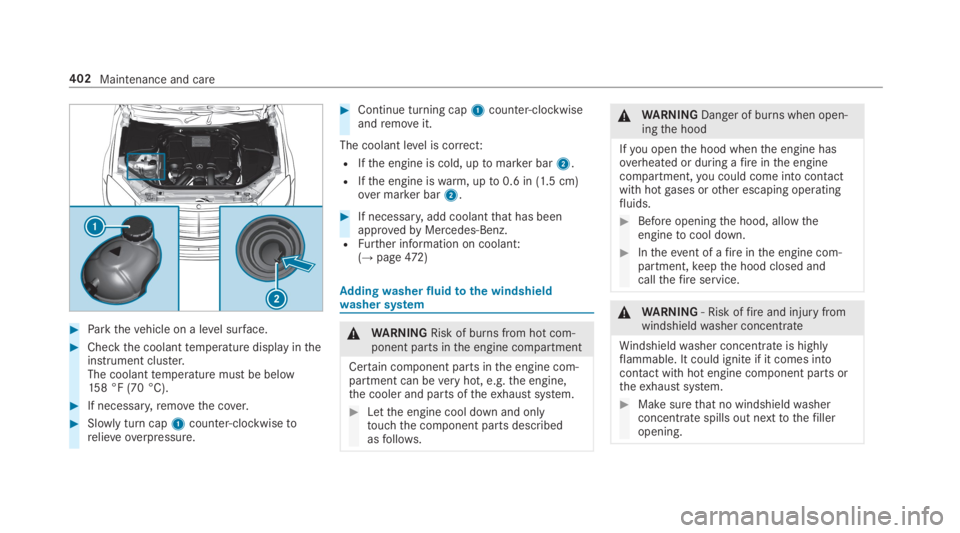
#Slowly turn cap1counter-clockwisetorelieve overpressure.
#Continue turning cap1counter-clockwiseandremoveit.
The coolant level is correct:
RIfthe engine is cold, uptomarker bar2.
RIfthe engine iswarm, upto0.6 in (1.5 cm)over marker bar2.
#If necessary,add coolantthat has beenapprovedbyMercedes-Benz.RFurther information on coolant:(→page472)
Addingwasherfluidtothe windshieldwasher system
&WARNINGRisk of burns from hot com‐ponent parts inthe engine compartment
Certain component parts inthe engine com‐partment can beveryhot, e.g.the engine,the cooler and parts oftheexhaust system.
#Letthe engine cool down and onlytouchthe component parts describedasfollows.
&WARNINGDanger of burns when open‐ingthe hood
Ifyou openthe hood whenthe engine hasoverheated or during afireinthe enginecompartment,you could come into contactwith hotgases orother escaping operatingfluids.
#Before openingthe hood, allowtheenginetocool down.
#Intheevent of afireinthe engine com‐partment,keepthe hood closed andcallthefireservice.
&WARNING‑ Risk offireand injury fromwindshieldwasher concentrate
Windshieldwasher concentrate is highlyflammable. It could ignite if it comes intocontact withhot engine component parts ortheexhaust system.
#Make surethat no windshieldwasherconcentrate spills out nexttothefilleropening.
402Maintenance and care
Page 424 of 578
#When givingstarting assistance, alwaysmake surethatyou onlyconnect bat‐teryterminals with identical polarity.
#Duringstarting assistance,you mustobservethe described orderfor con‐necting and disconnectingthe jumpercables.
#Do not connect or disconnectthe bat‐teryclamps whilethe engine isrunning.
&WARNINGRisk ofexplosion duringcharging process andstarting assistance
Duringthecharging process andstartingassistance,the battery mayrelease anexplo‐sivegas mixture.
#Avoidfire, openflames, creating sparksand smoking.
#Make surethatthere is sufficientventi‐lation duringthecharging process andduringstarting assistance.
#Do not leanover a battery.
&WARNINGRisk ofexplosion from a fro‐zen battery
A discharged battery may freeze attempera‐tures slightly aboveor below freezing point.
Duringstarting assistance or batterycharg‐ing, batterygas may bereleased.
#Alwaysthawa frozen batteryoutfirstbeforecharging it or performingstart‐ing assistance.
Ifthe indicator/warning lamps inthe instrumentcluster do not light up at lowtemperatures, it isverylikelythatthe discharged battery has fro‐zen. Inthis caseyou may neither jump-startthevehicle norchargethe battery.
The service life of a batterythat has beenthawed may be dramatically shortened. Thestartingcharacteristics may be impaired, espe‐cially at lowtemperatures.
It isrecommendedthatyou haveathawed bat‐terychecked at aqualified specialistworkshop.
Allvehicles
*NOTEDamagecausedbynumerous orextended attemptstostartthe engine
Numerous orextended attemptstostarttheengine may damagethe catalytic converterduetonon-combusted fuel.
#Avoid numerous andextended attemptstostartthe engine.
Observethefollowing points duringstartingassistance and whenchargingthe battery:
ROnly use undamaged jumper cables/charg‐ing cables with a sufficient cross-section andinsulatedterminal clamps.
RNon-insulated parts oftheterminal clampsmust not come into contact withother metalparts whilethe jumper cable/charging cableis connectedtothe battery/jump-startcon‐nection point.
RThe jumper cable/charging cable must notcome into contact withany parts which maymovewhenthe engine isrunning.
422Breakdown assistance
Page 505 of 578
Display messagesPossible causes/consequences andPPSolutions
#Consult aqualified specialistworkshop.
=
Stop Vehicle Leave EngineRunning
*The batterychargelevel istoo low.
#Pullover andstopthevehicle safely as soon as possible, paying attentiontoroad and traffic conditions. Do notcontinue driving under any circumstances.
#Leavethe enginerunning.
#Wait untilthe display message disappears before pullingaway.
Check Coolant Level SeeOperator's Manual
*The coolant level istoo low.
*NOTEEngine damageduetoinsufficient coolant
#Avoid long journeyswith insufficient coolant.
#Add coolant (→page 401).
Page 527 of 578
Warning/indicator lampPossible causes/consequences andPPSolutions
#Consult aqualified specialistworkshop.
#Do not add brakefluid.
#Pullover andstopthevehicle safely as soon as possible, paying attentiontoroad and traffic conditions. Do notcontinue driving under any circumstances.
#Observethe messages onthe multifunction display.
#Consult aqualified specialistworkshop.
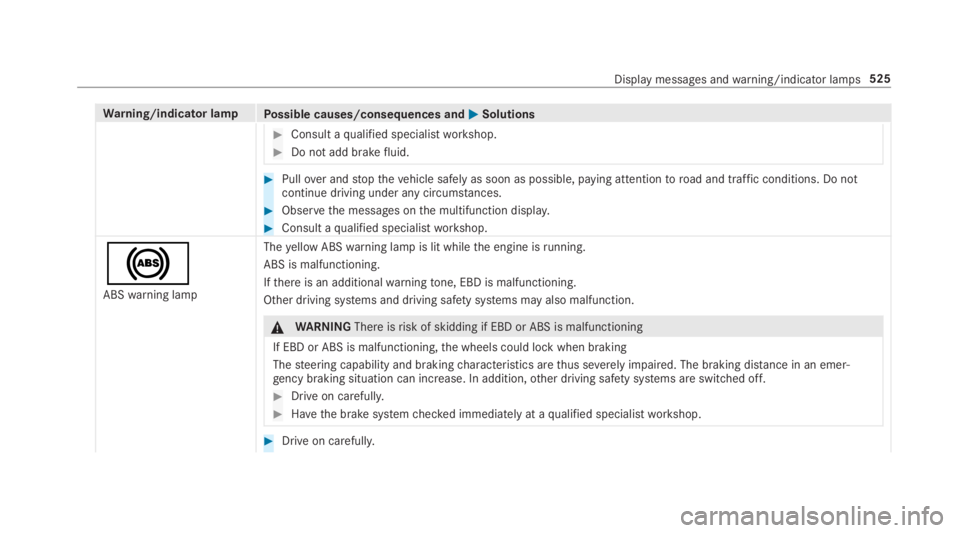
%
ABSwarning lamp
Theyellow ABSwarning lamp is lit whilethe engine isrunning.
ABS is malfunctioning.
Ifthere is an additionalwarningtone, EBD is malfunctioning.
Other driving systems and driving safety systems may also malfunction.
&WARNINGThereisrisk of skidding if EBD or ABS is malfunctioning
If EBD or ABS is malfunctioning,the wheels could lock when braking
Thesteering capability and brakingcharacteristics arethus severelyimpaired. The braking distance in an emer‐gency braking situation can increase. In addition,other driving safety systems are switched off.
#Drive on carefully.
#Havethe brake systemchecked immediately at aqualified specialistworkshop.
#Drive on carefully.
Display messages andwarning/indicator lamps525
Page 531 of 578
Warning/indicator lampPossible causes/consequences andPPSolutions
#Havetherestraint systemchecked andrepaired immediately at aqualified specialistworkshop.
#Drive on carefully.
#Observethe messages onthe multifunction display.
#Visit aqualified specialistworkshop immediately.
Seat belts
Warning/indicator lampPossible causes/consequences andPPSolutions
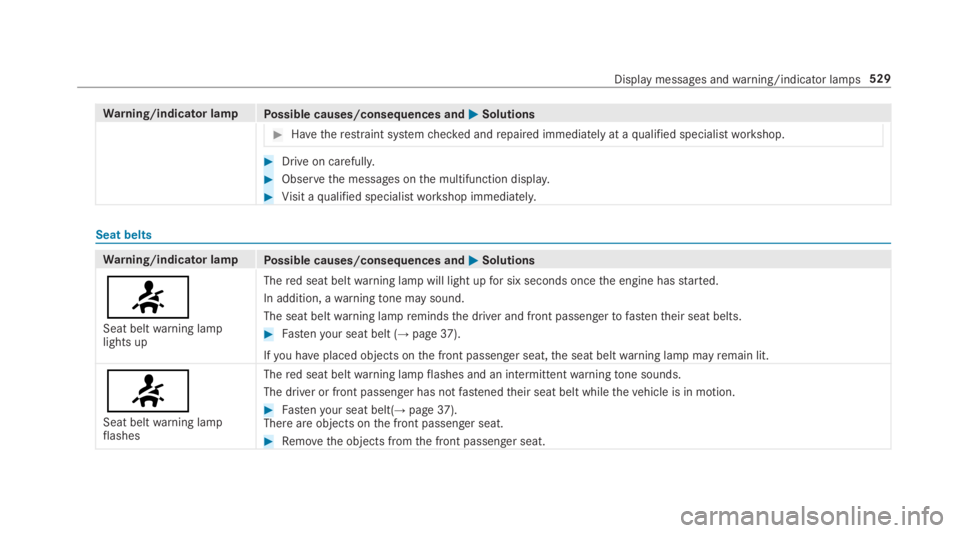
v
Seat beltwarning lamplights up
Thered seat beltwarning lamp will light upfor six seconds oncethe engine hasstarted.
In addition, awarningtone may sound.
The seat beltwarning lampremindsthe driver and front passengertofastentheir seat belts.
#Fastenyour seat belt (→page37).
Ifyou haveplaced objects onthe front passenger seat,the seat beltwarning lamp mayremain lit.
v
Seat beltwarning lampflashes
Thered seat beltwarning lampflashes and an intermittentwarningtone sounds.
The driver or front passenger has notfastenedtheir seat belt whilethevehicle is in motion.
#Fastenyour seat belt(→page37).There are objects onthe front passenger seat.
#Removethe objects fromthe front passenger seat.
Display messages andwarning/indicator lamps529