2019 MERCEDES-BENZ GLC length
[x] Cancel search: lengthPage 208 of 370
When overtaking, pay particular attention to theextended length of your vehicle/trailer combi-nation.
Due to the length of the vehicle/trailer combi-nation, you require additional road space whenovertaking before you can change back to theoriginal lane.
If the automatic transmission repeatedly shiftsbetween gears on uphill or downhill gradients,shift to a lower gear.
Driving in a lower gear and at a reduced speeddecreases the risk of engine damage.
If the coolant temperature increases signifi-cantly when climate control is switched on,switch climate control off.
Coolant heat can also be dissipated by openingthe windows and switching the ventilationblower and the interior temperature to the high-est level.
Decoupling a trailer
GWARNING
If you uncouple a trailer with the overrun
brake engaged, you could trap your hand
between the vehicle and the trailer drawbar.
There is a risk of injury.
Do not uncouple a trailer if the overrun brake
is engaged.
GWARNING
Vehicles with level control:
The vehicle is lowered as soon as you discon-
nect the trailer cable. This could result in your
limbs or those of other people that are
between the vehicle body and tires or under-
neath the vehicle being trapped. There is a
risk of injury.
Make sure that nobody is in the immediate
vicinity of the wheel housings or under the
vehicle when you disconnect the trailer cable.
!Do not disconnect a trailer with an engagedoverrun brake. Otherwise, your vehicle couldbe damaged by the rebounding of the overrunbrake.
XApply the vehicle's parking brake manually.
XShift the transmission to position].
XClose all doors and the tailgate.
XSwitch off the engine.
XSecure the vehicle and trailer against rollingaway.
XRemove the trailer cable.
XRemove the safety chains, if there are any.
XUncouple the trailer.
Removing the ball coupling
XObserve the manufacturer's installationinstructions.
XPress the protective cap into the ball couplingrecess.
XMake sure that the protective cap is firmly inplace.
Observe the loading guidelines (Ypage 278)and the safety notes regarding stowage spaces(Ypage 278).
Information on cleaning and care of the trailertow hitch (Ypage 310).
Trailer power supply
!Accessories with a maximum power con-sumption of 180 W can be connected to thepermanent power supply.
You must not charge a trailer battery using thepower supply.
The trailer socket of your vehicle is equipped atthe factory with a permanent power supply.
The permanent power supply is supplied viatrailer socket pin 4.
The trailer's permanent power supply isswitched off in the event of low vehicle supplyvoltage and after six hours at the latest.
A qualified specialist workshop can providemore information about installing the trailerelectrics.
Permissible trailer loads and trailer
drawbar noseweights
Weight specifications
The gross trailer weight is calculated as theweight of the trailer plus the weight of the loadand the trailer's equipment.
206Towing a trailer
Driving and parking
Page 323 of 370
Mercedes-Benz. These batteries provideincreased impact protection to prevent vehicleoccupants from suffering acid burns should thebattery be damaged in the event of an accident.
In order for the battery to achieve the maximumpossible service life, it must always be suffi-ciently charged.
Like other batteries, the vehicle battery maydischarge over time if you do not use the vehicle.In this case, have the battery disconnected at aqualified specialist workshop. You can alsocharge the battery with a charger recommendedby Mercedes-Benz. Contact a qualified special-ist workshop for further information.
Have the battery charge state checked morefrequently if you use the vehicle mainly for shorttrips or if you leave it standing idle for a lengthyperiod. Consult a qualified specialist workshopif you wish to leave your vehicle parked for a longperiod of time.
Remove the SmartKey if you park the vehicleand do not require any electrical consumers.The vehicle will then use very little energy, thusconserving battery power.
Charging the 12 V battery
Vehicles with a lithium-ion battery:
!Only use battery chargers with a maximumcharging voltage of 14.4 V.
All vehicles except vehicles with a lithium-ion battery:
!Only use battery chargers with a maximumcharging voltage of 14.8 V.
GWARNING
During charging and jump-starting, explosive
gases can escape from the battery. There is a
risk of an explosion.
Particularly avoid fire, open flames, creating
sparks and smoking. Ensure there is sufficient
ventilation while charging and jump-starting.
Do not lean over a battery.
GWARNING
Battery acid is caustic. There is a risk of injury.
Avoid contact with skin, eyes or clothing. Do
not inhale any battery gases. Do not lean over
the battery. Keep children away from batter-
ies. Wash away battery acid immediately with
plenty of clean water and seek medical atten-
tion.
GWARNING
A discharged battery can freeze at tempera-
tures below freezing point. When jump-start-
ing the vehicle or charging the battery, gases
can escape from the battery. There is a risk of
an explosion.
Allow the frozen battery to thaw out before
charging it or jump-starting.
All vehicles:
!Only charge the battery using the jump-starting connection point.
The jump-starting connection point is in theengine compartment (Ypage 322).
XOpen the hood.
XConnect the battery charger to the positiveterminal and ground point in the same orderas when connecting the donor battery in thejump-starting procedure (Ypage 322).
Keep away from fire and open flames. Do notlean over a battery. Never charge the battery if itis still installed in the vehicle, unless you use abattery charger which has been tested andapproved by Mercedes-Benz. A battery chargerunit specially adapted for Mercedes-Benz vehi-cles and tested and approved by Mercedes-Benz is available as an accessory. It permits thecharging of the battery in its installed position.Contact an authorized Mercedes-Benz Centerfor further information and availability. Read thebattery charger's operating instructions beforecharging the battery.
All vehicles except vehicles with a lithium-ion battery:if the warning and indicator lampson the instrument cluster do not light up at lowtemperatures, it is very likely that the dis-charged battery has frozen. In this case you mayneither jump-start the vehicle nor charge thebattery. The service life of a thawed-out batterymay be shorter. The starting characteristics canbe impaired, particularly at low temperatures.Have the thawed-out battery checked at a quali-fied specialist workshop.
Vehicles with a lithium-ion battery:at lowtemperatures, do not charge a battery which hasbeen removed using a battery charger. Allow the
Battery (vehicle)321
Breakdown assistance
Z
Page 325 of 370
!Avoid repeated and lengthy starting attempts. Otherwise, the catalytic converter could bedamaged by the non-combusted fuel.
Do not start the vehicle using a rapid charging device. If your vehicle's battery is discharged, theengine can be jump-started from another vehicle or from a donor battery using jumper cables.Observe the following points:
RThe battery is not accessible in all vehicles. If the other vehicle's battery is not accessible, jump-start the vehicle using a donor battery or a jump-starting device.
Ryou may only jump-start the vehicle when the engine and exhaust system are cold.
RAll vehicles except vehicles with a lithium-ion battery:do not start the engine if the batteryis frozen. Let the battery thaw first.
RJump-starting may be performed only using batteries with a nominal voltage of 12 V.
ROnly use jumper cables which have a sufficient cross-section and insulated terminal clamps.
RIf the battery is fully discharged, leave the battery that is being used to jump-start connected fora few minutes before attempting to start. This charges the battery slightly.
RMake sure that the two vehicles do not touch.
Make sure that:
RThe jumper cables are not damaged.
RBare parts of the terminal clamp do not come into contact with other metal parts while the jumpercables are connected to the battery.
RThe jumper cables cannot come into contact with parts that can move when the engine is running,such as the V-belt pulley or the fan.
XSecure the vehicle by applying the electric parking brake.
XShift the transmission to position].
XMake sure that the ignition is switched off. All indicator lamps in the instrument cluster must beoff. When using the SmartKey, turn the SmartKey to positionZin the ignition lock and remove it(Ypage 131).
XSwitch off all electrical consumers, e.g. rear window defroster, lighting, etc.
XOpen the hood.
iRight-hand-drive vehicle:the jump-starting connection points may be located on the otherside of the vehicle.
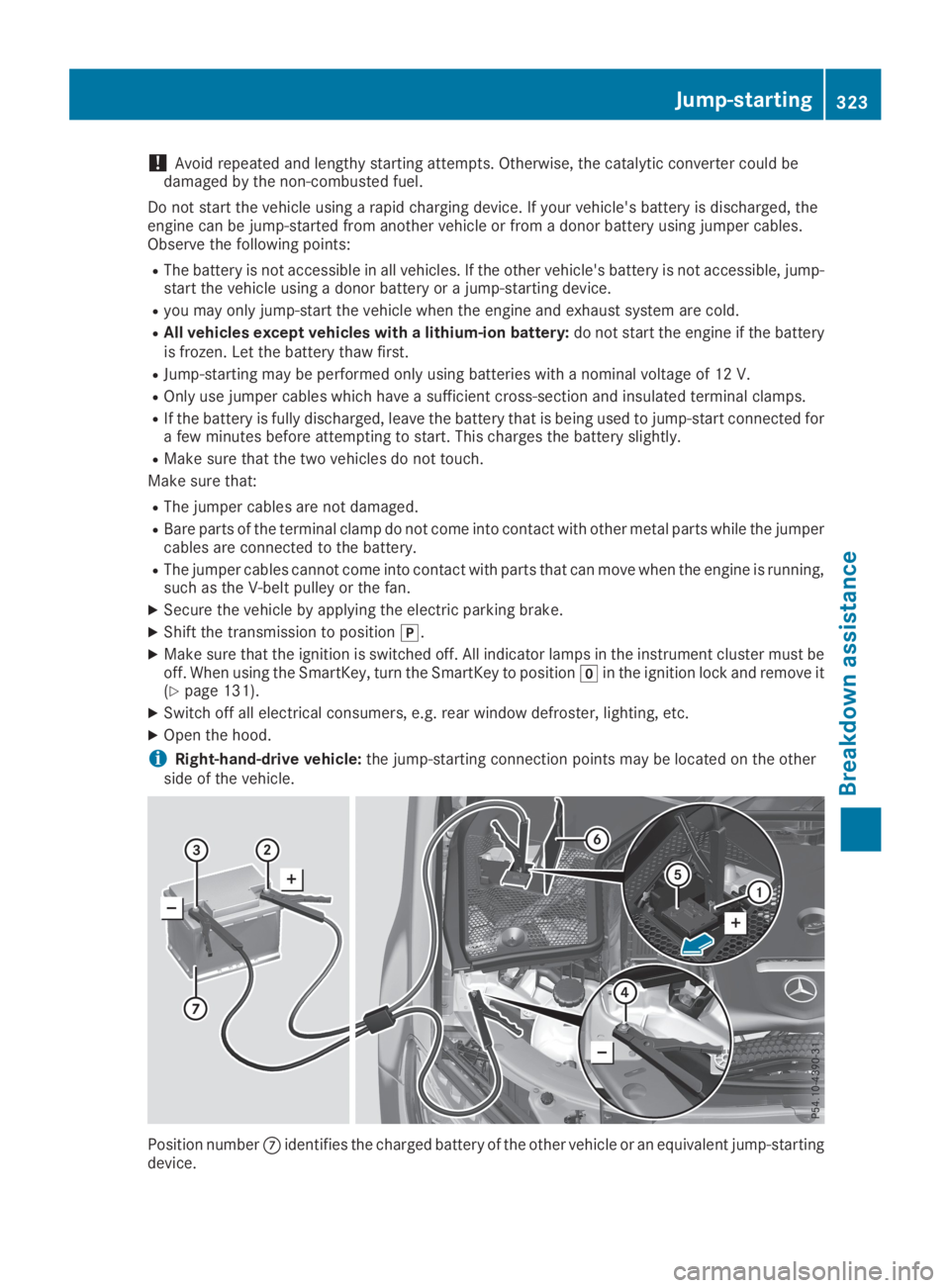
Position numberkidentifies the charged battery of the other vehicle or an equivalent jump-startingdevice.
Jump-starting323
Breakdown assistance
Z
Page 366 of 370
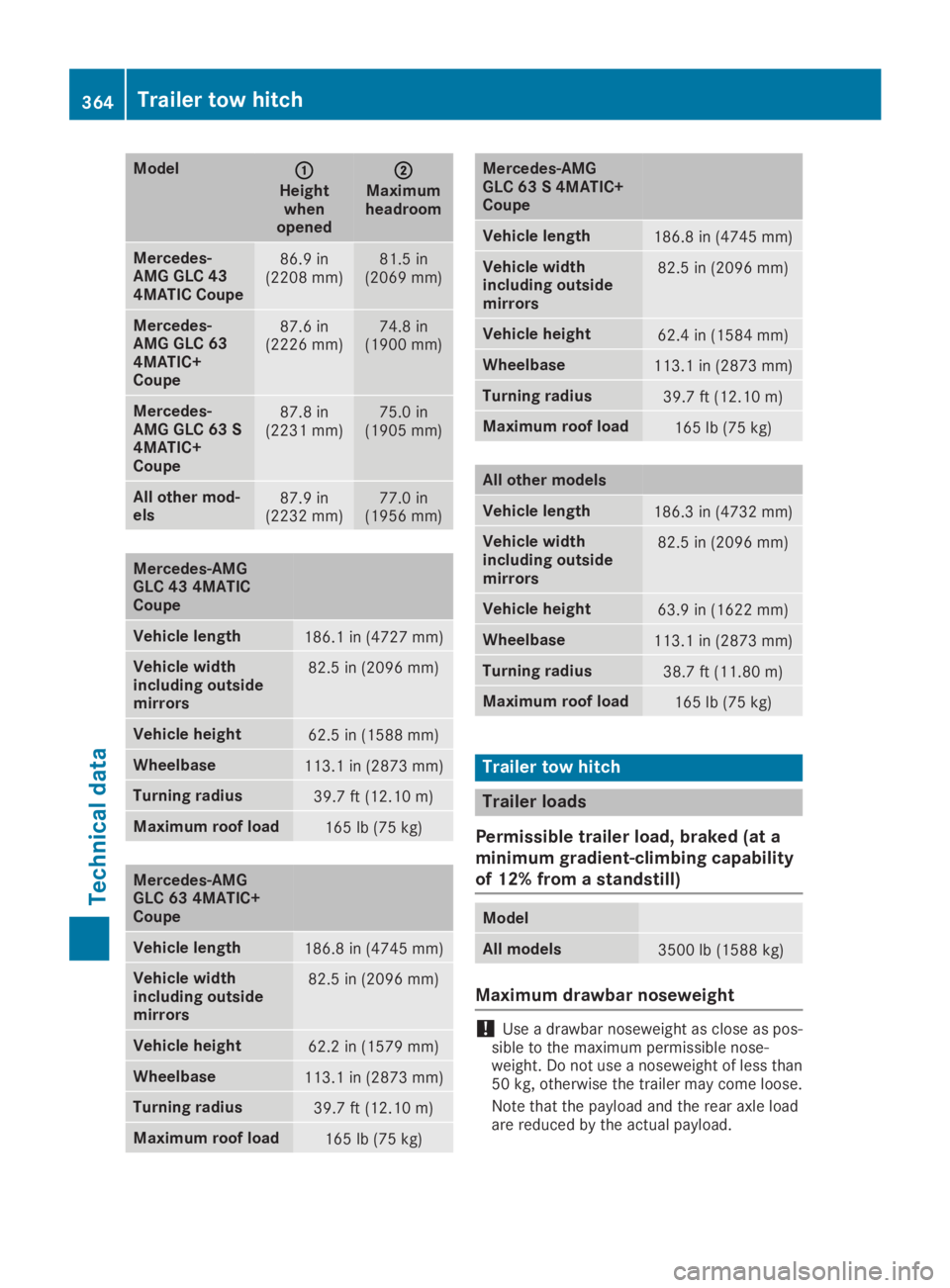
ModelCC
Heightwhenopened
DD
Maximumheadroom
Mercedes-AMG GLC 434MATIC Coupe
86.9 in(2208 mm)81.5 in(2069 mm)
Mercedes-AMG GLC 634MATIC+Coupe
87.6 in(2226 mm)74.8 in(1900 mm)
Mercedes-AMG GLC 63 S4MATIC+Coupe
87.8 in(2231 mm)75.0 in(1905 mm)
All other mod-els87.9 in(2232 mm)77.0 in(1956 mm)
Mercedes-AMGGLC 43 4MATICCoupe
Vehicle length186.1 in (4727 mm)
Vehicle widthincluding outsidemirrors
82.5 in (2096 mm)
Vehicle height62.5 in (1588 mm)
Wheelbase113.1 in (2873 mm)
Turning radius39.7 ft (12.10m)
Maximum roof load165 lb (75 kg)
Mercedes-AMGGLC 63 4MATIC+Coupe
Vehicle length186.8 in (4745 mm)
Vehicle widthincluding outsidemirrors
82.5 in (2096 mm)
Vehicle height62.2 in (1579 mm)
Wheelbase113.1 in (2873 mm)
Turning radius39.7 ft (12.10m)
Maximum roof load165 lb (75 kg)
Mercedes-AMGGLC 63 S 4MATIC+Coupe
Vehicle length186.8 in (4745 mm)
Vehicle widthincluding outsidemirrors
82.5 in (2096 mm)
Vehicle height62.4 in (1584 mm)
Wheelbase113.1 in (2873 mm)
Turning radius39.7 ft (12.10m)
Maximum roof load165 lb (75 kg)
All other models
Vehicle length186.3 in (4732 mm)
Vehicle widthincluding outsidemirrors
82.5 in (2096 mm)
Vehicle height63.9 in (1622 mm)
Wheelbase113.1 in (2873 mm)
Turning radius38.7 ft (11.80m)
Maximum roof load165 lb (75 kg)
Trailer tow hitch
Trailer loads
Permissible trailer load, braked (at a
minimum gradient-climbing capability
of 12% from a standstill)
Model
All models3500 lb (1588 kg)
Maximum drawbar noseweight
!Use a drawbar noseweight as close as pos-sible to the maximum permissible nose-weight. Do not use a noseweight of less than50 kg, otherwise the trailer may come loose.
Note that the payload and the rear axle loadare reduced by the actual payload.
364Trailer tow hitch
Technical data