2019 MERCEDES-BENZ CLA transmission
[x] Cancel search: transmissionPage 288 of 330
The towing eye is located with the vehicle toolkit under the cargo compartment floor(Ypage 274).
Vehicles with the TIREFIT kit: the towing eye isbeneath the tire inflation compressor(Ypage 274).
XPress the mark on coverCinwards in thedirection of the arrow.
XTake coverCoff the opening.
XScrew in the towing eye clockwise to the stop.
Removing the towing eye
XUnscrew and remove the towing eye.
XAttach coverCto the bumper and press untilit engages.
XPlace the towing eye in the stowage wellbeneath the cargo compartment floor in thecargo compartment (Ypage 274).
XVehicles with the TIREFIT kit: put back the tireinflation compressor (Ypage 274).
Towing the vehicle with the front axle
raised
Observe the important safety notes when tow-ing your vehicle with the front axle raised(Ypage 284).
Only vehicles without 4MATIC can be towedwith the front axle raised.
!Vehicles with 4MATIC must not be towedwith either the front or the rear axle raised, asdoing so will damage the transmission.
Vehicles with 4MATIC may either be towed awaywith both axles on the ground or be loaded upand transported.
!The ignition must be switched off if the vehi-cle is being towed with the front axle raised.
Otherwise, ESP®may intervene and damagethe brake system.
XOn vehicles with KEYLESS-GO or the KEY-LESS-GO start function:you must use theSmartKey instead of the Start/Stop button(Ypage 124).
XMake sure that the vehicle is stationary.
XTurn the SmartKey to positionHin the igni-tion lock.
XWhen the vehicle is stationary, depress thebrake pedal and keep it depressed.
XShift the automatic transmission to position].
XRelease the brake pedal.
XRelease the electric parking brake.
XSwitch off the automatic locking(Ypage 189).
XSwitch on the hazard warning lamps(Ypage 103).
XTurn the SmartKey in the ignition lock to posi-tionZand leave the SmartKey in the ignitionlock.
Towing a vehicle with both axles on
the ground
It is important that you observe the safetyinstructions when towing away your vehicle(Ypage 284).
XOn vehicles with KEYLESS-GO or the KEY-LESS-GO start function:you must use theSmartKey instead of the Start/Stop button(Ypage 124).
The automatic transmission automatically shiftsto position]when you open the driver's orfront-passenger door or when you remove theSmartKey from the ignition lock. In order toensure that the automatic transmission stays inposition\\when towing away the vehicle, youmust observe the following points:
XMake sure that the vehicle is stationary.
XTurn the SmartKey to positionHin the igni-tion lock.
XDepress and hold the brake pedal.
XShift the automatic transmission to position\\.
XLeave the SmartKey in positionHin the igni-tion lock.
XRelease the brake pedal.
XRelease the electric parking brake.
XSwitch on the hazard warning lamps(Ypage 103).
iIn order to signal a change of direction whentowing the vehicle with the hazard warninglamps switched on, use the combinationswitch as usual. In this case, only the indicatorlamps for the direction of travel flash. Afterresetting the combination switch, the hazardwarning lamp starts flashing again.
286Towing and tow-starting
Breakdown assistance
Page 289 of 330
Permitted towing methods
Mercedes-Benz recommends transporting yourvehicle in the case of a breakdown, rather thantowing it away.
When towing away, use a towing rope or a tow-ing bar with both axles on the ground. Do not useany tow bar systems.
Transporting the vehicle
Vehicles with automatic transmission
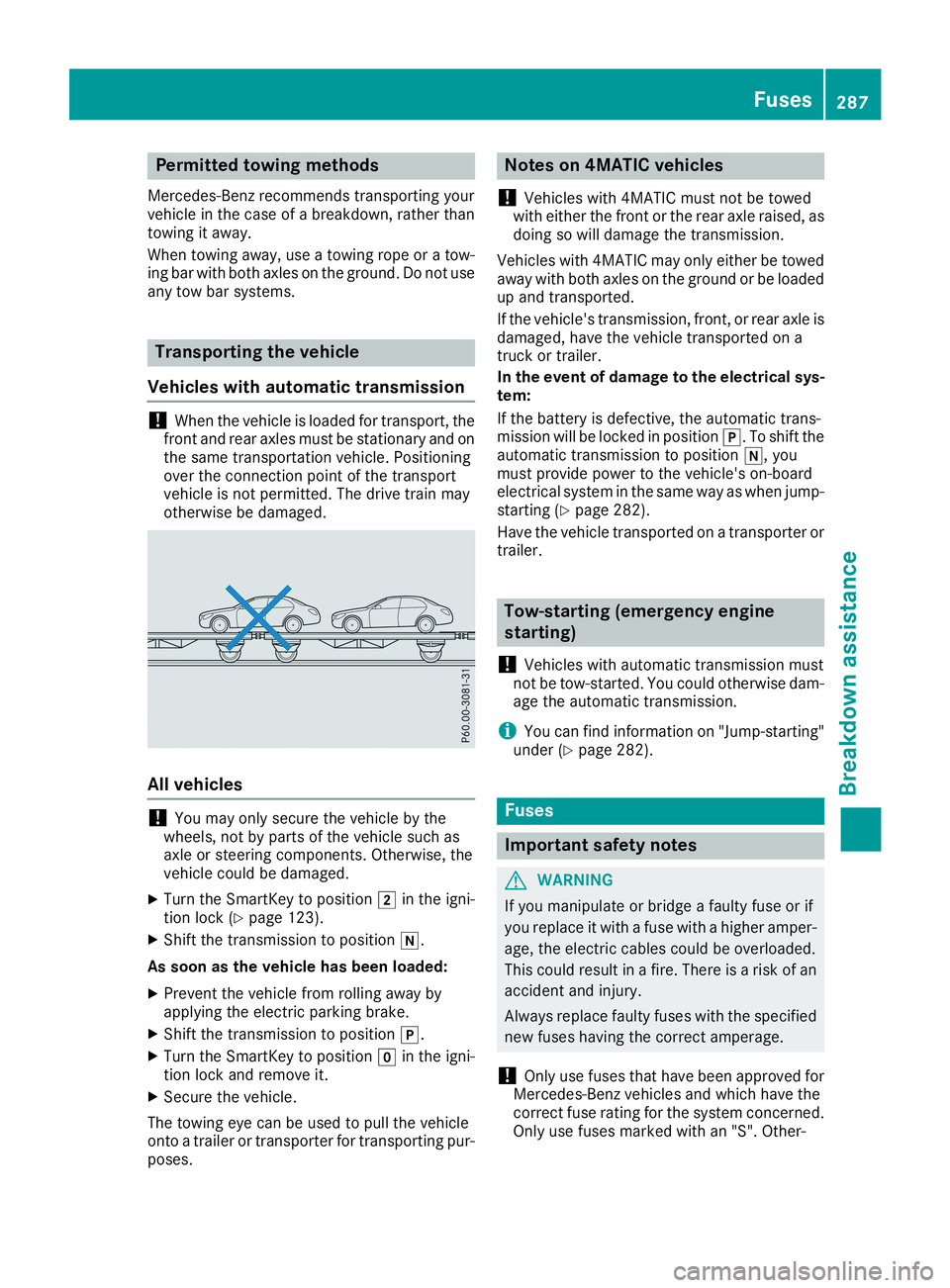
!When the vehicle is loaded for transport, thefront and rear axles must be stationary and onthe same transportation vehicle. Positioningover the connection point of the transportvehicle is not permitted. The drive train mayotherwise be damaged.
All vehicles
!You may only secure the vehicle by thewheels, not by parts of the vehicle such asaxle or steering components. Otherwise, thevehicle could be damaged.
XTurn the SmartKey to positionHin the igni-tion lock (Ypage 123).
XShift the transmission to position\\.
As soon as the vehicle has been loaded:
XPrevent the vehicle from rolling away byapplying the electric parking brake.
XShift the transmission to position].
XTurn the SmartKey to positionZin the igni-tion lock and remove it.
XSecure the vehicle.
The towing eye can be used to pull the vehicleonto a trailer or transporter for transporting pur-poses.
Notes on 4MATIC vehicles
!Vehicles with 4MATIC must not be towedwith either the front or the rear axle raised, asdoing so will damage the transmission.
Vehicles with 4MATIC may only either be towedaway with both axles on the ground or be loadedup and transported.
If the vehicle's transmission, front, or rear axle isdamaged, have the vehicle transported on atruck or trailer.
In the event of damage to the electrical sys-tem:
If the battery is defective, the automatic trans-mission will be locked in position]. To shift theautomatic transmission to position\\, youmust provide power to the vehicle's on-boardelectrical system in the same way as when jump-starting (Ypage 282).
Have the vehicle transported on a transporter ortrailer.
Tow-starting (emergency engine
starting)
!Vehicles with automatic transmission mustnot be tow-started. You could otherwise dam-age the automatic transmission.
iYou can find information on "Jump-starting"under (Ypage 282).
Fuses
Important safety notes
GWARNING
If you manipulate or bridge a faulty fuse or if
you replace it with a fuse with a higher amper-
age, the electric cables could be overloaded.
This could result in a fire. There is a risk of an
accident and injury.
Always replace faulty fuses with the specified
new fuses having the correct amperage.
!Only use fuses that have been approved forMercedes-Benz vehicles and which have thecorrect fuse rating for the system concerned.Only use fuses marked with an "S". Other-
Fuses287
Breakdown assistance
Z
Page 313 of 330
Tire-mounting tools should not be used nearthe valve. This could damage the electroniccomponents.
Only have tires changed at a qualified spe-cialist workshop.
Observe the instructions and safety notes in the"Changing a wheel" section (Ypage 310).
The wear patterns on the front and rear tiresdiffer, depending on the operating conditions.Rotate the wheels before a clear wear patternhas formed on the tires. Front tires typicallywear more on the shoulders and the rear tires inthe center.
On vehicles that have the same size front andrear wheels, you can rotate the wheels accord-ing to the intervals in the tire manufacturer'swarranty book in your vehicle documents. If nowarranty book is available, the tires should berotated every 3,000 to 6,000 miles (5,000 to10,000 km). Depending on tire wear, this maybe required earlier. Do not change the directionof wheel rotation.
Clean the contact surfaces of the wheel and thebrake disc thoroughly every time a wheel is rota-ted. Check the tire pressure and, if necessary,restart the tire pressure loss warning system(Canada only) or the tire pressure monitor (USAonly).
Direction of rotation
Tires with a specified direction of rotation haveadditional benefits, e.g. if there is a risk of hydro-planing. These advantages can only be gained ifthe tires are installed corresponding to thedirection of rotation.
An arrow on the sidewall of the tire indicates itscorrect direction of rotation.
Storing wheels
Store wheels that are not being used in a cool,dry and preferably dark place. Protect the tiresfrom oil, grease, gasoline and diesel.
Mounting a wheel
Preparing the vehicle
XStop the vehicle on solid, non-slippery andlevel ground.
XApply the electric parking brake manually.
XBring the front wheels into the straight-aheadposition.
XShift the transmission to position].
XSwitch off the engine.
XVehicles without KEYLESS-GO:remove theSmartKey from the ignition lock.
XVehicles with KEYLESS-GO start-functionor KEYLESS-GO:open the driver's door.The vehicle electronics are now in position
Page 320 of 330
The maximum transmission output (PEAK) at thebase of the antenna must not exceed the fol-lowing values:
Frequency bandMaximumtransmissionoutput
Short wave
3 - 54 MHz
100 W
4 m waveband
74 - 88 MHz
30 W
2 m waveband
144 - 174 MHz
50 W
Trunked radio system/Tetra
380 - 460 MHz
10 W
70 cm waveband
400 - 460 MHz
35 W
Mobile communications(2G/3G/4G)10 W
The following can be used in the vehicle withoutrestrictions:
RRF transmitters with a maximum transmis-sion output of up to 100 mW
RRF transmitters with transmitter frequenciesin the 380 - 410 MHz frequency band and amaximum transmission output of up to 2 W(trunked radio system/Tetra)
RMobile phones (2G/3G/4G)
There is no restriction for antenna positions onthe outside of the vehicle for the following fre-quency bands:
RTrunked radio system/Tetra
R70 cm waveband
R2G/3G/4G
Identification plates
Vehicle identification plate with vehi-
cle identification number (VIN)
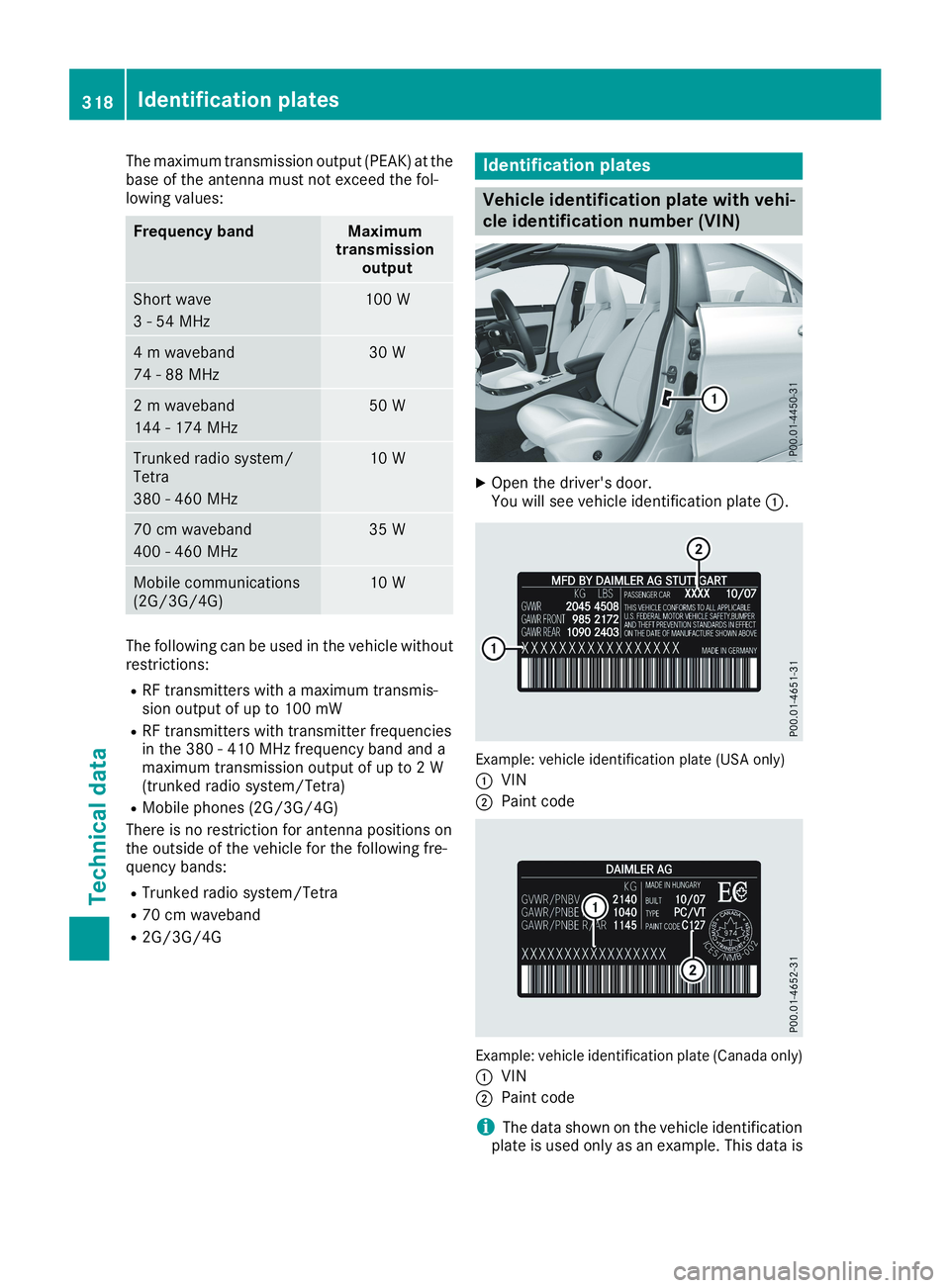
XOpen the driver's door.You will see vehicle identification plateC.
Example: vehicle identification plate (USA only)
CVIN
DPaint code
Example: vehicle identification plate (Canada only)
CVIN
DPaint code
iThe data shown on the vehicle identificationplate is used only as an example. This data is
318Identification plates
Technical data