2019 LEXUS UX250H low
[x] Cancel search: lowPage 428 of 476

4288-1. Specifications
information.
■DOT quality grades
All passenger vehicle tires must con-
form to Federal Safety Requirements in
addition to these grades. Quality
grades can be found where applicable
on the tire sidewall between tread
shoulder and maximum section width.
For example: Treadwear 200 Traction AA
Temperature A
■Treadwear
The treadwear grade is a comparative
rating based on the wear rate of the tire
when tested under controlled condi-
tions on a specified government test
course.
For example, a tire graded 150 would wear
one and a half (1 - 1/2) times as well on the
government course as a tire graded 100.
The relative performa nce of tires depends
upon the actual conditions of their use,
however, and may depart significantly from
the norm due to variatio ns in driving habits,
service practices and differences in road
characteristics and climate.
■Traction AA, A, B, C
The traction grades, from highest to
lowest, are AA, A, B and C, and they
represent the tire’s ability to stop on
wet pavement as measured under con-
trolled conditions on specified govern-
ment test surfaces of asphalt and
concrete.
A tire marked C may have poor traction
performance.
Warning: The traction grade assigned to
this tire is based on braking (straight
ahead) traction tests and does not include
cornering (turning) traction.
■Temperature A, B, C
The temperature grades are A (the
highest), B, and C, representing the
tire’s resistance to the generation of
heat and its ability to dissipate heat
when tested under controlled condi-
tions on a specified indoor laboratory
test wheel.
Sustained high temperature can cause the
material of the tire to degenerate and
reduce tire life, and excessive temperature
can lead to sudd en tire failure.
Grade C corresponds to a level of perfor-
mance which all passenger car tires must
meet under the Fede ral Motor Vehicle
Safety Standard No. 109.
Grades B and A represent higher levels of
performance on the laboratory test wheel
than the minimum required by law.
Warning: The temperature grades for this
tire are established for a tire that is prop-
erly inflated and not overloaded.
Excessive speed, unde rinflation, or exces-
sive loading, either separately or in combi-
nation, can cause heat buildup and
possible tire failure.
Page 429 of 476

4298-1. Specifications
8
Vehicle specifications
Glossary of tire terminology
Tire related termMeaning
Cold tire inflation pressure
Tire pressure when the vehicle has been parked for three
hours or more, or has not been driven more than 1 mile or 1.5
km under that condition
Maximum inflation pressureThe maximum cold inflated pre ssure to which a tire may be
inflated, shown on th e sidewall of the tire
Recommended inflation
pressureCold tire inflation pressure recommended by a manufac-
turer
Accessory weight
The combined weight (in excess of those standard items
which may be replaced) of hybr id transmission, power steer-
ing, power brakes, power windows, power seats, radio and
heater, to the extent that these items are available as factory-
installed equipment (whether installed or not)
Curb weight
The weight of a motor vehicle with standard equipment,
including the maximum capacity of fuel, oil and coolant, and
if so equipped, air conditio ning and additional weight
optional engine
Maximum loaded vehicle
weight
The sum of:
(a) Curb weight
(b) Accessory weight
(c) Vehicle capacity weight
(d) Production options weight
Normal occupant weight150 lb. (68 kg) times the number of occupants specified in
the second column of Table 1
* that follows
Occupant distributionDistribution of occupants in a ve hicle as specified in the third
column of Table 1
* below
Production options weight
The combined weight of in stalled regular production
options weighing over 5 lb. (2.3 kg) in excess of the stan-
dard items which they replace, not previously considered in
curb weight or accessory we ight, including heavy duty
brakes, ride levelers, roof r ack, heavy duty 12-volt battery,
and special trim
RimA metal support for a tire or a tire and tube assembly upon
which the tire beads are seated
Rim diameter
(Wheel diameter)Nominal diameter of the bead seat
Page 430 of 476
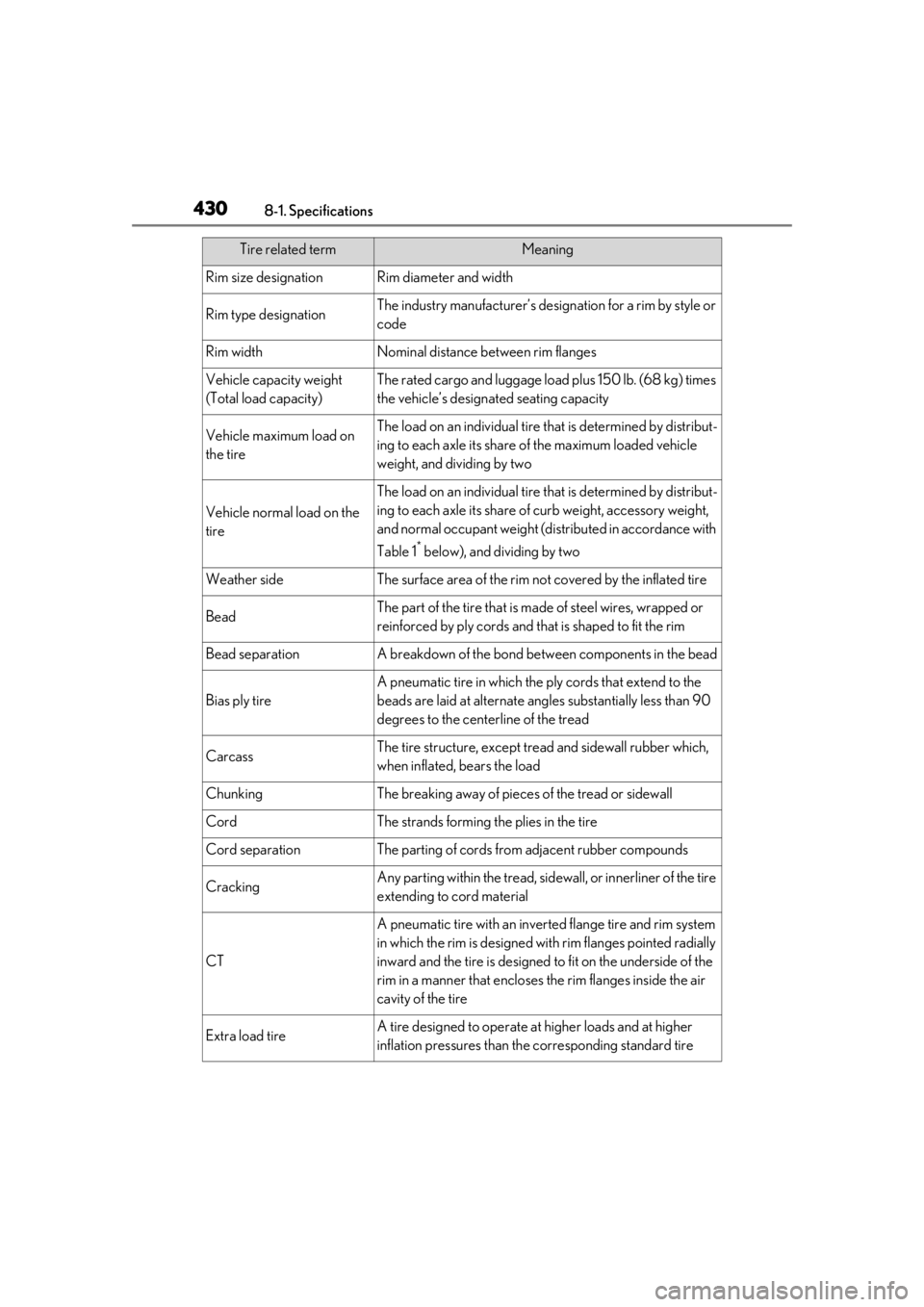
4308-1. Specifications
Rim size designationRim diameter and width
Rim type designationThe industry manufacturer’s designation for a rim by style or
code
Rim widthNominal distance between rim flanges
Vehicle capacity weight
(Total load capacity)The rated cargo and luggage load plus 150 lb. (68 kg) times
the vehicle’s designated seating capacity
Vehicle maximum load on
the tireThe load on an individual tire that is determined by distribut-
ing to each axle its share of the maximum loaded vehicle
weight, and dividing by two
Vehicle normal load on the
tire
The load on an individual tire that is determined by distribut-
ing to each axle its share of curb weight, accessory weight,
and normal occupant weight (distributed in accordance with
Table 1
* below), and dividing by two
Weather sideThe surface area of the rim not covered by the inflated tire
BeadThe part of the tire that is ma de of steel wires, wrapped or
reinforced by ply cords and th at is shaped to fit the rim
Bead separationA breakdown of the bond between components in the bead
Bias ply tire
A pneumatic tire in which the ply cords that extend to the
beads are laid at alternate angles substantially less than 90
degrees to the centerline of the tread
CarcassThe tire structure, except tread and sidewall rubber which,
when inflated, bears the load
ChunkingThe breaking away of pieces of the tread or sidewall
CordThe strands forming the plies in the tire
Cord separationThe parting of cords from adjacent rubber compounds
CrackingAny parting within the tread, side wall, or innerliner of the tire
extending to cord material
CT
A pneumatic tire with an inverted flange tire and rim system
in which the rim is designed wi th rim flanges pointed radially
inward and the tire is designed to fit on the underside of the
rim in a manner that encloses the rim flanges inside the air
cavity of the tire
Extra load tireA tire designed to operate at higher loads and at higher
inflation pressures than the corresponding standard tire
Tire related termMeaning
Page 436 of 476

4368-2. Customization
*1: For details about each function: P.78, 82, 91
*2: The default setting varies according to country.
*3:Except F SPORT models
*4: 2 of the following items: current fuel cons umption, average fuel economy (after reset),
average fuel economy (after start), average fuel economy (after refuel), average vehicle
speed (after reset), average vehicle speed (after start), elapsed time (after reset),
elapsed time (after start), distance (driving range), distance (after start), blank.
*5:F SPORT models
■Head-up Display* ( P.93)
*:If equipped
Rev indicator*5OnOffO
Rev indicator red zone set-
ting
*54000 r/min.2000 - 6200
r/min.O
Rev peak*5OnOffO
EV indicatorOnOffO
Suggestion functionOn
On (when the vehi-cle is stopped)
OO
Off
FunctionDefault settingCustomized set- ting
Gauge informationHybrid System IndicatorTachometerONo content
Route guidance to destinationOnOffO
Driving support system displayOnOffO
Compass*OnOffO
Audio system operation statusOnOffO
Function*1Default settingCustomized set- tingABC
ABC
Page 441 of 476
4418-2. Customization
8
Vehicle specifications
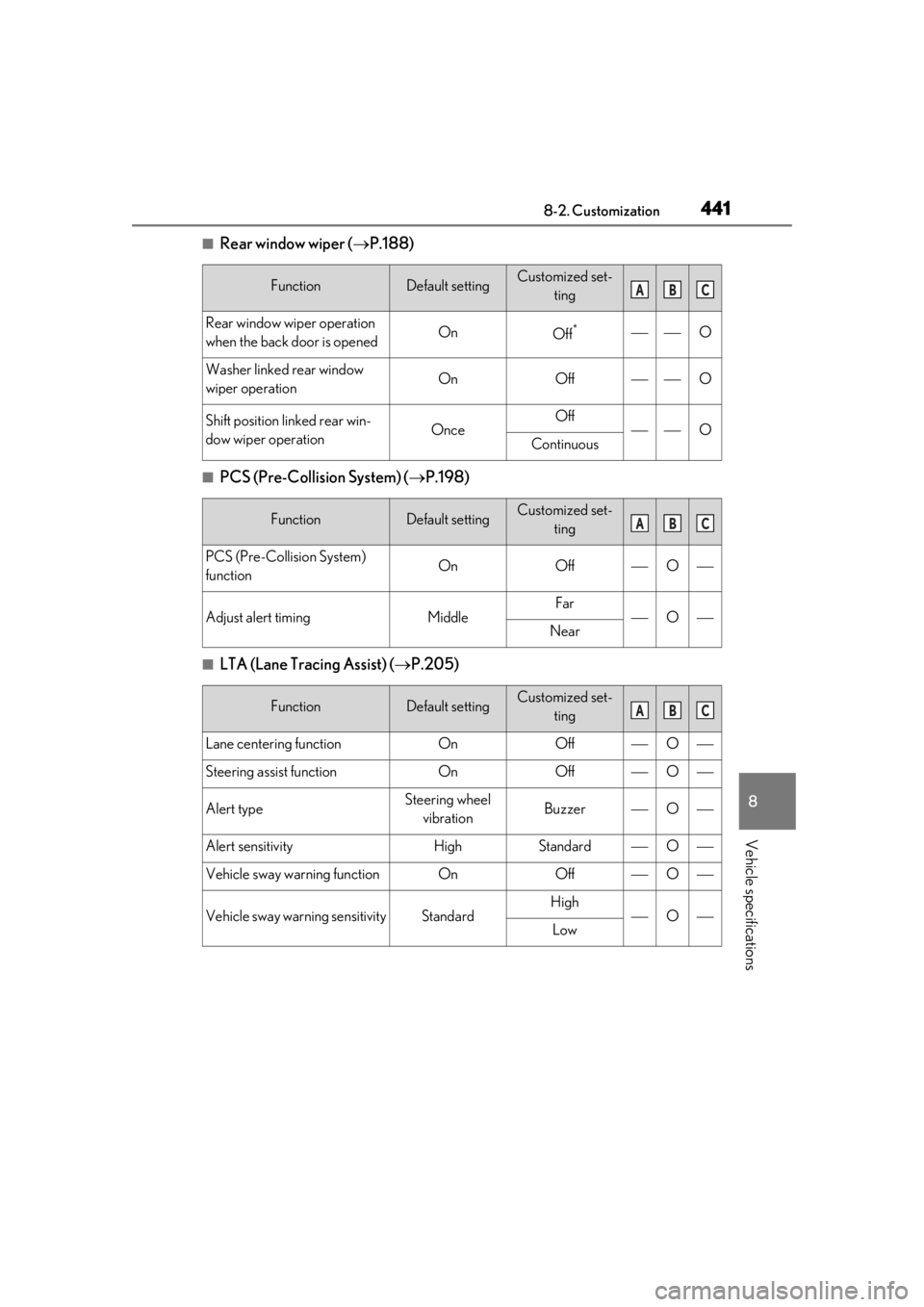
■Rear window wiper (P.188)
■PCS (Pre-Collision System) ( P.198)
■LTA (Lane Tracing Assist) ( P.205)
FunctionDefault settingCustomized set-
ting
Rear window wiper operation
when the back door is openedOnOff*O
Washer linked rear window
wiper operationOnOffO
Shift position linked rear win-
dow wiper operationOnceOffOContinuous
FunctionDefault settingCustomized set-ting
PCS (Pre-Collision System)
functionOnOffO
Adjust alert timingMiddleFarONear
FunctionDefault settingCustomized set-ting
Lane centering functionOnOffO
Steering assist functionOnOffO
Alert typeSteering wheel vibrationBuzzerO
Alert sensitivityHighStandardO
Vehicle sway warning functionOnOffO
Vehicle sway warning sensitivityStandardHighOLow
ABC
ABC
ABC
Page 444 of 476
4448-2. Customization
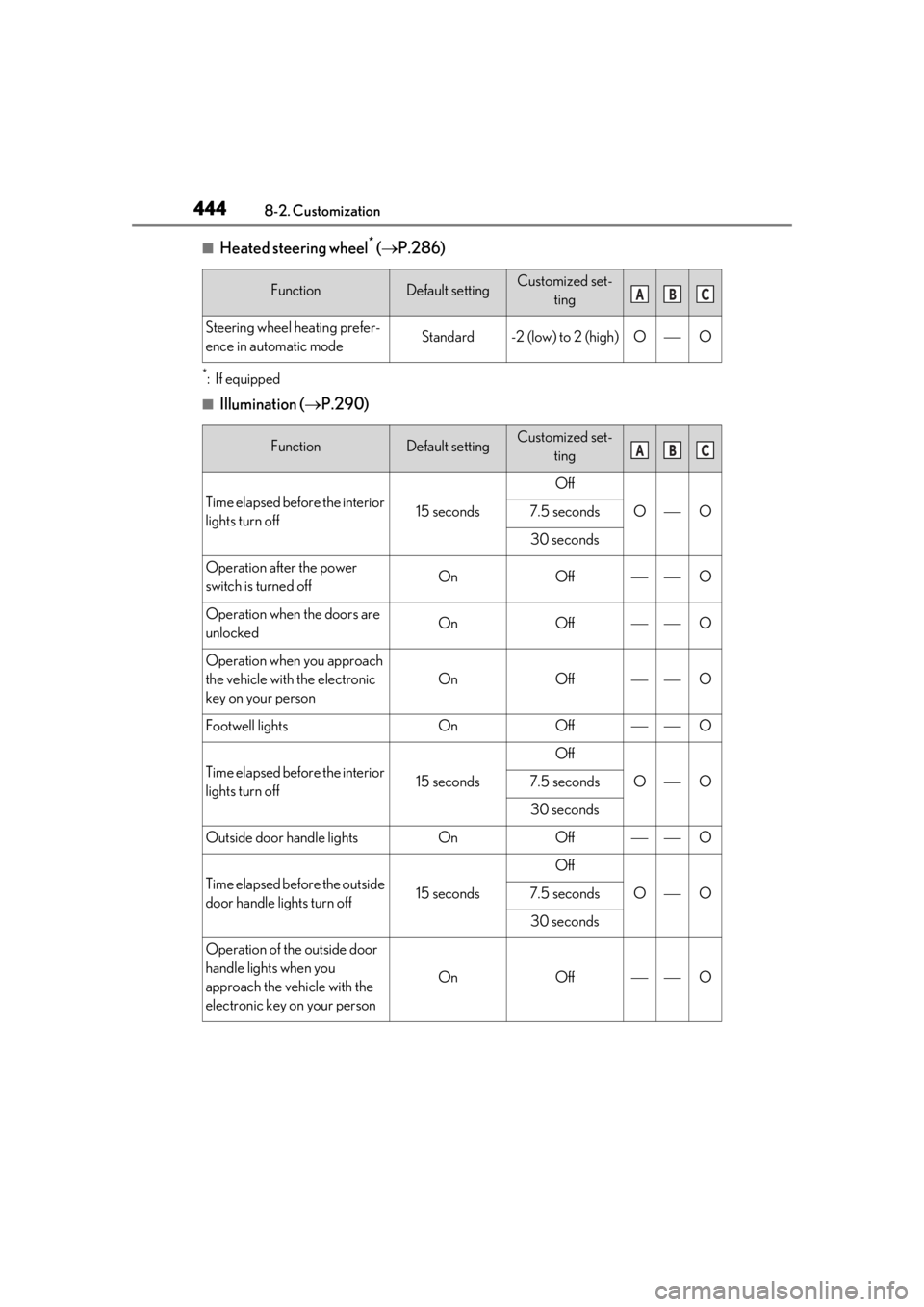
■Heated steering wheel* ( P.286)
*:If equipped
■Illumination ( P.290)
FunctionDefault settingCustomized set-
ting
Steering wheel heating prefer-
ence in automatic modeStandard-2 (low) to 2 (high)OO
FunctionDefault settingCustomized set-ting
Time elapsed before the interior
lights turn off15 seconds
Off
OO7.5 seconds
30 seconds
Operation after the power
switch is turned offOnOffO
Operation when the doors are
unlockedOnOffO
Operation when you approach
the vehicle with the electronic
key on your person
OnOffO
Footwell lightsOnOffO
Time elapsed before the interior
lights turn off15 seconds
Off
OO7.5 seconds
30 seconds
Outside door handle lightsOnOffO
Time elapsed before the outside
door handle lights turn off15 seconds
Off
OO7.5 seconds
30 seconds
Operation of the outside door
handle lights when you
approach the vehicle with the
electronic key on your person
OnOffO
ABC
ABC
Page 446 of 476
4468-3. Initialization
8-3.Initialization
*:If equipped
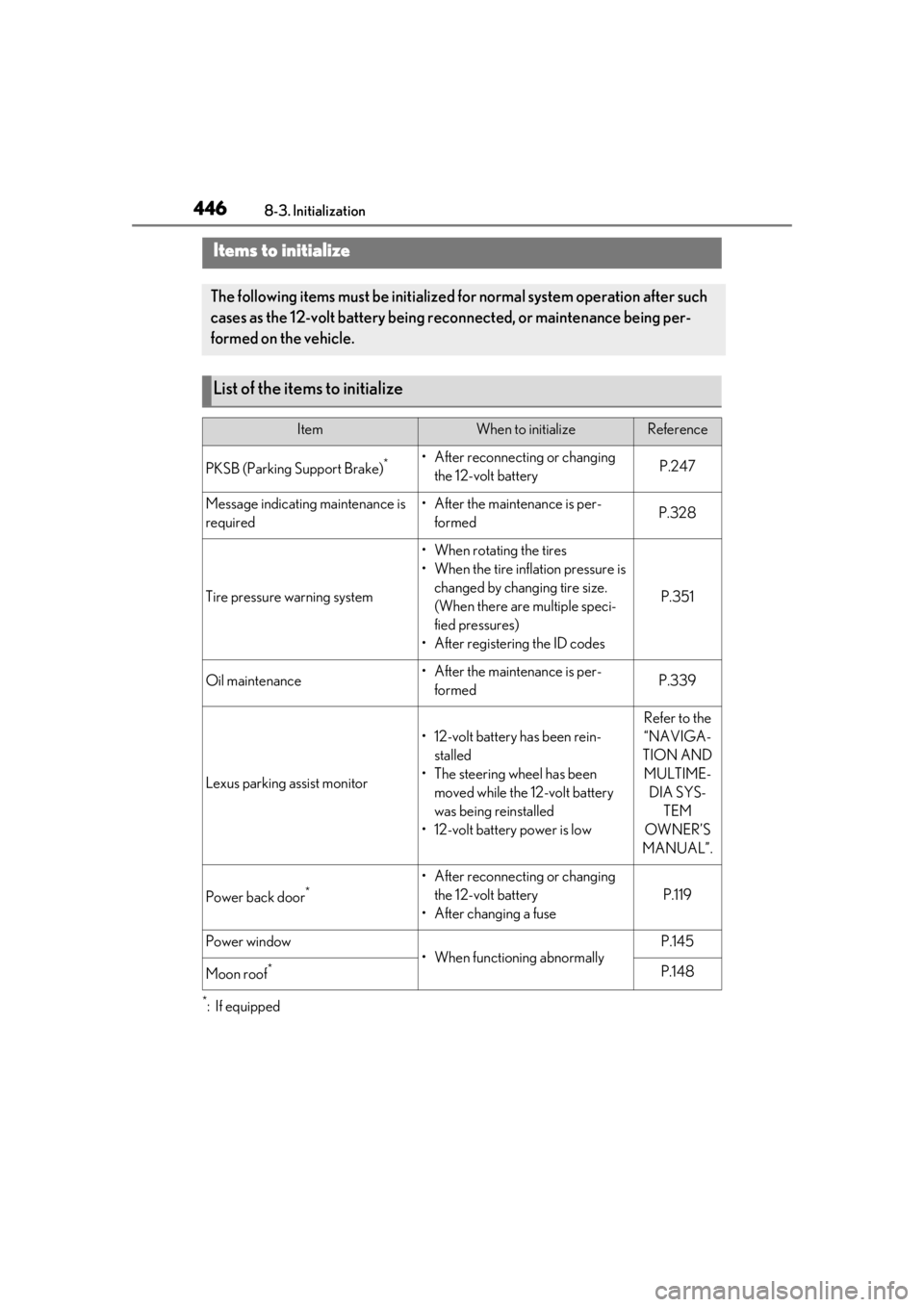
Items to initialize
The following items must be initialized for normal system operation after such
cases as the 12-volt battery being re connected, or maintenance being per-
formed on the vehicle.
List of the items to initialize
ItemWhen to initializeReference
PKSB (Parking Support Brake)*• After reconnecting or changing the 12-volt batteryP.247
Message indicating maintenance is
required• After the maintenance is per-formedP.328
Tire pressure warning system
• When rotating the tires
• When the tire inflation pressure is changed by changing tire size.
(When there are multiple speci-
fied pressures)
• After registering the ID codes
P.351
Oil maintenance• After the maintenance is per- formedP.339
Lexus parking assist monitor
• 12-volt battery has been rein-stalled
• The steering wheel has been moved while the 12-volt battery
was being reinstalled
• 12-volt battery power is low
Refer to the
“NAVIGA-
TION AND MULTIME- DIA SYS- TEM
OWNER’S
MANUAL”.
Power back door*• After reconnecting or changing the 12-volt battery
• After changing a fuse
P.119
Power window
• When functioning abnormally
P.145
Moon roof*P.148
Page 448 of 476
4489-1. For owners
9-1.For owners
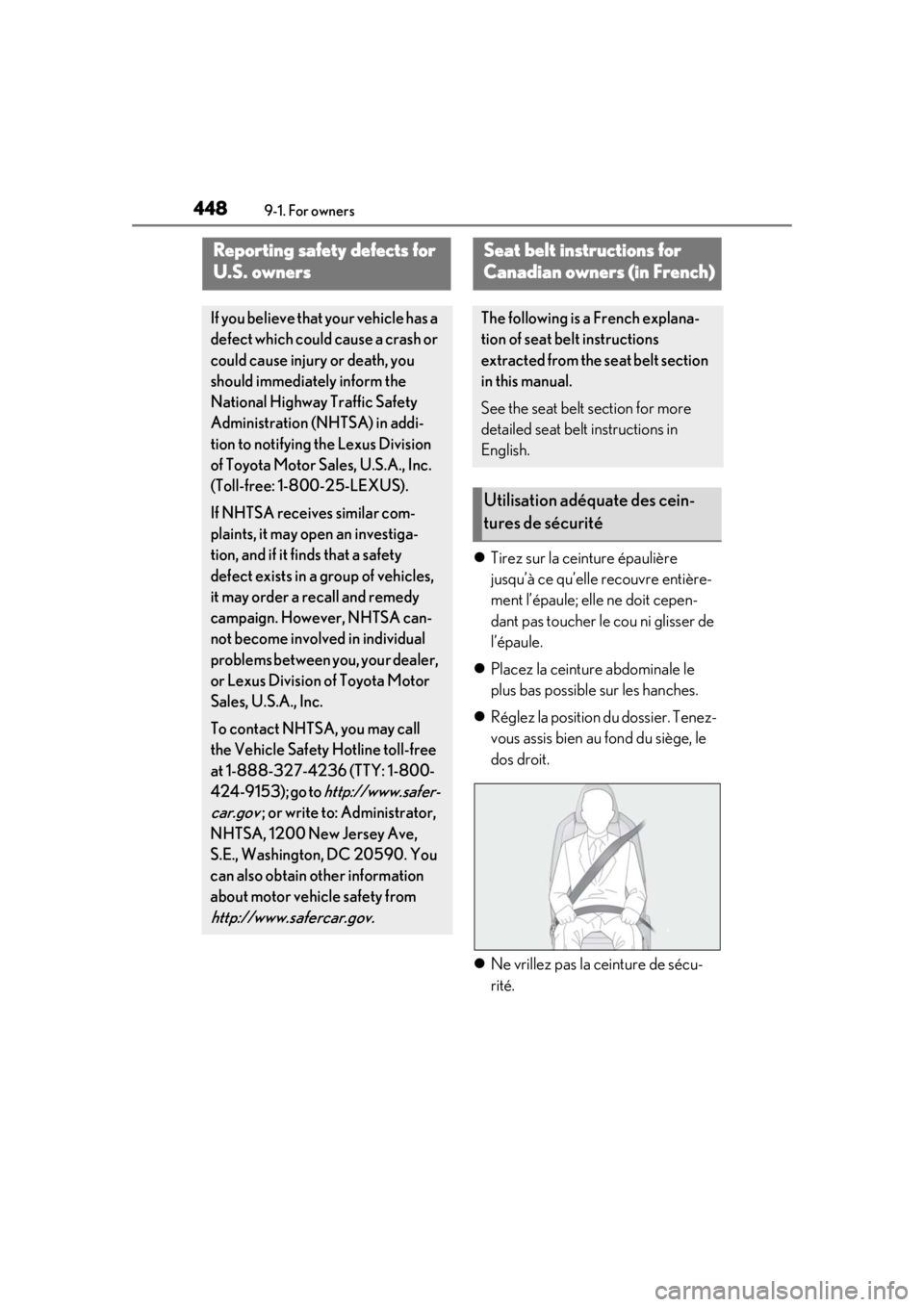
Tirez sur la ceinture épaulière
jusqu’à ce qu’elle recouvre entière-
ment l’épaule; elle ne doit cepen-
dant pas toucher le cou ni glisser de
l’épaule.
Placez la ceinture abdominale le
plus bas possible sur les hanches.
Réglez la position du dossier. Tenez-
vous assis bien au fond du siège, le
dos droit.
Ne vrillez pas la ceinture de sécu-
rité.
Reporting safety defects for
U.S. owners
If you believe that your vehicle has a
defect which could cause a crash or
could cause injury or death, you
should immediately inform the
National Highway Traffic Safety
Administration (NHTSA) in addi-
tion to notifying the Lexus Division
of Toyota Motor Sa les, U.S.A., Inc.
(Toll-free: 1-800-25-LEXUS).
If NHTSA receives similar com-
plaints, it may open an investiga-
tion, and if it finds that a safety
defect exists in a group of vehicles,
it may order a recall and remedy
campaign. However, NHTSA can-
not become involved in individual
problems between you, your dealer,
or Lexus Division of Toyota Motor
Sales, U.S.A., Inc.
To contact NHTS A, you may call
the Vehicle Safety Hotline toll-free
at 1-888-327-4236 (TTY: 1-800-
424-9153); go to
http://www.safer-
car.gov
; or write to: Administrator,
NHTSA, 1200 New Jersey Ave,
S.E., Washington, DC 20590. You
can also obtain other information
about motor vehicle safety from
http://www.safercar.gov.
Seat belt instructions for
Canadian owners (in French)
The following is a French explana-
tion of seat belt instructions
extracted from the seat belt section
in this manual.
See the seat belt section for more
detailed seat belt instructions in
English.
Utilisation adéquate des cein-
tures de sécurité