2019 LEXUS UX200 low
[x] Cancel search: lowPage 397 of 452

3978-1. Specifications
8
Vehicle specifications
■Gasoline quality
In very few cases, driveability problems may
be caused by the brand of gasoline you are
using. If driveability problems persist, try
changing the brand of gasoline. If this does
not correct the problem, consult your Lexus
dealer.
■Recommendation of the use of gasoline
containing detergent additives
●Lexus recommends the use of gasoline
that contains detergent additives to avoid
the build-up of engine deposits.
●All gasoline sold in the U.S.A. contains
minimum detergent additives to clean
and/or keep clean intake systems, per
EPA’s lowest additive s concentration pro-
gram.
●Lexus strongly recommends the use of
Top Tier Detergent Gasoline. For more
information on Top Tier Detergent Gaso-
line and a list of marketers, please go to
the official websit e www.toptiergas.com.
■Recommendation of the use of low
emissions gasoline
Gasolines containing oxygenates such as
ethers and ethanol, as well as reformulated
gasolines, are available in some cities.
These fuels are typically acceptable for use,
providing they meet other fuel require-
ments. Lexus recommends these fuels, since the
formulations allow for reduced vehicle
emissions.
■Non-recommendation of the use of
blended gasoline
●Use only gasoline containing up to 15%
ethanol.
DO NOT use any flex-fuel or gasoline
that could contain more than 15% etha-
nol, including from
any pump labeled
E30 (30% ethanol ), E50 (50% eth-
anol ), E85 (85% ethanol )
(which are only some examples of fuel
containing more than 15% ethanol).
●If you use gasohol in your vehicle, be sure
that it has an octane rating no lower than
87.
●Lexus does not recommend the use of
gasoline containing methanol.
■Non-recommendation of the use of gas-
oline containing MMT
Some gasoline contains an octane enhanc-
ing additive called MMT (Methylcyclopen-
tadienyl Manganese Tricarbonyl).
Lexus does not recommend the use of gas-
oline that contains MMT. If fuel containing
MMT is used, your emission control system
may be adversely affected.
The malfunction indicator lamp on the
instrument cluster may come on. If this hap-
pens, contact your Lexus dealer for service.
■If your engine knocks
●Consult your Lexus dealer.
●You may occasionally notice light knock-
ing for a short time wh ile accelerating or
driving uphill. This is normal and there is
no need for concern.
Fuel information
You must only use unleaded gaso-
line.
Select octane rating 87 (Research
Octane Number 91) or higher. Use
of unleaded gasoline with an octane
rating lower than 87 may result in
engine knocking. Persistent knock-
ing can lead to engine damage.
At minimum, the gasoline you use
should meet the specifications of
ASTM D4814 in the U.S.A.
A
BC
Page 398 of 452

3988-1. Specifications
NOTICE
■Notice on fuel quality
●Do not use improper fuels. If improper
fuels are used, the engine will be dam-
aged.
●Do not use leaded gasoline.
Leaded gasoline can cause damage to
your vehicle’s three-way catalytic con-
verters causing the emission control sys-
tem to malfunction.
●Do not use gasohol other than the type
previously stated.
Other gasohol may cause fuel system
damage or vehicle performance prob-
lems.
●Using unleaded gasoline with an
octane number or rating lower than
the level previously stated may cause
persistent he avy knocking.
At worst, this may lead to engine damage
and will void the vehicle warranty.
■Fuel-related poor driveability
If poor driveability (poor hot starting,
vaporization, engine knocking, etc.) is
encountered after using a different type
of fuel, discontinue the use of that type of
fuel.
■When refueling with gasohol
Take care not to spill gasohol. It can dam-
age your vehicle’s paint.
Page 400 of 452
4008-1. Specifications
For details, see “Uniform Tire Quality Grading” that follows.
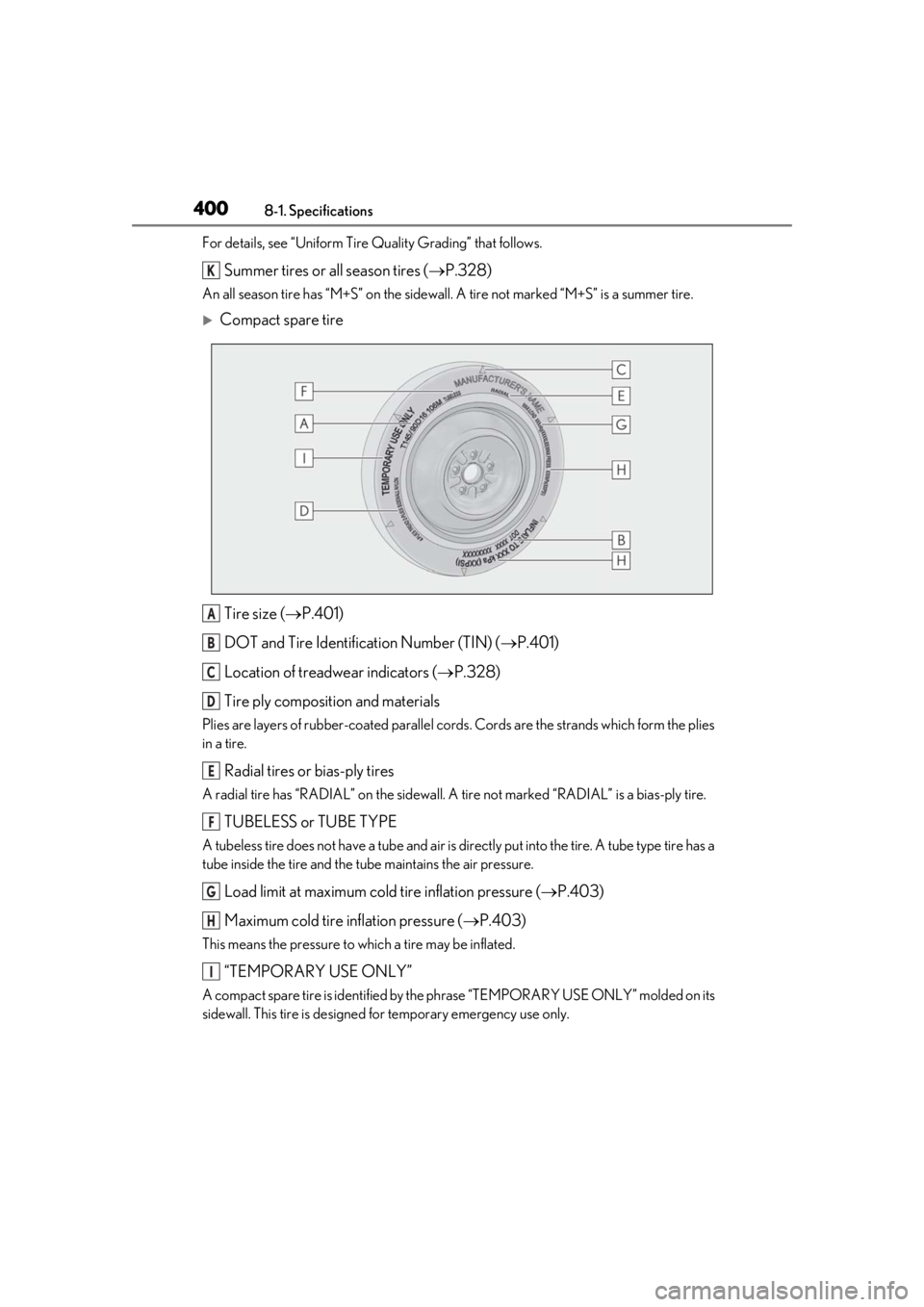
Summer tires or all season tires (P.328)
An all season tire has “M+S” on the sidewall. A tire not marked “M+S” is a summer tire.
Compact spare tire
Tire size ( P.401)
DOT and Tire Identification Number (TIN) ( P.401)
Location of treadwear indicators ( P.328)
Tire ply composition and materials
Plies are layers of rubber-coated parallel cords. Cords are the strands which form the plies
in a tire.
Radial tires or bias-ply tires
A radial tire has “RADIAL” on the sidewall. A tire not marked “RADIAL” is a bias-ply tire.
TUBELESS or TUBE TYPE
A tubeless tire does not have a tube and air is directly put into the tire. A tube type tire has a
tube inside the tire and the tube maintains the air pressure.
Load limit at maximum cold tire inflation pressure ( P.403)
Maximum cold tire inflation pressure ( P.403)
This means the pressure to which a tire may be inflated.
“TEMPORARY USE ONLY”
A compact spare tire is identified by the phrase “TEMPORARY USE ONLY” molded on its
sidewall. This tire is designed for temporary emergency use only.
K
A
B
C
D
E
F
G
H
I
Page 403 of 452
4038-1. Specifications
8
Vehicle specifications
■Traction AA, A, B, C
The traction grades, from highest to
lowest, are AA, A, B and C, and they
represent the tire’s ability to stop on
wet pavement as measured under con-
trolled conditions on specified govern-
ment test surfaces of asphalt and
concrete.
A tire marked C may have poor traction
performance.
Warning: The traction grade assigned to
this tire is based on braking (straight
ahead) traction tests and does not include
cornering (turning) traction.
■Temperature A, B, C
The temperature grades are A (the
highest), B, and C, representing the
tire’s resistance to the generation of
heat and its ability to dissipate heat when tested under controlled condi-
tions on a specified indoor laboratory
test wheel.
Sustained high temperature can cause the
material of the tire to degenerate and
reduce tire life, and excessive temperature
can lead to sudd
en tire failure.
Grade C corresponds to a level of perfor-
mance which all passenger car tires must
meet under the Fede ral Motor Vehicle
Safety Standard No. 109.
Grades B and A represent higher levels of
performance on the laboratory test wheel
than the minimum required by law.
Warning: The temperature grades for this
tire are established for a tire that is prop-
erly inflated and not overloaded.
Excessive speed, unde rinflation, or exces-
sive loading, either separately or in combi-
nation, can cause heat buildup and
possible tire failure.
Glossary of tire terminology
Tire related termMeaning
Cold tire inflation pressure
Tire pressure when the vehicle has been parked for three
hours or more, or has not been driven more than 1 mile or
1.5 km under that condition
Maximum inflation pressureThe maximum cold inflated pressure to which a tire may
be inflated, shown on the sidewall of the tire
Recommended inflation pres-
sureCold tire inflation pressure recommended by a manufac-
turer
Accessory weight
The combined weight (in excess of those standard items
which may be replaced) of automatic transmission, power
steering, power brakes, powe r windows, power seats,
radio and heater, to the extent that these items are avail-
able as factory-installed equi pment (whether installed or
not)
Page 404 of 452

4048-1. Specifications
Curb weight
The weight of a motor vehicle with standard equipment,
including the maximum capacity of fuel, oil and coolant,
and if so equipped, air conditioning and additional weight
optional engine
Maximum loaded vehicle
weight
The sum of:
(a) Curb weight
(b) Accessory weight
(c) Vehicle capacity weight
(d) Production options weight
Normal occupant weight150 lb. (68 kg) times the number of occupants specified in
the second column of Table 1
* that follows
Occupant distributionDistribution of occupants in a vehicle as specified in the
third column of Table 1
* below
Production options weight
The combined weight of in stalled regular production
options weighing over 5 lb. (2.3 kg) in excess of the stan-
dard items which they replace, not previously considered
in curb weight or accessory weight, including heavy duty
brakes, ride levelers, roof rack, heavy duty battery, and
special trim
RimA metal support for a tire or a tire and tube assembly upon
which the tire beads are seated
Rim diameter
(Wheel diameter)Nominal diameter of the bead seat
Rim size designationRim diameter and width
Rim type designationThe industry manufacturer’s designation for a rim by style
or code
Rim widthNominal distance between rim flanges
Vehicle capacity weight
(Total load capacity)The rated cargo and luggage load plus 150 lb. (68 kg)
times the vehicle’s desi gnated seating capacity
Vehicle maximum load on the
tireThe load on an individual tire that is determined by distrib-
uting to each axle its share of the maximum loaded vehicle
weight, and dividing by two
Vehicle normal load on the tire
The load on an individual tire that is determined by distrib-
uting to each axle its shar e of curb weight, accessory
weight, and normal occupant we ight (distributed in accor-
dance with Table 1
* below), and dividing by two
Tire related termMeaning
Page 410 of 452

4108-2. Customization
*2: The default setting varies according to country.
*3:Except F SPORT models
*4: 2 of the following items: current fuel consumption, average fuel economy (after reset),
average fuel economy (after start), average fuel economy (after refuel), average vehicle
speed (after reset), average vehicle speed (after start), elapsed time (after reset),
elapsed time (after start), distance (driving range), distance (after start), blank.
*5:F SPORT models
■Head-up Display* ( P.86)
*:If equipped
■Door lock ( P.98, 380)
FunctionDefault settingCustomized setting
Gauge informationTachometerEco Driving IndicatorONo content
Route guidance to destina-
tionOnOffO
Street name*OnOffO
Driving support system dis-
playOnOffO
Compass*OnOffO
Audio system operation sta-
tusOnOffO
FunctionDefault settingCustomized setting
Unlocking using a mechani-
cal key
Driver’s door
unlocked in one step, all doors
unlocked in two step
All doors unlocked in one stepO
Automatic door locking func-
tionShift position
linked door lock- ing operationOff
OOSpeed linked door locking operation
ABC
ABC
Page 415 of 452

4158-2. Customization
8
Vehicle specifications
■LTA (Lane Tracing Assist) (P.193)
■RSA (Road Sign Assist)* ( P.202)
*:If equipped
■BSM (Blind Spot Monitor)* ( P.214)
FunctionDefault settingCustomized setting
Lane centering functionOnOffO
Steering assist functionOnOffO
Alert typeSteering wheel
vibrationBuzzerO
Alert sensitivityHighStandardO
Vehicle sway warning func-
tionOnOffO
Vehicle sway warning sensi-
tivityStandardHighOLow
FunctionDefault settingCustomized setting
RSA (Road Sign Assist)OnOffO
Excess speed notification
methodNo notificationDisplay onlyODisplay and buzzer
Excess speed notification
level1 mph (2 km/h)5 mph (10 km/h)O3 mph (5 km/h)
Other notifications method
(No-entry notification)Display onlyNo notificationODisplay and buzzer
FunctionDefault settingCustomized setting
BSM (Blind Spot Monitor)OnOffO
Outside rear view mirror indi-
cator brightnessBrightDimO
Alert timing for presence of
approaching vehicle (sensitiv-
ity)
Intermediate
Early
OLate
Only when vehicle
detected in blind spot
ABC
ABC
ABC
Page 417 of 452
4178-2. Customization
8
Vehicle specifications
■Seat heater*/seat ventilators* ( P.271)
*:If equipped
■Heated steering wheel* ( P.271)
*:If equipped
■Illumination ( P.274)
FunctionDefault settingCustomized setting
Driver’s seat temperature
preference in automatic
mode
Standard-2 (cooler) to 2
(warmer)OO
Passenger’s seat tempera-
ture preference in automatic
mode
Standard-2 (cooler) to 2 (warmer)OO
FunctionDefault settingCustomized setting
Steering wheel heating pref-
erence in automatic modeStandard-2 (low) to 2 (high)OO
FunctionDefault settingCustomized setting
Time elapsed before the inte-
rior lights turn off15 seconds
Off
OO7.5 seconds
30 seconds
Operation after the engine
switch is turned offOnOffO
Operation when the doors
are unlockedOnOffO
Operation when you
approach the vehicle with the
electronic key on your person
OnOffO
Footwell lightsOnOffO
Time elapsed before the inte-
rior lights turn off15 seconds
Off
OO7.5 seconds
30 seconds
Outside door handle lightsOnOffO
ABC
ABC
ABC