2019 LEXUS UX200 ECO
[x] Cancel search: ECOPage 388 of 452

3887-2. Steps to take in an emergency
1Stop the engine. Shift the shift lever
to P and set the parking brake.
2
Remove the mud, snow or sand
from around the front wheels.
3
Place wood, stones or some other
material under the front wheels to
help provide traction.
4
Restart the engine.
5
Shift the shift lever to D or R and
release the parking brake. Then,
while exercising caution, depress
the accelerator pedal.
■When it is difficult to free the vehicle
Press the switch to turn off TRAC.
( P.245)
If the vehicle becomes stuck
Carry out the following proce-
dures if the tires spin or the vehicle
becomes stuck in mud, dirt or snow:
Recovering procedure
WARNING
■When attempting to free a stuck vehi-
cle
If you choose to push the vehicle back
and forth to free it, make sure the sur-
rounding area is clear to avoid striking
other vehicles, objects or people. The
vehicle may also lunge forward or lunge
back suddenly as it becomes free. Use
extreme caution.
■When shifting the shift lever
Be careful not to shif t the shift lever with
the accelerator pedal depressed.
This may lead to un expected rapid accel-
eration of the vehicle that may cause an
accident resulting in death or serious
injury.
NOTICE
■To avoid damage to the transmission
and other components
●Avoid spinning the tires and depress-
ing the accelerator pedal more than
necessary.
●If the vehicle remains stuck even after
these procedures are performed, the
vehicle may require towing to be freed.
Page 392 of 452
![LEXUS UX200 2019 Owners Manual 3928-1. Specifications
■Oil capacity (Drain and refill [Ref-
erence*])
*: The engine oil capacity is a reference quantity to be used when changing the
engine oil. Warm up and turn off the
engine,](/manual-img/36/58038/w960_58038-391.png "LEXUS UX200 2019 Owners Manual 3928-1. Specifications
■Oil capacity (Drain and refill [Ref-
erence*])
*: The engine oil capacity is a reference quantity to be used when changing the
engine oil. Warm up and turn off the
engine,")
3928-1. Specifications
■Oil capacity (Drain and refill [Ref-
erence*])
*: The engine oil capacity is a reference quantity to be used when changing the
engine oil. Warm up and turn off the
engine, wait more than 5 minutes, and
check the oil level on the dipstick.
■Engine oil selection
“Toyota Genuine Motor Oil” is used in
your Lexus vehicle. Use Lexus
approved “Toyota Genuine Motor Oil”
or equivalent to satisfy the following
grade and viscosity.
Oil grade: API SN/RC multigrade
engine oil
Recommended viscosity: SAE 0W-16
SAE 0W-16 is the best choice for good
fuel economy and good starting in cold
weather.
If SAE 0W-16 is not available, SAE
0W-20 oil may be used. However, it
must be replaced with SAE 0W-16 at
the next oil change.
Outside temperature Oil viscosity (0W-16 is explained here
as an example):
• The 0W in 0W-16 indicates the
characteristic of the oil which allows
cold startability. Oils with a lower
value before the W allow for easier
starting of the engine in cold
weather.
• The 16 in 0W-16 indicates the vis- cosity characteristic of the oil when
the oil is at high temperature. An oil
with a higher viscosity (one with a
higher value) may be better suited if
the vehicle is operated at high
speeds, or under extreme load con-
ditions.
How to read oil container label:
API registered marks is added to some
oil containers to help you select the oil
you should use.
Lubrication system
With filter4.9 qt. (4.6 L, 4.0 Imp.qt.)
Without filter4.5 qt. (4.3 L, 3.8 Imp.qt.)
A
Page 393 of 452

3938-1. Specifications
8
Vehicle specifications
*: The coolant capacity is a reference quantity.If replacement is necessary, contact your Lexus dealer.
■Spark plug
■Battery
Cooling system
Capacity*6.8 qt. (6.4 L, 5.6 Imp.qt.)
Coolant type
Use either of the following:
• “Toyota Super Long Life Coolant”
• Similar high-quality ethylene glycol-based non-silicate, non-
amine, non-nitrite, and non-borate coolant with long-life hybrid
organic acid technology
Do not use plain water alone.
Ignition system
MakeDENSO FC20HR-Q8
Gap0.031 in. (0.8 mm)
NOTICE
■Iridium-tipped spark plugs
Use only iridium-tipped spark plugs. Do not adjust the spark plug gap.
Electrical system
Open voltage at 68°F (20°C):12.3 V or higher
If the voltage is lower than the standard value,
charge the battery.
(After charging the battery, turn on the high beam
headlights for 30 seconds with the engine switch
OFF, and turn the headlights off.)
Charging rates:
Quick charge
Slow charge
15 A max.
5 A max.
Page 394 of 452
3948-1. Specifications
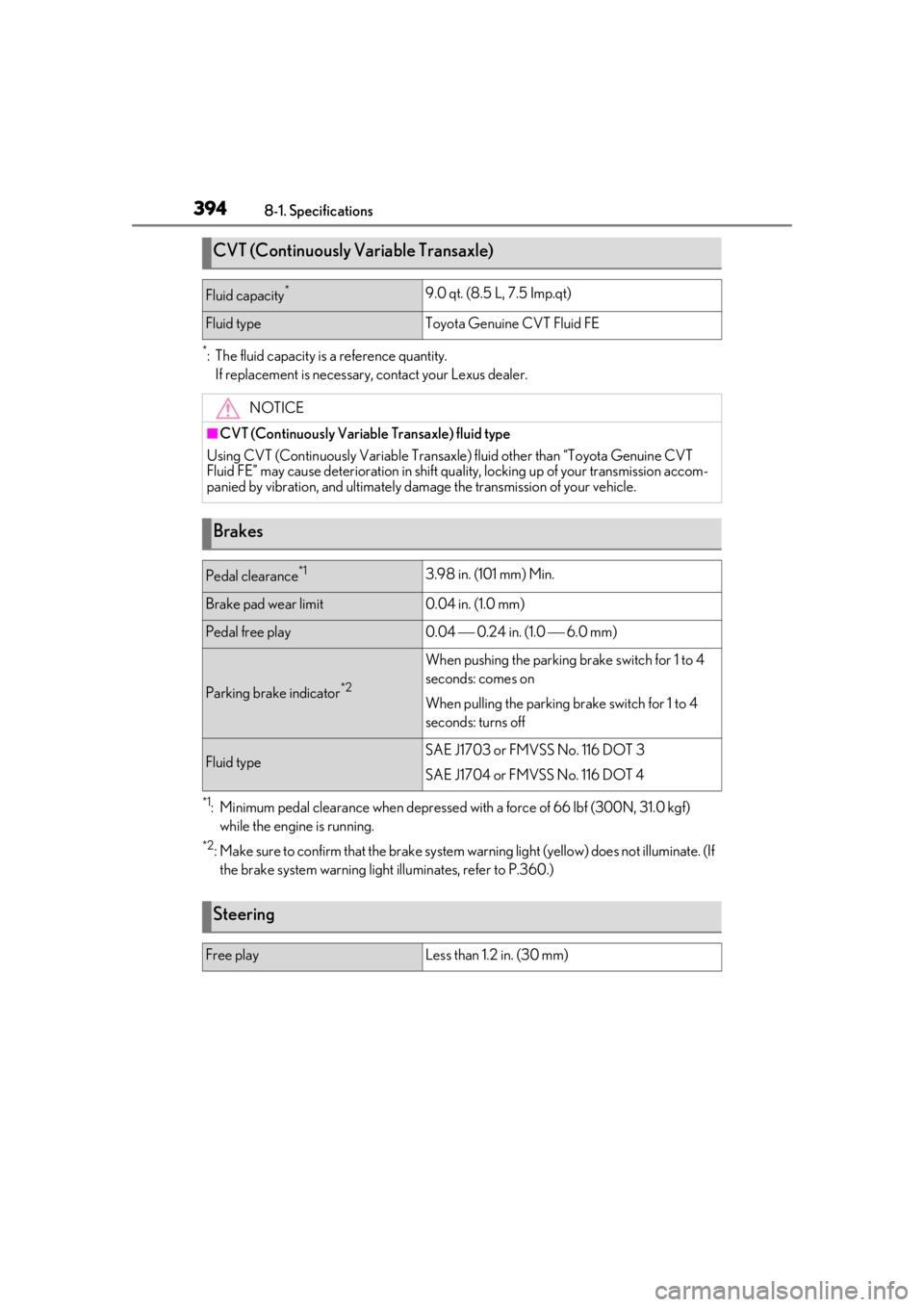
*: The fluid capacity is a reference quantity.If replacement is necessary, contact your Lexus dealer.
*1: Minimum pedal clearance when depressed with a force of 66 lbf (300N, 31.0 kgf) while the engine is running.
*2: Make sure to confirm that the brake system wa rning light (yellow) does not illuminate. (If
the brake system warning light illuminates, refer to P.360.)
CVT (Continuously Variable Transaxle)
Fluid capacity*9.0 qt. (8.5 L, 7.5 Imp.qt)
Fluid typeToyota Genuine CVT Fluid FE
NOTICE
■CVT (Continuously Variable Transaxle) fluid type
Using CVT (Continuously Variable Transaxl e) fluid other than “Toyota Genuine CVT
Fluid FE” may cause deterioration in shift qua lity, locking up of your transmission accom-
panied by vibration, and ultimately damage the transmission of your vehicle.
Brakes
Pedal clearance*13.98 in. (101 mm) Min.
Brake pad wear limit0.04 in. (1.0 mm)
Pedal free play0.04 0.24 in. (1.0 6.0 mm)
Parking brake indicator*2
When pushing the parking brake switch for 1 to 4
seconds: comes on
When pulling the parking brake switch for 1 to 4
seconds: turns off
Fluid typeSAE J1703 or FMVSS No. 116 DOT 3
SAE J1704 or FMVSS No. 116 DOT 4
Steering
Free playLess than 1.2 in. (30 mm)
Page 395 of 452
3958-1. Specifications
8
Vehicle specifications
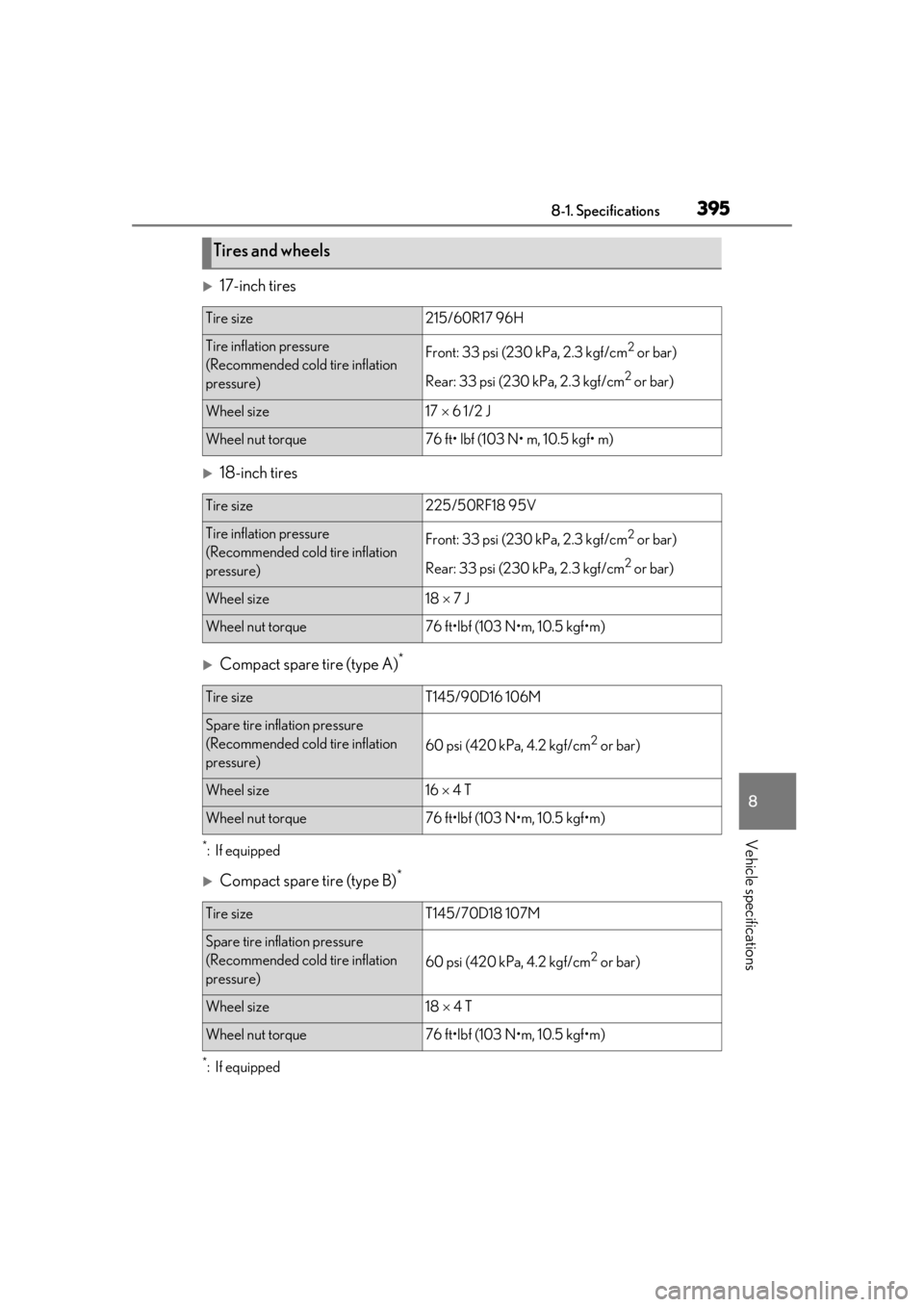
17-inch tires
18-inch tires
Compact spare tire (type A)*
*:If equipped
Compact spare tire (type B)*
*:If equipped
Tires and wheels
Tire size215/60R17 96H
Tire inflation pressure
(Recommended cold tire inflation
pressure)Front: 33 psi (230 kPa, 2.3 kgf/cm2 or bar)
Rear: 33 psi (230 kPa, 2.3 kgf/cm
2 or bar)
Wheel size17 6 1/2 J
Wheel nut torque76 ft• lbf (103 N• m, 10.5 kgf• m)
Tire size225/50RF18 95V
Tire inflation pressure
(Recommended cold tire inflation
pressure)Front: 33 psi (230 kPa, 2.3 kgf/cm2 or bar)
Rear: 33 psi (230 kPa, 2.3 kgf/cm
2 or bar)
Wheel size18 7 J
Wheel nut torque76 ft•lbf (103 N•m, 10.5 kgf•m)
Tire sizeT145/90D16 106M
Spare tire inflation pressure
(Recommended cold tire inflation
pressure)
60 psi (420 kPa, 4.2 kgf/cm2 or bar)
Wheel size16 4 T
Wheel nut torque76 ft•lbf (103 N•m, 10.5 kgf•m)
Tire sizeT145/70D18 107M
Spare tire inflation pressure
(Recommended cold tire inflation
pressure)
60 psi (420 kPa, 4.2 kgf/cm2 or bar)
Wheel size18 4 T
Wheel nut torque76 ft•lbf (103 N•m, 10.5 kgf•m)
Page 397 of 452

3978-1. Specifications
8
Vehicle specifications
■Gasoline quality
In very few cases, driveability problems may
be caused by the brand of gasoline you are
using. If driveability problems persist, try
changing the brand of gasoline. If this does
not correct the problem, consult your Lexus
dealer.
■Recommendation of the use of gasoline
containing detergent additives
●Lexus recommends the use of gasoline
that contains detergent additives to avoid
the build-up of engine deposits.
●All gasoline sold in the U.S.A. contains
minimum detergent additives to clean
and/or keep clean intake systems, per
EPA’s lowest additive s concentration pro-
gram.
●Lexus strongly recommends the use of
Top Tier Detergent Gasoline. For more
information on Top Tier Detergent Gaso-
line and a list of marketers, please go to
the official websit e www.toptiergas.com.
■Recommendation of the use of low
emissions gasoline
Gasolines containing oxygenates such as
ethers and ethanol, as well as reformulated
gasolines, are available in some cities.
These fuels are typically acceptable for use,
providing they meet other fuel require-
ments. Lexus recommends these fuels, since the
formulations allow for reduced vehicle
emissions.
■Non-recommendation of the use of
blended gasoline
●Use only gasoline containing up to 15%
ethanol.
DO NOT use any flex-fuel or gasoline
that could contain more than 15% etha-
nol, including from
any pump labeled
E30 (30% ethanol ), E50 (50% eth-
anol ), E85 (85% ethanol )
(which are only some examples of fuel
containing more than 15% ethanol).
●If you use gasohol in your vehicle, be sure
that it has an octane rating no lower than
87.
●Lexus does not recommend the use of
gasoline containing methanol.
■Non-recommendation of the use of gas-
oline containing MMT
Some gasoline contains an octane enhanc-
ing additive called MMT (Methylcyclopen-
tadienyl Manganese Tricarbonyl).
Lexus does not recommend the use of gas-
oline that contains MMT. If fuel containing
MMT is used, your emission control system
may be adversely affected.
The malfunction indicator lamp on the
instrument cluster may come on. If this hap-
pens, contact your Lexus dealer for service.
■If your engine knocks
●Consult your Lexus dealer.
●You may occasionally notice light knock-
ing for a short time wh ile accelerating or
driving uphill. This is normal and there is
no need for concern.
Fuel information
You must only use unleaded gaso-
line.
Select octane rating 87 (Research
Octane Number 91) or higher. Use
of unleaded gasoline with an octane
rating lower than 87 may result in
engine knocking. Persistent knock-
ing can lead to engine damage.
At minimum, the gasoline you use
should meet the specifications of
ASTM D4814 in the U.S.A.
A
BC
Page 403 of 452
4038-1. Specifications
8
Vehicle specifications
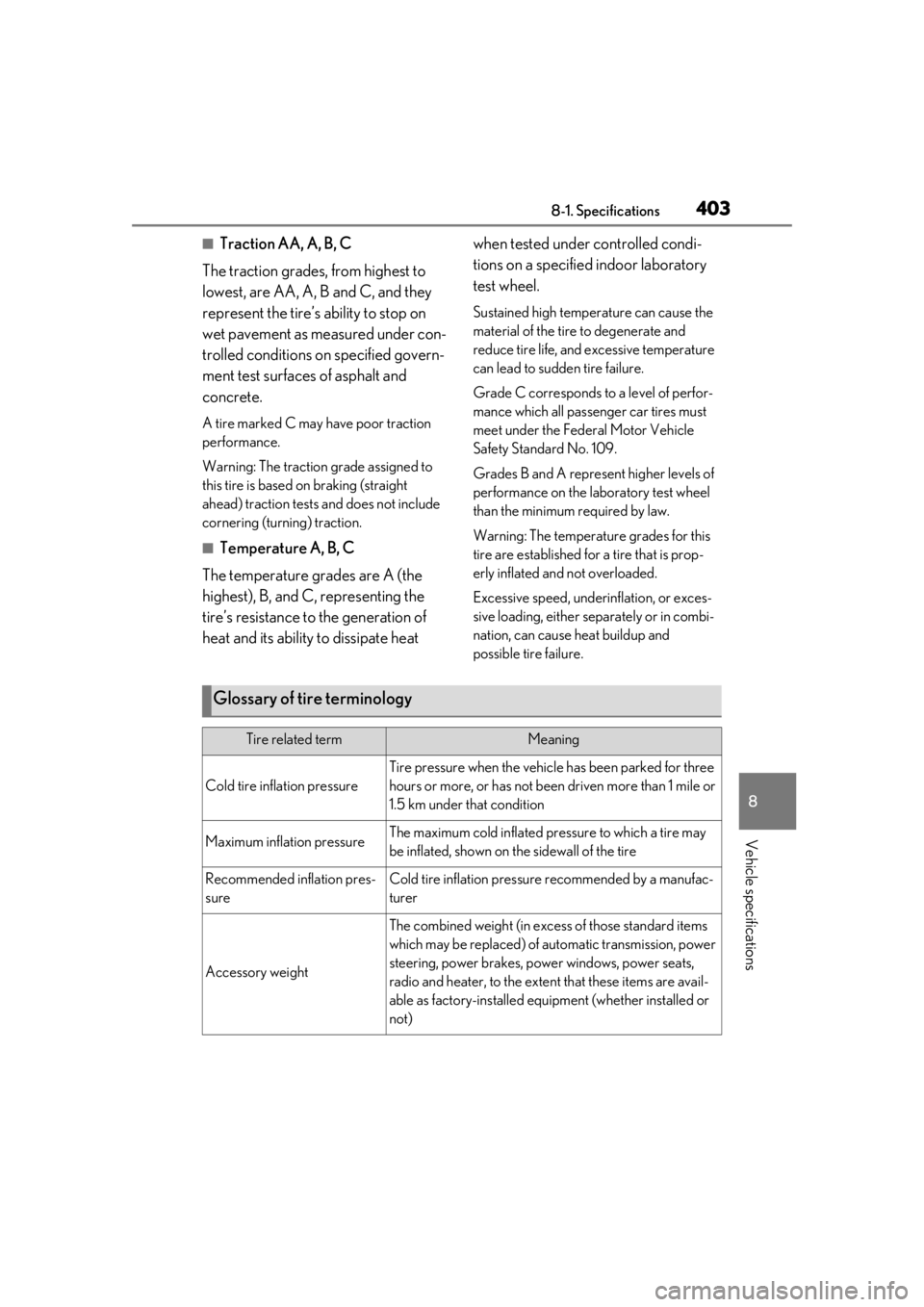
■Traction AA, A, B, C
The traction grades, from highest to
lowest, are AA, A, B and C, and they
represent the tire’s ability to stop on
wet pavement as measured under con-
trolled conditions on specified govern-
ment test surfaces of asphalt and
concrete.
A tire marked C may have poor traction
performance.
Warning: The traction grade assigned to
this tire is based on braking (straight
ahead) traction tests and does not include
cornering (turning) traction.
■Temperature A, B, C
The temperature grades are A (the
highest), B, and C, representing the
tire’s resistance to the generation of
heat and its ability to dissipate heat when tested under controlled condi-
tions on a specified indoor laboratory
test wheel.
Sustained high temperature can cause the
material of the tire to degenerate and
reduce tire life, and excessive temperature
can lead to sudd
en tire failure.
Grade C corresponds to a level of perfor-
mance which all passenger car tires must
meet under the Fede ral Motor Vehicle
Safety Standard No. 109.
Grades B and A represent higher levels of
performance on the laboratory test wheel
than the minimum required by law.
Warning: The temperature grades for this
tire are established for a tire that is prop-
erly inflated and not overloaded.
Excessive speed, unde rinflation, or exces-
sive loading, either separately or in combi-
nation, can cause heat buildup and
possible tire failure.
Glossary of tire terminology
Tire related termMeaning
Cold tire inflation pressure
Tire pressure when the vehicle has been parked for three
hours or more, or has not been driven more than 1 mile or
1.5 km under that condition
Maximum inflation pressureThe maximum cold inflated pressure to which a tire may
be inflated, shown on the sidewall of the tire
Recommended inflation pres-
sureCold tire inflation pressure recommended by a manufac-
turer
Accessory weight
The combined weight (in excess of those standard items
which may be replaced) of automatic transmission, power
steering, power brakes, powe r windows, power seats,
radio and heater, to the extent that these items are avail-
able as factory-installed equi pment (whether installed or
not)
Page 404 of 452

4048-1. Specifications
Curb weight
The weight of a motor vehicle with standard equipment,
including the maximum capacity of fuel, oil and coolant,
and if so equipped, air conditioning and additional weight
optional engine
Maximum loaded vehicle
weight
The sum of:
(a) Curb weight
(b) Accessory weight
(c) Vehicle capacity weight
(d) Production options weight
Normal occupant weight150 lb. (68 kg) times the number of occupants specified in
the second column of Table 1
* that follows
Occupant distributionDistribution of occupants in a vehicle as specified in the
third column of Table 1
* below
Production options weight
The combined weight of in stalled regular production
options weighing over 5 lb. (2.3 kg) in excess of the stan-
dard items which they replace, not previously considered
in curb weight or accessory weight, including heavy duty
brakes, ride levelers, roof rack, heavy duty battery, and
special trim
RimA metal support for a tire or a tire and tube assembly upon
which the tire beads are seated
Rim diameter
(Wheel diameter)Nominal diameter of the bead seat
Rim size designationRim diameter and width
Rim type designationThe industry manufacturer’s designation for a rim by style
or code
Rim widthNominal distance between rim flanges
Vehicle capacity weight
(Total load capacity)The rated cargo and luggage load plus 150 lb. (68 kg)
times the vehicle’s desi gnated seating capacity
Vehicle maximum load on the
tireThe load on an individual tire that is determined by distrib-
uting to each axle its share of the maximum loaded vehicle
weight, and dividing by two
Vehicle normal load on the tire
The load on an individual tire that is determined by distrib-
uting to each axle its shar e of curb weight, accessory
weight, and normal occupant we ight (distributed in accor-
dance with Table 1
* below), and dividing by two
Tire related termMeaning