2019 LEXUS UX200 air
[x] Cancel search: airPage 384 of 452

3847-2. Steps to take in an emergency
6Open and close any of the doors of
your vehicle with the engine switch
OFF.
7 Maintain the engine speed of the
second vehicle and start the engine
of your vehicle by turning the
engine switch to ON.
8 Once the vehicle’s engine has
started, remove the jumper cables
in the exact reverse order from
which they were connected.
Once the engine starts, have the vehi-
cle inspected at your Lexus dealer as
soon as possible.■Starting the engine when the battery is
discharged
The engine cannot be started by push-start-
ing.
■To prevent battery discharge
●Turn off the headlights, the air condition-
ing system, the audio system, etc. while
the engine is off.
●Turn off any unnecessary electrical com-
ponents when the vehicle is running at a
low speed for an extended period, such
as in heavy traffic.
■Charging the battery
The electricity stored in the battery will dis-
charge gradually even when the vehicle is
not in use, due to natural discharge and the
draining effects of certain electrical appli-
ances. If the vehicle is left for a long time,
the battery may discharge, and the engine
may be unable to start. (The battery
recharges automatically during driving.)
■When the battery is removed or dis-
charged
●Information stored in the ECU is cleared.
When the battery is depleted, have the
vehicle inspected at your Lexus dealer.
●In some cases, it may not be possible to
unlock the doors using the smart access
system with push-button start when the
battery is discharged. Use the wireless
remote control or the mechanical key to
lock or unlock the doors.
●The engine may not start on the first
attempt after the battery has recharged
but will start normally after the second
attempt. This is not a malfunction.
●The engine switch mode is memorized by
the vehicle. When the battery is recon-
nected, the system will return to the
mode it was in before the battery was dis-
charged. Before disconnecting the bat-
tery, turn the engine switch off.
If you are unsure wh at mode the engine
switch was in before the battery dis-
charged, be especially careful when
reconnecting the battery.
●The power back door must be initialized.
( P.109)
Page 386 of 452

3867-2. Steps to take in an emergency
1Stop the vehicle in a safe place and
turn off the air conditioning system,
and then stop the engine.
2 If you see steam:
Carefully lift the hood after the
steam subsides.
If you do not see steam:
Carefully lift the hood.
3 After the engine has cooled down
sufficiently, inspect the hoses and radiator core (radiator) for any
leaks.
Radiator
Cooling fan
If a large amount of coolant leaks, immedi-
ately contact your Lexus dealer.
4
The coolant level is satisfactory if it
is between the “FULL” and “LOW”
lines on the reservoir.
Reservoir
“FULL” line
“LOW” line
5 Add coolant if necessary.
Water can be used in an emergency if
If your vehicle overheats
The following may indicate that
your vehicle is overheating.
The engine coolant temperature
gauge ( P.72, 75) enters the red
zone, or a loss of engine power is
experienced. (For example, the
vehicle speed does not increase.)
“Engine Coolant Temp High Stop
in a Safe Place See Owner’s
Manual” is shown on the multi-
information display.
Steam comes out from under the
hood.
Correction procedures
A
B
A
B
C
Page 387 of 452

3877-2. Steps to take in an emergency
7
When trouble arises
coolant is unavailable.
6Start the engine and turn the air
conditioning system on to check
that the radiator cooling fan oper-
ates and to check for coolant leaks
from the radiator or hoses.
The fan operates when the air conditioning
system is turned on immediately after a
cold start. Confirm that the fan is operating
by checking the fan sound and air flow. If it
is difficult to check these, turn the air con-
ditioning system on and off repeatedly.
(The fan may not operate in freezing tem-
peratures.)
7If the fan is not operating:
Stop the engine immediately and
contact your Lexus dealer.
If the fan is operating:
Have the vehicle inspected at the
nearest Lexus dealer.
8
Check if “Engine Coolant Temp
High Stop in a Safe Place See
Owner’s Manual” is shown on the
multi-information display.
If the message does not disappear:
Stop the engine and contact your
Lexus dealer.
If the message is not displayed:
Have the vehicle inspected at the
nearest Lexus dealer.
WARNING
■To prevent an accident or injury when
inspecting under the hood of your
vehicle
Observe the following precautions.
Failure to do so may result in serious
injury such as burns.
●If steam is seen coming from under the
hood, do not open the hood until the
steam has subsided. The engine com-
partment may be very hot.
●Keep hands and clothing (especially a
tie, a scarf or a muffler) away from the
fan and belts. Failure to do so may
cause the hands or clothing to be
caught, resulting in serious injury.
●Do not loosen the coolant reservoir
cap while the engine and radiator are
hot.
High temperature steam or coolant
could spray out.
NOTICE
■When adding engine coolant
Add coolant slowly after the engine has
cooled down sufficiently. Adding cool
coolant to a hot engine too quickly can
cause damage to the engine.
■To prevent damage to the cooling sys-
tem
Observe the following precautions:
●Avoid contaminating the coolant with
foreign matter (such as sand or dust,
etc.).
●Do not use any coolant additive.
Page 399 of 452
3998-1. Specifications
8
Vehicle specifications
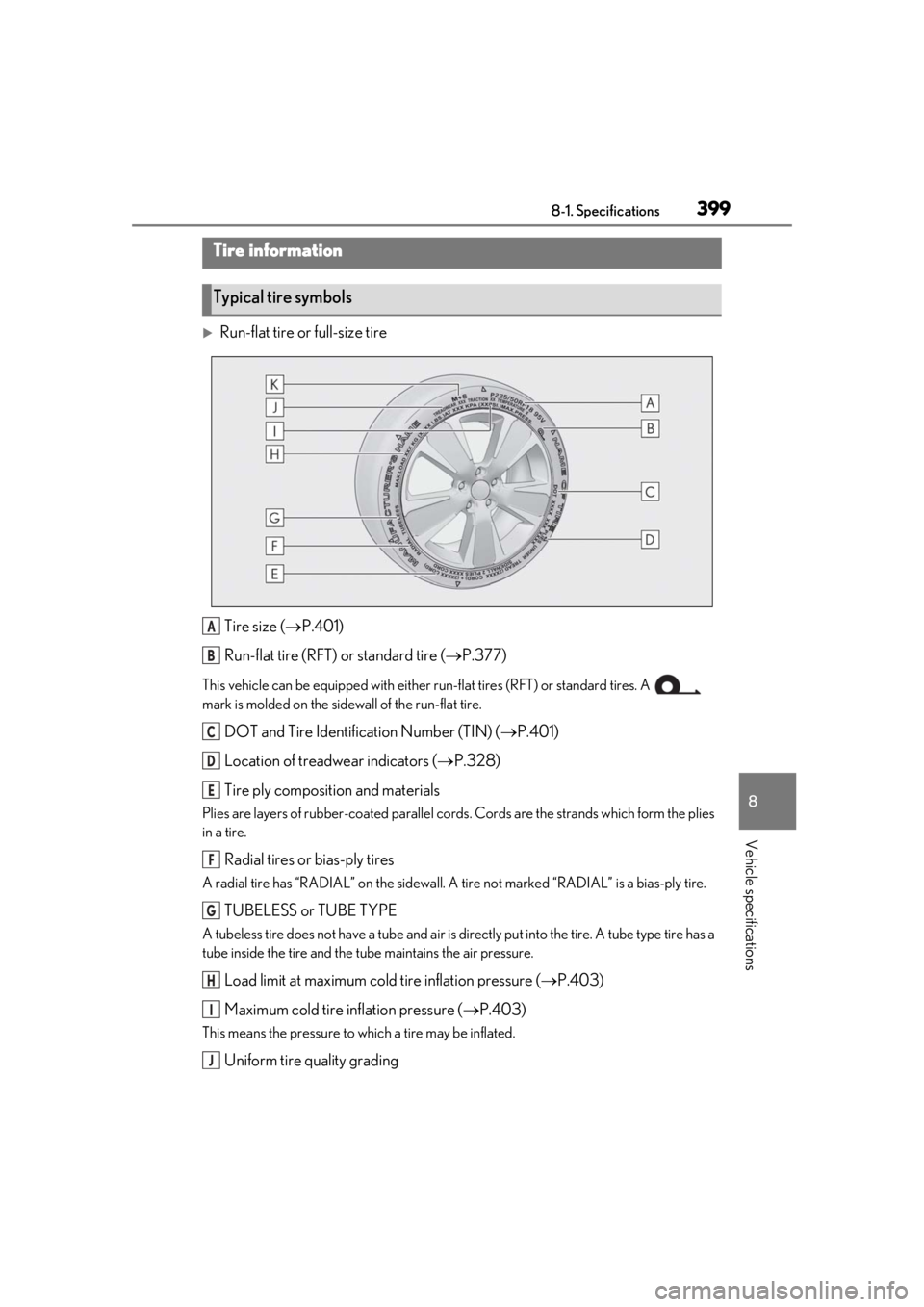
Run-flat tire or full-size tireTire size ( P.401)
Run-flat tire (RFT) or standard tire ( P.377)
This vehicle can be equipped with either run-flat tires (RFT) or standard tires. A
mark is molded on the sidewall of the run-flat tire.
DOT and Tire Identification Number (TIN) ( P.401)
Location of treadwear indicators ( P.328)
Tire ply composition and materials
Plies are layers of rubber-coated parallel cords. Cords are the strands which form the plies
in a tire.
Radial tires or bias-ply tires
A radial tire has “RADIAL” on the sidewall. A tire not marked “RADIAL” is a bias-ply tire.
TUBELESS or TUBE TYPE
A tubeless tire does not have a tube and air is directly put into the tire. A tube type tire has a
tube inside the tire and the tube maintains the air pressure.
Load limit at maximum cold tire inflation pressure ( P.403)
Maximum cold tire inflation pressure ( P.403)
This means the pressure to which a tire may be inflated.
Uniform tire quality grading
Tire information
Typical tire symbols
A
B
C
D
E
F
G
H
I
J
Page 400 of 452
4008-1. Specifications
For details, see “Uniform Tire Quality Grading” that follows.
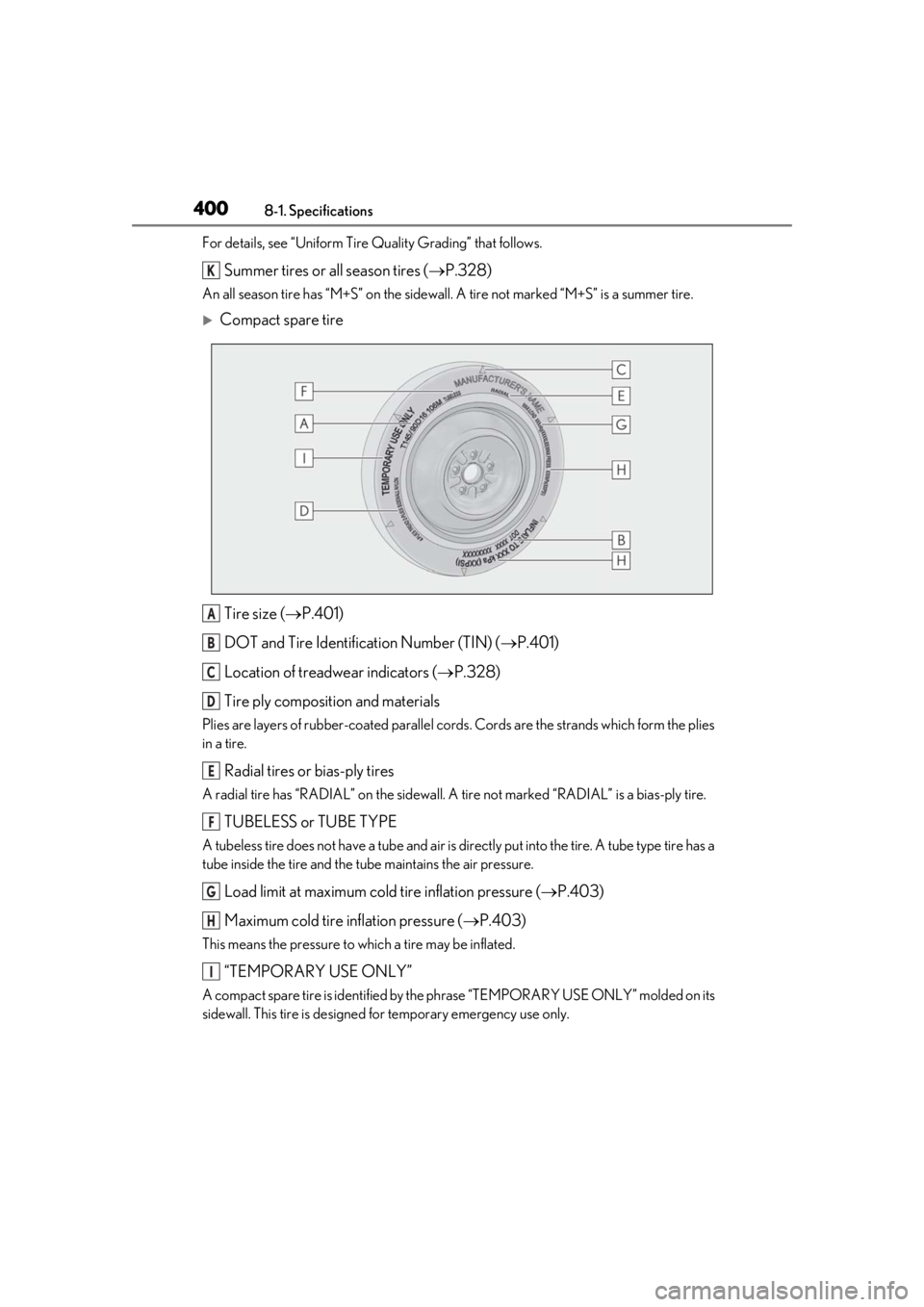
Summer tires or all season tires (P.328)
An all season tire has “M+S” on the sidewall. A tire not marked “M+S” is a summer tire.
Compact spare tire
Tire size ( P.401)
DOT and Tire Identification Number (TIN) ( P.401)
Location of treadwear indicators ( P.328)
Tire ply composition and materials
Plies are layers of rubber-coated parallel cords. Cords are the strands which form the plies
in a tire.
Radial tires or bias-ply tires
A radial tire has “RADIAL” on the sidewall. A tire not marked “RADIAL” is a bias-ply tire.
TUBELESS or TUBE TYPE
A tubeless tire does not have a tube and air is directly put into the tire. A tube type tire has a
tube inside the tire and the tube maintains the air pressure.
Load limit at maximum cold tire inflation pressure ( P.403)
Maximum cold tire inflation pressure ( P.403)
This means the pressure to which a tire may be inflated.
“TEMPORARY USE ONLY”
A compact spare tire is identified by the phrase “TEMPORARY USE ONLY” molded on its
sidewall. This tire is designed for temporary emergency use only.
K
A
B
C
D
E
F
G
H
I
Page 404 of 452

4048-1. Specifications
Curb weight
The weight of a motor vehicle with standard equipment,
including the maximum capacity of fuel, oil and coolant,
and if so equipped, air conditioning and additional weight
optional engine
Maximum loaded vehicle
weight
The sum of:
(a) Curb weight
(b) Accessory weight
(c) Vehicle capacity weight
(d) Production options weight
Normal occupant weight150 lb. (68 kg) times the number of occupants specified in
the second column of Table 1
* that follows
Occupant distributionDistribution of occupants in a vehicle as specified in the
third column of Table 1
* below
Production options weight
The combined weight of in stalled regular production
options weighing over 5 lb. (2.3 kg) in excess of the stan-
dard items which they replace, not previously considered
in curb weight or accessory weight, including heavy duty
brakes, ride levelers, roof rack, heavy duty battery, and
special trim
RimA metal support for a tire or a tire and tube assembly upon
which the tire beads are seated
Rim diameter
(Wheel diameter)Nominal diameter of the bead seat
Rim size designationRim diameter and width
Rim type designationThe industry manufacturer’s designation for a rim by style
or code
Rim widthNominal distance between rim flanges
Vehicle capacity weight
(Total load capacity)The rated cargo and luggage load plus 150 lb. (68 kg)
times the vehicle’s desi gnated seating capacity
Vehicle maximum load on the
tireThe load on an individual tire that is determined by distrib-
uting to each axle its share of the maximum loaded vehicle
weight, and dividing by two
Vehicle normal load on the tire
The load on an individual tire that is determined by distrib-
uting to each axle its shar e of curb weight, accessory
weight, and normal occupant we ight (distributed in accor-
dance with Table 1
* below), and dividing by two
Tire related termMeaning
Page 405 of 452
4058-1. Specifications
8
Vehicle specifications
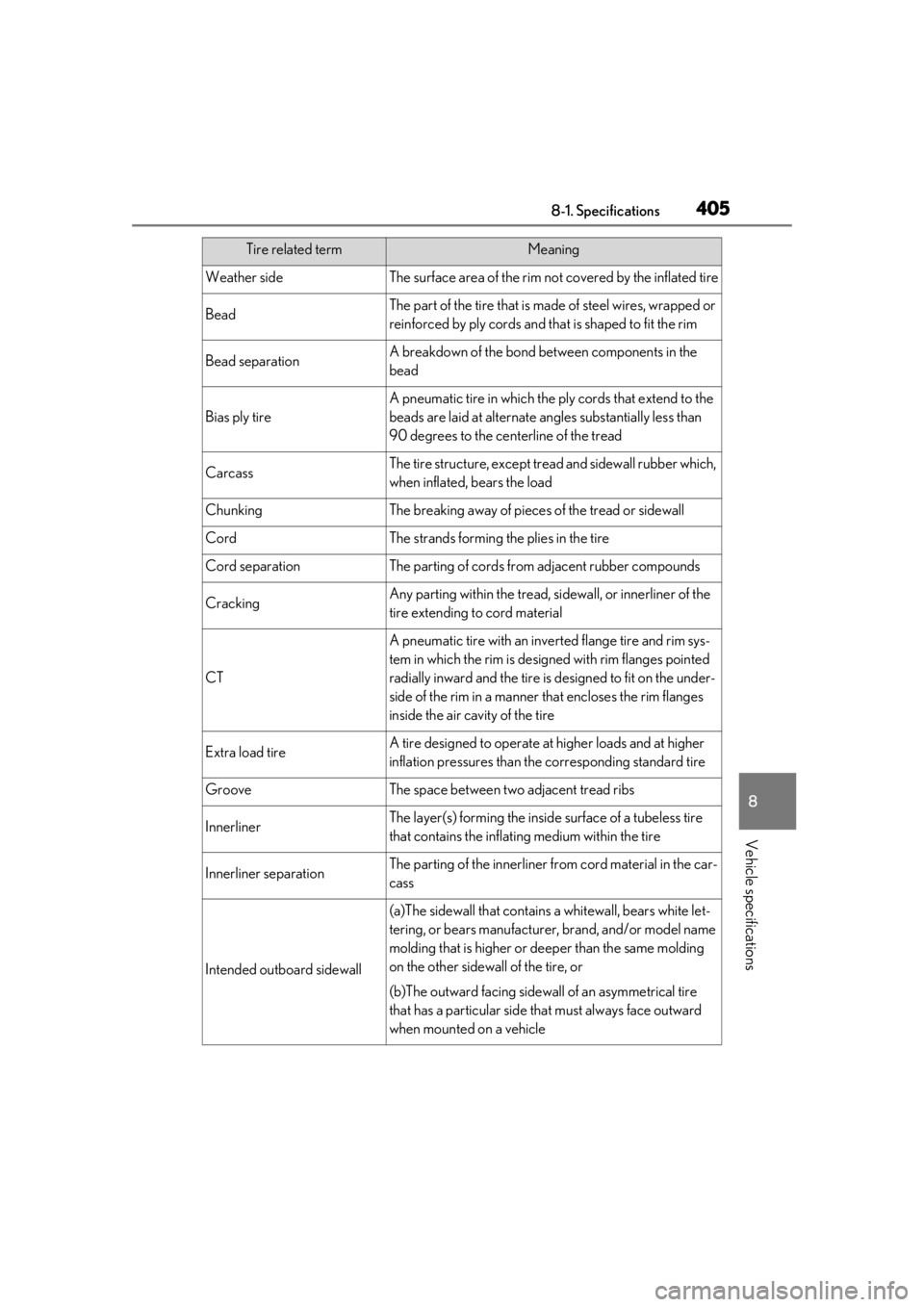
Weather sideThe surface area of the rim not covered by the inflated tire
BeadThe part of the tire that is made of steel wires, wrapped or
reinforced by ply cords and th at is shaped to fit the rim
Bead separationA breakdown of the bond between components in the
bead
Bias ply tire
A pneumatic tire in which the ply cords that extend to the
beads are laid at alternate angles substantially less than
90 degrees to the centerline of the tread
CarcassThe tire structure, except tread and sidewall rubber which,
when inflated, bears the load
ChunkingThe breaking away of pieces of the tread or sidewall
CordThe strands forming the plies in the tire
Cord separationThe parting of cords from adjacent rubber compounds
CrackingAny parting within the tread, si dewall, or innerliner of the
tire extending to cord material
CT
A pneumatic tire with an inverted flange tire and rim sys-
tem in which the rim is designed with rim flanges pointed
radially inward and the tire is designed to fit on the under-
side of the rim in a manner that encloses the rim flanges
inside the air cavity of the tire
Extra load tireA tire designed to operate at higher loads and at higher
inflation pressures than the corresponding standard tire
GrooveThe space between two adjacent tread ribs
InnerlinerThe layer(s) forming the inside surface of a tubeless tire
that contains the inflating medium within the tire
Innerliner separationThe parting of the innerliner fr om cord material in the car-
cass
Intended outboard sidewall
(a)The sidewall that contains a whitewall, bears white let-
tering, or bears manufacturer, brand, and/or model name
molding that is higher or de eper than the same molding
on the other sidewall of the tire, or
(b)The outward facing sidewall of an asymmetrical tire
that has a particular side that must always face outward
when mounted on a vehicle
Tire related termMeaning
Page 416 of 452
4168-2. Customization
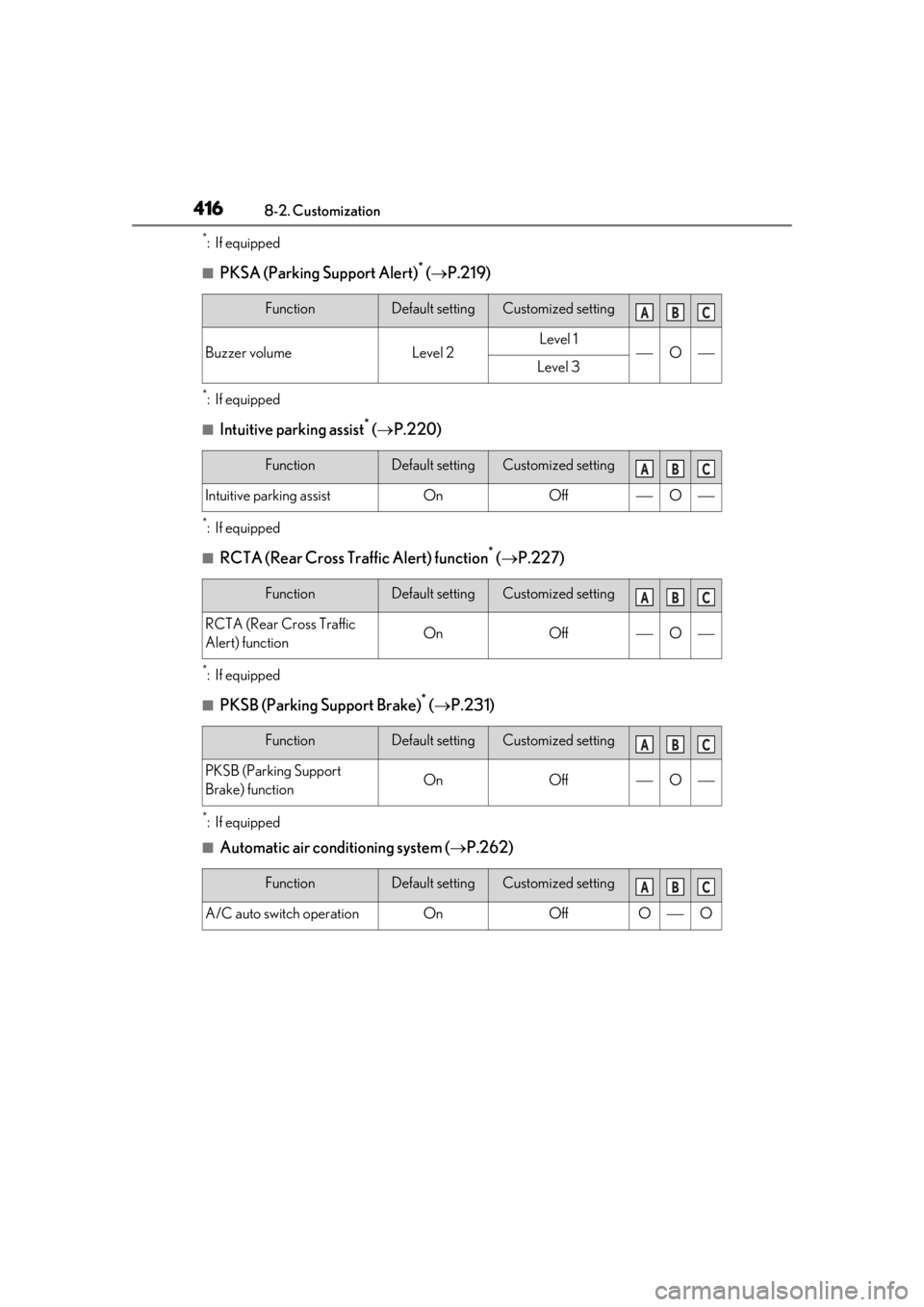
*:If equipped
■PKSA (Parking Support Alert)* ( P.219)
*:If equipped
■Intuitive parking assist* ( P.220)
*:If equipped
■RCTA (Rear Cross Traffic Alert) function* ( P.227)
*:If equipped
■PKSB (Parking Support Brake)* ( P.231)
*:If equipped
■Automatic air conditioning system ( P.262)
FunctionDefault settingCustomized setting
Buzzer volumeLevel 2Level 1OLevel 3
FunctionDefault settingCustomized setting
Intuitive parking assistOnOffO
FunctionDefault settingCustomized setting
RCTA (Rear Cross Traffic
Alert) functionOnOffO
FunctionDefault settingCustomized setting
PKSB (Parking Support
Brake) functionOnOffO
FunctionDefault settingCustomized setting
A/C auto switch operationOnOffOO
ABC
ABC
ABC
ABC
ABC