Page 697 of 777

696 8-2. Steps to take in an emergency
RX350/RX350L_U WARNING ■
When attempting to free a stuck vehicle
If you choose to push the vehicle back and forth to free it, make sure the surrounding
area is clear to avoid striking other vehicl es, objects or people. The vehicle may also
lunge forward or lunge back suddenly as it becomes free. Use extreme caution. ■
When shifting the shift lever
Be careful not to shift the shift lever with the accelerator pedal depressed.
This may lead to unexpected rapid acceleration of the vehicle that may cause an acci-
dent resulting in deat h or serious injury.
NOTICE ■
To avoid damage to the tran smission and other components●
Avoid spinning the front wheels and depre ssing the accelerator pedal more than nec-
essary. ●
If the vehicle remains stuck even after th ese procedures are performed, the vehicle
may require towing to be freed. ●
When a warning message for the automatic transmission fluid temperature is dis-
played while attempting to free a stuck vehicle, immediately remove your foot from
the accelerator pedal and wait until the warning message disappears. Otherwise, the
transmission may become damaged. ( P. 662)
Page 699 of 777
698
RX350/RX350L_U 9-1. Specifications
* 1
:RX350
* 2
:RX350L
* 3
:Unladen vehicle
* 4
: Vehicles with towing package
* 5
: For GGL25L-BWZGBA models* 9
* 6
: Except for GGL25L-BWZGBA models* 9
* 7
: Vehicles with separate seat
* 8
: Vehicles with bench seat
* 9
: The model code is indicated on the Certification Label. ( P. 699)Maintenance data (fuel, oil level, etc.) Dimensions and weight Overall length 192.5 in. (4890 mm)
* 1
196.9 in. (5000 mm)
* 2
Overall width 74.6 in. (1895 mm)
Overall height
* 3
67.7 in. (1720 mm)
Wheelbase 109.8 in. (2790 mm)
Tread Front 64.4 in. (1635 mm)
* 1
64.5 in. (1640 mm)
* 2
Rear 64.0 in. (1625 mm)
* 1
64.1 in. (1630 mm)
* 2
Vehicle capacity weight
(Occupants + luggage) 1050 lb. (480 kg)
* 1, 5
920 lb. (420 kg)
* 1, 6
1140 lb. (520 kg)
* 2, 7
1235 lb. (560 kg)
* 2, 8
Trailer Weight Rating
* 4
(Trailer weight + cargo weight) 3500 lb. (1585 kg)
Page 705 of 777
704 9-1. Specifications
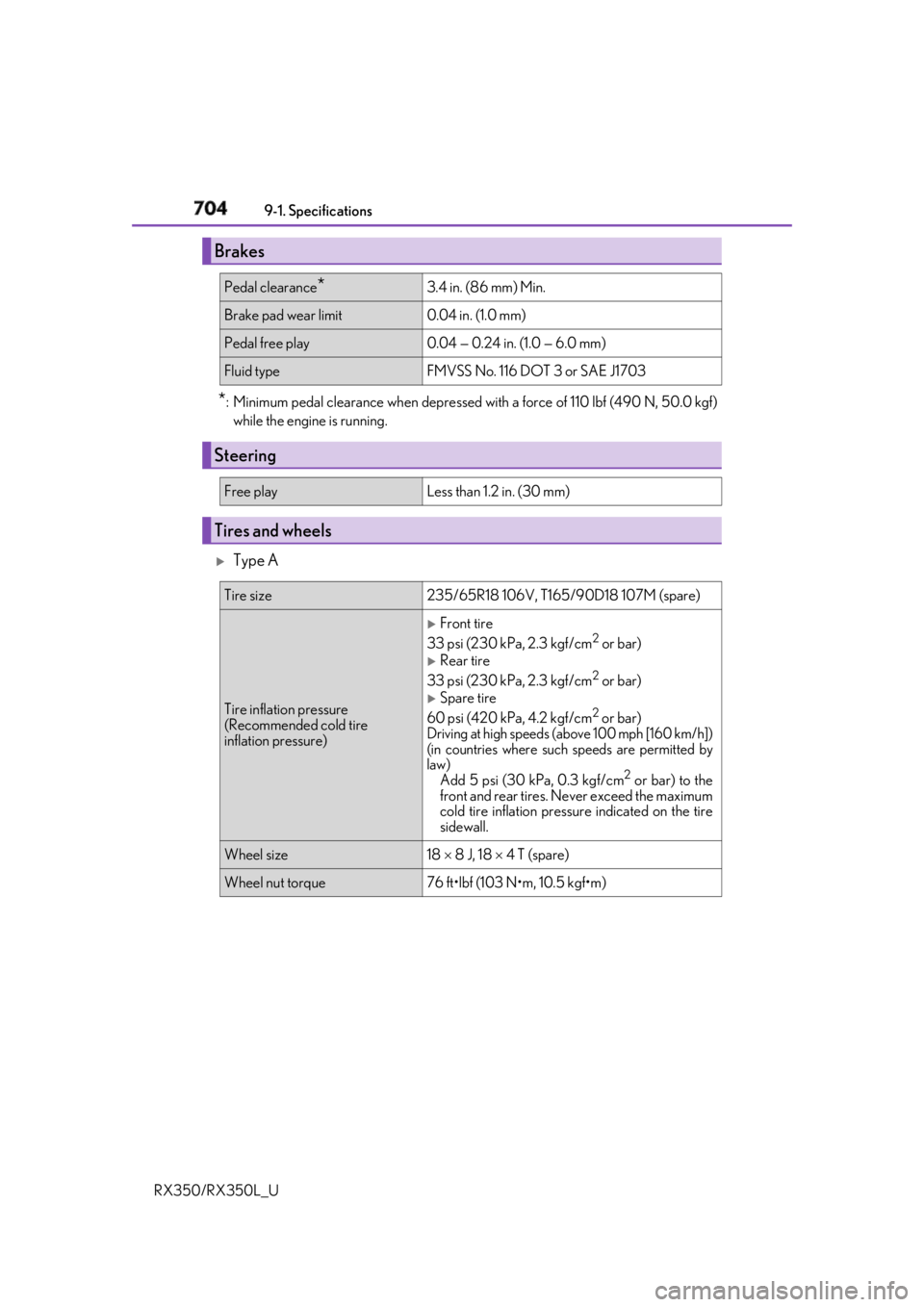
RX350/RX350L_U * : Minimum pedal clearance when depressed wi th a force of 110 lbf (490 N, 50.0 kgf)
while the engine is running.
Type ABrakes Pedal clearance
* 3.4 in. (86 mm) Min.
Brake pad wear limit 0.04 in. (1.0 mm)
Pedal free play 0.04 — 0.24 in. (1.0 — 6.0 mm)
Fluid type FMVSS No. 116 DOT 3 or SAE J1703
Steering Free play Less than 1.2 in. (30 mm)
Tires and wheels Tire size 235/65R18 106V, T165/90D18 107M (spare)
Tire inflation pressure
(Recommended cold tire
inflation pressure)
Front tire
33 psi (230 kPa, 2.3 kgf/cm 2
or bar)
Rear tire
33 psi (230 kPa, 2.3 kgf/cm 2
or bar)
Spare tire
60 psi (420 kPa, 4.2 kgf/cm 2
or bar)
Driving at high speeds (above 100 mph [160 km/h])
(in countries where such speeds are permitted by
law)
Add 5 psi (30 kPa, 0.3 kgf/cm 2
or bar) to the
front and rear tires. Never exceed the maximum
cold tire inflation pressu re indicated on the tire
sidewall.
Wheel size 18 8 J, 18 4 T (spare)
Wheel nut torque 76 ft•lbf (103 N•m, 10.5 kgf•m)
Page 706 of 777

7059-1. Specifications
9
Vehicle specifications
RX350/RX350L_U
Type B
A: Wedge base bulbs (amber)
B: Wedge base bulbs (clear)
* 1
: Vehicles with single-beam headlights
* 2
: Vehicles without door trim ornament lightsTire size 235/55R20 102V, T165/90D18 107M (spare)
Tire inflation pressure
(Recommended cold tire
inflation pressure)
Front tire
33 psi (230 kPa, 2.3 kgf/cm 2
or bar)
Rear tire
33 psi (230 kPa, 2.3 kgf/cm 2
or bar)
Spare tire
60 psi (420 kPa, 4.2 kgf/cm 2
or bar)
Driving at high speeds (above 100 mph [160 km/h])
(in countries where such speeds are permitted by
law)
Add 11 psi (70 kPa, 0.7 kgf/cm 2
or bar) to the
front and rear tires. Never exceed the maximum
cold tire inflation pressu re indicated on the tire
sidewall.
Wheel size 20 8 J, 18 4 T (spare)
Wheel nut torque 76 ft•lbf (103 N•m, 10.5 kgf•m)
Light bulbs Light bulbs Bulb No. W Type
Exterior Front side marker lights
* 1
5 B
Front turn signal lights
* 1
7444NA 28/8 A
Rear turn signal lights
* 1
21 A
Back-up lights 921 16 B
Interior Door courtesy lights
* 2
5 B
Vanity lights 8 B
Luggage compartment light 5 B
Page 713 of 777
712 9-1. Specifications
RX350/RX350L_U ■
Typical tire size information
The illustration indicates typical tire size.
Tire use
(P = Passenger car,
T = Temporary use)
Section width (millimeters)
Aspect ratio
(tire height to section width)
Tire construction code
(R = Radial, D = Diagonal)
Wheel diameter (inches)
Load index (2 digits or 3 digits)
Speed symbol (alphabet with one letter)■
Tire dimensions
Section width
Tire height
Wheel diameterTire size 1
2
3
4
5
6
7
1
2
3
Page 716 of 777
7159-1. Specifications
9
Vehicle specifications
RX350/RX350L_U ■
Temperature A, B, C
The temperature grades are A (the highes t), B, and C, representing the tire’s
resistance to the generation of heat and its ability to dissipate heat when
tested under controlled conditions on a specified indoor laboratory test
wheel. Sustained high temperature can cause the ma terial of the tire to degenerate and
reduce tire life, and excessive temperature can lead to sudden tire failure.
Grade C corresponds to a level of perfor mance which all passenger car tires must
meet under the Federa l Motor Vehicle Safety Standard No. 109.
Grades B and A represent higher levels of performance on the laboratory test
wheel than the minimum required by law.
Warning: The temperature grades of a tire assume that it is properly inflated and
not overloaded.
Excessive speed, underi nflation, or excessive loading, either separately or in com-
bination, can cause heat buildup and possible tire failure.
Page 718 of 777
7179-1. Specifications
9
Vehicle specifications
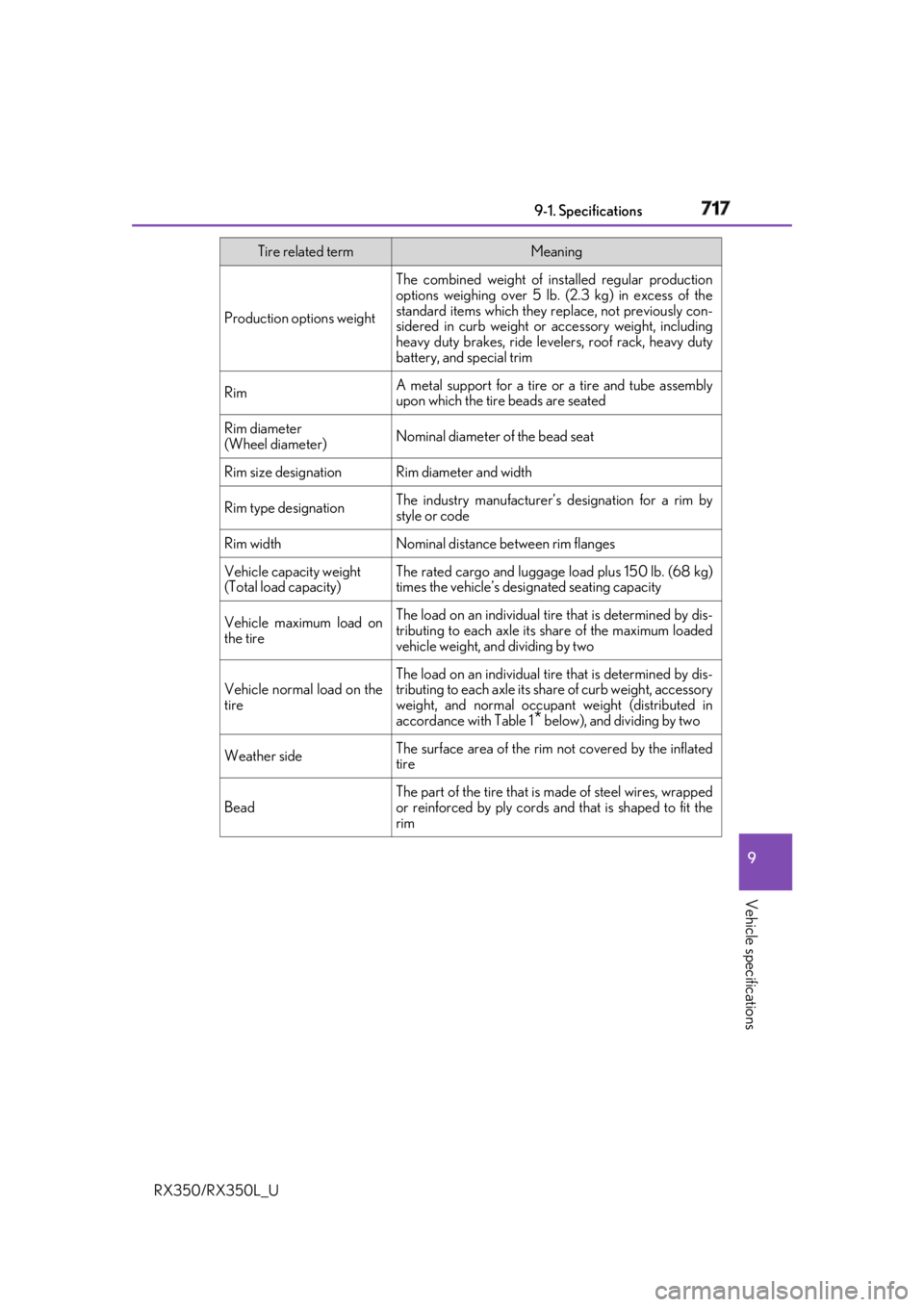
RX350/RX350L_U Production options weight The combined weight of in stalled regular production
options weighing over 5 lb. (2.3 kg) in excess of the
standard items which they re place, not previously con-
sidered in curb weight or accessory weight, including
heavy duty brakes, ride leve lers, roof rack, heavy duty
battery, and special trim
Rim A metal support for a tire or a tire and tube assembly
upon which the tire beads are seated
Rim diameter
(Wheel diameter) Nominal diameter of the bead seat
Rim size designation Rim diameter and width
Rim type designation The industry manufacturer’s designation for a rim by
style or code
Rim width Nominal distance between rim flanges
Vehicle capacity weight
(Total load capacity) The rated cargo and luggage load plus 150 lb. (68 kg)
times the vehicle’s desi gnated seating capacity
Vehicle maximum load on
the tire The load on an individual tire that is determined by dis-
tributing to each axle its share of the maximum loaded
vehicle weight, and dividing by two
Vehicle normal load on the
tire The load on an individual tire that is determined by dis-
tributing to each axle its sh are of curb weight, accessory
weight, and normal occupant weight (distributed in
accordance with Table 1
* below), and dividing by two
Weather side The surface area of the rim not covered by the inflated
tire
Bead The part of the tire that is made of steel wires, wrapped
or reinforced by ply cords an d that is shaped to fit the
rimTire related term Meaning
Page 721 of 777
720 9-1. Specifications
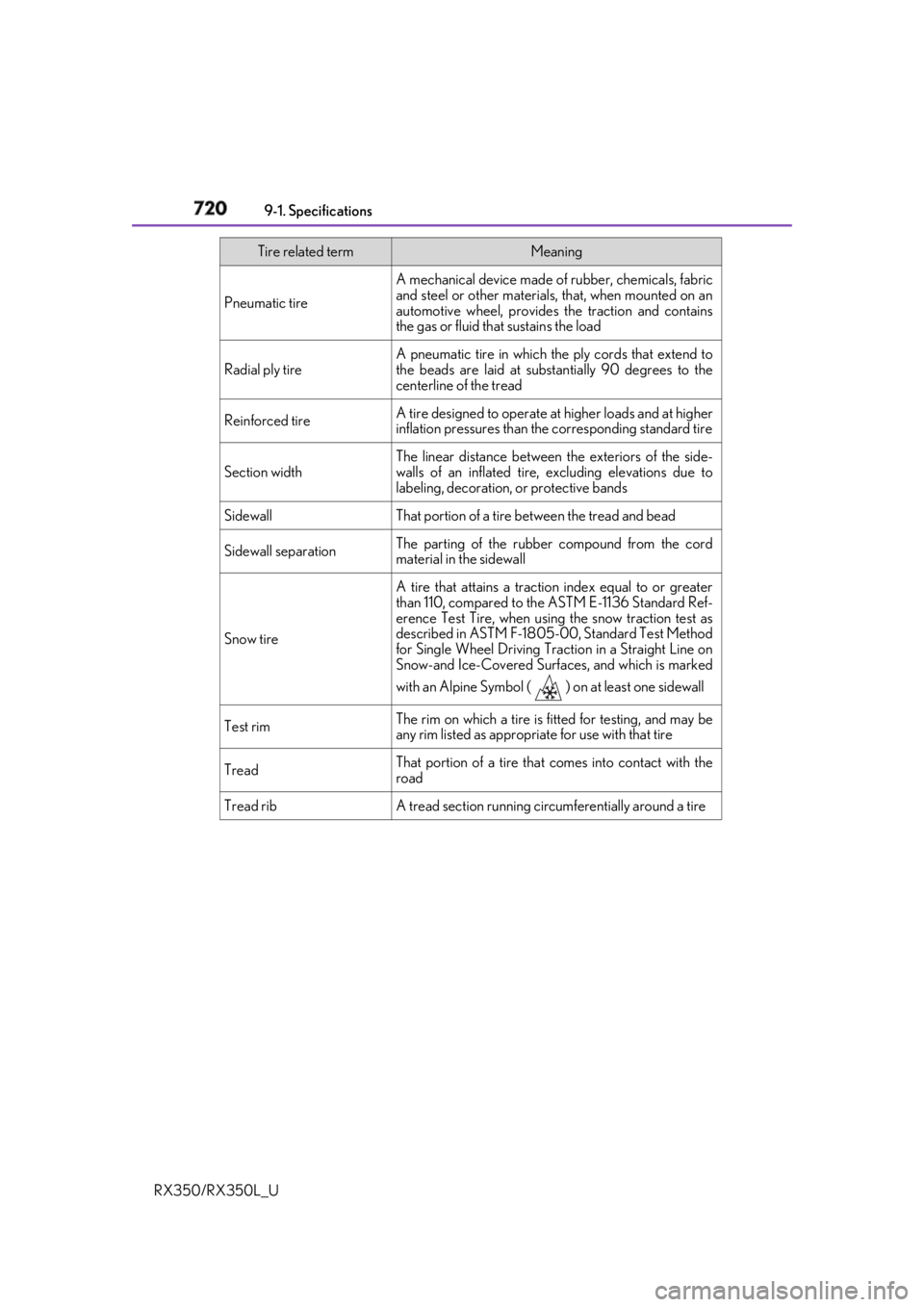
RX350/RX350L_U Pneumatic tire A mechanical device made of rubber, chemicals, fabric
and steel or other materials, that, when mounted on an
automotive wheel, provides the traction and contains
the gas or fluid that sustains the load
Radial ply tire A pneumatic tire in which the ply cords that extend to
the beads are laid at substa ntially 90 degrees to the
centerline of the tread
Reinforced tire A tire designed to operate at higher loads and at higher
inflation pressures than the corresponding standard tire
Section width The linear distance between the exteriors of the side-
walls of an inflated tire, excluding elevations due to
labeling, decoration, or protective bands
Sidewall That portion of a tire between the tread and bead
Sidewall separation The parting of the rubber compound from the cord
material in the sidewall
Snow tire A tire that attains a traction index equal to or greater
than 110, compared to the ASTM E-1136 Standard Ref-
erence Test Tire, when using the snow traction test as
described in ASTM F-1805-00, Standard Test Method
for Single Wheel Driving Traction in a Straight Line on
Snow-and Ice-Covered Surf aces, and which is marked
with an Alpine Symbol (
) on at least one sidewall
Test rim The rim on which a tire is fitted for testing, and may be
any rim listed as appropriate for use with that tire
Tread That portion of a tire that comes into contact with the
road
Tread rib A tread section running circ umferentially around a tireTire related term Meaning