2019 LEXUS LS500 light
[x] Cancel search: lightPage 431 of 512

4317-2. Steps to take in an emergency
LS500_OM_(U)_1810 7
When trouble arises ( P.435)
The battery terminal connections
may be loose or corroded.
( P.380)
The engine starting system may be
malfunctioning due to an electrical
problem such as electronic key battery
depletion or a blown fuse. However, an
interim measure is available to start the
engine. ( P.431)
One of the following may be the cause
of the problem:
One or both of the battery terminals
may be disconnected. ( P.380)
The battery may be discharged.
( P.435)
There may be a malfunction in the
steering lock system. Contact your Lexus dealer if the problem
cannot be repaired, or if repair procedures
are unknown.
When the engine does not start, the
following steps can be used as an
interim measure to start the engine if
the engine switch is functioning nor- mally.
Do not use this starting procedure
except in cases of emergency.
1 Press the parking brake switch to
check that the parking brake is set.
( P.174) Parking brake indicator will come on.
2 Turn the engine switch to ACCES-
SORY mode.
3 Press and hold the engine switch
for about 15 seconds while
depressing the brake pedal firmly.
Even if the engine can be started using
the above steps, the system may be
malfunctioning. Have the vehicle
inspected by your Lexus dealer.The starter motor does not turn
over
The starter motor does not turn
over, the interior lights and head-
lights do not turn on, or the horn
does not sound.
Starting the engine in an emer-
gency
Page 436 of 512

436 7-2. Steps to take in an emergency
LS500_OM_(U)_1810 4 Start the engine of the second vehi-
cle. Increase the engine speed
slightly and maintain at that level for
approximately 5 minutes to
recharge the battery of your vehi-
cle.
5 Open and close any of the doors of
your vehicle with the engine switch
off.
6 Maintain the engine speed of the
second vehicle and start the engine
of your vehicle by turning the
engine switch to IGNITION ON
mode.
7 Once the vehicle’s engine has
started, remove the jumper cables
in the exact reverse order from
which they were connected.
Method connecting jumper (or
booster) cables to the exclusive
jump starting terminal
1 Confirm that the electronic key is
being carried.When connecting the jumper (or booster)
cables, depending on the situation, the
alarm may activate and doors locked.
( P.66) 2 Open the hood. Remove the pas-
senger side engine compartment
cover. ( P.371, 374)
3 Remove the service
cover.( P.375)
4 Open the fuse box cover. Push the tab in and lift the lid off.
5 Open the exclusive jump starting
terminal cover.
6 Connect a positive jumper cable clamp to on your vehicle and connect the
clamp on the other end of the positive cab le to on the second vehicle. Then, A
B
Page 437 of 512

4377-2. Steps to take in an emergency
LS500_OM_(U)_1810 7
When trouble arises connect a negative cable clamp to on the second vehicle and connect the
clamp at the other end of the negative cable to .
Exclusive jump starting terminal (your vehicle)
Positive (+) battery terminal (second vehicle)
Negative (-) battery terminal (second vehicle)
Solid, stationary, unpainted metallic point away from the exclusive jump starting
terminal and any mo ving parts as shown in the illustration
7 Start the engine of the second vehi-
cle. Increase the engine speed
slightly and maintain at that level for
approximately 5 minutes to
recharge the battery of your vehi-
cle.
8 Open and close any of the doors of
your vehicle with the engine switch
off.
9 Maintain the engine speed of the
second vehicle and start the engine
of your vehicle by turning the
engine switch to IGNITION ON
mode.
10 Once the vehicle’s engine has
started, remove the jumper cables
in the exact reverse order from
which they were connected. 11 Close the exclusive jump starting
terminal cover, and reinstall the fuse
box cover to its original position.
12 Install the service cover.( P.375)
13 Install the engine compartment
cover.
Once the engine starts, have the vehi-
cle inspected at your Lexus dealer as
soon as possible. ■
Starting the engine when the battery is
discharged
The engine cannot be started by push-start-
ing.
■
To prevent battery discharge
●
Turn off the headlights and the audio sys-
tem while the engine is off.
●
Turn off any unnecessary electrical com-
ponents when the vehicle is running at a C
D
A
B
C
D
Page 439 of 512
4397-2. Steps to take in an emergency
LS500_OM_(U)_1810 7
When trouble arises WARNING■
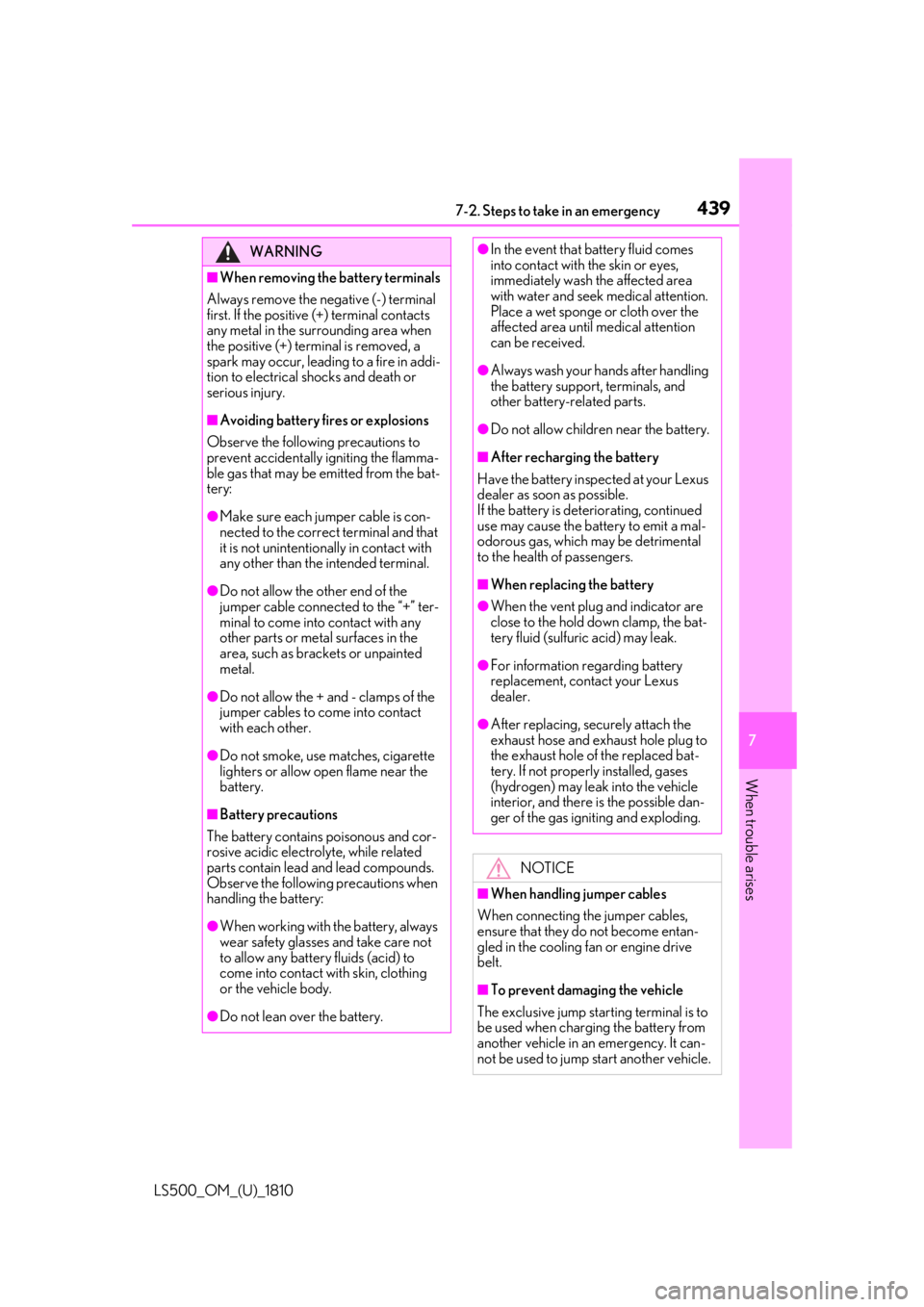
When removing the battery terminals
Always remove the negative (-) terminal
first. If the positive (+) terminal contacts
any metal in the surrounding area when
the positive (+) terminal is removed, a
spark may occur, leadin g to a fire in addi-
tion to electrical shocks and death or
serious injury. ■
Avoiding battery fires or explosions
Observe the following precautions to
prevent accidentally igniting the flamma-
ble gas that may be emitted from the bat-
tery: ●
Make sure each jumper cable is con-
nected to the correct terminal and that
it is not unintentiona lly in contact with
any other than the intended terminal.●
Do not allow the other end of the
jumper cable connected to the “+” ter-
minal to come into contact with any
other parts or metal surfaces in the
area, such as brackets or unpainted
metal.●
Do not allow the + and - clamps of the
jumper cables to come into contact
with each other.
●
Do not smoke, use matches, cigarette
lighters or allow open flame near the
battery.
■
Battery precautions
The battery contains poisonous and cor-
rosive acidic electrolyte, while related
parts contain lead and lead compounds.
Observe the following precautions when
handling the battery:
●
When working with the battery, always
wear safety glasses and take care not
to allow any battery fluids (acid) to
come into contact with skin, clothing
or the vehicle body.
●
Do not lean over the battery. ●
In the event that battery fluid comes
into contact with the skin or eyes,
immediately wash the affected area
with water and seek medical attention.
Place a wet sponge or cloth over the
affected area until medical attention
can be received. ●
Always wash your ha nds after handling
the battery support, terminals, and
other battery-related parts. ●
Do not allow children near the battery. ■
After recharging the battery
Have the battery inspected at your Lexus
dealer as soon as possible.
If the battery is deteriorating, continued
use may cause the battery to emit a mal-
odorous gas, which may be detrimental
to the health of passengers. ■
When replacing the battery ●
When the vent plug and indicator are
close to the hold down clamp, the bat-
tery fluid (sulfuric acid) may leak. ●
For information regarding battery
replacement, contact your Lexus
dealer. ●
After replacing, se curely attach the
exhaust hose and exhaust hole plug to
the exhaust hole of the replaced bat-
tery. If not properly installed, gases
(hydrogen) may leak into the vehicle
interior, and there is the possible dan-
ger of the gas igniting and exploding.
NOTICE
■
When handling jumper cables
When connecting the jumper cables,
ensure that they do not become entan-
gled in the cooling fan or engine drive
belt.
■
To prevent damaging the vehicle
The exclusive jump starting terminal is to
be used when chargi ng the battery from
another vehicle in an emergency. It can-
not be used to jump start another vehicle.
Page 450 of 512
450 8-1. Specifications
LS500_OM_(U)_1810 *
: The fluid capacity is a reference quantity.
If replacement is necessary, contact your Lexus dealer.
*
: Your Lexus vehicle is filled with Toyota ge nuine gear oil at the factory. Use Lexus
approved Toyota genuine gear oil or an equi valent of matching qu ality to satisfy the
above specification. Plea se contact your Lexus dealer for further details.
*
: Your Lexus vehicle is filled with “Toyota Genu ine Differential Gear Oil” at the factory.
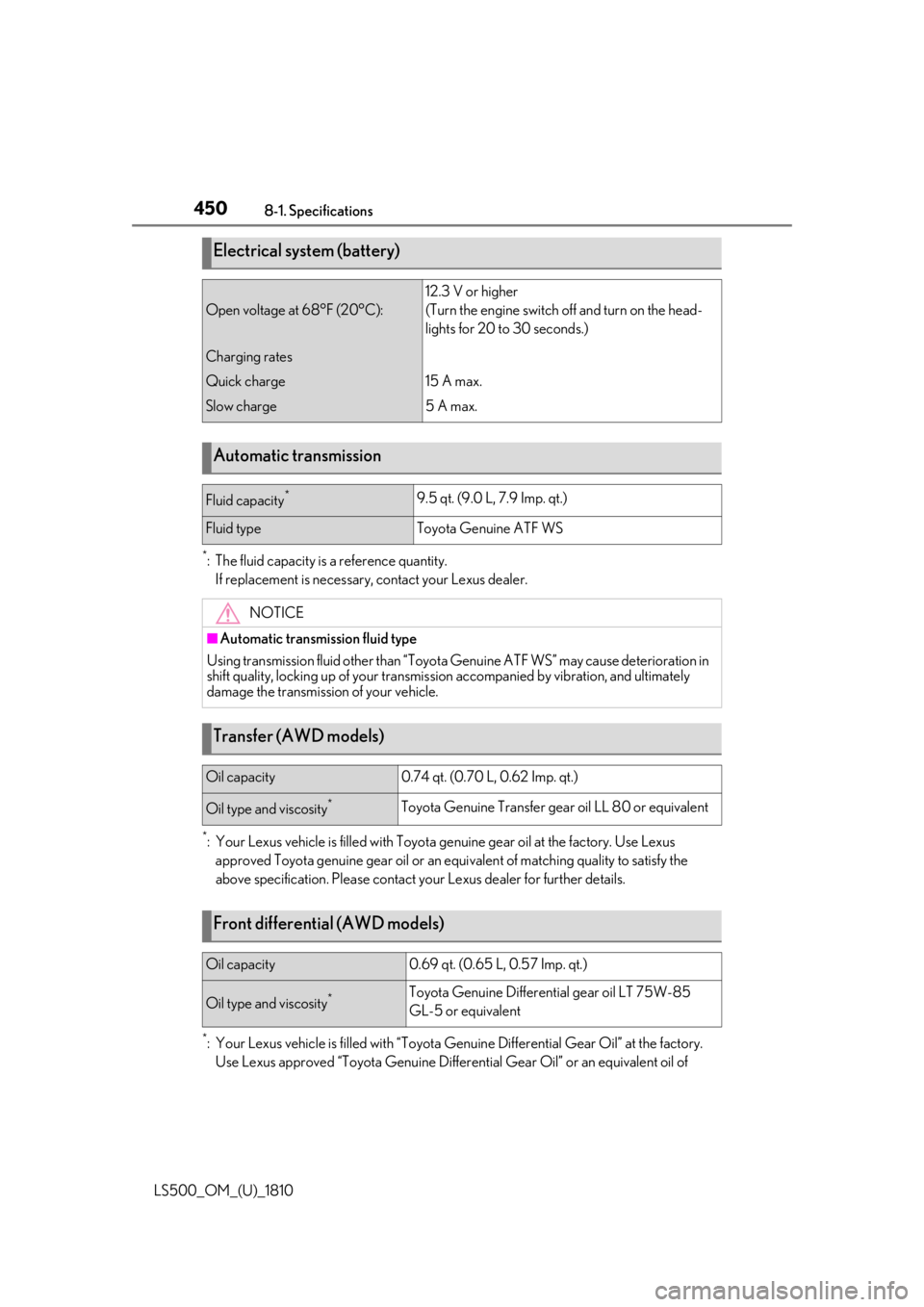
Use Lexus approved “Toyota Ge nuine Differential Gear Oil” or an equivalent oil of Electrical system (battery) Open voltage at 68°F (20°C): 12.3 V or higher
(Turn the engine switch off and turn on the head-
lights for 20 to 30 seconds.)
Charging rates
Quick charge
Slow charge 15 A max.
5 A max.
Automatic transmission Fluid capacity *
9.5 qt. (9.0 L, 7.9 Imp. qt.)
Fluid type Toyota Genuine ATF WS
NOTICE■
Automatic transmission fluid type
Using transmission fluid other than “Toyota Genuine ATF WS” may ca use deterioration in
shift quality, locking up of your transmission accompanied by vibration, and ultimately
damage the transmission of your vehicle.
Transfer (AWD models) Oil capacity 0.74 qt. (0.70 L, 0.62 Imp. qt.)
Oil type and viscosity *
Toyota Genuine Transfer gear oil LL 80 or equivalent
Front differential (AWD models) Oil capacity 0.69 qt. (0.65 L, 0.57 Imp. qt.)
Oil type and viscosity *
Toyota Genuine Differential gear oil LT 75W-85
GL-5 or equivalent
Page 451 of 512

4518-1. Specifications
LS500_OM_(U)_1810 8
Vehicle specifications matching quality to satisfy th e above specification. Please contact your Lexus dealer for
further details.
2WD models
AWD models *
: Your Lexus vehicle is filled with “Toyota Genu ine Differential Gear Oil” at the factory.
Use Lexus approved “Toyota Ge nuine Differential Gear Oil” or an equivalent oil of
matching quality to satisfy th e above specification. Please contact your Lexus dealer for
further details.
*1
: Minimum pedal clearance when depressed with a force of 11 2 lbf (500 N, 51 kgf) while
the engine is running.
When performing the brake pedal inspection, also be sure to check that the brake sys-
tem warning light is not illuminated when th e engine is running. (If the brake system Rear differential Oil capacity 0.90 qt. (0.85 L, 0.75 Imp. qt.)
Oil type and viscosity *
Toyota Genuine Differential gear oil LT 75W-85
GL-5 or equivalent
Oil capacity 1.42 qt. (1.35 L, 1.19 Imp. qt.)
Oil type and viscosity *
Toyota Genuine Differential gear oil LT 75W-85
GL-5 or equivalent
Brakes Pedal clearance *1
4.8 in. (121 mm) Min. *3
4.8 in. (122 mm) Min. *4
Pedal free play 0.04 0.24 in. (1 6 mm)
Brake pad wear limit 0.04 in. (1 mm)
Parking brake lining wear limit 0.04 in. (1 mm)
Parking brake indicator *2
When pushing the parking brake switch for 1 to 2
seconds: comes on
When pulling the parking brake switch for 1 to 2
seconds: turns off
Fluid type FMVSS No.116 DOT 3 or SAE J1703
FMVSS No.116 DOT 4 or SAE J1704
Page 452 of 512
452 8-1. Specifications
LS500_OM_(U)_1810 warning light is illumin ated, refer to P.415.)*2
: Make sure to confirm that the brake warning light (yellow) does not illuminate. (If the
brake warning light illuminates, refer to P.415.) *3
: Vehicles without Lexus Safety System + A *4
: Vehicles with Lexus Safety System + A
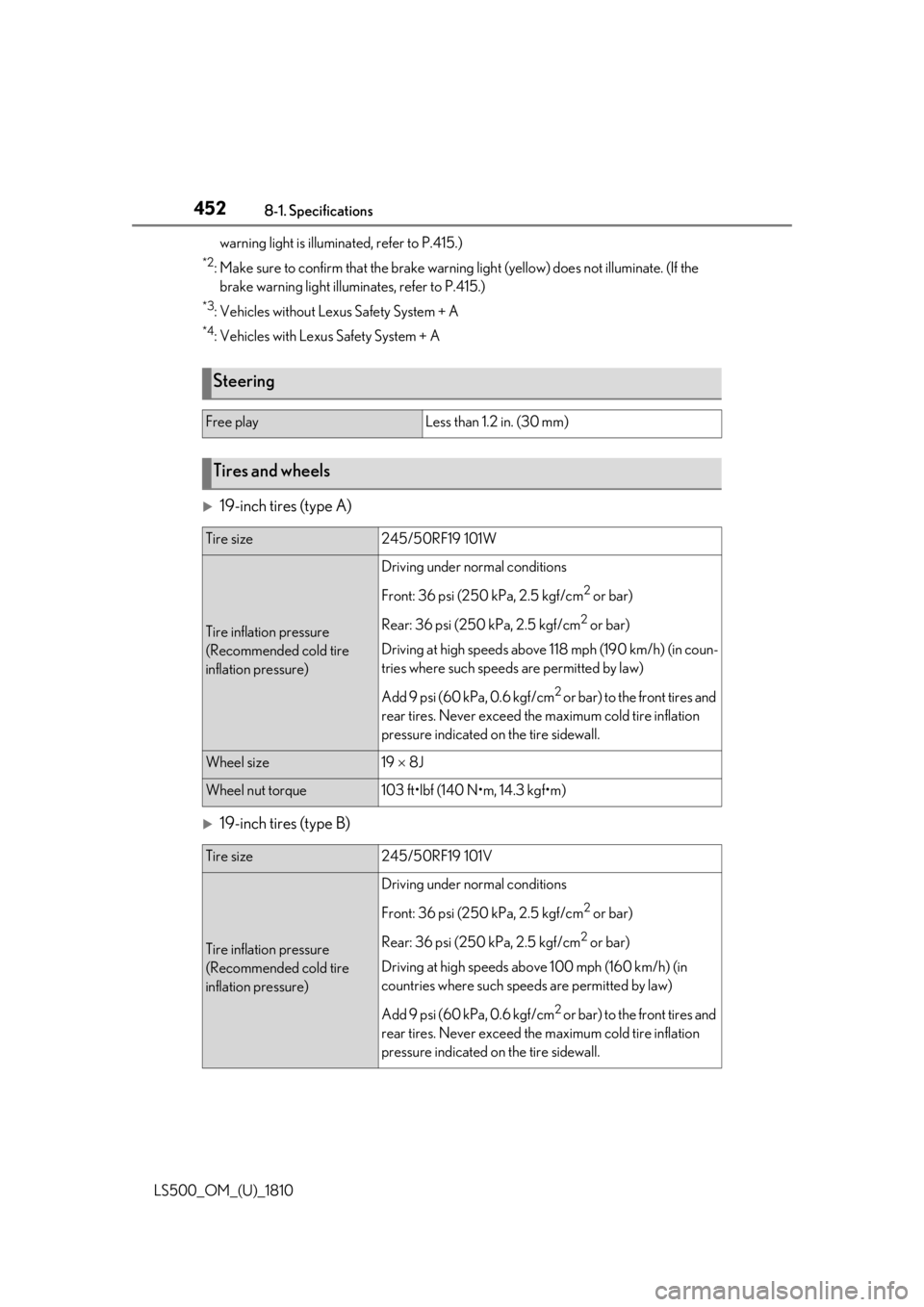
19-inch tires (type A)
19-inch tires (type B)Steering Free play Less than 1.2 in. (30 mm)
Tires and wheels Tire size 245/50RF19 101W
Tire inflation pressure
(Recommended cold tire
inflation pressure) Driving under normal conditions
Front: 36 psi (250 kPa, 2.5 kgf/cm 2
or bar)
Rear: 36 psi (250 kPa, 2.5 kgf/cm 2
or bar)
Driving at high speeds above 118 mph (190 km/h) (in coun-
tries where such speeds are permitted by law)
Add 9 psi (60 kPa, 0.6 kgf/cm 2
or bar) to the front tires and
rear tires. Never exceed the maximum cold tire inflation
pressure indicated on the tire sidewall.
Wheel size 19 8J
Wheel nut torque 103 ft•lbf (140 N•m, 14.3 kgf•m)
Tire size 245/50RF19 101V
Tire inflation pressure
(Recommended cold tire
inflation pressure) Driving under normal conditions
Front: 36 psi (250 kPa, 2.5 kgf/cm 2
or bar)
Rear: 36 psi (250 kPa, 2.5 kgf/cm 2
or bar)
Driving at high speeds above 100 mph (160 km/h) (in
countries where such speeds are permitted by law)
Add 9 psi (60 kPa, 0.6 kgf/cm 2
or bar) to the front tires and
rear tires. Never exceed the maximum cold tire inflation
pressure indicated on the tire sidewall.
Page 455 of 512
4558-1. Specifications
LS500_OM_(U)_1810 8
Vehicle specifications ■
Gasoline quality
In very few cases, driveability problems may
be caused by the brand of gasoline you are
using. If driveability problems persist, try
changing the brand of gasoline. If this does
not correct the problem, consult your Lexus
dealer. ■
Recommendation of the use of gasoline
containing detergent additives●
Lexus recommends the use of gasoline
that contains detergent additives to avoid
the build-up of engine deposits.●
All gasoline sold in the U.S.A. contains
minimum detergent additives to clean
and/or keep clean intake systems, per
EPA’s lowest additive s concentration pro-
gram.
●
Lexus strongly recommends the use of
Top Tier Detergent Gasoline. For more
information on Top Tier Detergent Gaso-
line and a list of marketers, please go to
the official websit e www.toptiergas.com.
■
Recommendation of the use of low
emissions gasoline
Gasolines containing oxygenates such as
ethers and ethanol, as well as reformulated gasolines, are available in some cities.
These fuels are typically acceptable for use,
providing they meet other fuel require-
ments.
Lexus recommends these fuels, since the
formulations allow for reduced vehicle
emissions. ■
Non-recommendation of the use of
blended gasoline ●
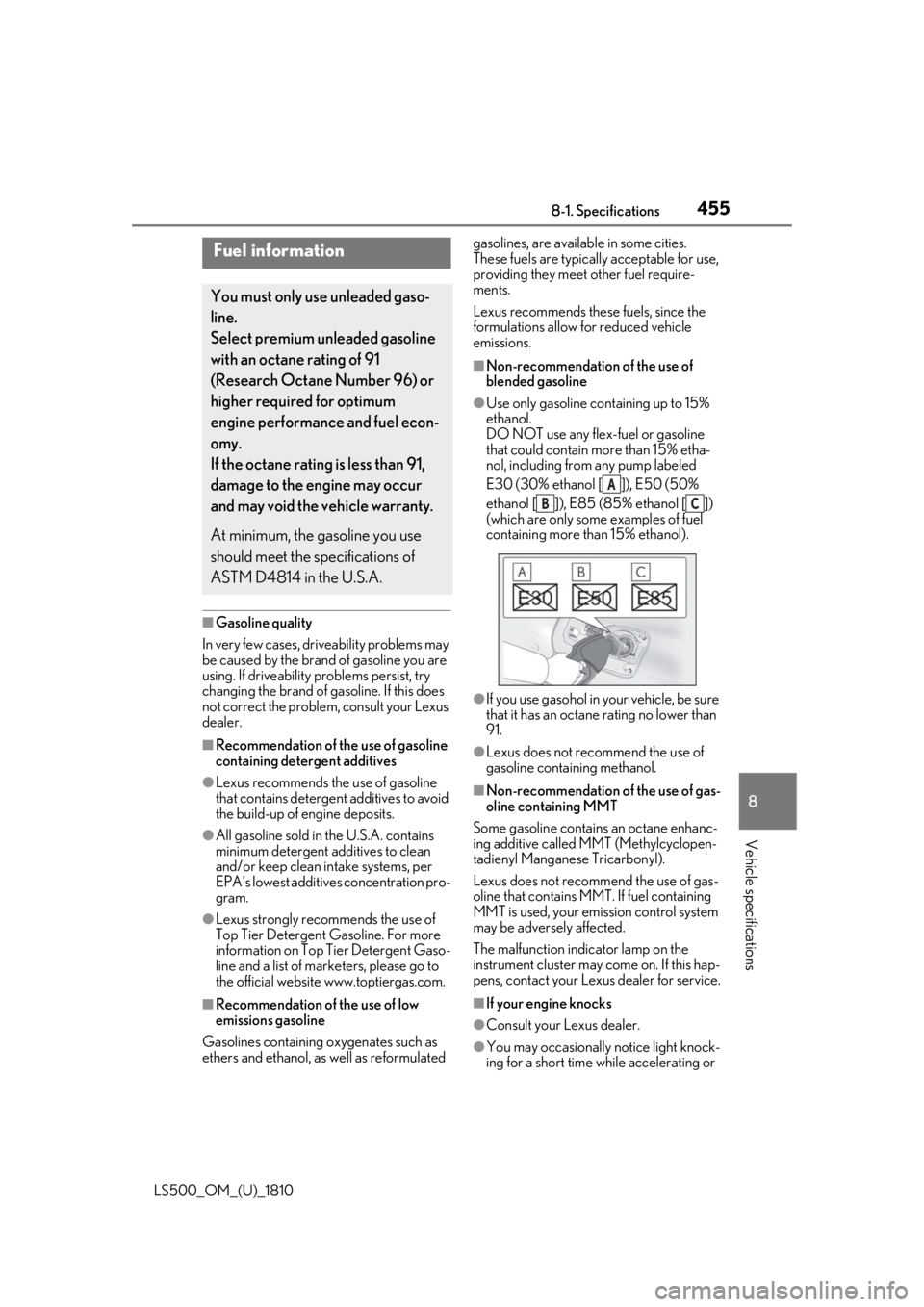
Use only gasoline containing up to 15%
ethanol.
DO NOT use any flex-fuel or gasoline
that could contain more than 15% etha-
nol, including from any pump labeled
E30 (30% ethanol [ ]), E50 (50%
ethanol [ ]), E85 (85% ethanol [ ])
(which are only some examples of fuel
containing more than 15% ethanol).
●
If you use gasohol in your vehicle, be sure
that it has an octane rating no lower than
91. ●
Lexus does not recommend the use of
gasoline containing methanol. ■
Non-recommendation of the use of gas-
oline containing MMT
Some gasoline contains an octane enhanc-
ing additive called MMT (Methylcyclopen-
tadienyl Manganese Tricarbonyl).
Lexus does not recommend the use of gas-
oline that contains MMT. If fuel containing
MMT is used, your emission control system
may be adversely affected.
The malfunction indicator lamp on the
instrument cluster may come on. If this hap-
pens, contact your Lexus dealer for service.
■
If your engine knocks
●
Consult your Lexus dealer.
●
You may occasionally notice light knock-
ing for a short time wh ile accelerating or Fuel information You must only use unleaded gaso-
line.
Select premium unleaded gasoline
with an octane rating of 91
(Research Octane Number 96) or
higher required for optimum
engine performance and fuel econ-
omy.
If the octane rating is less than 91,
damage to the engine may occur
and may void the vehicle warranty.
At minimum, the gasoline you use
should meet the specifications of
ASTM D4814 in the U.S.A. A
B C