2019 Lexus LC500 Steps to take in an
[x] Cancel search: Steps to take in anPage 4 of 432
4TABLE OF CONTENTS
General maintenance ................284
Emission inspection and mainte- nance (I/M) programs ............ 287
6-3. Do-it-yourself maintenance Do-it-yourself service precautions........................................................... 288
Hood.................................................. 290
Positioning a floor jack............... 290
Engine compartment.................. 292
12-volt battery................................ 299
Tires .................................................... 301
Replacing the tire ......................... 309
Tire inflation pressure .................. 313
Wheels............................................... 315
Air conditioning filter...................316
Electronic key battery ................. 318
Checking and replacing fuses . 319
Headlight aim................................. 323
Light bulbs ....................................... 324
7-1. Essential information Emergency flashers..................... 326
If your vehicle has to be stopped in an emergency ............................. 326
If the vehicle is trapped in rising water............................................... 327
7-2. Steps to take in an emergency If your vehicle needs to be towed........................................................... 329
If you think something is wrong ........................................................... 333
Fuel pump shut off system (LC500)....................................... 334
If a warning light turns on or a warn- ing buzzer sounds ..................... 335If a warning messa
ge is displayed
.......................................................... 344
If you have a flat tire .................... 350
If the engine will not start (LC500) ........................................................... 351
If the hybrid syst em will not start
(LC500h).................................... 352
If you lose your keys.................... 354
If the fuel filler door cannot be opened .......................................... 354
If the electronic key does not oper- ate properly ................................. 355
If the 12-volt battery is discharged .......................................................... 357
If your vehicle overheats (LC500) .......................................................... 364
If your vehicle overheats (LC500h) .......................................................... 366
If the vehicle becomes stuck ... 370
8-1. Specifications Maintenance data (fuel, oil level, etc.) ................................................. 372
Fuel information............................. 381
Tire information ............................ 383
8-2. Customization Customizable features ............... 391
8-3. Items to initialize Items to
initialize ........................... 403
9-1. For owners Reporting safety defects for U.S. owners ........................................... 406
7When trouble arises
8Vehicle specifications
9For owners
Page 325 of 432
325
7
7
When trouble arises
When trouble arises
7-1. Essential informationEmergency flashers.................. 326
If your vehicle has to be stopped in an emergency .......................... 326
If the vehicle is trapped in rising water............................................ 327
7-2. Steps to take in an emergency If your vehicle needs to be towed........................................................ 329
If you think something is wrong ........................................................ 333
Fuel pump shut off system (LC500).................................... 334
If a warning light turns on or a warning buzzer sounds ....... 335
If a warning message is displayed ........................................................ 344
If you have a flat tire.................. 350
If the engine will not start (LC500)..................................... 351
If the hybrid system will not start (LC500h) ................................. 352
If you lose your keys ................. 354
If the fuel filler door cannot be opened........................................ 354
If the electronic key does not operate properly .................... 355
If the 12-volt battery is discharged ........................................................ 357
If your vehicle overheats (LC500).................................... 364If your vehicle overheats
(LC500h)................................. 366
If the vehicle becomes stuck 370
Page 329 of 432
3297-2. Steps to take in an emergency
7
When trouble arises
7-2.Steps to take in an emergency
If your vehicle needs to be
towed
If towing is necessary, we recom-
mend having your vehicle towed by
your Lexus dealer or commercial
towing service, using a wheel-lift
type truck or flatbed truck.
Use a safety chain system for all
towing, and abide by all state/pro-
vincial and local laws.
WARNING
Observe the following precautions.
Failure to do so may result in death or
serious injury.
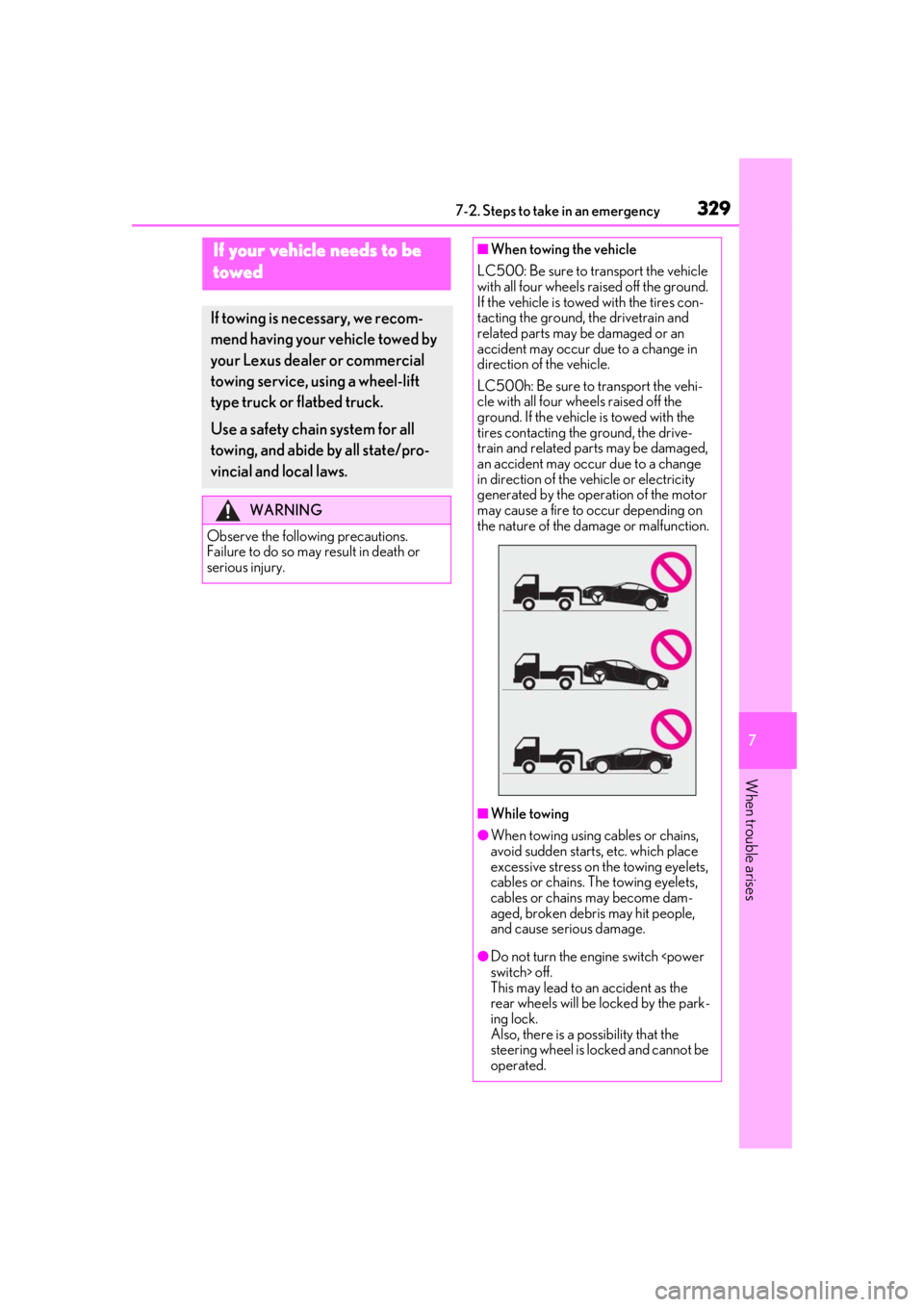
■When towing the vehicle
LC500: Be sure to transport the vehicle
with all four wheels raised off the ground.
If the vehicle is towed with the tires con-
tacting the ground, the drivetrain and
related parts may be damaged or an
accident may occur due to a change in
direction of the vehicle.
LC500h: Be sure to transport the vehi-
cle with all four wheels raised off the
ground. If the vehicle is towed with the
tires contacting the ground, the drive-
train and related parts may be damaged,
an accident may occur due to a change
in direction of the vehicle or electricity
generated by the operation of the motor
may cause a fire to occur depending on
the nature of the damage or malfunction.
■While towing
●When towing using cables or chains,
avoid sudden starts, etc. which place
excessive stress on the towing eyelets,
cables or chains. The towing eyelets,
cables or chains may become dam-
aged, broken debris may hit people,
and cause serious damage.
●Do not turn the engine switch
This may lead to an accident as the
rear wheels will be locked by the park-
ing lock.
Also, there is a possibility that the
steering wheel is locked and cannot be
operated.
Page 330 of 432
3307-2. Steps to take in an emergency
In the following situations, it is not pos-
sible to be towed by another vehicle
using cables or chains, as the rear
wheels may be locked due to the park-
ing lock. Contact your Lexus dealer or
commercial towing service.
There is a malfunction in the shift control system. (
P.149, 153, 347)
There is a malfunction in the engine
immobilizer system
There is a malfunction in the smart
access system with push-button
start. ( P.355)
The 12-volt battery is discharged.
( P.357)
The following may indicate a problem
with your transmission. Contact your
Lexus dealer or commercial towing
service before towing.
LC500: The engine is running but
the vehicle does not move.
LC500h: The hybrid system warn-
ing message is shown on the multi-
information display and the vehicle
does not move.
The vehicle makes an abnormal
sound.
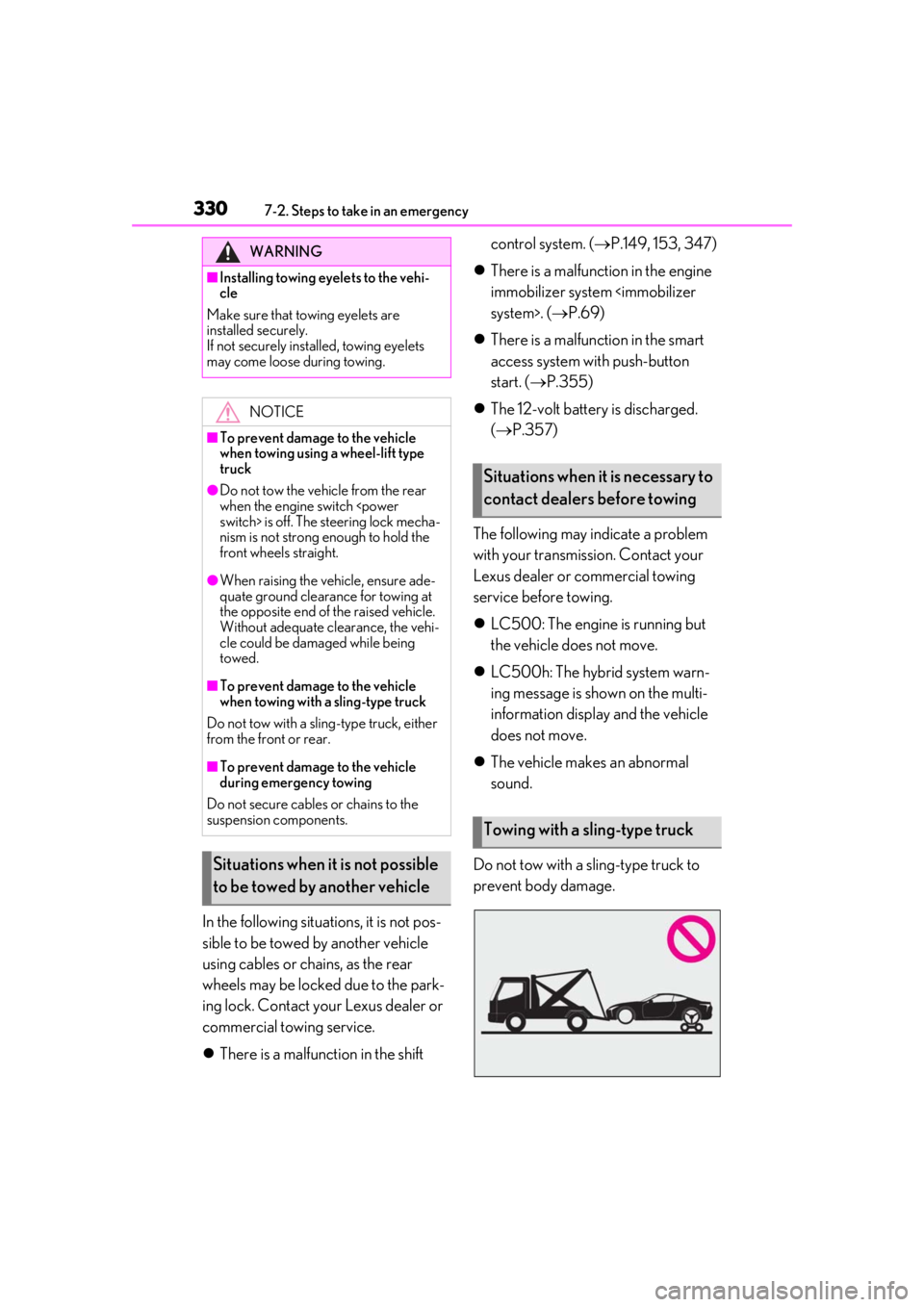
Do not tow with a sling-type truck to
prevent body damage.
WARNING
■Installing towing eyelets to the vehi-
cle
Make sure that towing eyelets are
installed securely.
If not securely installed, towing eyelets
may come loose during towing.
NOTICE
■To prevent damage to the vehicle
when towing using a wheel-lift type
truck
●Do not tow the vehicle from the rear
when the engine switch
nism is not strong enough to hold the
front wheels straight.
●When raising the vehicle, ensure ade-
quate ground clearance for towing at
the opposite end of the raised vehicle.
Without adequate clearance, the vehi-
cle could be damaged while being
towed.
■To prevent damage to the vehicle
when towing with a sling-type truck
Do not tow with a sling-type truck, either
from the front or rear.
■To prevent damage to the vehicle
during emergency towing
Do not secure cables or chains to the
suspension components.
Situations when it is not possible
to be towed by another vehicle
Situations when it is necessary to
contact dealers before towing
Towing with a sling-type truck
Page 331 of 432
3317-2. Steps to take in an emergency
7
When trouble arises
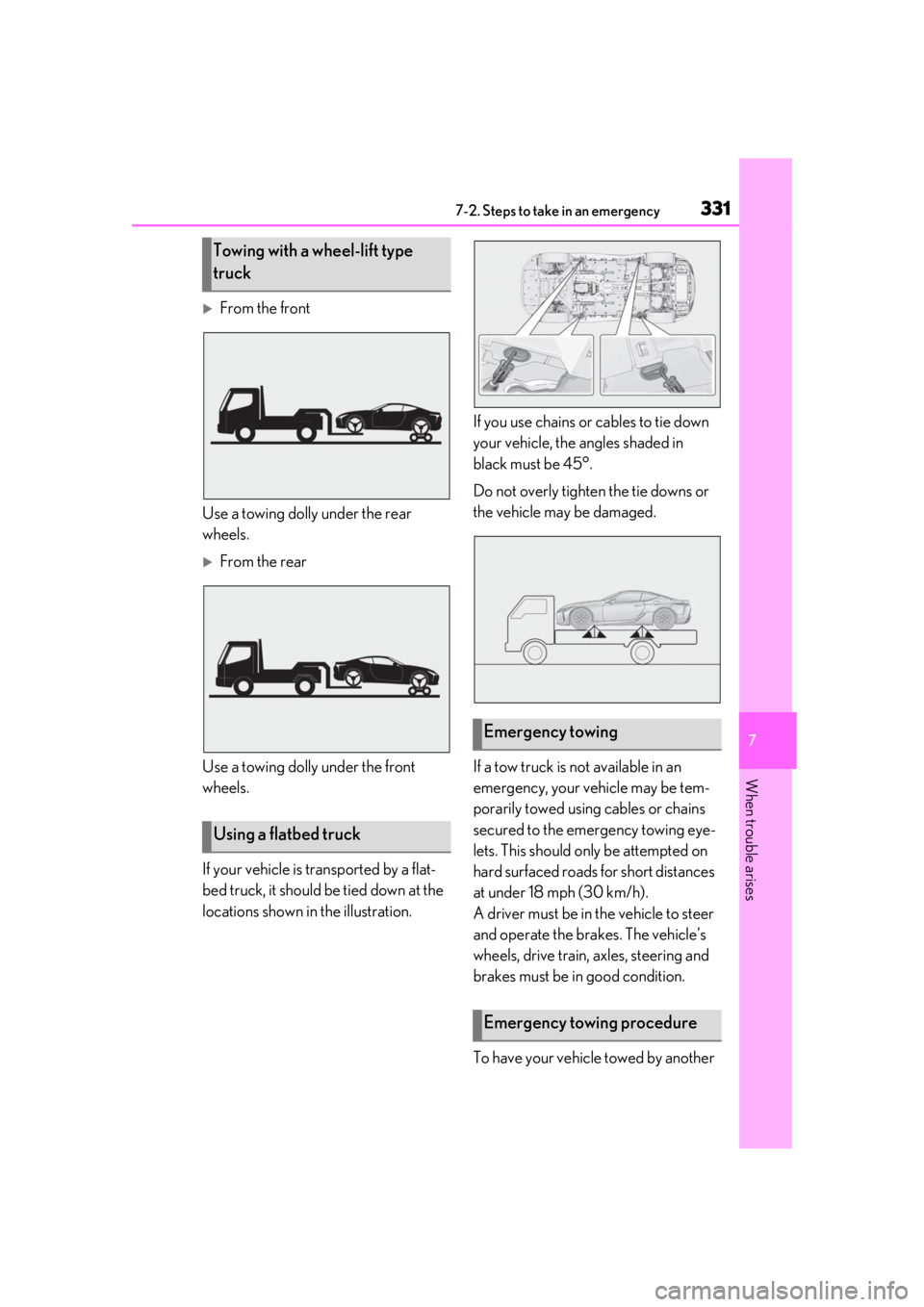
From the front
Use a towing dolly under the rear
wheels.
From the rear
Use a towing dolly under the front
wheels.
If your vehicle is transported by a flat-
bed truck, it should be tied down at the
locations shown in the illustration. If you use chains or cables to tie down
your vehicle, the angles shaded in
black must be 45°.
Do not overly tighten the tie downs or
the vehicle may be damaged.
If a tow truck is not available in an
emergency, your vehicle may be tem-
porarily towed using cables or chains
secured to the emergency towing eye-
lets. This should only be attempted on
hard surfaced roads for short distances
at under 18 mph (30 km/h).
A driver must be in the vehicle to steer
and operate the brakes. The vehicle’s
wheels, drive train, axles, steering and
brakes must be in good condition.
To have your vehicle towed by another
Towing with a wheel-lift type
truck
Using a flatbed truck
Emergency towing
Emergency towing procedure
Page 332 of 432
3327-2. Steps to take in an emergency
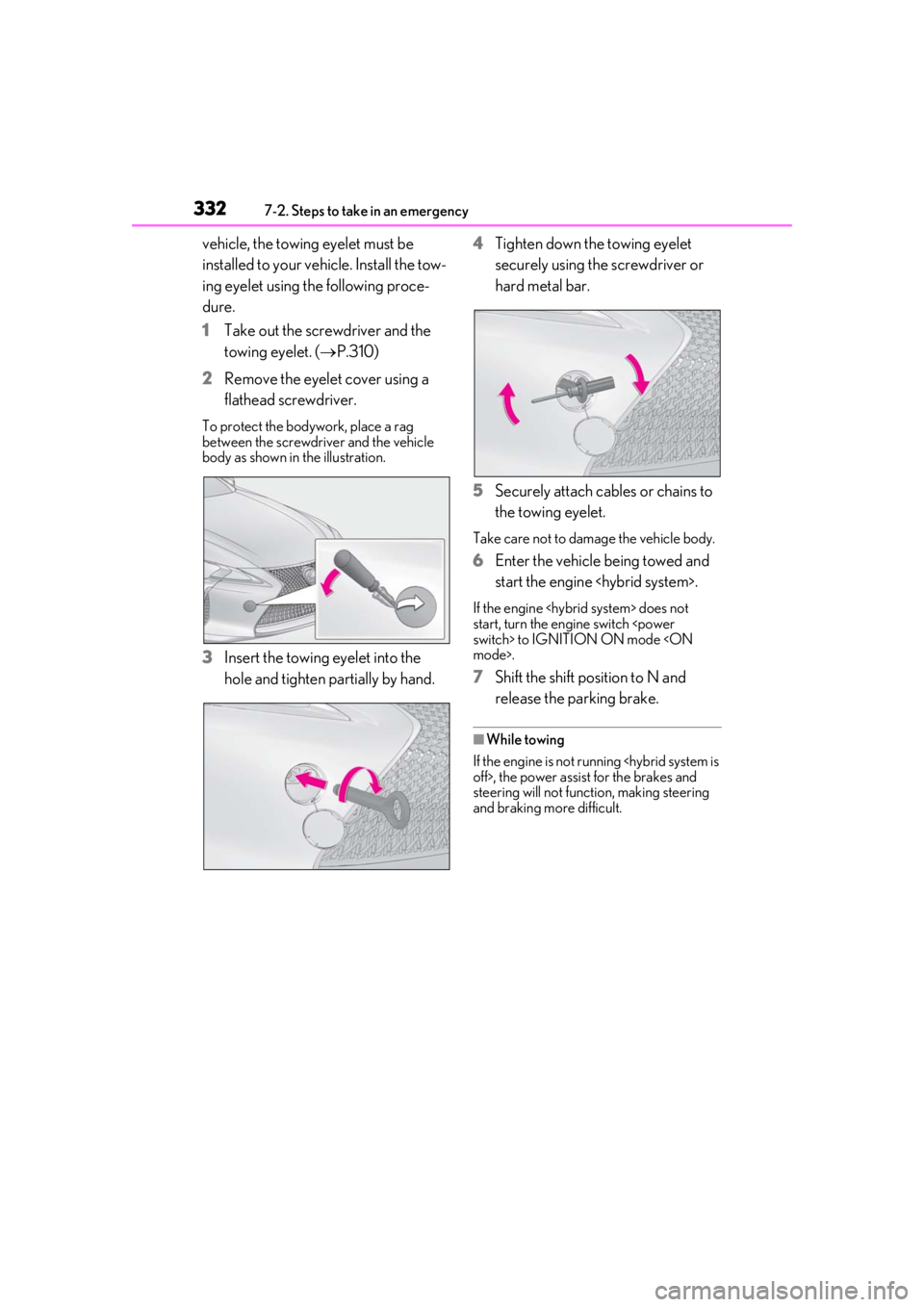
vehicle, the towing eyelet must be
installed to your vehicle. Install the tow-
ing eyelet using the following proce-
dure.
1Take out the screwdriver and the
towing eyelet. ( P.310)
2 Remove the eyelet cover using a
flathead screwdriver.
To protect the bodywork, place a rag
between the screwdriver and the vehicle
body as shown in the illustration.
3Insert the towing eyelet into the
hole and tighten partially by hand. 4
Tighten down the towing eyelet
securely using the screwdriver or
hard metal bar.
5 Securely attach cables or chains to
the towing eyelet.
Take care not to damage the vehicle body.
6Enter the vehicle being towed and
start the engine
If the engine
start, turn the engine switch
7Shift the shift position to N and
release the parking brake.
■While towing
If the engine is not running
steering will not function, making steering
and braking more difficult.
Page 333 of 432
3337-2. Steps to take in an emergency
7
When trouble arises
Fluid leaks under the vehicle. (Water
dripping from the air conditioning
after use is normal.)
Flat-looking tires or uneven tire
wear
Engine coolant temperature gauge
continually points higher than nor-
mal.
Changes in exhaust sound
Excessive tire squeal when corner-
ing
Strange noises related to the sus-
pension system
Pinging or other noises related to
the engine
Engine missing, stumbling or run-
ning roughly
Appreciable loss of power
Vehicle pulls heavily to one side
when braking
Vehicle pulls heavily to one side
when driving on a level road
Loss of brake effectiveness, spongy
feeling, pedal almost touches the
floor
If you think something is
wrong
If you notice any of the following
symptoms, your vehicle probably
needs adjustment or repair. Con-
tact your Lexus dealer as soon as
possible.
Visible symptoms
Audible symptoms
Operational symptoms
Page 334 of 432
3347-2. Steps to take in an emergency
Follow the procedure below to restart
the engine after the system is activated.
1Turn the engine switch to ACCES-
SORY mode or turn it off.
2 Restart the engine.
Fuel pump shut off system
(LC500)
To minimize the risk of fuel leakage
when the engine stalls or when an
airbag inflates upon collision, the
fuel pump shut off system stops the
supply of fuel to the engine.
Restarting the engine
NOTICE
■Before starting the engine
Inspect the ground under the vehicle.
If you find that fuel has leaked onto the
ground, the fuel system has been dam-
aged and is in need of repair. Do not
restart the engine.