2019 Lexus IS350 flat
[x] Cancel search: flatPage 6 of 660

TABLE OF CONTENTS6
IS350 AWD/IS350/IS300 AWD/IS300_U
7-1. Maintenance and careCleaning and protecting the vehicle exterior ................ 454
Cleaning and protecting the vehicle interior.................. 458
7-2. Maintenance Maintenance requirements ..............................461
General mainte nance.............. 464
Emission inspection and maintenance (I/M)
programs.................................... 467
7-3. Do-it-yourself maintenance
Do-it-yourself service precautions................................ 468
Hood ............................................... 470
Positioning a floor jack .............. 471
Engine compartment ............... 473
Tires ................................................. 485
Tire inflation pressure .............. 495
Wheels ........................................... 498
Air conditioning filter ...............500
Electronic key battery.............. 502
Checking and replacing fuses.............................................. 504
Light bulbs .................................... 507 8-1. Essential information
Emergency flashers ....................514
If your vehicle has to be stopped in an
emergency ................................. 515
If the vehicle is trapped in rising water ..................................516
8-2. Steps to take in an emergency
If your vehicle needs to be towed ............................................. 517
If you think something is wrong........................................... 523
Fuel pump shut off system.......................................... 524
If a warning light turns on or a warning buzzer
sounds ......................................... 525
If a warning message is displayed .................................... 532
If you have a flat tire .................. 559
If the engine will not start ........ 570
If the electronic key does not operate properly ............. 572
If the vehicle battery is discharged................................. 575
If your vehicle overheats......... 579
If the vehicle becomes stuck .............................................583
7Maintenance and care8When trouble arises
Page 15 of 660

15Pictorial index
IS350 AWD/IS350/IS300 AWD/IS300_U
Windshield wipers . . . . . . . . . . . . . . . . . . . . . . . . . . . . . . . . . . . . . . . . . . . . . . . . . . . P. 210
Precautions against winter season . . . . . . . . . . . . . . . . . . . . . . . . . . . . . . . . . . . . . P. 306
To prevent freezing (windshield wiper de-icer)
*. . . . . . . . . . . . . . . . . . . . . . . P. 422
Precautions against car wash . . . . . . . . . . . . . . . . . . . . . . . . . . . . . . . . . . . . . . . . . . P. 456
Fuel filler door . . . . . . . . . . . . . . . . . . . . . . . . . . . . . . . . . . . . . . . . . . . . . . . . . . . . . . . P. 218
Refueling method . . . . . . . . . . . . . . . . . . . . . . . . . . . . . . . . . . . . . . . . . . . . . . . . . . . . . . . P. 218
Fuel type/fuel tank capacity . . . . . . . . . . . . . . . . . . . . . . . . . . . . . . . . . . . . . . . . . . . . P. 589
Tires . . . . . . . . . . . . . . . . . . . . . . . . . . . . . . . . . . . . . . . . . . . . . . . . . . . . . . . . . . . . . . . . . P. 485
Tire size/inflation pressure . . . . . . . . . . . . . . . . . . . . . . . . . . . . . . . . . . . . . . . . . . . . . P. 595
Winter tires/tire chain . . . . . . . . . . . . . . . . . . . . . . . . . . . . . . . . . . . . . . . . . . . . . . . . . P. 30 6
Checking/rotation/tire pressure warning system . . . . . . . . . . . . . . . . . . . . . . P. 485
Coping with flat tires . . . . . . . . . . . . . . . . . . . . . . . . . . . . . . . . . . . . . . . . . . . . . . . . . . . P. 559
Hood . . . . . . . . . . . . . . . . . . . . . . . . . . . . . . . . . . . . . . . . . . . . . . . . . . . . . . . . . . . . . . . . .P. 470
Opening. . . . . . . . . . . . . . . . . . . . . . . . . . . . . . . . . . . . . . . . . . . . . . . . . . . . . . . . . . . . . . . P. 470
Engine oil . . . . . . . . . . . . . . . . . . . . . . . . . . . . . . . . . . . . . . . . . . . . . . . . . . . . . . . . . . . . . . P. 590
Coping with overheat. . . . . . . . . . . . . . . . . . . . . . . . . . . . . . . . . . . . . . . . . . . . . . . . . . P. 579
Warning messages . . . . . . . . . . . . . . . . . . . . . . . . . . . . . . . . . . . . . . . . . . . . . . . . . . . . P. 535
Headlights . . . . . . . . . . . . . . . . . . . . . . . . . . . . . . . . . . . . . . . . . . . . . . . . . . . . . . . . . . P. 202
Parking lights/daytime running lights. . . . . . . . . . . . . . . . . . . . . . . . . . . . . . P. 202
Turn signal lights . . . . . . . . . . . . . . . . . . . . . . . . . . . . . . . . . . . . . . . . . . . . . . . . . . . . . P. 198
Tail lights . . . . . . . . . . . . . . . . . . . . . . . . . . . . . . . . . . . . . . . . . . . . . . . . . . . . . . . . . . . . P. 202
Stop lights . . . . . . . . . . . . . . . . . . . . . . . . . . . . . . . . . . . . . . . . . . . . . . . . . . . . . . . . . . . . P. 172
Back-up lights
Shifting the shift lever to R . . . . . . . . . . . . . . . . . . . . . . . . . . . . . . . . . . . . . . . . . . . . . . P. 1 91
License plate lights . . . . . . . . . . . . . . . . . . . . . . . . . . . . . . . . . . . . . . . . . . . . . . . . . P. 202
Side marker lights . . . . . . . . . . . . . . . . . . . . . . . . . . . . . . . . . . . . . . . . . . . . . . . . . . P. 202
4
5
6
7
Light bulbs of the exterior lights for driving(Replacing method: P. 507, Watts: P. 597)
*: If equipped
8
9
10
11
12
13
14
Page 36 of 660
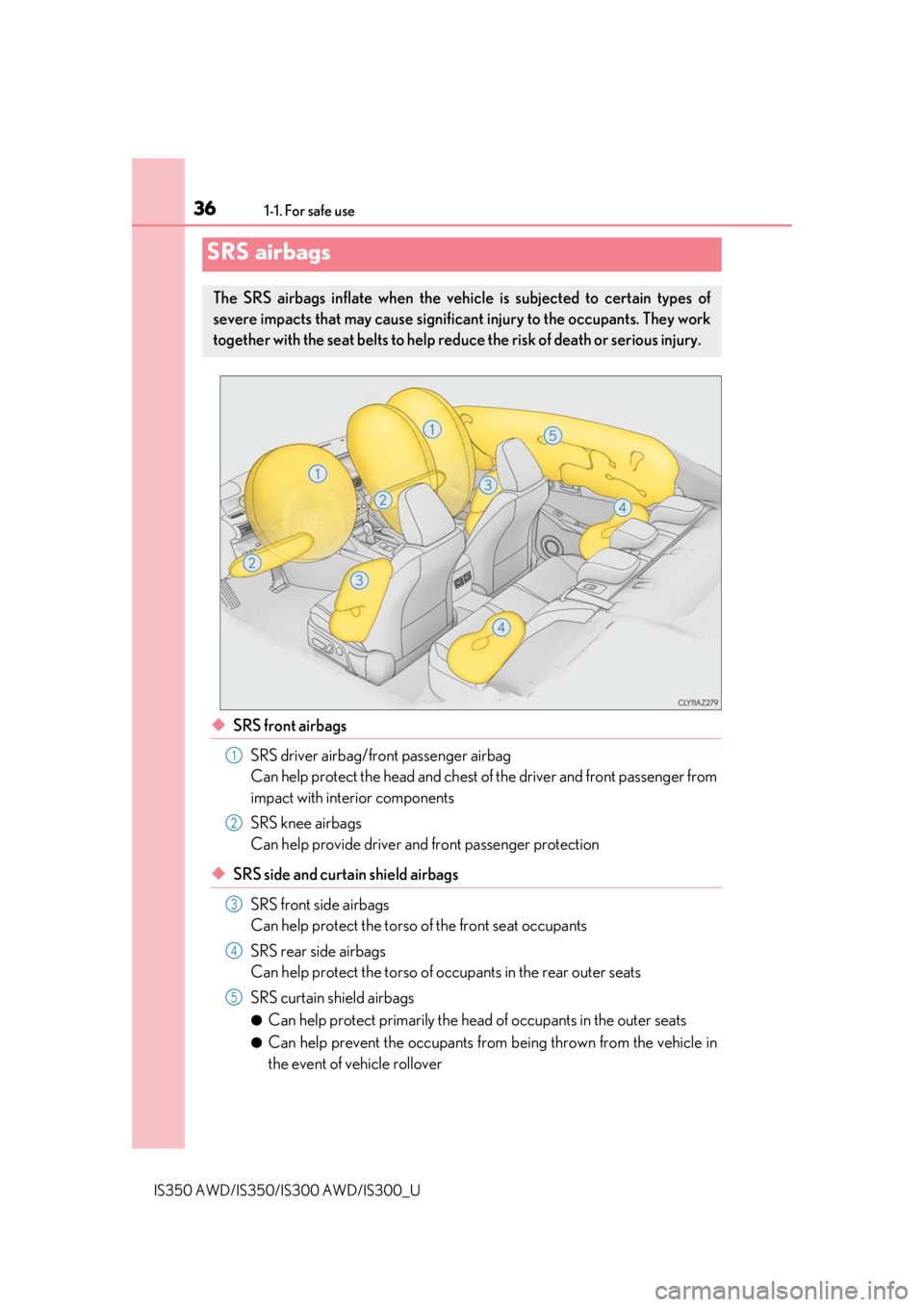
361-1. For safe use
IS350 AWD/IS350/IS300 AWD/IS300_U
◆SRS front airbagsSRS driver airbag/front passenger airbag
Can help protect the head and chest of the driver and front passenger from
impact with interior components
SRS knee airbags
Can help provide driver and front passenger protection
◆SRS side and curtain shield airbags
SRS front side airbags
Can help protect the torso of the front seat occupants
SRS rear side airbags
Can help protect the torso of o ccupants in the rear outer seats
SRS curtain shield airbags
●Can help protect primarily the head of occupants in the outer seats
●Can help prevent the occupants from being thrown from the vehicle in
the event of vehicle rollover
SRS airbags
The SRS airbags inflate when the vehi cle is subjected to certain types of
severe impacts that may ca use significant injury to the occupants. They work
together with the seat belts to help redu ce the risk of death or serious injury.
1
2
3
4
5
Page 37 of 660

371-1. For safe use
1
For safety and security
IS350 AWD/IS350/IS300 AWD/IS300_U
Your vehicle is equipped with ADVANCED AIRBAGS designed based on the
US motor vehicle safety standards (F MVSS208). The airbag sensor assembly
(ECU) controls airbag deployment based on information obtained from the sen-
sors etc. shown in the system compon ents diagram above. This information
includes crash severity and occupant information. As the airbags deploy, a
chemical reaction in the inflators quickly fills the airbags with non-toxic gas to
help restrain the motion of the occupants.
SRS airbag system components
Front passenger occupant classifi-
cation system (ECU and sensors)
Side impact sensors (front doors)
Knee airbags
Front passenger airbag
Curtain shield airbags
“AIR BAG ON” and “AIR BAG
OFF” indicator lights
Seat belt pretensioners and force
limiters
Side impact sensors (front) Front side airbags
SRS warning light
Driver airbag
Rear side airbags
Side impact sensors (rear)
Driver’s seat position sensor
Driver’s seat belt buckle switch
Airbag sensor assembly
Front passenger’s seat belt buckle
switch
Front impact sensors1
2
3
4
5
6
7
8
9
10
11
12
13
14
15
16
17
18
Page 38 of 660

381-1. For safe use
IS350 AWD/IS350/IS300 AWD/IS300_U
WARNING
■SRS airbag precautions
Observe the following precautions regarding the SRS airbags.
Failure to do so may cause death or serious injury.
●The driver and all passengers in the vehicle must wear their seat belts properly.
The SRS airbags are supplemental devices to be us ed with the seat belts.
●The SRS driver airbag deploys with considerable force, and can cause death or seri-
ous injury especially if the driver is very close to the airbag. The National Highway
Traffic Safety Administration (NHTSA) advises:
Since the risk zone for the driver’s airbag is the first 2 - 3 in. (50 - 75 mm) of inflation,
placing yourself 10 in. (250 mm) from your driver airbag provides you with a clear
margin of safety. This distance is measured from the center of the steering wheel to
your breastbone. If you sit less than 10 in . (250 mm) away now, you can change your
driving position in several ways:
• Move your seat to the rear as far as you can while still reaching the pedals com-
fortably.
• Slightly recline the back of the seat. Although vehicle designs vary, many drivers can achieve the 10 in. (250 mm) dis-
tance, even with the driver seat all the wa y forward, simply by reclining the back of
the seat somewhat. If reclining the back of your seat makes it hard to see the road,
raise yourself by using a firm , non-slippery cushion, or raise the seat if your vehicle
has that feature.
• If your steering wheel is ad justable, tilt it downward. This points the airbag toward
your chest instead of your head and neck.
The seat should be adjusted as recommended by NHTSA ab ove, while still maintain-
ing control of the foot pedals, steering whee l, and your view of the instrument panel
controls.
Page 40 of 660

401-1. For safe use
IS350 AWD/IS350/IS300 AWD/IS300_U
WARNING
■SRS airbag precautions
●Do not hang coat hangers or other hard objects on the coat hooks. All of these items
could become projectiles and may cause deat h or serious injury, should the SRS cur-
tain shield airbags deploy.
●If a vinyl cover is put on the area where the SRS knee airbag will deploy, be sure to
remove it.
●Do not use seat accessories which cover th e parts where the SRS side airbags inflate
as they may interfere with inflation of th e SRS airbags. Such accessories may prevent
the side airbags from activating correctly, disable the system or cause the side airbags
to inflate accidentally, resultin g in death or serious injury.
●Do not lean against the door, the roof side rail
or the front, side and rear pillars.
●Do not allow anyone to kneel on the passen-
ger seat toward the door or put their head or
hands outside the vehicle.
●Do not attach anything to or lean anything
against areas such as the dashboard, steering
wheel pad and lower portion of the instru-
ment panel.
These items can become projectiles when the
SRS driver, front passeng er and knee airbags
deploy.
●Do not attach anything to areas such as a
door, windshield glass, side door glass, front
or rear pillar, roof side rail and assist grip.
Page 41 of 660

411-1. For safe use
1
For safety and security
IS350 AWD/IS350/IS300 AWD/IS300_U
WARNING
■SRS airbag precautions
●Do not strike or apply significant levels of force to the area of the SRS airbag compo-
nents.
Doing so can cause the SRS airbags to malfunction.
●Do not touch any of the component part s immediately after the SRS airbags have
deployed (inflated) as they may be hot.
●If breathing becomes difficult after the SR S airbags have deployed, open a door or
window to allow fresh air in, or leave the vehicl e if it is safe to do so. Wash off any resi-
due as soon as possible to prevent skin irritation.
●If the areas where the SRS airbags are stored, such as the steering wheel pad and
front and rear pillar garnishes, are damaged or cracked, have them replaced by your
Lexus dealer.
●Do not place anything, such as a cushion, on the front passenger’s seat. Doing so will
disperse the passenger’s weight, which prevents the sensor from detecting the pas-
senger’s weight properly. As a result, the SRS front airb ags for the front passenger
may not deploy in the event of a collision.
■Modification and disposal of SRS airbag system components
Do not dispose of your vehicle or perform any of the following modifications without
consulting your Lexus dealer. The SRS airb ags may malfunction or deploy (inflate)
accidentally, causing death or serious injury.
●Installation, removal, disassembly and repair of the SRS airbags
●Repairs, modifications, removal or replacement of the steering wheel, instrument
panel, dashboard, seats or seat upholstery, front, side and rear pilla rs or roof side rails
●Repairs or modifications of the front fender, front bumper, or side of the occupant
compartment
●Installation of a grille guard (bull bars, ka ngaroo bar, etc.), snow plows, winches or
roof luggage carrier
●Modifications to the vehicle’s suspension system
●Installation of electronic devices such as mobile two-way radios and CD players
●Modifications to your vehicle for a person with a physical disability
Page 42 of 660

421-1. For safe use
IS350 AWD/IS350/IS300 AWD/IS300_U
■If the SRS airbags deploy (inflate)
●Slight abrasions, burns, bruising etc., may be sustained from SRS airbags, due to the
extremely high speed deployment (inflation) by hot gases.
●A loud noise and white powder will be emitted.
●Parts of the airbag module (steering wheel hub, airbag cover and inflator) as well as the
seats, parts of the front and rear pillars, an d roof side rails may be hot for several min-
utes. The airbag itself may also be hot.
●The windshield may crack.
●All of the doors will be unlocked. ( P. 129)
●Fuel supply to the engi ne will be stopped. (P. 524)
●For Lexus Enform Safety Connect subscribers, if any of the following situations occur,
the system is designed to send an emerge ncy call to the response center, notifying
them of the vehicle’s location (without needing to push the “SOS” button) and an agent
will attempt to speak with the occupants to ascertain the level of emergency and assis-
tance required. If the occupants are unable to communicate, the agent automatically
treats the call as an emergency and helps to dispatch the necessary emergency ser-
vices. ( P. 68)
• An SRS airbag is deployed.
• A seat belt pretensioner is activated.
• The vehicle is involved in a severe rear-end collision.
■SRS airbag deployment cond itions (SRS front airbags)
●The SRS front airbags will deploy in the event of an impact that exceeds the set thresh-
old level (the level of force corresponding to an approximately 12 - 18 mph [20 - 30
km/h] frontal collision with a fixed wa ll that does not move or deform).
However, this threshold velocity will be cons iderably higher in the following situations:
• If the vehicle strikes an object, such as a parked vehicle or sign pole, which can move
or deform on impact
• If the vehicle is involved in an underride collision, such as a collision in which the
front of the vehicle “underrides”, or goes under, the bed of a truck
●Depending on the type of collision, it is possi ble that only the seat belt pretensioners will
activate.
●The SRS front airbags for the fr ont passenger will not activate if there is no passenger
sitting in the front passenger seat. However, the SRS front airbags for the front passen-
ger may deploy if luggage is put in the seat, even if the seat is unoccupied. ( P. 46)
■SRS airbag deployment conditions (S RS side and curtain shield airbags)
●The SRS side and curtain shield airbags w ill deploy in the event of an impact that
exceeds the set threshold level (the level of force corresponding to the impact force
produced by an approximately 3300 lb. [15 00 kg] vehicle colliding with the vehicle
cabin from a direction perpendicular to the vehicle orientation at an approximate
speed of 12 - 18 mph [20 - 30 km/h]).
●Both SRS curtain shield airbags will de ploy in the event of vehicle rollover.
●Both SRS curtain shield airbags will deploy in the event of a severe frontal collision.