2019 KIA SORENTO transmission oil
[x] Cancel search: transmission oilPage 365 of 573
Driving your vehicle
88
5
Various driving situations, which you
may encounter in SMART mode
The driving mode automatically
changes to ECO mode after a cer-
tain period of time, when you gen-
tly depress the accelerator pedal
(Your driving is categorized to be
mild.).
The driving mode automatically changes from SMART ECO mode
to SMART COMFORT mode after
a certain period of time, when you
sharply or repetitively depress the
accelerator pedal.
The driving mode automatically changes to SMART COMFORT
mode with the same driving pat-
terns, when the vehicle starts to
drive on an upward slope of a cer-
tain angle. The driving mode auto-
matically returns to SMART ECO
mode, when the vehicle enters a
leveled road. The driving mode automatically
changes to SMART SPORT, when
you abruptly accelerate the vehicle
or repetitively operate the steering
wheel (Your driving is categorized
to be sporty.). In this mode, your
vehicle drives in a lower gear for
abrupt accelerating/decelerating
and increases the engine brake
performance.
You may still sense the engine brake performance, even when you
release the accelerator pedal in
SMART SPORT mode. It is
because your vehicle remains to
be in a lower gear over a certain
period of time for next acceleration.
Thus, it is a normal driving situa-
tion, not indicating any malfunc-
tion.
The driving mode automatically changes to SMART SPORT mode
only in harsh driving situations. In
most of the normal driving situa-
tions, the driving mode sets to be
either in SMART ECO mode or in
SMART COMFORT mode. Limitation of SMART mode
The SMART mode may be limited in
following situations. (The OFF indica-
tor illuminates in those situations.)
The driver manually moves the
shift lever : It deactivates SMART
mode. The vehicle drives, as the
driver manually moves the shift
lever.
The cruise control is activated : The cruise system may deactivate
the SMART mode. When a higher
system is set by the cruise system,
it starts to control vehicle speed
and deactivates SMART mode.
(SMART mode is not deactivated
just by activing the cruise system.)
The transmission oil temperature is either extremely low or extremely
high : The SMART mode can be
active in most of the normal driving
situations. However, an extremely
high/ low transmission oil tempera-
ture may temporarily deactivate the
SMART mode, because the trans-
mission condition is out of normal
operation condition.
Page 408 of 573
5131
Driving your vehicle
When you are ready to leave after
parking on a hill
1. With the automatic transmission inP (Park), apply your brakes and
hold the brake pedal down while
you:
and
2. Slowly remove your foot from the brake pedal.
3. Drive slowly until the trailer is clear of the chocks.
4. Stop and have someone pick up and store the chocks.Maintenance when trailer tow-
ing
Your vehicle will need service more
often when you regularly pull a trail-
er. Important items to pay particular
attention to include engine oil, auto-
matic transmission fluid, axle lubri-
cant and cooling system fluid. Brake
condition is another important item to
frequently check. Each item is cov-
ered in this manual, and the Index
will help you find them quickly. If
you’re trailering, it’s a good idea to
review these sections before you
start your trip.
Don’t forget to also maintain your
trailer and hitch. Follow the mainte-
nance schedule that accompanied
your trailer and check it periodically.
Preferably, conduct the check at the
start of each day’s driving. Most
importantly, all hitch nuts and bolts
should be tight. When towing check transmission
fluid more frequently.
CAUTION - Air condition
Do not use the A/C while usingyour vehicle to tow uphill. Dueto higher load during trailerusage, overheating might occuron hot days or during uphilldriving.
Page 450 of 573

77
Maintenance
OWNER MAINTENANCE
The following lists are vehicle checks
and inspections that should be per-
formed by the owner or an author-
ized Kia dealer at the frequencies
indicated to help ensure safe,
dependable operation of your vehi-
cle.
Any adverse conditions should be
brought to the attention of your deal-
er as soon as possible.
These Owner Maintenance Checks
are generally not covered by war-
ranties and you may be charged for
labor, parts and lubricants used.Owner maintenance schedule
When you stop for fuel:
Check the engine oil level.
Check the coolant level in thecoolant reservoir.
Check the windshield washer fluid level.
Look for low or under-inflated tires.
While operating your vehicle:
Note any changes in the sound of the exhaust or any smell of
exhaust fumes in the vehicle.
Check for vibrations in the steering wheel. Notice any increased steer-
ing effort or looseness in the steer-
ing wheel, or change in its straight-
ahead position.
Notice if your vehicle constantly turns slightly or “pulls” to one side
when traveling on smooth, level
road.
When stopping, listen and check for unusual sounds, pulling to one
side, increased brake pedal travel
or “hard-to-push” brake pedal.
If any slipping or changes in the operation of your transmission
occurs, check the transmission
fluid level.
Check the automatic transmission P (Park) function.
Check the parking brake.
Check for fluid leaks under your vehicle (water dripping from the air
conditioning system during or after
use is normal).
WARNING - Hot coolant
Be careful when checking your
engine coolant level when the
engine is hot. Scalding hot
coolant and steam may blow
out under pressure.
Page 455 of 573

Maintenance
12
7
Number of months or driving distance, whichever comes first
Months1224364860728496108120132144156168180
Miles×1,0007.51522.530 37.5 45 52.5 60 67.5 75 82.5 90 97.5 105 112.5
Km×1,00012 24 36 48 60 72 84 96 108 120 132 144 156 168 180
Cooling system---I-I-I-I-I-I-
Automatic transmission fluidNo check, No service required
Rear axle oil (AWD) *5---I---I---I---
Transfer case oil (AWD) *5---I---I---I---
Vapor hose and fuel filler cap-I-I-I-I-I-I-I-
Fuel tank air filter *4-I-I-I-I-I-I-I-
Fuel lines, hoses and connections---I---I---I---
Parking brake (Foot Type)-I-I-I-I-I-I-I-
Brake fluid-I-I-I-I-I-I-I-
Cooling system hoses and connectionsInspect every 12,000 km (7,500 miles) or 6 months
Clutch (if equipped) and brake pedal free
playInspect every 12,000 km (7,500 miles) or 6 months
All latch, hinges and locksInspect every 24,000 km (15,000 miles) or 12 months
MAINTENANCE
INTERVALS
MAINTENANCE
ITEM
Normal Maintenance Schedule - Non Turbo Models (CONT.)
I : Inspect and if necessary, adjust, correct, clean or replace.
R : Replace or change.
*
4: Fuel tank air filter are considered to be maintenance free but periodic inspection is recommended for this maintenance sched- ule depends on fuel quality.
*
5: Transfer case oil and rear axle oil should be changed anytime they have been submerged in water.
Page 456 of 573
713
Maintenance
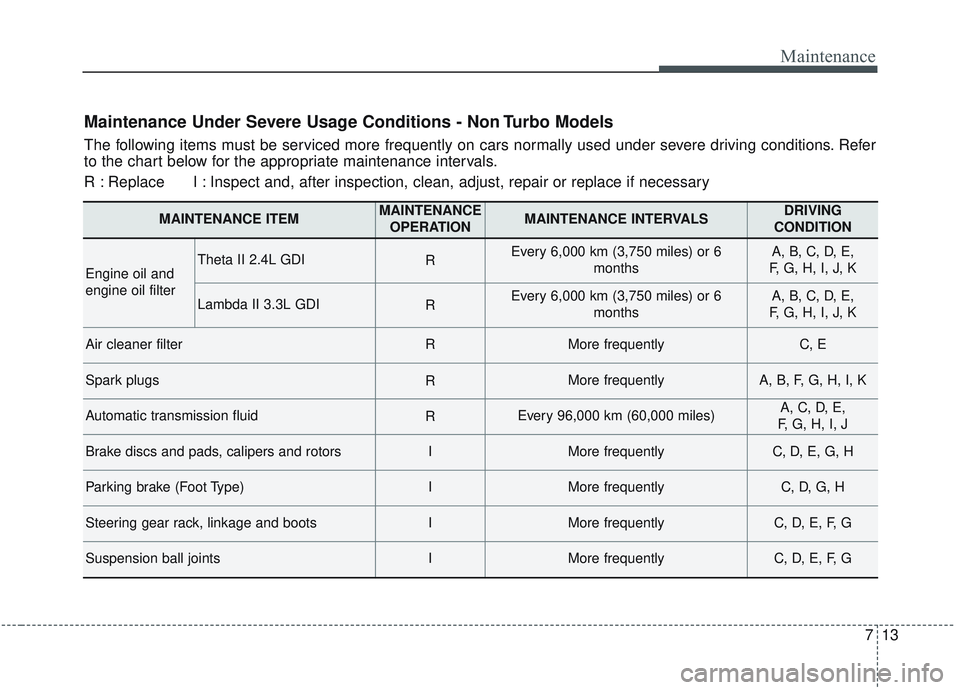
Maintenance Under Severe Usage Conditions - Non Turbo Models
The following items must be serviced more frequently on cars normally used under severe driving conditions. Refer
to the chart below for the appropriate maintenance intervals.
R : Replace I : Inspect and, after inspection, clean, adjust, repair or replace if neces\
sary
MAINTENANCE ITEMMAINTENANCEOPERATIONMAINTENANCE INTERVALSDRIVING
CONDITION
Engine oil and
engine oil filterTheta II 2.4L GDIREvery 6,000 km (3,750 miles) or 6 monthsA, B, C, D, E,
F, G, H, I, J, K
Lambda II 3.3L GDIREvery 6,000 km (3,750 miles) or 6 monthsA, B, C, D, E,
F, G, H, I, J, K
Air cleaner filterRMore frequentlyC, E
Spark plugs RMore frequentlyA, B, F, G, H, I, K
Automatic transmission fluidREvery 96,000 km (60,000 miles)A, C, D, E,
F, G, H, I, J
Brake discs and pads, calipers and rotorsIMore frequentlyC, D, E, G, H
Parking brake (Foot Type)IMore frequentlyC, D, G, H
Steering gear rack, linkage and bootsIMore frequentlyC, D, E, F, G
Suspension ball jointsIMore frequentlyC, D, E, F, G
Page 553 of 573
87
Specifications & Consumer information
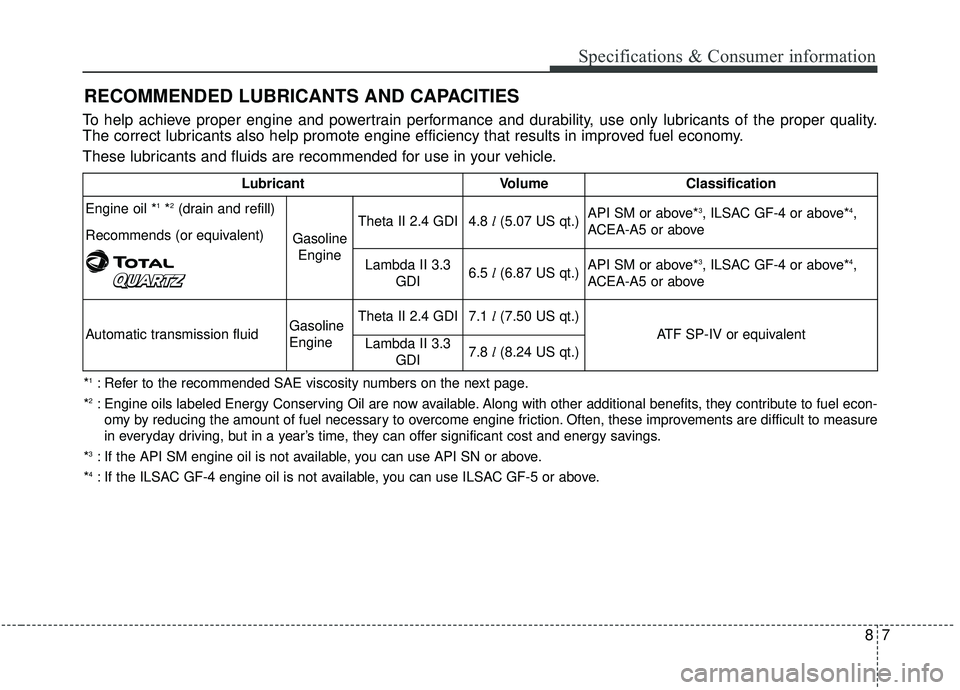
RECOMMENDED LUBRICANTS AND CAPACITIES
To help achieve proper engine and powertrain performance and durability, use only lubricants of the proper quality.
The correct lubricants also help promote engine efficiency that results in improved fuel economy.
These lubricants and fluids are recommended for use in your vehicle.
Lubricant VolumeClassification
Engine oil *1*2(drain and refill)
Recommends (or equivalent)
Gasoline Engine
Theta II 2.4 GDI4.8 l(5.07 US qt.)API SM or above*3, ILSAC GF-4 or above*4,
ACEA-A5 or above
Lambda II 3.3 GDI6.5 l(6.87 US qt.)API SM or above*3, ILSAC GF-4 or above*4,
ACEA-A5 or above
Automatic transmission fluidGasoline
EngineTheta II 2.4 GDI7.1 l(7.50 US qt.)
ATF SP-IV or equivalentLambda II 3.3
GDI7.8 l(8.24 US qt.)
*1: Refer to the recommended SAE viscosity numbers on the next page.
*
2: Engine oils labeled Energy Conserving Oil are now available. Along with other additional benefits, they contribute to fuel econ -
omy by reducing the amount of fuel necessary to overcome engine friction. Often, these improvements are difficult to measure
in everyday driving, but in a year’s time, they can offer significant cost and energy savings.
*
3: If the API SM engine oil is not available, you can use API SN or above.
*
4: If the ILSAC GF-4 engine oil is not available, you can use ILSAC GF-5 or above.
Page 563 of 573

Index
6I
Engine will not start . . . . . . . . . . . . . . . . . . . . . . . . . . . . 6-4
Evaporative emission control (including ORVR: Onboard Refueling Vapor Recovery) system . . . . 7-100
Exhaust emission control system . . . . . . . . . . . . . . . . 7-101
Explanation of scheduled maintenance items . . . . . . . 7-15 Engine oil and filter . . . . . . . . . . . . . . . . . . . . . . . . . 7-15
Drive belts . . . . . . . . . . . . . . . . . . . . . . . . . . . . . . . . 7-15
Fuel filter (for gasoline) . . . . . . . . . . . . . . . . . . . . . . 7-15
Fuel lines, fuel hoses and connections . . . . . . . . . . . 7-15
Vapor hose and fuel filler cap . . . . . . . . . . . . . . . . . 7-15
Vacuum crankcase ventilation hoses . . . . . . . . . . . . 7-16
Air cleaner filter . . . . . . . . . . . . . . . . . . . . . . . . . . . . 7-16
Spark plugs . . . . . . . . . . . . . . . . . . . . . . . . . . . . . . . . 7-16
Valve clearance. . . . . . . . . . . . . . . . . . . . . . . . . . . . . 7-16
Cooling system . . . . . . . . . . . . . . . . . . . . . . . . . . . . . 7-16
Coolant . . . . . . . . . . . . . . . . . . . . . . . . . . . . . . . . . . . 7-\
16
Automatic transmission fluid . . . . . . . . . . . . . . . . . . 7-16
Brake hoses and lines . . . . . . . . . . . . . . . . . . . . . . . . 7-17
Brake fluid . . . . . . . . . . . . . . . . . . . . . . . . . . . . . . . . 7-17
Parking brake . . . . . . . . . . . . . . . . . . . . . . . . . . . . . . 7-17
Brake discs, pads, calipers and rotors . . . . . . . . . . . 7-17
Exhaust pipe and muffler . . . . . . . . . . . . . . . . . . . . . 7-17
Suspension mounting bolts . . . . . . . . . . . . . . . . . . . 7-17
Steering gear box, linkage & boots/lower arm ball joint . . . . . . . . . . . . . . . . . . . . . . . . . . . . . . . . . 7-18
Drive shafts and boots . . . . . . . . . . . . . . . . . . . . . . . 7-18
Air conditioning refrigerant . . . . . . . . . . . . . . . . . . . 7-18
Exterior care . . . . . . . . . . . . . . . . . . . . . . . . . . . . . . . . . 7-96 Exterior features . . . . . . . . . . . . . . . . . . . . . . . . . . . . . 4-185
Roof rack . . . . . . . . . . . . . . . . . . . . . . . . . . . . . . . . 4-185
Exterior overview . . . . . . . . . . . . . . . . . . . . . . . . . . . . . . 2-2
Flat tire . . . . . . . . . . . . . . . . . . . . . . . . . . . . . . . . . . . . \
. 6-16 Jack and tools . . . . . . . . . . . . . . . . . . . . . . . . . . . . . . 6-16
Removing and storing the spare tire . . . . . . . . . . . . 6-17
Changing tires . . . . . . . . . . . . . . . . . . . . . . . . . . . . . 6-19
Floor mat anchor(s) . . . . . . . . . . . . . . . . . . . . . . . . . . 4-182
Fluid Brake fluid . . . . . . . . . . . . . . . . . . . . . . . . . . . . . . . . 7-24
Washer fluid . . . . . . . . . . . . . . . . . . . . . . . . . . . . . . . 7-25
Folding key . . . . . . . . . . . . . . . . . . . . . . . . . . . . . . . . . . . 4-\
5 Record your key number . . . . . . . . . . . . . . . . . . . . . . 4-5
Key operations . . . . . . . . . . . . . . . . . . . . . . . . . . . . . . 4-5
Transmitter precautions . . . . . . . . . . . . . . . . . . . . . . . 4-7
Battery replacement . . . . . . . . . . . . . . . . . . . . . . . . . . 4-8
Immobilizer system . . . . . . . . . . . . . . . . . . . . . . . . . . 4-9
Folding the outside rearview mirror . . . . . . . . . . . . . . . 4-71
Forward Collision-Avoidance assist (FCA) . . . . . . . . . 5-49 System setting and activation. . . . . . . . . . . . . . . . . . 5-49
FCA warning message and system control . . . . . . . 5-51
Brake operation . . . . . . . . . . . . . . . . . . . . . . . . . . . . 5-52
FCA front radar/camera sensor . . . . . . . . . . . . . . . . 5-53
System malfunction . . . . . . . . . . . . . . . . . . . . . . . . . 5-55
F