2019 KIA SORENTO homelink
[x] Cancel search: homelinkPage 151 of 573

463
Features of your vehicle
And telematics buttons are on the
mirror.
(1) Roadside Assist
(2) AVN : UVO Voice Local SearchD-AUDIO, UVO AUDIO : Phone
Projection Map
(3) SOS
(4) Rear light sensorElectric chromic mirror (ECM) with HomeLink®system and com-
pass (if equipped)
Your vehicle may be equipped with a
Gentex Automatic-Dimming Mirror
with a Z-Nav
®Electronic Compass
Display and an Integrated HomeLink®
Wireless Control System.
During nighttime driving, this feature
will automatically detect and reduce
rearview mirror glare while the com-
pass indicates the direction the vehi-
cle is pointed. The HomeLink
®
Universal Transceiver allows you to
activate your garage door(s), electric
gate, home lighting, etc. (1) Roadside Assist button
(2) AVN : UVO Voice Local Search
button
D-AUDIO, UVO AUDIO : Phone
Projection Map button
(3) SOS button
(4) Dimming ON/OFF button
(5) Status indicator LED
(6) Channel 1 button
(7) Channel 2 button
(8) Channel 3 button
(9) Compass display
(10) Rear light sensor
OCK047066C
Page 154 of 573
Features of your vehicle
66
4
There are some conditions that can
cause changes to the vehicle mag-
nets, such as installing a ski rack or
a CB antenna. Body repair work on
the vehicle can also cause changes
to the vehicle's magnetic field. In
these situations, the compass will
need to be re-calibrated to quickly
correct for these changes. To re-cali-
brate the compass:
1. Press and hold the button for
more than 6 seconds. When the
compass memory is cleared, a "C"
will appear in the display.
2. To calibrate the compass, drive the vehicle in 2 complete circles at
less than 8 km/h (5 mph). Integrated HomeLink®Wireless
Control System
The HomeLink
®Wireless Control
System provides a convenient way to
replace up to three hand-held radio-
frequency (RF) transmitters with a
single built-in device. This innovative
feature will learn the radio frequency
codes of most current transmitters to
operate devices such as gate opera-
tors, garage door openers, entry
door locks, security systems, even
home lighting. Both standard and
rolling code-equipped transmitters
can be programmed by following the
outlined procedures. Additional
HomeLink
®information can be found
at: www.homelink.com or by calling
1-800-355-3515.
❈ HomeLink
®is a registered trade-
mark of Johnson Controls, Inc. Retain the original transmitter of the
RF device you are programming for
use in other vehicles as well as for
future HomeLink
®programming. It is
also suggested that upon the sale of
the vehicle, the programmed
HomeLink
®buttons be erased for
security purposes.
Page 155 of 573

467
Features of your vehicle
Programming HomeLink®
✽ ✽NOTICE
• When programming a garage
door opener, it is advised to park
the vehicle outside of the garage.
• It is recommended that a new bat- tery be placed in the hand-held
transmitter of the device being pro-
grammed to HomeLink
®for quick-
er training and accurate transmis-
sion of the radio-frequency signal.
• Some vehicles may require the igni- tion switch to be turned to the sec-
ond position for programming
and/or operation of HomeLink
®.
• In the event that there are still pro- gramming difficulties or questions
after following the programming
steps listed below, contact
HomeLink
®at: www.homelink.com
or 1-800-355-3515.
Standard programming
To train most devices, follow these
instructions:
1. For first-time programming, press
and hold the two outside buttons,
HomeLink
®Channel 1 and
Channel 3 Buttons, until the indi-
cator light begins to flash (after 20
seconds). Release both buttons.
Do not hold the buttons for longer
than 30 seconds.
2. Position the end of your hand-held transmitter 2-8 cm (1-3 inches)
away from the HomeLink
®buttons
while keeping the indicator light in
view.
3. Simultaneously press and hold both the HomeLink
®and hand-
held transmitter button. DO NOT
release the buttons until step 4
has been completed.
4. While continuing to hold the but- tons the red Indicator Status LED
will flash slowly and then rapidly
after HomeLink
®successfully
trains to the frequency signal from
the hand-held transmitter. Release
both buttons. 5. Press and hold the just-trained
HomeLink
®button and observe
the red Status Indicator LED. If the
indicator light stays on constantly,
programming is complete and
your device should activate when
the HomeLink
® button is pressed
and released.
6. To program the remaining two HomeLink
® buttons, follow steps 2
through 5.
Page 156 of 573
Features of your vehicle
68
4
Rolling code programming
Rolling code devices which are
“code-protected” and manufactured
after 1996 may be determined by the
following:
Reference the device owner's
manual for verification.
The handheld transmitter appears to program the HomeLink
®
Universal Transceiver but does not
activate the device.
Press and hold the trained HomeLink
®button. The device has
the rolling code feature if the indi-
cator light flashes rapidly and then
turns solid after 2 seconds. To train rolling code devices, follow
these instructions:
1.At the garage door opener receiver
(motor-head unit) in the garage,
locate the “learn” or “smart” button.
This can usually be found where
the hanging antenna wire is
attached to the motor-head unit.
Exact location and color of the but-
ton may vary by garage door open-
er brand.
If there is difficulty locating the
training button, reference the
device owner's manual or please
visit our web site at www.home-
link.com.
2.Firmly press and release the “learn” or “smart” button (which
activates the “training light”).
✽ ✽ NOTICE
There are 30 seconds in which to ini-
tiate step 3.
3.Return to the vehicle, firmly press
and hold for two seconds the
desired HomeLink
®button then
release. Repeat the
“press/hold/release” sequence a
second time to complete the pro-
gramming. (Some devices may
require you to repeat this sequence
a third time to complete the pro-
gramming.)
4.Press and hold the just-trained HomeLink
®button and observe the
red Status Indicator LED. If the indi-
cator light stays on constantly, pro-
gramming is complete and your
device should activate.
5.To program the remaining two HomeLink
®buttons, follow either
steps 1 through 4 above for other
Rolling Code devices or steps 2
through 5 in Standard Programming
for standard devices.
Page 157 of 573
469
Features of your vehicle
Gate operator & Canadian pro-
gramming
During programming, your handheld
transmitter may automatically stop
transmitting. Continue to press the
Integrated HomeLink
®Wireless
Control System button (note steps 2
through 4 in the Standard
Programming portion of this docu-
ment) while you press and re-press
(“cycle”) your handheld transmitter
every two seconds until the frequen-
cy signal has been learned. The indi-
cator light will flash slowly and then
rapidly after several seconds upon
successful training.
Operating HomeLink®
To operate, simply press and release
the programmed HomeLink®button.
Activation will now occur for the
trained device (i.e. garage door
opener, gate operator, security sys-
tem, entry door lock, home/office
lighting, etc.). For convenience, the
hand-held transmitter of the device
may also be used at any time.
Reprogramming a single
HomeLink®button
To program a new device to a previ-
ously trained HomeLink®button, fol-
low these steps:
1. Press and hold the desired HomeLink
®button. Do NOT
release until step 4 has been com-
pleted.
2. When the indicator light begins to flash slowly (after 20 seconds),
position the handheld transmitter 2
to 8 cm (1 to 3 inches) away from
the HomeLink
®surface.
3. Press and hold the handheld transmitter button. The HomeLink
®
indicator light will flash, first slowly
and then rapidly.
4. When the indicator light begins to flash rapidly, release both buttons.
5. Press and hold the just-trained HomeLink
®button and observe
the red Status Indicator LED. If the
indicator light stays on constantly,
programming is complete and
your new device should activate.
Page 158 of 573
Features of your vehicle
70
4
Erasing HomeLink®buttons
Individual buttons cannot be erased.
However, to erase all three pro-
grammed buttons:
1. Press and hold the two outer
HomeLink
®buttons until the indi-
cator light begins to flash-after 20
seconds.
2. Release both buttons. Do not hold for longer than 30 seconds.
The Integrated HomeLink
®Wireless
Control System is now in the training
(learn) mode and can be pro-
grammed at any time following the
appropriate steps in the
Programming sections above. FCC ID: NZLZTVHL3
IC: 4112A-ZTVHL3
This device complies with Industry
Canada licence-exempt RSS stan-
dard(s).
Operation is subject to the following
two conditions:
(1) This device may not cause inter-
ference, and
(2) This device must accept any
interference, including interfer-
ence that may cause undesired
operation of the device. The transceiver has been tested and
complies with FCC and Industry
Canada rules. Changes or modifica-
tions not expressly approved by the
party responsible for compliance
could void the user's authority to
operate the device.
NVS
®and Z-NAV™ are registered
trademarks. Nav®are of Gentex
Corporation, Zeeland, Michigan.
HomeLink
®is a registered trademark
owned by Johnson Controls
Technology Company, Holland,
Michigan.
Page 562 of 573

I5
Index
Drive mode integrated control system . . . . . . . . . . . . . 5-86SMART mode . . . . . . . . . . . . . . . . . . . . . . . . . . . . . 5-86
SPORT mode . . . . . . . . . . . . . . . . . . . . . . . . . . . . . . 5-89
ECO mode . . . . . . . . . . . . . . . . . . . . . . . . . . . . . . . . 5-89
Driver Attention Warning (DAW) system . . . . . . . . . 5-110 System setting and activation . . . . . . . . . . . . . . . . . 5-110
Resetting the system . . . . . . . . . . . . . . . . . . . . . . . . 5-112
System disabled . . . . . . . . . . . . . . . . . . . . . . . . . . . 5-113
System malfunction . . . . . . . . . . . . . . . . . . . . . . . . 5-113
Driver position memory system . . . . . . . . . . . . . . . . . . 3-10
Driver's and passenger's front air bag. . . . . . . . . . . . . . 3-59
Driving at night. . . . . . . . . . . . . . . . . . . . . . . . . . . . . . 5-120
Driving in flooded areas . . . . . . . . . . . . . . . . . . . . . . . 5-121
Driving in the rain . . . . . . . . . . . . . . . . . . . . . . . . . . . 5-120
Driving off-road . . . . . . . . . . . . . . . . . . . . . . . . . . . . . 5-121
Driving with a trailer . . . . . . . . . . . . . . . . . . . . . . . . . 5-127
Dynamic Bending Light (DBL) . . . . . . . . . . . . . . . . . 4-130
ECO mode (Drive mode integrated control system) . . 5-89
Economical operation . . . . . . . . . . . . . . . . . . . . . . . . . 5-115
Electric chromatic mirror (ECM) with compass . . . . . 4-63
Electric power steering . . . . . . . . . . . . . . . . . . . . . . . . . 4-57
Electrical equipment . . . . . . . . . . . . . . . . . . . . . . . . . . . 8-15
Electrochromic mirror (ECM) . . . . . . . . . . . . . . . . . . . 4-62
Electrochromic mirror with HomeLink system . . . . . . 4-66
Electronic parking brake (EPB) . . . . . . . . . . . . . . . . . . 5-30 Electronic Stability Control (ESC) . . . . . . . . . . . . . . . . 5-41
Emergency liftgate safety release . . . . . . . . . . . . . . . . . 4-38
Emergency starting . . . . . . . . . . . . . . . . . . . . . . . . . . . . . 6-5
Jump starting . . . . . . . . . . . . . . . . . . . . . . . . . . . . . . . 6-5
Emergency while driving . . . . . . . . . . . . . . . . . . . . . . . . 6-3
Emission control system . . . . . . . . . . . . . . . . . . . . . . . 7-100 Crankcase emission control system . . . . . . . . . . . . 7-100
Evaporative emission control (including ORVR: Onboard Refueling Vapor Recovery) system . . . 7-100
Exhaust emission control system . . . . . . . . . . . . . . 7-101
Engine . . . . . . . . . . . . . . . . . . . . . . . . . . . . . . . . . . . . \
. . . 8-2
Engine compartment . . . . . . . . . . . . . . . . . . . . . . . . . . . . 2-6
Engine compartment . . . . . . . . . . . . . . . . . . . . . . . . . . . . 7-3
Engine coolant . . . . . . . . . . . . . . . . . . . . . . . . . . . . . . . 7-21 Checking the coolant level . . . . . . . . . . . . . . . . . . . . 7-21
Changing the coolant . . . . . . . . . . . . . . . . . . . . . . . . 7-23
Engine coolant temperature gauge . . . . . . . . . . . . . . . . 4-78
Engine number . . . . . . . . . . . . . . . . . . . . . . . . . . . . . . . 8-11
Engine oil . . . . . . . . . . . . . . . . . . . . . . . . . . . . . . . . . . . 7-\
19 Checking the engine oil level. . . . . . . . . . . . . . . . . . 7-19
Changing the engine oil and filter . . . . . . . . . . . . . . 7-20
Engine overheats. . . . . . . . . . . . . . . . . . . . . . . . . . . . . . . 6-8
Engine start/stop button . . . . . . . . . . . . . . . . . . . . . . . . 5-10 Illuminated engine start/stop button. . . . . . . . . . . . . 5-10
Engine start/stop button position . . . . . . . . . . . . . . . 5-10
Starting the engine . . . . . . . . . . . . . . . . . . . . . . . . . . 5-12
Engine start/stop button illumination . . . . . . . . . . . . . . 5-10
Engine start/stop button position . . . . . . . . . . . . . . . . . 5-10
E
Page 568 of 573
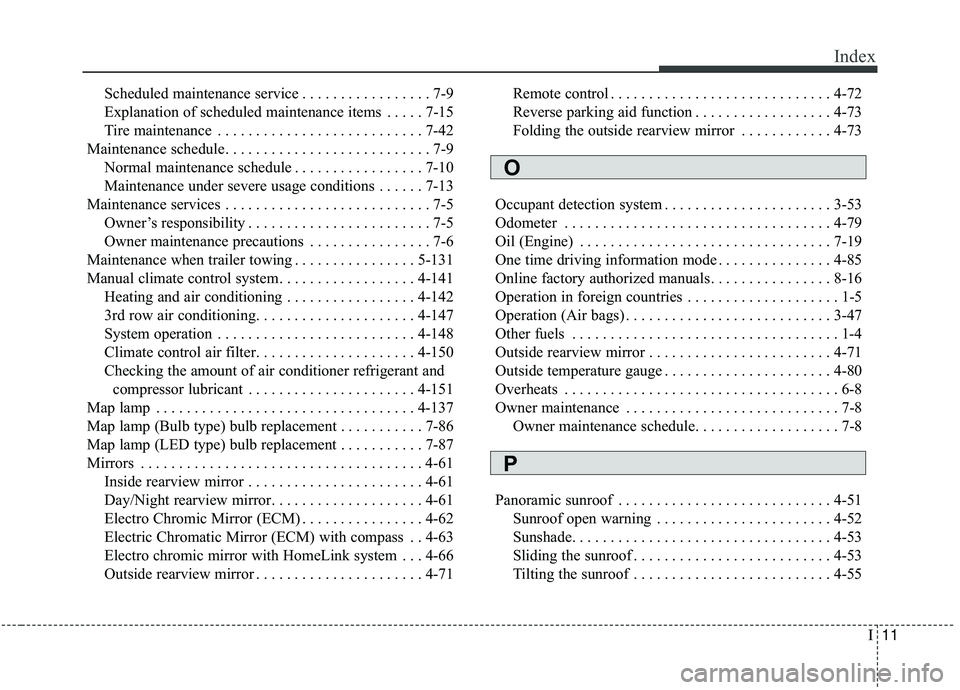
I11
Index
Scheduled maintenance service . . . . . . . . . . . . . . . . . 7-9
Explanation of scheduled maintenance items . . . . . 7-15
Tire maintenance . . . . . . . . . . . . . . . . . . . . . . . . . . . 7-42
Maintenance schedule. . . . . . . . . . . . . . . . . . . . . . . . . . . 7-9 Normal maintenance schedule . . . . . . . . . . . . . . . . . 7-10
Maintenance under severe usage conditions . . . . . . 7-13
Maintenance services . . . . . . . . . . . . . . . . . . . . . . . . . . . 7-5 Owner’s responsibility . . . . . . . . . . . . . . . . . . . . . . . . 7-5
Owner maintenance precautions . . . . . . . . . . . . . . . . 7-6
Maintenance when trailer towing . . . . . . . . . . . . . . . . 5-131
Manual climate control system. . . . . . . . . . . . . . . . . . 4-141 Heating and air conditioning . . . . . . . . . . . . . . . . . 4-142
3rd row air conditioning. . . . . . . . . . . . . . . . . . . . . 4-147
System operation . . . . . . . . . . . . . . . . . . . . . . . . . . 4-148
Climate control air filter. . . . . . . . . . . . . . . . . . . . . 4-150
Checking the amount of air conditioner refrigerant and compressor lubricant . . . . . . . . . . . . . . . . . . . . . . 4-151
Map lamp . . . . . . . . . . . . . . . . . . . . . . . . . . . . . . . . . . 4-13\
7
Map lamp (Bulb type) bulb replacement . . . . . . . . . . . 7-86
Map lamp (LED type) bulb replacement . . . . . . . . . . . 7-87
Mirrors . . . . . . . . . . . . . . . . . . . . . . . . . . . . . . . . . . . . \
. 4-61 Inside rearview mirror . . . . . . . . . . . . . . . . . . . . . . . 4-61
Day/Night rearview mirror. . . . . . . . . . . . . . . . . . . . 4-61
Electro Chromic Mirror (ECM) . . . . . . . . . . . . . . . . 4-62
Electric Chromatic Mirror (ECM) with compass . . 4-63
Electro chromic mirror with HomeLink system . . . 4-66
Outside rearview mirror . . . . . . . . . . . . . . . . . . . . . . 4-71 Remote control . . . . . . . . . . . . . . . . . . . . . . . . . . . . . 4-72
Reverse parking aid function . . . . . . . . . . . . . . . . . . 4-73
Folding the outside rearview mirror . . . . . . . . . . . . 4-73
Occupant detection system . . . . . . . . . . . . . . . . . . . . . . 3-53
Odometer . . . . . . . . . . . . . . . . . . . . . . . . . . . . . . . . . . . 4-\
79
Oil (Engine) . . . . . . . . . . . . . . . . . . . . . . . . . . . . . . . . . 7-19
One time driving information mode . . . . . . . . . . . . . . . 4-85
Online factory authorized manuals. . . . . . . . . . . . . . . . 8-16
Operation in foreign countries . . . . . . . . . . . . . . . . . . . . 1-5
Operation (Air bags) . . . . . . . . . . . . . . . . . . . . . . . . . . . 3-47
Other fuels . . . . . . . . . . . . . . . . . . . . . . . . . . . . . . . . . . . 1-\
4
Outside rearview mirror . . . . . . . . . . . . . . . . . . . . . . . . 4-71
Outside temperature gauge . . . . . . . . . . . . . . . . . . . . . . 4-80
Overheats . . . . . . . . . . . . . . . . . . . . . . . . . . . . . . . . . . . . \
6-8
Owner maintenance . . . . . . . . . . . . . . . . . . . . . . . . . . . . 7-8 Owner maintenance schedule. . . . . . . . . . . . . . . . . . . 7-8
Panoramic sunroof . . . . . . . . . . . . . . . . . . . . . . . . . . . . 4-51 Sunroof open warning . . . . . . . . . . . . . . . . . . . . . . . 4-52
Sunshade. . . . . . . . . . . . . . . . . . . . . . . . . . . . . . . . . . 4-53\
Sliding the sunroof . . . . . . . . . . . . . . . . . . . . . . . . . . 4-53
Tilting the sunroof . . . . . . . . . . . . . . . . . . . . . . . . . . 4-55
P
O