Page 506 of 573
763
Maintenance
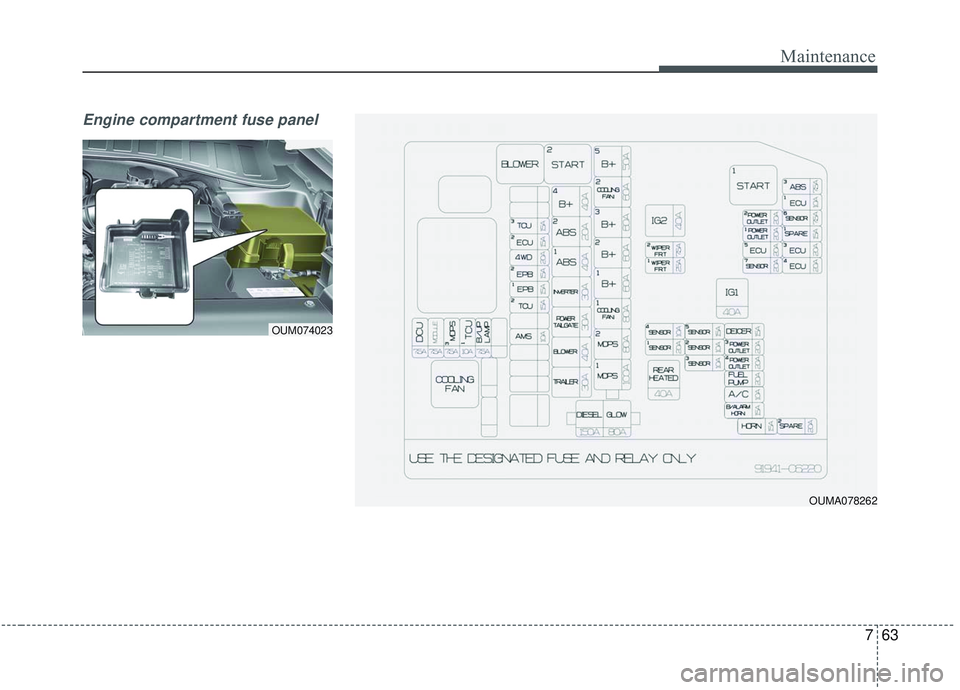
Engine compartment fuse panel
OUMA078262
OUM074023
Page 509 of 573
Maintenance
66
7
DescriptionFuse ratingProtected component
ABS 3 7.5AESC Control Module, Multipurpose Check Connector
ECU 1 10APCM
IG 2 40ARLY. 4 (Start Relay), PDM (IG2) Relay, Ignition Switch
POWER
OUTLET 1 20AFront Power Outlet & Cigarette Lighter
SENSOR 6 7.5AGCU
POWER
OUTLET 2 20AFront Power Outlet
MODULE7.5ASmart Cruise Control Radar
ECU 4 20A[Theta II 2.4L Engine] PCM (E-CVVT Relay)
WIPER 125AWiper Low Relay
DEICER 15AFront Deicer Relay
ECU 5 20A[Theta II 2.4L Engine] PCM (E-CVVT Relay)
IG 1 40APDM (IG1) Relay, PDM (ACC) Relay, Ignition Switch
SENSOR 4 10A[Theta II 2.4L Engine] Oxygen Sensor (Up/Down)
[Lambda II 3.3L Engine] PCM, Oxygen Sensor #1/#2/#3/#4
SENSOR 5 15A[Theta II 2.4L Engine] PCM
Page 510 of 573
![KIA SORENTO 2019 Owners Manual 767
Maintenance
DescriptionFuse ratingProtected component
WIPER 27.5AWiper Parking Signal
POWER
OUTLET 3 20ARear Power Outlet
SENSOR 1 20A[Theta II 2.4L Engine] Ignition Coil #1/#2/#3/#4 [Lambda II](/manual-img/2/40476/w960_40476-509.png "KIA SORENTO 2019 Owners Manual 767
Maintenance
DescriptionFuse ratingProtected component
WIPER 27.5AWiper Parking Signal
POWER
OUTLET 3 20ARear Power Outlet
SENSOR 1 20A[Theta II 2.4L Engine] Ignition Coil #1/#2/#3/#4 [Lambda II")
767
Maintenance
DescriptionFuse ratingProtected component
WIPER 27.5AWiper Parking Signal
POWER
OUTLET 3 20ARear Power Outlet
SENSOR 1 20A[Theta II 2.4L Engine] Ignition Coil #1/#2/#3/#4 [Lambda II 3.3L Engine]\
Ignition Coil #1/#2/#3/#4/#5/#6,
Condecser #1/#2
SENSOR 3 10A[Theta II 2.4L Engine] Fuel Pump Relay [Lambda II 3.3L Engine] Fuel Pump Relay, PCM
POWER
OUTLET 4 20ALuggage Power Outlet
REAR
HEATED 40ARear Defogger Relay
SENSOR 2 10A
[Theta II 2.4L Engine] E/R Junction Block (Cooling Fan 1 Relay), Oil Control Valve (Exhaust), Purge Control
Solenoid Valve, Canister Close Valve, Variable Intake Solenoid Valve
[Lambda II 3.3L Engine] E/R Junction Block (Cooling Fan 1 Relay), Variable Intake Solenoid Valve #1/#2, Purge
Control Solenoid Valve, Oil Control Valve #1/#2/#3/#4 (Intake/Exhaust), PCM, Canister close valve, A/CON
Compressor Relay
FUEL PUMP 20AFuel Pump Relay
HORN 15AHorn Relay
B/ALARM HORN 15ABurglar Alarm Horn Relay
A/C10AA/CON Compressor
SPARE 115ADUMMY
SENSOR 720ANOx SENSOR
Page 512 of 573

769
Maintenance
LIGHT BULBS
Bulb replacement precaution
Please keep extra bulbs on hand
with appropriate wattage ratings in
case of emergencies.
Refer to “Bulb Wattage” in chapter 8.
When changing lamps, first turn off
the engine at a safe place, firmly
apply the parking brake and detach
the battery’s negative (-) terminal.
Use only bulbs of the specifiedwattage. net-work failure
The headlamp, taillight, and fog light
may light up when the head lamp
switch is turned ON, and not light up
when the taillight or for light switch is
turned ON. This may be cause by
network failure or vehicle electrical
control system malfunction. If there is
a problem, we recommend the sys-
tem be serviced by an authorized Kia
dealer.
trical control system stabilization
A normally functioning lamp may
flicker momentarily. This momentary
occurrence is due to stabilization
function of the vehicle's electrical on
control system. If the lamp soon
returns to normal, the vehicle does
not require service.
However, if the lamp goes out after
the momentary flickering, or the flick-
ering continues, we recommend the
system be serviced by an authorized
Kia dealer.
WARNING- Working on the lights
Prior to working on the light,
firmly apply the parking brake,
ensure that the ignition switch
is turned to the LOCK position
and turn off the lights to avoid
sudden movement of the vehi-
cle and burning your fingers or
receiving an electric shock.
CAUTION -Light replace-
ment
Be sure to replace the burned- out bulb with one of the samewattage rating. Otherwise, itmay cause damage to the fuseor electric wiring system.
CAUTION -Headlamp
Lens
To prevent damage, do notclean the headlamp lens withchemical solvents or strongdetergents.
Page 535 of 573

Maintenance
92
7
High-pressure washing
When using high-pressure wash-
ers, make sure to maintain suffi-
cient distance from the vehicle.
Insufficient clearance or excessive
pressure can lead to component
damage or water penetration.
Do not spray the camera, sensors or its surrounding area directly with
a high pressure washer. Shock
applied from high pressure water
may cause the device to not oper-
ate normally.
Do not bring the nozzle tip close to boots (rubber or plastic covers) or
connectors as they may be dam-
aged if they come into contact with
high pressure water. Waxing
Wax the vehicle when water will no
longer bead on the paint.
Always wash and dry the vehicle
before waxing. Use a good quality
liquid or paste wax, and follow the
manufacturer’s instructions. Wax all
metal trim to protect it and to main-
tain its luster.
Removing oil, tar, and similar materi-
als with a spot remover will usually
strip the wax from the finish. Be sure
to re-wax these areas even if the rest
of the vehicle does not yet need wax-
ing.
Do not apply wax on embossed
unpainted unit, as it may tarnish the
unit.
CAUTION - Wet engine
Water washing in the engine
compartment including highpressure water washing maycause the failure of electricalcircuits located in the enginecompartment.
Never allow water or other liq- uids to come in contact withelectrical/electronic compo-nents inside the vehicle asthis may damage them.
OUM078249L
Page 544 of 573
7101
Maintenance
Canister
Fuel vapors generated inside the fuel
tank are absorbed and stored in the
onboard canister. When the engine is
running, the fuel vapors absorbed in
the canister are drawn into the surge
tank through the purge control sole-
noid valve.
Purge Control Solenoid Valve(PCSV)
The purge control solenoid valve is
controlled by the Engine Control
Module (ECM); when the engine
coolant temperature is low during
idling, the PCSV closes so that evap-
orated fuel is not taken into the
engine. After the engine warms up
during ordinary driving, the PCSV
opens to introduce evaporated fuel to
the engine.
3. Exhaust emission control system
The Exhaust Emission Control
System is a highly effective system
which controls exhaust emissions
while maintaining good vehicle per-
formance.
Vehicle modifications
This vehicle should not be modified.
Modification of your vehicle could
affect its performance, safety or
durability and may even violate gov-
ernmental safety and emissions reg-
ulations.
In addition, damage or performance
problems resulting from any modifi-
cation may not be covered under
warranty.
If you use unauthorized electronic
devices, it may cause the vehicle to
operate abnormally, wire damage,
battery discharge and fire. For your
safety, do not use unauthorized
electronic devices.
Engine exhaust gas precautions
(carbon monoxide)
Carbon monoxide can be present with other exhaust fumes.
Therefore, if you smell exhaust
fumes of any kind inside your vehi-
cle, have it inspected and repaired
immediately. If you ever suspect
exhaust fumes are coming into
your vehicle, drive it only with all
the windows fully open. Have your
vehicle checked and repaired
immediately.
WARNING - Exhaust
Engine exhaust gases contain
carbon monoxide (CO). Though
colorless and odorless, it is
dangerous and could be lethal if
inhaled. Follow the instructions
on this page to avoid CO poi-
soning.
Page 545 of 573
Maintenance
102
7
Do not operate the engine in con-
fined or closed areas (such as
garages) any more than what is
necessary to move the vehicle in or
out of the area.
When the vehicle is stopped in an open area for more than a short
time with the engine running,
adjust the ventilation system (as
needed) to draw outside air into the
vehicle.
Never sit in a parked or stopped vehicle for any extended time with
the engine running.
When the engine stalls or fails to start, excessive attempts to restart
the engine may cause damage to
the emission control system.Operating precautions for catalyt-
ic converters (if equipped)
WARNING- Catalytic converter
Keep away from the catalytic
converter and exhaust system
while the vehicle is running or
immediately thereafter. The
exhaust and catalytic systems
are very hot and may burn you.
WARNING- Fire
Do not park, idle or drive the vehicle over or near flamma-
ble objects, such as grass,
vegetation, paper, leaves, etc.
A hot exhaust system can
ignite flammable items under
your vehicle.
Also, do not remove the heat sink around the exhaust sys-
tem, do not seal the bottom of
the vehicle or do not coat the
vehicle for corrosion control.
It may present a fire risk under
certain conditions.
Page 546 of 573
7103
Maintenance
Your vehicle is equipped with a cat-
alytic converter emission control
device.
Therefore, the following precautions
must be observed:
Use only UNLEADED FUEL forgasoline engines.
Do not operate the vehicle when there are signs of engine malfunc-
tion, such as misfire or a noticeable
loss of performance.
Do not misuse or abuse the engine. Examples of misuse are
coasting with the ignition off and
descending steep grades in gear
with the ignition off.
Do not operate the engine at high idle speed for extended periods (5
minutes or more).
Do not modify or tamper with any part of the engine or emission con-
trol system. All inspections and
adjustments must be made by an
authorized Kia dealer.
Avoid driving with an extremely low fuel level. Running out of fuel could
cause the engine to misfire, dam-
aging the catalytic converter. Failure to observe these precautions
could result in damage to the catalyt-
ic converter and to your vehicle.
Additionally, such actions could void
your warranties.