Page 15 of 553
H9
Normal Charge
You can charge your vehicle by plug-
ging into a public charger at a charg-
ing station.
How to Connect to a NormalCharger
1. Depress the brake pedal and apply the parking brake.
2. Turn OFF all switches, move the shift lever to P (Park), and turn
OFF the vehicle.
3. After unlocking doors, open the charging door by pressing it.
✽ ✽NOTICE
• The charging door does not open
when the theft alarm system is
armed.
• To open the charging inlet cover, all vehicle doors must be
unlocked. When the doors are
locked, the charging inlet cover
will not open.
OJFHPQ016021L
■ Normal Charger
OJFHPQ016010L
Page 16 of 553

H104. Remove any dust on the charging
connector and charging inlet.
5. Hold the charging connector han- dle and insert it into the charging
inlet while pressing the release
button(1), until you hear a click
sound. If it is not fully connected, a
bad connection between the
charging connector and the charg-
ing terminals may cause a fire. 6. Check if the charging cable con-
nection indicator of the high volt-
age battery in the instrument clus-
ter is turned ON.
Charging does not occur when the
indicator is OFF. When the charg-
ing connector is not connected
properly, reconnect the charging
cable to charge.
✽ ✽ NOTICE
• The charging is in progress only
when the shift lever is in P (Park).
Charging the battery with the
Engine Start/Stop button in the
ACC position is possible. However,
it may discharge the 12-V battery.
Thus, if possible, charge the bat-
tery with the Engine Start/Stop
button in the OFF position.
• Moving the shift lever from P (Park) to R (Reverse)/N(Neutral)/D
(Drive) stops the charging process.
To restart the charging process,
move the shift lever to P (Park),
press the Engine Start/Stop button
to the OFF position, and discon-
nect the charging cable. Then,
connect the charging cable.
CHARGING THE PLUG-IN HYBRID VEHICLE (CONT.)
OJFHPQ016026 OJFHP046428L
Page 20 of 553
H14
How to Connect PortableCharging Cable (ICCB: In-Cable Control Box)
1. Turn OFF all switches, move the shift lever to P (Park), and turn
OFF the vehicle.
2. Connect the plug to a household electric outlet. 3. Check if all LED lamps on the con-
trol box blinks for 0.5 seconds.
Then, check if the power lamp
(green) turns ON. 4. Depress the brake pedal and
apply the parking brake.
5. After unlocking doors, open the charging door by pressing it.
✽ ✽NOTICE
The charging door does not open
when the theft alarm system is
armed.
OJFHPQ016016LOJFHPQ016010L
OJFHPQ016015N
CHARGING THE PLUG-IN HYBRID VEHICLE (CONT.)
Page 22 of 553

H16
✽ ✽NOTICE
• The charging is in progress only
when the shift lever is in P (Park).
Charging the battery with the
Engine Start/Stop button in the
ACC position is possible. However,
it may discharge the 12-V battery.
Thus, if possible, charge the bat-
tery with the Engine Start/Stop
button in the OFF position.
• Moving the shift lever from P (Park) to R (Reverse)/N(Neutral)/D
(Drive) stops the charging process.
To restart the charging process,
move the shift lever to P (Park),
press the Engine Start/Stop button
to the OFF position, and discon-
nect the charging cable. Then,
connect the charging cable and
restart the vehicle again.
10. After charging has started, the
estimated charging time is dis-
played on the instrument cluster
for about 1 minute. It is also dis-
played when the driver's door is
opened with charging in progress.
When scheduled charging is set,
the estimated charging time is dis-
played as "--".
Checking Charging Status
You can monitor the charging status
outside of the vehicle when charging
the high-voltage battery.
CHARGING THE PLUG-IN HYBRID VEHICLE (CONT.)
OJFHPQ016009L
OJFHP048429N
Page 29 of 553

H23
Coasting guide (if equipped)
A chime will sound and the coasting
guide indicator will blink four times to
inform the driver when to take the
foot off from the accelerator by antic-
ipating a decelerating event* based
on the analysis of driving routes and
road conditions according to the nav-
igation system. It encourages the
driver to remove the driver's foot from
the pedal and allow coasting down
the road with EV motor only.
This helps prevent unnecessary fuel
consumption and may increases fuel
efficiency.
❈Example of a deceleration event is
going down an extended hill,
approaching a toll booth, and
approaching reduced speed
zones.
Press the Engine Start/Stop button
and put the shift lever in P(Park). In
the User Settings Mode, select
Driving Assist, Coasting Guide, and
then On to turn on the system.
Cancel the selection of coasting
guide to turn off the system. For the
explanation of the system, press and
hold the [OK] button.
To activate the system, take the fol-
lowing procedures. Enter your desti-
nation information on the navigation
and select the driving route. Select
the ECO mode in the Integrated
Driving Control System. Then, satisfy
the following.
- The driving speed should be
between 37 mph (60 km/h) and 99
mph (160 km/h).
❈ The operating speed may vary
due to difference between instru-
ment cluster and navigation effect-
ed by tire inflation level.
✽ ✽ NOTICE
Coasting guide is only a supplemen-
tal system to assist with fuel-efficient
driving in certain situations. Thus,
the operating conditions may be dif-
ferent in accordance with
traffic/road conditions (i.e. driving
in a traffic jam, driving on a slope,
driving on a curve). Thus, take the
actual driving conditions into con-
sideration, such as distances from
the vehicles ahead/ behind, while
referring to the coasting guide sys-
tem as guidance.
Page 30 of 553

H24
Unplug vehicle to start (Plug-in hybrid)
This message is displayed when you
start the engine without unplugging
the charging cable. Unplug the
charging cable, and then start the
vehicle.
Shift to P to charge(Plug-in hybrid)
This message is displayed when the
charging connector is plugged with
the shift lever in R (Reverse), N
(Neutral) or D (Drive). Move the shift
lever to P (Park) and re-start the
charging process.
Remaining time (Plug-in hybrid)
This message is displayed to notify
the remaining time to fully charge the
battery.
Battery charged. Maintaining cur-rent mode (Plug-in hybrid)
This message is displayed when the
vehicle is unable to convert to charg-
ing mode even when pressing and
holding the HEV button during
EV/HEV mode driving because the
high-voltage (hybrid) battery is
already fully charged.
Low battery. Maintaining Hybridmode (Plug-in hybrid)
This message is displayed when the
vehicle is unable to convert to EV
mode even when pressing the HEV
button during HEV mode driving due
to insufficient high-voltage (hybrid)
battery level.
Low battery temp. Maintainingcurrent (Plug-in hybrid)
This message is displayed when the
vehicle is unable to convert to EV
mode even when pressing the HEV
button during HEV mode driving due
to low battery temperature.
DRIVING THE HYBRID/PLUG-IN HYBRID VEHICLE (CONT.)
Page 38 of 553

H32
Starting the Hybrid System
1.Carry the smart key into the vehicle.
2.Make sure the parking brake isfirmly applied.
3.Place the shift lever in the P(Park) position.
In N (neutral) position, you cannot
start the vehicle.
4.Depress the brake pedal.
5.Press the engine start/stop button.
6.The engine should be started with- out pressing the accelerator. In
extremely cold weather or after the
vehicle has not been operated for
several days, let the engine warm up
without depressing the accelerator.
vehicle, if it is far away from you,
the engine may not start.
ton is in the ACC or ON position
and if any door is open, the sys-
tem checks for the smart key. If
the smart key is not in the vehicle,
the warning, "Key is not in vehi-
cle" will come on, and if all doors
are closed, the chime will also
sound for about 5 seconds. Keep
the smart key in the vehicle when
using the ACC position or if the
vehicle engine is on. The indica-
tor will turn off while the vehicle is
moving. If the starting procedure is fol-
lowed, the " " symbol on the
instrument cluster will turn on.
For more details, Please check
chapter 6.
STARTING THE HYBRID/PLUG-IN HYBRID VEHICLE (SMART KEY)
Page 42 of 553
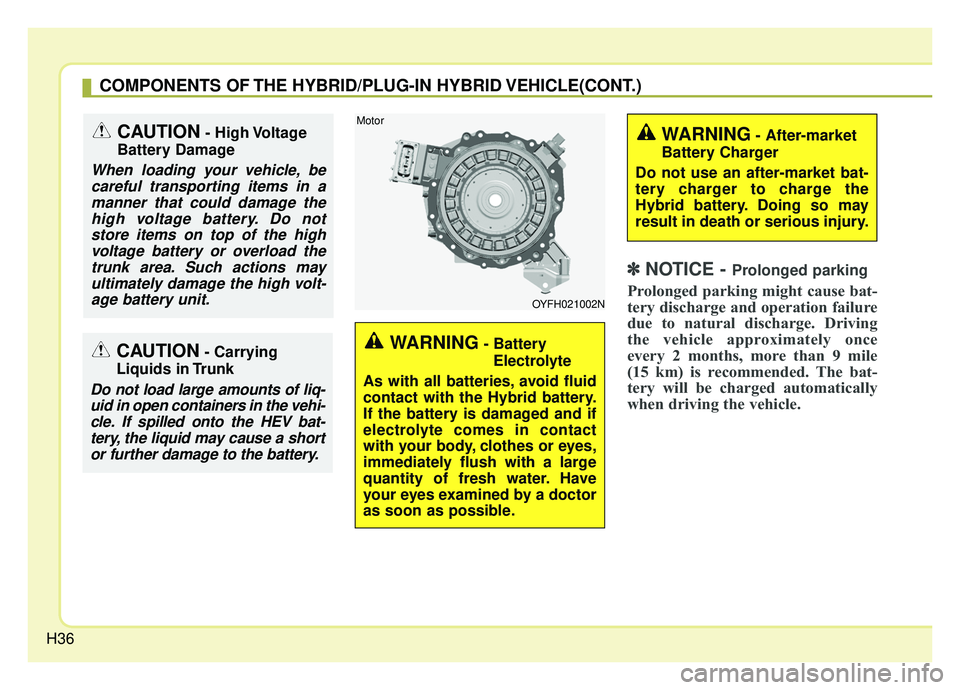
H36
✽ ✽NOTICE - Prolonged parking
Prolonged parking might cause bat-
tery discharge and operation failure
due to natural discharge. Driving
the vehicle approximately once
every 2 months, more than 9 mile
(15 km) is recommended. The bat-
tery will be charged automatically
when driving the vehicle.
CAUTION- High Voltage
Battery Damage
When loading your vehicle, be careful transporting items in amanner that could damage thehigh voltage battery. Do notstore items on top of the highvoltage battery or overload thetrunk area. Such actions mayultimately damage the high volt-age battery unit.
CAUTION- Carrying
Liquids in Trunk
Do not load large amounts of liq- uid in open containers in the vehi-cle. If spilled onto the HEV bat-tery, the liquid may cause a shortor further damage to the battery.
COMPONENTS OF THE HYBRID/PLUG-IN HYBRID VEHICLE(CONT.)
WARNING- Battery
Electrolyte
As with all batteries, avoid fluid
contact with the Hybrid battery.
If the battery is damaged and if
electrolyte comes in contact
with your body, clothes or eyes,
immediately flush with a large
quantity of fresh water. Have
your eyes examined by a doctor
as soon as possible.
OYFH021002N
Motor
WARNING- After-market
Battery Charger
Do not use an after-market bat-
tery charger to charge the
Hybrid battery. Doing so may
result in death or serious injury.

