2019 KIA FORTE ESP
[x] Cancel search: ESPPage 414 of 550
What to do in an emergency
28
6
Using the Tire Mobility Kit
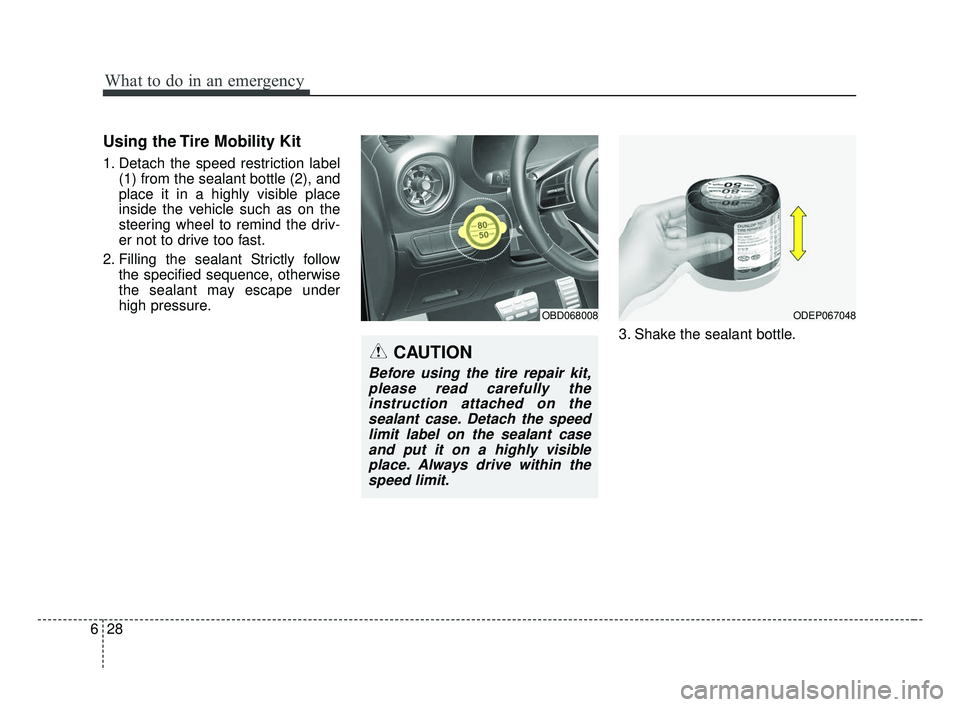
1. Detach the speed restriction label
(1) from the sealant bottle (2), and
place it in a highly visible place
inside the vehicle such as on the
steering wheel to remind the driv-
er not to drive too fast.
2. Filling the sealant Strictly follow the specified sequence, otherwise
the sealant may escape under
high pressure.
3. Shake the sealant bottle.
OBD068008ODEP067048
CAUTION
Before using the tire repair kit,please read carefully theinstruction attached on thesealant case. Detach the speedlimit label on the sealant caseand put it on a highly visibleplace. Always drive within thespeed limit.
BDm CAN (ENG) 6.qxp 7/4/2018 10:21 AM Page 28
Page 423 of 550

637
What to do in an emergency
Emergency towing precautions
Turn the ignition switch to ACC sothe steering wheel isn’t locked.
Place the transaxle shift lever in N (Neutral).
Release the parking bake.
Press the brake pedal with more force than normal since you will
have reduced brake performance.
More steering effort will be required because the power steer-
ing system will be disabled.
If you are driving down a long hill, the brakes may overheat and brake
performance will be reduced. Stop
often and let the brakes cool off.
If the car is being towed with all four wheels on the ground, it can
be towed only from the front. Be
sure that the transaxle is in neutral.
Be sure the steering is unlocked by
placing the ignition switch in the
ACC position. A driver must be in
the towed vehicle to operate the
steering and brakes.CAUTION
- Intelligent Variable
Transmission (IVT)
Vehicles with Intelligent VariableTransmission (IVT) can only betowed to an ordinary vehiclewhen there is no IVT transmis-sion oil leakage. If towing to anordinary vehicle in the event ofoil leakage, the transmissionmay be damaged. If towing to anordinary vehicle in the event ofoil leakage, the transmissionmay be damaged.
CAUTION
- Intelligent Variable
Transmission
If the car is being towed with all four wheels on the ground,it can be towed only from thefront.
(Continued)
(Continued)Be sure that the transmissionis in neutral. Be sure the steer-ing is unlocked by placing theignition switch in the ACCposition. A driver must be inthe towed vehicle to operatethe steering and brakes.
To avoid serious damage to the Intelligent VariableTransmission limit the vehiclespeed to 15 km/h (10 mph) anddrive less than 1.5 km (1 mile)when towing.
Before towing, check the Intelligent VariableTransmission for fluid leaksunder your vehicle. If theIntelligent VariableTransmission fluid is leaking,flatbed equipment or a towingdolly must be used.
BDm CAN (ENG) 6.qxp 7/4/2018 10:21 AM Page 37
Page 424 of 550

Maintenance
Engine compartment . . . . . . . . . . . . . . . . . . . . . . . . 7-4
Maintenance services . . . . . . . . . . . . . . . . . . . . . . . . 7-5
• Owner’s responsibility . . . . . . . . . . . . . . . . . . . . . . . . . 7-5
• Owner maintenance precautions . . . . . . . . . . . . . . . . . 7-6
Owner maintenance . . . . . . . . . . . . . . . . . . . . . . . . . 7-8
• Owner maintenance schedule . . . . . . . . . . . . . . . . . . . 7-8
Scheduled maintenance service. . . . . . . . . . . . . . . 7-10
Explanation of scheduled maintenance items . . . 7-16
• Engine oil and filter. . . . . . . . . . . . . . . . . . . . . . . . . . . 7-16
• Drive belts . . . . . . . . . . . . . . . . . . . . . . . . . . . . . . . . . . 7-16\
• Fuel filter (for gasoline) . . . . . . . . . . . . . . . . . . . . . . . 7-16
• Fuel lines, fuel hoses and connections . . . . . . . . . . . . 7-16
• Vapor hose and fuel filler cap . . . . . . . . . . . . . . . . . . 7-16
• Vacuum crankcase ventilation hoses . . . . . . . . . . . . . 7-17
• Air cleaner filter . . . . . . . . . . . . . . . . . . . . . . . . . . . . . 7-17
• Spark plugs . . . . . . . . . . . . . . . . . . . . . . . . . . . . . . . . . 7-17
• Cooling system . . . . . . . . . . . . . . . . . . . . . . . . . . . . . . . 7-17
• Coolant . . . . . . . . . . . . . . . . . . . . . . . . . . . . . . . . . . . . \
. 7-17
• Intelligent Variable Transmission (IVT) fluid . . . . . 7-17
• Manual transaxle fluid . . . . . . . . . . . . . . . . . . . . . . . . 7-18
• Brake hoses and lines . . . . . . . . . . . . . . . . . . . . . . . . . 7-18
• Brake fluid . . . . . . . . . . . . . . . . . . . . . . . . . . . . . . . . . . 7-19\
• Parking brake . . . . . . . . . . . . . . . . . . . . . . . . . . . . . . . 7-19
• Brake discs, pads, calipers and rotors. . . . . . . . . . . . 7-19
• Exhaust pipe and muffler . . . . . . . . . . . . . . . . . . . . . . 7-19
• Suspension mounting bolts . . . . . . . . . . . . . . . . . . . . . 7-19• Steering gear box, linkage &
boots/lower arm ball joint . . . . . . . . . . . . . . . . . . . . 7-20
• Drive shafts and boots. . . . . . . . . . . . . . . . . . . . . . . . . 7-20
• Air conditioning refrigerant . . . . . . . . . . . . . . . . . . . . 7-20
Checking fluid levels . . . . . . . . . . . . . . . . . . . . . . . 7-20
Engine oil. . . . . . . . . . . . . . . . . . . . . . . . . . . . . . . . . 7-21
• Checking the engine oil level . . . . . . . . . . . . . . . . . . . 7-21
• Changing the engine oil and filter . . . . . . . . . . . . . . . 7-22
Engine coolant . . . . . . . . . . . . . . . . . . . . . . . . . . . . 7-23
• Checking the coolant level . . . . . . . . . . . . . . . . . . . . . 7-23
• Changing the coolant . . . . . . . . . . . . . . . . . . . . . . . . . 7-25
Brake/clutch fluid . . . . . . . . . . . . . . . . . . . . . . . . . . 7-26
• Checking the brake/clutch fluid level . . . . . . . . . . . . 7-26
Washer fluid . . . . . . . . . . . . . . . . . . . . . . . . . . . . . . 7-27
• Checking the washer fluid level . . . . . . . . . . . . . . . . . 7-27
Parking brake . . . . . . . . . . . . . . . . . . . . . . . . . . . . . 7-28
• Checking the parking brake. . . . . . . . . . . . . . . . . . . . 7-28
Air cleaner. . . . . . . . . . . . . . . . . . . . . . . . . . . . . . . . 7-29
• Filter replacement . . . . . . . . . . . . . . . . . . . . . . . . . . . . 7-29
Climate control air filter . . . . . . . . . . . . . . . . . . . . 7-31
• Filter inspection . . . . . . . . . . . . . . . . . . . . . . . . . . . . . . 7-31
Wiper blades . . . . . . . . . . . . . . . . . . . . . . . . . . . . . . 7-33
• Blade inspection . . . . . . . . . . . . . . . . . . . . . . . . . . . . . . 7-33
• Blade replacement . . . . . . . . . . . . . . . . . . . . . . . . . . . . 7-33
7
BDm CAN (ENG) 7.qxp 7/4/2018 10:23 AM Page 1
Page 428 of 550

75
Maintenance
MAINTENANCE SERVICES
You should exercise the utmost care
to prevent damage to your vehicle
and injury to yourself whenever per-
forming any maintenance or inspec-
tion procedures.
Should you have any doubts con-
cerning the inspection or servicing of
your vehicle, we strongly recom-
mend that you have an authorized
Kia dealer perform this work.
An authorized Kia dealer has factory-
trained technicians and genuine Kia
parts to service your vehicle proper-
ly. For expert advice and quality serv-
ice, see an authorized Kia dealer.
Inadequate, incomplete or insuffi-
cient servicing may result in opera-
tional problems with your vehicle that
could lead to vehicle damage, an
accident, or personal injury.Owner’s responsibility
✽ ✽NOTICE
Maintenance Service and Record
Retention are the owner's responsi-
bility.
You should retain documents that
show proper maintenance has been
performed on your vehicle in accor-
dance with the scheduled mainte-
nance service charts shown on the
following pages. You need this infor-
mation to establish your compliance
with the servicing and maintenance
requirements of your vehicle war-
ranties.
Detailed warranty information is
provided in your Warranty &
Consumer Information manual.
Repairs and adjustments required as
a result of improper maintenance or
a lack of required maintenance are
not covered.
We recommend you have your vehi-
cle maintained and repaired by an
authorized Kia dealer. An authorized
Kia dealer meets Kia’s high service
quality standards and receives tech-
nical support from Kia in order to pro-
vide you with a high level of service
satisfaction.
BDm CAN (ENG) 7.qxp 7/4/2018 10:23 AM Page 5
Page 429 of 550
Maintenance
67
WARNING- Maintenancework
Do not wear jewelry or loose
clothing while working under
the hood of your vehicle with
the engine running. These can
become entangled in moving
parts, if you must run the
engine while working under the
hood, make certain that you
remove all jewelry (especially
rings, bracelets, watches, and
necklaces) and all neckties,
scarves, and similar loose
clothing before getting near the
engine or cooling fans.Owner maintenance precau-
tions
Improper or incomplete service may
result in problems. This section gives
instructions only for the maintenance
items that are easy to perform.
As explained earlier in this section,
several procedures can be done only
by an authorized Kia dealer with spe-
cial tools.
✽ ✽ NOTICE
Improper owner maintenance dur-
ing the warranty period may affect
warranty coverage. For details, read
the separate Warranty & Consumer
Information manual provided with
the vehicle. If you're unsure about
any servicing or maintenance proce-
dure, have it done by an authorized
Kia dealer.
BDm CAN (ENG) 7.qxp 7/4/2018 10:23 AM Page 6
Page 443 of 550

Maintenance
20
7
CHECKING FLUID LEVELS
Steering gear box, linkage &
boots/lower arm ball joint
With the vehicle stopped and engine
off, check for excessive free-play in
the steering wheel.
Check the linkage for bends or dam-
age. Check the dust boots and ball
joints for deterioration, cracks, or
damage. Replace any damaged
parts.
Drive shafts and boots
Check the drive shafts, boots and
clamps for cracks, deterioration, or
damage. Replace any damaged
parts and, if necessary, repack the
grease.
Air conditioning refrigerant
Check the air conditioning lines and
connections for leakage and damage. When checking engine oil, engine
coolant, brake fluid, and washer fluid,
always be sure to clean the area
around any filler plug, drain plug, or
dipstick before checking or draining
any lubricant or fluid. This is espe-
cially important in dusty or sandy
areas and when the vehicle is used
on unpaved roads. Cleaning the plug
and dipstick areas will prevent dirt
and grit from entering the engine and
other mechanisms that could be
damaged.
BDm CAN (ENG) 7.qxp 7/4/2018 10:24 AM Page 20
Page 463 of 550

Maintenance
40
7
TIRES AND WHEELS
Tire care
For proper maintenance, safety, and
maximum fuel economy, you must
always maintain recommended tire
inflation pressures and stay within
the load limits and weight distribution
recommended for your vehicle.
Recommended cold tire infla-
tion pressures
All tire pressures (including the
spare) should be checked when the
tires are cold. “Cold Tires” means the
vehicle has not been driven for at
least three hours or driven less than
1.6 km (one mile).
Recommended pressures must be
maintained for the best ride, top vehi-
cle handling, and minimum tire wear.
For recommended inflation pressure
refer to “Tire and wheels” in chapter
8. All specifications (sizes and pres-
sures) can be found on a label
attached to the driver’s side center
pillar.
Failure to maintain specified pres-
sure may result in excessive wear,
poor handling, reduced fuel econo-
my, deformation of tire and/or wheel,
harsh ride conditions, possibility for
additional damage from road haz-
ards, or result in tire failure.OJF085012
WARNING - Tire underin-flation
Inflate your tires consistent with
the instructions provided in this
manual.
Regularly check the tire infla-
tion pressure, and correct it as
needed. (Continued)
(Continued)
If you may be driving on under-
inflated tires, which may not
only compromise your vehicle's
driving stability, but also lead to
tire damage and the risk of an
accident.
Especially, severe under infla-
tion(70kPa (10 psi) or more) can
lead to severe heat build up,
causing blowouts, tread separa-
tion and other tire failures that
can result in the loss of vehicle
control.This risk is much higher on hot
days and when driving for long
periods at high speeds.
BDm CAN (ENG) 7.qxp 7/4/2018 10:25 AM Page 40
Page 469 of 550

Maintenance
46
7
2. Tire size designation
A tire’s sidewall is marked with a tire
size designation. You will need this
information when selecting replace-
ment tires for your car. The following
explains what the letters and num-
bers in the tire size designation
mean.
Example tire size designation:
(These numbers are provided as an
example only; your tire size designa-
tor could vary depending on your
vehicle.)
P205/55R16 89H
P - Applicable vehicle type (tires
marked with the prefix “P’’ are
intended for use on passenger
vehicles or light trucks; however,
not all tires have this marking).
205 - Tire width in millimeters.
55 - Aspect ratio. The tire’s section height as a percentage of its
width.
R - Tire construction code (Radial).
16 - Rim diameter in inches. 89 - Load Index, a numerical code
associated with the maximum
load the tire can carry.
H - Speed Rating Symbol. See the speed rating chart in this section
for additional information.
Wheel size designation
Wheels are also marked with impor-
tant information that you need if you
ever have to replace one. The follow-
ing explains what the letters and
numbers in the wheel size designa-
tion mean.
Example wheel size designation:
6.0JX16
6.0 - Rim width in inches.
J - Rim contour designation.
16 - Rim diameter in inches. Tire speed ratings
The chart below lists many of the dif-
ferent speed ratings currently being
used for passenger vehicles. The
speed rating is part of the tire size
designation on the sidewall of the
tire. This symbol corresponds to that
tire's designed maximum safe oper-
ating speed.
S 180 km/h (112 mph)
T 190 km/h (118 mph)
H 210 km/h (130 mph) V 240 km/h (149 mph)Z Above 240 km/h (149 mph)
Maximum Speed
Speed
Rating
Symbol
BDm CAN (ENG) 7.qxp 7/4/2018 10:25 AM Page 46