2019 KIA FORTE engine overheat
[x] Cancel search: engine overheatPage 392 of 550

What to do in an emergency
66
Jump starting procedure
1.Make sure the booster battery is12-volt and that its negative termi-
nal is grounded.
2.If the booster battery is in another vehicle, do not allow the vehicles to
come in contact.
3.Turn off all unnecessary electrical loads.
4.Connect the jumper cables in the exact sequence shown in the illus-
tration. First connect one end of a
jumper cable to the positive termi-
nal of the discharged battery (1),
then connect the other end to the
positive terminal of the booster
battery (2).
Proceed to connect one end of the
other jumper cable to the negative
terminal of the booster battery (3),
then the other end to a solid, sta-
tionary, metallic point (for example,
the engine lifting bracket) away
from the battery (4). Do not con-
nect it to or near any part that
moves when the engine is cranked. Do not allow the jumper cables to
contact anything except the correct
battery terminals or the correct
ground. Do not lean over the bat-
tery when making connections.
5.Start the engine of the vehicle with the booster battery and let it run at
2,000 rpm, then start the engine of
the vehicle with the discharged
battery.
If the cause of your battery discharg-ing is not apparent, you should haveyour vehicle checked by an author-ized Kia dealer.
Push-starting
Your manual transmission-equipped
vehicle should not be push-started
because it might damage the emis-
sion control system.
Vehicles equipped with intelligent
variable transmission cannot be
push-started.
Follow the directions in this section
for jump-starting.
WARNING - Tow starting
vehicle
Never tow a vehicle to start it.
When the engine starts, the
vehicle can suddenly surge for-
ward and could cause a colli-
sion with the tow vehicle.
WARNING - Battery cables
Do not connect the jumper cable
from the negative terminal of the
booster battery to the negative
terminal of the discharged bat-
tery. This can cause the dis-
charged battery to overheat and
crack, releasing battery acid.
Make sure to connect one end of
the jumper cable to the negative
terminal of the booster battery,
and the other end to a metallic
point, far away from the battery.
BDm CAN (ENG) 6.qxp 7/4/2018 10:20 AM Page 6
Page 393 of 550

67
What to do in an emergency
IF THE ENGINE OVERHEATS
If your temperature gauge indicates
overheating, you experience a loss
of power, or hear loud pinging or
knocking, the engine will probably be
too hot. If this happens, you should:
1.Pull off the road and stop as soonas it is safe to do so.
2.Place the shift lever in P (for Intelligent Variable Transmission) or
in Neutral for (Manual Transmission)
and set the parking brake. If the air
conditioning is on, turn it off.
3.If engine coolant is running out under the vehicle or steam is com-
ing out from underneath the hood,
stop the engine. Do not open the
hood until the coolant has stopped
running or the steaming has
stopped. If there is no visible loss
of engine coolant and no steam,
leave the engine running and
check to be sure the engine cool-
ing fan is operating. If the fan is not
running, turn the engine off. 4.Check to see if the water pump
drive belt is missing. If it is not
missing, check to see that it is
tight. If the drive belt seems to be
satisfactory, check for coolant leak-
ing from the radiator, hoses or
under the vehicle. (If the air condi-
tioning had been in use, it is nor-
mal for cold water to be draining
from it when you stop).
5.If the water pump drive belt is bro- ken or engine coolant is leaking
out, stop the engine immediately
and call the nearest authorized Kia
dealer for assistance. 6.If you cannot find the cause of the
overheating, wait until the engine
temperature has returned to nor-
mal. If coolant has been lost, care-
fully add coolant to the reservoir to
bring the fluid level in the reservoir
up to the halfway mark.
7.Proceed with caution, keeping alert for further signs of overheat-
ing. If overheating happens again,
call an authorized Kia dealer for
assistance.
Serious loss of coolant indicates
there is a leak in the cooling system
and this should be checked as soon
as possible by an authorized Kia
dealer.
WARNING - Under the hood
While the engine is running, keep hair,
hands and clothing
away from moving
parts such as the fan
and drive belts to pre-
vent injury.
WARNING - Radiator cap
Do not remove the
radiator cap when the
engine is hot. This may
result in coolant being
blown out of the open-
ing and cause serious
burns.
BDm CAN (ENG) 6.qxp 7/4/2018 10:20 AM Page 7
Page 411 of 550

625
What to do in an emergency
Notes on the safe use of the
Tire Mobility Kit
Park your car at the side of theroad so that you can work with the
Tire Mobility Kit away from moving
traffic.
To be sure your vehicle will not move, even when you're on fairly
level ground, always set your park-
ing brake.
Only use the Tire Mobility Kit for sealing/inflation passenger car
tires. Only punctured areas located
within the tread region of the tire
can be sealed using the Tire
Mobility Kit.
Do not use on motorcycles, bicy- cles or any other type of tires.
When the tire and wheel are dam- aged, do not use Tire Mobility Kit
for your safety. Use of the Tire Mobility Kit may not
be effective for tire damage larger
than approximately 6 mm (0.24 in).
Please contact the nearest Kia
dealership if the tire cannot be
made roadworthy with the Tire
Mobility Kit.
Do not remove any foreign objects such as nails or screws that have
penetrated the tire.
Provided the car is outdoors, leave the engine running. Otherwise
operating the compressor may
eventually drain the car battery.
Never leave the Tire Mobility Kit unattended while it is being used.
Do not leave the compressor run- ning for more than 10 min. at a time
or it may overheat.
Do not use the Tire Mobility Kit if the ambient temperature is below -30°C
(-22°F ).
WARNING
If sealant comes into contactwith skin, wash the affected
areas thoroughly. Seek med-
ical attention if irritation
develops and persists.
If sealant comes into contact with the eyes, flush eyes with
water for at least 15 minutes.
Seek medical attention if irri-
tation persists.
If sealant is swallowed, call a physician or poison control
center immediately.
WARNING
Do not use the Tire Mobility Kit if
a tire is severely damaged.
BDm CAN (ENG) 6.qxp 7/4/2018 10:21 AM Page 25
Page 447 of 550
Maintenance
24
7
Check the condition and connections
of all cooling system hoses and
heater hoses. Replace any swollen
or deteriorated hoses.
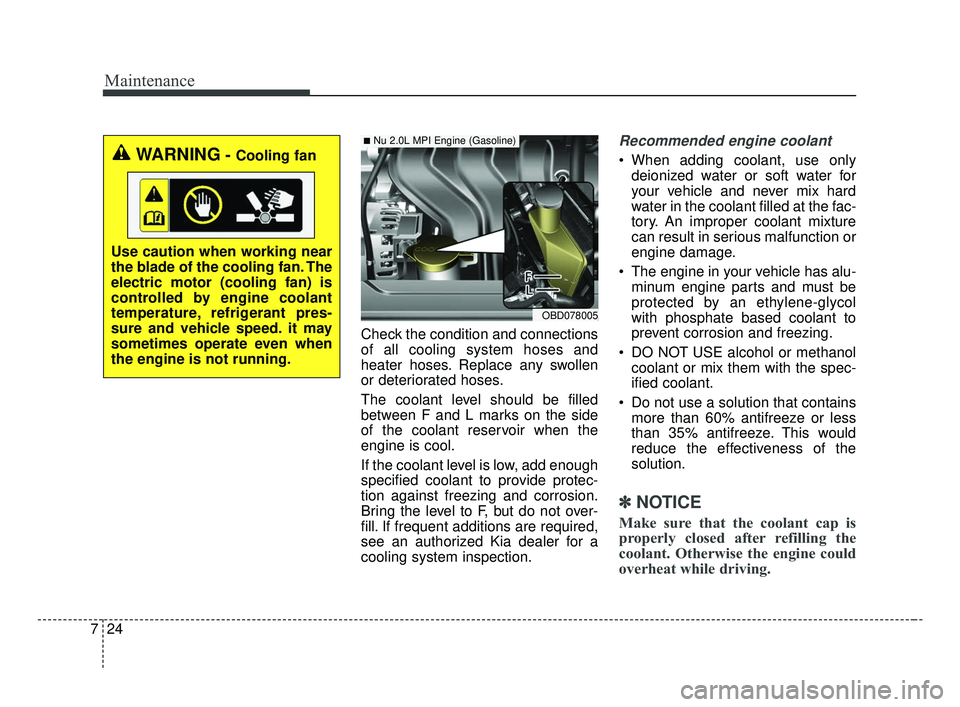
The coolant level should be filled
between F and L marks on the side
of the coolant reservoir when the
engine is cool.
If the coolant level is low, add enough
specified coolant to provide protec-
tion against freezing and corrosion.
Bring the level to F, but do not over-
fill. If frequent additions are required,
see an authorized Kia dealer for a
cooling system inspection.
Recommended engine coolant
When adding coolant, use only
deionized water or soft water for
your vehicle and never mix hard
water in the coolant filled at the fac-
tory. An improper coolant mixture
can result in serious malfunction or
engine damage.
The engine in your vehicle has alu- minum engine parts and must be
protected by an ethylene-glycol
with phosphate based coolant to
prevent corrosion and freezing.
DO NOT USE alcohol or methanol coolant or mix them with the spec-
ified coolant.
Do not use a solution that contains more than 60% antifreeze or less
than 35% antifreeze. This would
reduce the effectiveness of the
solution.
✽ ✽ NOTICE
Make sure that the coolant cap is
properly closed after refilling the
coolant. Otherwise the engine could
overheat while driving.
WARNING- Cooling fan
Use caution when working near
the blade of the cooling fan. The
electric motor (cooling fan) is
controlled by engine coolant
temperature, refrigerant pres-
sure and vehicle speed. it may
sometimes operate even when
the engine is not running.
OBD078005
■Nu 2.0L MPI Engine (Gasoline)
BDm CAN (ENG) 7.qxp 7/4/2018 10:24 AM Page 24
Page 540 of 550

I5
Index
Emergency Trunksafety release . . . . . . . . . . . . . . . . . . 4-25
Emergency while driving . . . . . . . . . . . . . . . . . . . . . . . . 6-3
Emission control system . . . . . . . . . . . . . . . . . . . . . . . . 7-99Crankcase emission control system . . . . . . . . . . . . . 7-99
Evaporative emission control (including ORVR: Onboard Refueling Vapor Recovery) system . . . . 7-99
Exhaust emission control system . . . . . . . . . . . . . . 7-100
Engine . . . . . . . . . . . . . . . . . . . . . . . . . . . . . . . . . . . . \
. . . 8-2
Engine compartment . . . . . . . . . . . . . . . . . . . . . . . . . . . . 7-4
Engine coolant . . . . . . . . . . . . . . . . . . . . . . . . . . . . . . . 7-23 Changing the coolant . . . . . . . . . . . . . . . . . . . . . . . . 7-25
Checking the coolant level . . . . . . . . . . . . . . . . . . . . 7-23
Engine coolant temperature gauge . . . . . . . . . . . . . . . . 4-59
Engine number . . . . . . . . . . . . . . . . . . . . . . . . . . . . . . . 8-10
Engine oil . . . . . . . . . . . . . . . . . . . . . . . . . . . . . . . . . . . 7-\
21 Changing the engine oil and filter . . . . . . . . . . . . . . 7-22
Checking the engine oil level. . . . . . . . . . . . . . . . . . 7-21
Engine overheats. . . . . . . . . . . . . . . . . . . . . . . . . . . . . . . 6-7
Engine start/stop button . . . . . . . . . . . . . . . . . . . . . . . . 5-11 Engine start/stop button position . . . . . . . . . . . . . . . 5-11
Illuminated engine start/stop button . . . . . . . . . . . . . 5-11
Starting the engine . . . . . . . . . . . . . . . . . . . . . . . . . . 5-14
Engine start/stop button illumination . . . . . . . . . . . . . . 5-11
Engine start/stop button position . . . . . . . . . . . . . . . . . 5-11
Engine will not start . . . . . . . . . . . . . . . . . . . . . . . . . . . . 6-4 Evaporative emission control (including ORVR:
Onboard Refueling Vapor Recovery) system . . . . . 7-99
Exhaust emission control system . . . . . . . . . . . . . . . . 7-100
Explanation of scheduled maintenance items . . . . . . . 7-16 Air cleaner filter . . . . . . . . . . . . . . . . . . . . . . . . . . . . 7-17
Air conditioning refrigerant . . . . . . . . . . . . . . . . . . 7-20
Brake discs, pads, calipers and rotors . . . . . . . . . . . 7-19
Brake fluid . . . . . . . . . . . . . . . . . . . . . . . . . . . . . . . . 7-19
Brake hoses and lines . . . . . . . . . . . . . . . . . . . . . . . . 7-18
Coolant . . . . . . . . . . . . . . . . . . . . . . . . . . . . . . . . . . 7-17\
Cooling system . . . . . . . . . . . . . . . . . . . . . . . . . . . . . 7-17
Drive belts . . . . . . . . . . . . . . . . . . . . . . . . . . . . . . . . 7-16
Drive shafts and boots . . . . . . . . . . . . . . . . . . . . . . . 7-20
Engine oil and filter . . . . . . . . . . . . . . . . . . . . . . . . . 7-16
Exhaust pipe and muffler . . . . . . . . . . . . . . . . . . . . . 7-19
Fuel filter (for gasoline) . . . . . . . . . . . . . . . . . . . . . . 7-16
Fuel lines, fuel hoses and connections . . . . . . . . . . . 7-16
Intelligent Variable Transmission (IVT) fluid . . . . . 7-17
Manual transaxle fluid . . . . . . . . . . . . . . . . . . . . . . . 7-18
Parking brake . . . . . . . . . . . . . . . . . . . . . . . . . . . . . 7-19
Spark plugs . . . . . . . . . . . . . . . . . . . . . . . . . . . . . . . . 7-17
Steering gear box, linkage & boots/lower arm ball joint . . . . . . . . . . . . . . . . . . . . . . . . . . . . . . . . . 7-20
Suspension mounting bolts . . . . . . . . . . . . . . . . . . . 7-19
Vacuum crankcase ventilation hoses . . . . . . . . . . . . 7-17
Vapor hose and fuel filler cap . . . . . . . . . . . . . . . . . 7-16
Exterior care . . . . . . . . . . . . . . . . . . . . . . . . . . . . . . . . . 7-91
BDm CAN (ENG) Index.qxp 6/30/2018 2:03 PM Page 5
Page 545 of 550

Index
10I
Owner maintenance . . . . . . . . . . . . . . . . . . . . . . . . . . 7-8
Scheduled maintenance service . . . . . . . . . . . . . . . . 7-10
Tire maintenance . . . . . . . . . . . . . . . . . . . . . . . . . . . 7-45
Maintenance schedule. . . . . . . . . . . . . . . . . . . . . . . . . . 7-10 Maintenance under severe usage conditions - Non turbo models . . . . . . . . . . . . . . . . . . . . . . . . 7-14
Normal maintenance schedule - Non turbo models . . . . . . . . . . . . . . . . . . . . . . . . 7-11
Maintenance services . . . . . . . . . . . . . . . . . . . . . . . . . . . 7-5 Owner maintenance precautions . . . . . . . . . . . . . . . . 7-6
Owner’s responsibility . . . . . . . . . . . . . . . . . . . . . . . . 7-5
Manual climate control system . . . . . . . . . . . . . . . . . . 4-115 Checking the amount of air conditioner refrigerant and compressor lubricant . . . . . . . . . . 4-124
Climate control air filter. . . . . . . . . . . . . . . . . . . . . 4-123
Heating and air conditioning . . . . . . . . . . . . . . . . . 4-116
System operation . . . . . . . . . . . . . . . . . . . . . . . . . . 4-121
Manual transmission . . . . . . . . . . . . . . . . . . . . . . . . . . . 5-18 Good driving practices . . . . . . . . . . . . . . . . . . . . . . . 5-20
Manual transmission operation . . . . . . . . . . . . . . . . 5-18
Map lamp . . . . . . . . . . . . . . . . . . . . . . . . . . . . . . . . . . 4-110
Map lamp (Bulb type) bulb replacement . . . . . . . . . . . 7-86
Map lamp (LED type) bulb replacement . . . . . . . . . . . 7-87
Mirrors . . . . . . . . . . . . . . . . . . . . . . . . . . . . . . . . . . . . \
. 4-51 Day/night rearview mirror . . . . . . . . . . . . . . . . . . . . 4-51
ElectroChromic Mirror (ECM) . . . . . . . . . . . . . . . . 4-51
Folding the outside rearview mirror . . . . . . . . . . . . 4-54
Inside rearview mirror . . . . . . . . . . . . . . . . . . . . . . . 4-51 Outside rearview mirror . . . . . . . . . . . . . . . . . . . . . . 4-52
Remote control . . . . . . . . . . . . . . . . . . . . . . . . . . . . . 4-53
Non-inflation conditions (Air bags) . . . . . . . . . . . . . . . 3-66
Occupant Detection System . . . . . . . . . . . . . . . . . . . . . 3-50
Odometer . . . . . . . . . . . . . . . . . . . . . . . . . . . . . . . . . . . 4-\
60
Oil (Engine) . . . . . . . . . . . . . . . . . . . . . . . . . . . . . . . . . 7-21
Opening the trunk . . . . . . . . . . . . . . . . . . . . . . . . . . . . . 4-24
Outside rearview mirror . . . . . . . . . . . . . . . . . . . . . . . . 4-52
Outside Temperature . . . . . . . . . . . . . . . . . . . . . . . . . . . 4-60
Overheats . . . . . . . . . . . . . . . . . . . . . . . . . . . . . . . . . . . . \
6-7
Owner maintenance . . . . . . . . . . . . . . . . . . . . . . . . . . . . 7-8 Owner maintenance schedule. . . . . . . . . . . . . . . . . . . 7-8
Parking & Tail light . . . . . . . . . . . . . . . . . . . . . . . . . . 4-101
Parking brake . . . . . . . . . . . . . . . . . . . . . . . . . . . . . . . . 5-33
Parking brake . . . . . . . . . . . . . . . . . . . . . . . . . . . . . . . . 7-28 Checking the parking brake . . . . . . . . . . . . . . . . . . . 7-28
N
O
P
BDm CAN (ENG) Index.qxp 6/30/2018 2:03 PM Page 10