2019 KIA FORTE Front brakes
[x] Cancel search: Front brakesPage 294 of 550

Driving your vehicle
48
5
Prerequisite for activation
The FCA gets ready to be activated,
when the FCA is selected on the
LCD display, and when the following
prerequisites are satisfied.
- The ESC is ON.
- The driving speed is over 10 km/h
(6 mph ). (However, FCA is activat-
ed within certain driving speed.)
- When recognizing a vehicle in front. (However, FCA deactivate
according to conditions in front and
vehicle systems, but it notices only
certain warnings.)
- The FCA automatically deactivates upon canceling the ESC. When the
ESC is cancelled, the FCA cannot
be activated on the LCD display. In
this situation, the FCA warning
light will illuminate.
FCA warning message and
system control
The FCA system produces warning
messages, warning alarms, and
emergency braking based on the risk
of a frontal collision, such as when a
vehicle ahead suddenly brakes.
The driver can select the initial warn-
ing activation time in the User Settings
in the LCD display. The options for the
initial Forward Collision-Avoidance
Assist include Early, Normal or Late
initial warning time.
WARNING
The FCA automatically acti-vates upon placing the igni-
tion switch to the ON position.
The driver can deactivate the
FCA by canceling the system
setting on the LCD display.
The FCA automatically deacti- vates upon canceling the
ESC. When the ESC is can-
celled, the FCA cannot be
activated on the LCD display.
The FCA warning light will
illuminate, but it does not indi-
cate a malfunction of the sys-
tem.
Set or cancel FCA with con- trolling switches on steering
wheel after stopping the vehi-
cle in the safe place for your
safety.
BDm CAN (ENG) 5.QXP 7/4/2018 10:13 AM Page 48
Page 307 of 550

561
Driving your vehicle
Prerequisite for activation
The FCA gets ready to be activated,
when the FCA is selected on the
LCD display, and when the following
prerequisites are satisfied.
- The ESC is ON.
- The driving speed is over 10 km/h(6 mph). (However, FCA is activat-
ed within certain driving speed.)
- When recognizing a vehicle or the pedestrian in front. (However, FCA
deactivate according to conditions
in front and vehicle systems, but it
notices only certain warnings.)
- The FCA automatically deactivates upon canceling the ESC. When the
ESC is cancelled, the FCA cannot
be activated on the LCD display. In
this situation, the FCA warning
light will illuminate.
FCA warning message and
system control
The FCA system produces warning
messages, warning alarms, and
emergency braking based on the risk
of a frontal collision, such as when a
vehicle ahead suddenly brakes.
The driver can select the initial warn-
ing activation time in the User
Settings in the LCD display. The
options for the initial Forward
Collision-Avoidance Assist include
Early, Normal or Late initial warning
time.
WARNING
The FCA automatically acti-vates upon placing the igni-
tion switch to the ON position.
The driver can deactivate the
FCA by canceling the system
setting on the LCD display.
The FCA automatically deacti- vates upon canceling the
ESC. When the ESC is can-
celled, the FCA cannot be
activated on the LCD display.
The FCA warning light will
illuminate, but it does not indi-
cate a malfunction of the sys-
tem.
Set or cancel FCA with con- trolling switches on steering
wheel after stopping the vehi-
cle in the safe place for your
safety.
BDm CAN (ENG) 5.QXP 7/4/2018 10:14 AM Page 61
Page 319 of 550

573
Driving your vehicle
The cruise control system allows you
to program the vehicle to maintain a
constant speed without depressing
the accelerator pedal.
This system is designed to function
above approximately 30 km/h (20
mph).
If the cruise control is left on,
(CRUISE indicator light in the instru-
ment cluster illuminated) the cruise
control can be switched on acciden-
tally. Keep the cruise control system
off (CRUISE indicator light OFF)
when the cruise control is not in use,
to avoid inadvertently setting a speed.Use the cruise control system only
when traveling on open highways in
good weather.
Do not use the cruise control when
driving in heavy or varying traffic, or
on slippery (rainy, icy or snow-cov-
ered) or winding roads or over 6%
up-hill or down-hill roads.
✽ ✽
NOTICE
• During normal cruise control oper-
ation, when the SET switch is acti-
vated or reactivated after applying
the brakes, the cruise control will
activate after approximately 3 sec-
onds. This delay is normal.
• To activate cruise control, depress the brake pedal at least once after
turning the ignition switch to the
ON position or starting the engine.
CRUISE CONTROL SYSTEM
WARNING - Misuse of
Cruise Control
Do not use cruise control if the
traffic situation does not allow
you to drive safely at a constant
speed and with sufficient dis-
tance to the vehicle in front.
OJF058445L
BDm CAN (ENG) 5.QXP 7/4/2018 10:15 AM Page 73
Page 374 of 550
Driving your vehicle
128
5
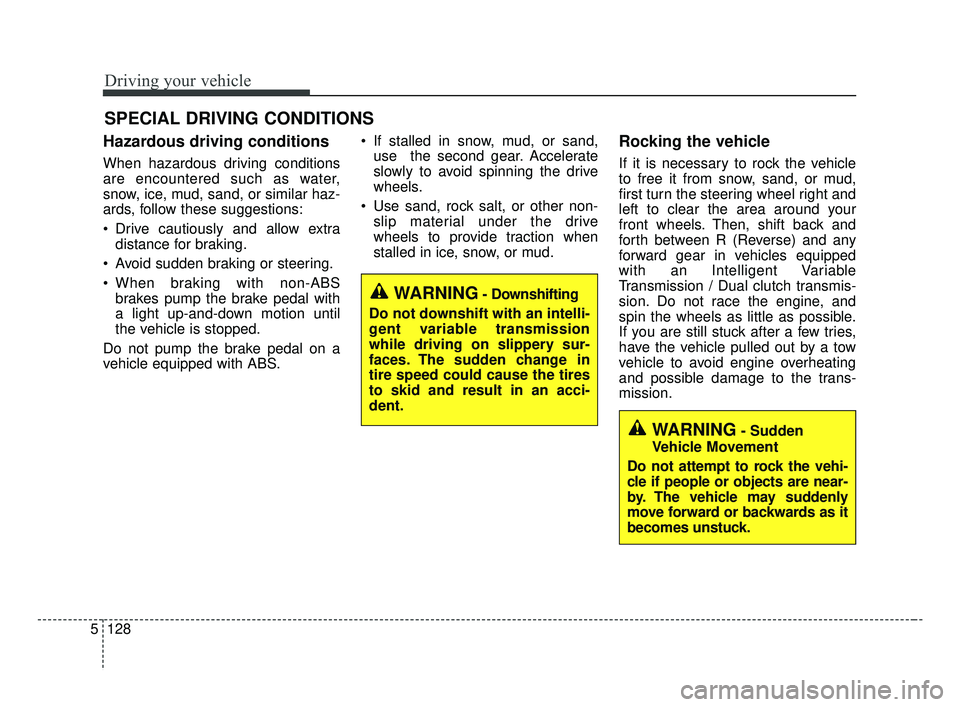
Hazardous driving conditions
When hazardous driving conditions
are encountered such as water,
snow, ice, mud, sand, or similar haz-
ards, follow these suggestions:
Drive cautiously and allow extra
distance for braking.
Avoid sudden braking or steering.
When braking with non-ABS brakes pump the brake pedal with
a light up-and-down motion until
the vehicle is stopped.
Do not pump the brake pedal on a
vehicle equipped with ABS. If stalled in snow, mud, or sand,
use the second gear. Accelerate
slowly to avoid spinning the drive
wheels.
Use sand, rock salt, or other non- slip material under the drive
wheels to provide traction when
stalled in ice, snow, or mud.
Rocking the vehicle
If it is necessary to rock the vehicle
to free it from snow, sand, or mud,
first turn the steering wheel right and
left to clear the area around your
front wheels. Then, shift back and
forth between R (Reverse) and any
forward gear in vehicles equipped
with an Intelligent Variable
Transmission / Dual clutch transmis-
sion. Do not race the engine, and
spin the wheels as little as possible.
If you are still stuck after a few tries,
have the vehicle pulled out by a tow
vehicle to avoid engine overheating
and possible damage to the trans-
mission.
SPECIAL DRIVING CONDITIONS
WARNING- Downshifting
Do not downshift with an intelli-
gent variable transmission
while driving on slippery sur-
faces. The sudden change in
tire speed could cause the tires
to skid and result in an acci-
dent.
WARNING- Sudden
Vehicle Movement
Do not attempt to rock the vehi-
cle if people or objects are near-
by. The vehicle may suddenly
move forward or backwards as it
becomes unstuck.
BDm CAN (ENG) 5.QXP 7/4/2018 10:18 AM Page 128
Page 380 of 550

Driving your vehicle
134
5
Don’t let your parking brake
freeze
Under some conditions your parking
brake can freeze in the engaged
position. This is most likely to happen
when there is an accumulation of
snow or ice around or near the rear
brakes or if the brakes are wet. If
there is a risk the parking brake may
freeze, apply it only temporarily while
you put the gear shift lever in P
(Park, Intelligent variable transmis-
sion / Dual clutch transmission) and
block the rear wheels so the vehicle
cannot roll. Then release the parking
brake.
Don't let ice and snow accu-
mulate underneath
Under some conditions, snow and
ice can build up under the fenders
and interfere with the steering. When
driving in severe winter conditions
where this may happen, you should
periodically check underneath the
vehicle to be sure the movement of
the front wheels and the steering
components are not obstructed.
Carry emergency equipment
Depending on the severity of the
weather, you should carry appropri-
ate emergency equipment. Some of
the items you may want to carry
include tow straps or chains, flash-
light, emergency flares, sand, shov-
el, jumper cables, window scraper,
gloves, ground cloth, coveralls, blan-
ket, etc.
TRAILER TOWING
We do not recommend using this
vehicle for trailer towing.
BDm CAN (ENG) 5.QXP 7/4/2018 10:18 AM Page 134
Page 421 of 550

635
What to do in an emergency
Removable towing hook
(if equipped)
1. Open the tailgate, and remove thetowing hook from the tool case.
2. Remove the hole cover pressing the lower (front) part of the cover
on the bumper.
3. Install the towing hook by turning it clockwise into the hole until it is
fully secured.
4. Remove the towing hook and install the cover after use.
Emergency towing
If towing is necessary, we recom-
mend you to have it done by an
authorized Kia dealer or a com-
mercial tow truck service. If towing service is not available in an
emergency, your vehicle may be
temporarily towed using a cable or
chain secured to the emergency
towing hook under the front (or
rear) of the vehicle. Use extreme
caution when towing the vehicle. A
driver must be in the vehicle to
steer it and operate the brakes.
Towing in this manner may be done only on hard-surfaced roads for a
short distance and at low speed.
Also, the wheels, axles, power
train, steering and brakes must all
be in good condition.
Do not use the tow hooks to pull a vehicle out of mud, sand or other
conditions from which the vehicle
cannot be driven out under its own
power.
Avoid towing a vehicle heavier than the vehicle doing the towing.
The drivers of both vehicles should communicate with each other fre-
quently.
OBD068013
■ Front
OBD068015
OBD068016
■ Front
■ Rear
BDm CAN (ENG) 6.qxp 7/4/2018 10:21 AM Page 35
Page 423 of 550

637
What to do in an emergency
Emergency towing precautions
Turn the ignition switch to ACC sothe steering wheel isn’t locked.
Place the transaxle shift lever in N (Neutral).
Release the parking bake.
Press the brake pedal with more force than normal since you will
have reduced brake performance.
More steering effort will be required because the power steer-
ing system will be disabled.
If you are driving down a long hill, the brakes may overheat and brake
performance will be reduced. Stop
often and let the brakes cool off.
If the car is being towed with all four wheels on the ground, it can
be towed only from the front. Be
sure that the transaxle is in neutral.
Be sure the steering is unlocked by
placing the ignition switch in the
ACC position. A driver must be in
the towed vehicle to operate the
steering and brakes.CAUTION
- Intelligent Variable
Transmission (IVT)
Vehicles with Intelligent VariableTransmission (IVT) can only betowed to an ordinary vehiclewhen there is no IVT transmis-sion oil leakage. If towing to anordinary vehicle in the event ofoil leakage, the transmissionmay be damaged. If towing to anordinary vehicle in the event ofoil leakage, the transmissionmay be damaged.
CAUTION
- Intelligent Variable
Transmission
If the car is being towed with all four wheels on the ground,it can be towed only from thefront.
(Continued)
(Continued)Be sure that the transmissionis in neutral. Be sure the steer-ing is unlocked by placing theignition switch in the ACCposition. A driver must be inthe towed vehicle to operatethe steering and brakes.
To avoid serious damage to the Intelligent VariableTransmission limit the vehiclespeed to 15 km/h (10 mph) anddrive less than 1.5 km (1 mile)when towing.
Before towing, check the Intelligent VariableTransmission for fluid leaksunder your vehicle. If theIntelligent VariableTransmission fluid is leaking,flatbed equipment or a towingdolly must be used.
BDm CAN (ENG) 6.qxp 7/4/2018 10:21 AM Page 37
Page 546 of 550

I11
Index
Parking distance warning-reverse. . . . . . . . . . . . . . . . . 4-96Non-operational conditions of parking distance warning-reverse . . . . . . . . . . . . . . . . . . . . . . . . . . . 4-97
Operation of the parking distance warning-reverse . 4-96
parking distance warning-reverse precautions . . . . . 4-98
Self-diagnosis . . . . . . . . . . . . . . . . . . . . . . . . . . . . . . 4-98
Pocket lamp. . . . . . . . . . . . . . . . . . . . . . . . . . . . . . . . . 4-113
Position lamp / Day time running lamp (LED type) replacement (Headlamp Type B) . . . . . . . . . . . . . . 7-79
Power brakes. . . . . . . . . . . . . . . . . . . . . . . . . . . . . . . . . 5-31
Power outlet . . . . . . . . . . . . . . . . . . . . . . . . . . . . . . . . 4-148
Power window lock button . . . . . . . . . . . . . . . . . . . . . . 4-34
Power windows. . . . . . . . . . . . . . . . . . . . . . . . . . . . . . . 4-31
Precautions . . . . . . . . . . . . . . . . . . . . . . . . . . . . . . . . . . 3-28\
Pre-tensioner seat belt. . . . . . . . . . . . . . . . . . . . . . . . . . 3-25
Rear seat . . . . . . . . . . . . . . . . . . . . . . . . . . . . . . . . . . . . \
3-13
Rear turn signal lamp bulb replacement . . . . . . . . . . . . 7-84
Rear view monitor . . . . . . . . . . . . . . . . . . . . . . . . . . . . 4-99
Recommended lubricants and capacities . . . . . . . . . . . . 8-6 Recommended SAE viscosity number. . . . . . . . . . . . 8-8
Record your key number . . . . . . . . . . . . . . . . . . . . . . . . 4-4
Remote control (outside rear view mirror) . . . . . . . . . . 4-53 Remote keyless entry
Battery replacement . . . . . . . . . . . . . . . . . . . . . . . . . 4-12
Immobilizer system . . . . . . . . . . . . . . . . . . . . . . . . . 4-13
Remote keyless entry system operations . . . . . . . . . 4-10
Remote keyless entry system operations . . . . . . . . . . . 4-10
Resetting the sunroof . . . . . . . . . . . . . . . . . . . . . . . . . . 4-45
Road warning . . . . . . . . . . . . . . . . . . . . . . . . . . . . . . . . . 6-2
Rocking the vehicle . . . . . . . . . . . . . . . . . . . . . . . . . . 5-128
Room lamp . . . . . . . . . . . . . . . . . . . . . . . . . . . . . . . . . 4-110
Room lamp (Bulb type) bulb replacement . . . . . . . . . . 7-87
Room lamp (LED type) bulb replacement . . . . . . . . . . 7-88
Rotation (Tire) . . . . . . . . . . . . . . . . . . . . . . . . . . . . . . . 7-42
Scheduled maintenance service . . . . . . . . . . . . . . . . . . 7-10 Maintenance under severe usage conditions - Non turbo models . . . . . . . . . . . . . . . . . . . . . . . . 7-14
Normal maintenance schedule - Non turbo models . . . . . . . . . . . . . . . . . . . . . . . . 7-11
Seat belt restraint system . . . . . . . . . . . . . . . . . . . . . . . 3-18
Seat belts . . . . . . . . . . . . . . . . . . . . . . . . . . . . . . . . . . . . \
3-18 Care of seat belts . . . . . . . . . . . . . . . . . . . . . . . . . . . 3-30
Driver's seat belt warning. . . . . . . . . . . . . . . . . . . . . 3-20
Front passenger seat belt warning. . . . . . . . . . . . . . 3-20
Precautions . . . . . . . . . . . . . . . . . . . . . . . . . . . . . . . . 3-28
R
S
BDm CAN (ENG) Index.qxp 6/30/2018 2:03 PM Page 11