Page 32 of 332

on and remain on until both outboard front seat
belts are buckled. The outboard front passenger
seat BeltAlert is not active when an outboard
front passenger seat is unoccupied.
BeltAlert Warning Sequence
The BeltAlert warning sequence is activated
when the vehicle is moving above a specified
vehicle speed range and the driver or outboard
front seat passenger is unbuckled (if equipped
with outboard front passenger seat BeltAlert).
The BeltAlert warning sequence starts by blink-
ing the Seat Belt Reminder Light and sounding
an intermittent chime. Once the BeltAlert warn-
ing sequence has completed, the Seat Belt
Reminder Light will remain on until the seat
belts are buckled. The BeltAlert warning se-
quence may repeat based on vehicle speed
until the driver and occupied outboard front seat
passenger seat belts are buckled. The driver
should instruct all occupants to buckle their seat
belts.Change Of Status
If the driver or outboard front seat passenger (if
equipped with outboard front passenger seat
BeltAlert) unbuckles their seat belt while the
vehicle is traveling, the BeltAlert warning se-
quence will begin until the seat belts are buck-
led again.
The outboard front passenger seat BeltAlert is
not active when the outboard front passenger
seat is unoccupied. BeltAlert may be triggered
when an animal or other items are placed on the
outboard front passenger seat or when the seat
is folded flat (if equipped). It is recommended
that pets be restrained in the rear seat (if
equipped) in pet harnesses or pet carriers that
are secured by seat belts, and cargo is properly
stowed.
BeltAlert can be activated or deactivated by
your authorized dealer. FCA International Op-
erations LLC does not recommend deactivating
BeltAlert.NOTE:
If BeltAlert has been deactivated and the
driver or outboard front seat passenger (if
equipped with outboard front passenger
seat BeltAlert) is unbuckled the Seat Belt
Reminder Light will turn on and remain on
until the driver and outboard front seat pas-
senger seat belts are buckled.
Lap/Shoulder Belts
All seating positions in your vehicle are
equipped with lap/shoulder belts.
The seat belt webbing retractor will lock only
during very sudden stops or collisions. This
feature allows the shoulder part of the seat belt
to move freely with you under normal condi-
tions. However, in a collision the seat belt will
lock and reduce your risk of striking the inside of
the vehicle or being thrown out of the vehicle.
28
Page 233 of 332

WARNING!(Continued)
•Being under a jacked-up vehicle is danger-
ous. The vehicle could slip off the jack and
fall on you. You could be crushed. Never
put any part of your body under a vehicle
that is on a jack. If you need to get under a
raised vehicle, take it to a service center
where it can be raised on a lift.
•Never start or run the engine while the
vehicle is on a jack.
•The jack is designed to be used as a tool
for changing tires only. The jack should not
be used to lift the vehicle for service pur-
poses. The vehicle should be jacked on a
firm level surface only. Avoid ice or slippery
areas.
Jack LocationThe jack and jack-handle are stowed under the
load floor in the cargo area.
Spare Tire StowageThe compact spare tire is stowed under the rear
load floor in the cargo area.
Spare Tire Removal
Lift up the load floor cover and remove the hold
down.
Preparations For Jacking
1. Park the vehicle on a firm level surface,
avoiding ice or slippery areas.
WARNING!
Do not attempt to change a tire on the side of
the vehicle close to moving traffic, pull far
enough off the road to avoid the danger of
being hit when operating the jack or chang-
ing the wheel.
2. Turn on the Hazard Warning flasher.
3. Set the parking brake.
4. Place the gear selector in PARK (automatic
transmission) or REVERSE (manual trans-
mission).
5. Turn OFF the ignition.
6. Block both the front and rear
of the wheel diagonally op-
posite of the jacking posi-
tion. For example, if chang-
ing the right front tire, block
the left rear wheel.
Spare Tire And Jack Stowage
229
Page 234 of 332
NOTE:
Passengers should not remain in the vehicle
while the vehicle is being jacked.
Jacking Instructions
WARNING!
Carefully follow these tire changing warnings
to help prevent personal injury or damage to
your vehicle:
•Always park on a firm, level surface as far
from the edge of the roadway as possible
before raising the vehicle.
•Turn on the Hazard Warning flasher.
•Block the wheel diagonally opposite the
wheel to be raised.
•Set the parking brake firmly and set an
automatic transmission in PARK; a manual
transmission in REVERSE.
•Never start or run the engine with the
vehicle on a jack.
(Continued)
WARNING!(Continued)
•Do not let anyone sit in the vehicle when it
is on a jack.
•Do not get under the vehicle when it is on
a jack. If you need to get under a raised
vehicle, take it to a service center where it
can be raised on a lift.
•Only use the jack in the positions indicated
and for lifting this vehicle during a tire
change.
•If working on or near a roadway, be ex-
tremely careful of motor traffic.
•To assure that spare tires, flat or inflated,
are securely stowed, spares must be
stowed with the valve stem facing the
ground.NOTE:
Refer to “Tires — General Information” in
“Starting And Operating” for further infor-
mation about the spare tire, it’s use, and
operation.
1. Remove the scissors jack and lug wrench
from the spare wheel as an assembly. Turn
the jack screw to the left to loosen the lug
wrench and remove the wrench from the
jack assembly.
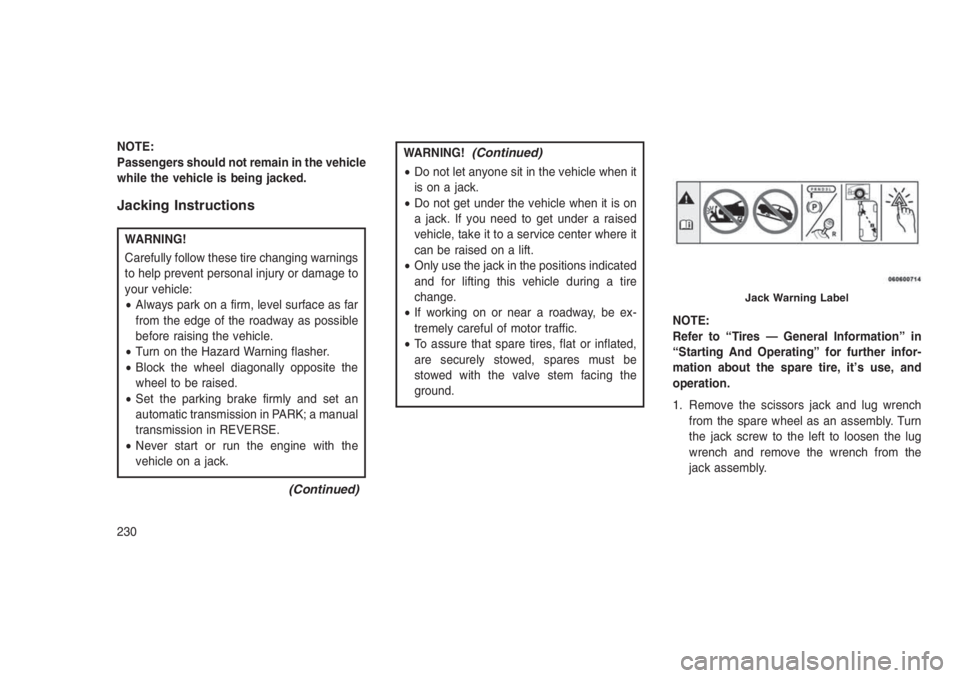
Jack Warning Label
230
Page 253 of 332
All Transmissions
If you must use the accessories (wipers, de-
froster, etc.) while being towed, the key must be
in the ON/RUN position, not the ACC position.
Make certain the transmission remains in
NEUTRAL.
CAUTION!
•Do not use sling-type equipment when
towing. Vehicle damage may occur.
•When securing the vehicle to a flatbed
truck, do not attach to front or rear suspen-
sion components. Damage to your vehicle
may result from improper towing.Without The Ignition Key
Special care must be taken when the vehicle is
towed with the ignition in the LOCK/OFF posi-
tion. The only approved method of towing with-
out the ignition key is with a flatbed truck.
Proper towing equipment is necessary to pre-
vent damage to the vehicle.
249
