2019 JEEP PATRIOT ECU
[x] Cancel search: ECUPage 183 of 332

NOTE:
Refer to “Electronic Brake Control System/
Electronic Stability Control (ESC)” in “Start-
ing And Operating” for further information.
ON-ROAD DRIVING TIPS
Utility vehicles have higher ground clearance
and a narrower track to make them capable of
performing in a wide variety of off-road applica-
tions. Specific design characteristics give them
a higher center of gravity than ordinary vehicles.
An advantage of the higher ground clearance is
a better view of the road, allowing you to
anticipate problems. They are not designed for
cornering at the same speeds as conventional
two-wheel drive vehicles any more than low-
slung sports cars are designed to perform sat-
isfactorily in off-road conditions. If at all pos-
sible, avoid sharp turns or abrupt maneuvers.
As with other vehicles of this type, failure to
operate this vehicle correctly may result in loss
of control or vehicle rollover.
OFF-ROAD DRIVING TIPS
You will encounter many types of terrain driving
off-road. You should be familiar with the terrain
and area before proceeding. There are many
types of surface conditions: hard packed dirt,
gravel, rocks, grass, sand, mud, snow and ice.
Every surface has a different effect on your
vehicle’s steering, handling and traction. Con-
trolling your vehicle is one of the keys to suc-
cessful off-road driving, so always keep a firm
grip on the steering wheel and maintain a good
driving posture. Avoid sudden accelerations,
turns or braking. In most cases there are no
road signs, posted speed limits or signal lights.
Therefore you will need to use your own good
judgment on what is safe and what is not. When
on a trail, you should always be looking ahead
for surface obstacles and changes in terrain.
The key is to plan your future driving route while
remembering what you are currently driving
over.CAUTION!
Never park your vehicle over dry grass or
other combustible materials. The heat from
your vehicle exhaust system could cause a
fire.
WARNING!
Always wear your seat belt and firmly tie
down cargo. Unsecured cargo can become
projectiles in an off-road situation.
When To Use Low (L Off-Road) With
The 4WD Lock Lever Engaged — If
Equipped
When driving off-road, shift into low (L Off-Road
[if equipped] ) and activate the 4WD LOCK. This
will provide additional traction and activates the
numerous off-road features to improve handling
and control on slippery or difficult terrain. Due to
the sustained lower gearing, low (L Off-Road [if
equipped] ) with 4WD LOCK engaged will allow
the engine to operate in a higher power range.
179
Page 221 of 332
WARNING!
Improper towing can lead to an injury acci-
dent. Follow these guidelines to make your
trailer towing as safe as possible:
•Make certain that the load is secured in the
trailer and that it will not shift during travel.
When trailering cargo that is not fully se-
cured, dynamic load shifts can occur that
may be difficult for the driver to control. You
could lose control of your vehicle and have
an accident.
•All trailer hitches should be professionally
installed on your vehicle.
•When hauling cargo or towing a trailer, do
not overload your vehicle or trailer. Over-
loading can cause a loss of control, poor
performance, or damage to brakes, axle,
engine, transmission, steering, suspen-
sion, chassis structure, or tires.
(Continued)
WARNING!(Continued)
•Safety chains must always be used be-
tween your vehicle and trailer. Always con-
nect the chains to the frame or hook re-
tainers of the vehicle hitch. Cross the
chains under the trailer tongue and allow
enough slack for turning corners.
•Vehicles with trailers should not be parked
on a grade. When parking, apply the park-
ing brake on the tow vehicle. Always, block
or"chock"the trailer wheels.
•GCWR must not be exceeded.
•Total weight must be distributed be-
tween the tow vehicle and the trailer
such that the following four ratings are
not exceeded:
1. GVWR
2. GTW
3. GAWR
4. Tongue weight rating for the trailer hitch
utilized.Towing Requirements — Tires
•Do not attempt to tow a trailer while using a
compact spare tire.
•Proper tire inflation pressures are essential
for the safe and satisfactory operation of your
vehicle. Refer to “Tires – General Informa-
tion” in “Starting and Operating” for proper
tire inflation procedures.
•Check the trailer tires for proper tire inflation
pressures before trailer usage.
•Check for signs of tire wear or visible tire
damage before towing a trailer. Refer to
“Tires – General Information” in “Starting and
Operating” for the proper inspection
procedure.
•When replacing tires, refer to “Tires – Gen-
eral Information” in “Starting and Operating”
for proper tire replacement procedures. Re-
placing tires with a higher load carrying ca-
pacity will not increase the vehicle’s GVWR
and GAWR limits.
217
Page 234 of 332
NOTE:
Passengers should not remain in the vehicle
while the vehicle is being jacked.
Jacking Instructions
WARNING!
Carefully follow these tire changing warnings
to help prevent personal injury or damage to
your vehicle:
•Always park on a firm, level surface as far
from the edge of the roadway as possible
before raising the vehicle.
•Turn on the Hazard Warning flasher.
•Block the wheel diagonally opposite the
wheel to be raised.
•Set the parking brake firmly and set an
automatic transmission in PARK; a manual
transmission in REVERSE.
•Never start or run the engine with the
vehicle on a jack.
(Continued)
WARNING!(Continued)
•Do not let anyone sit in the vehicle when it
is on a jack.
•Do not get under the vehicle when it is on
a jack. If you need to get under a raised
vehicle, take it to a service center where it
can be raised on a lift.
•Only use the jack in the positions indicated
and for lifting this vehicle during a tire
change.
•If working on or near a roadway, be ex-
tremely careful of motor traffic.
•To assure that spare tires, flat or inflated,
are securely stowed, spares must be
stowed with the valve stem facing the
ground.NOTE:
Refer to “Tires — General Information” in
“Starting And Operating” for further infor-
mation about the spare tire, it’s use, and
operation.
1. Remove the scissors jack and lug wrench
from the spare wheel as an assembly. Turn
the jack screw to the left to loosen the lug
wrench and remove the wrench from the
jack assembly.
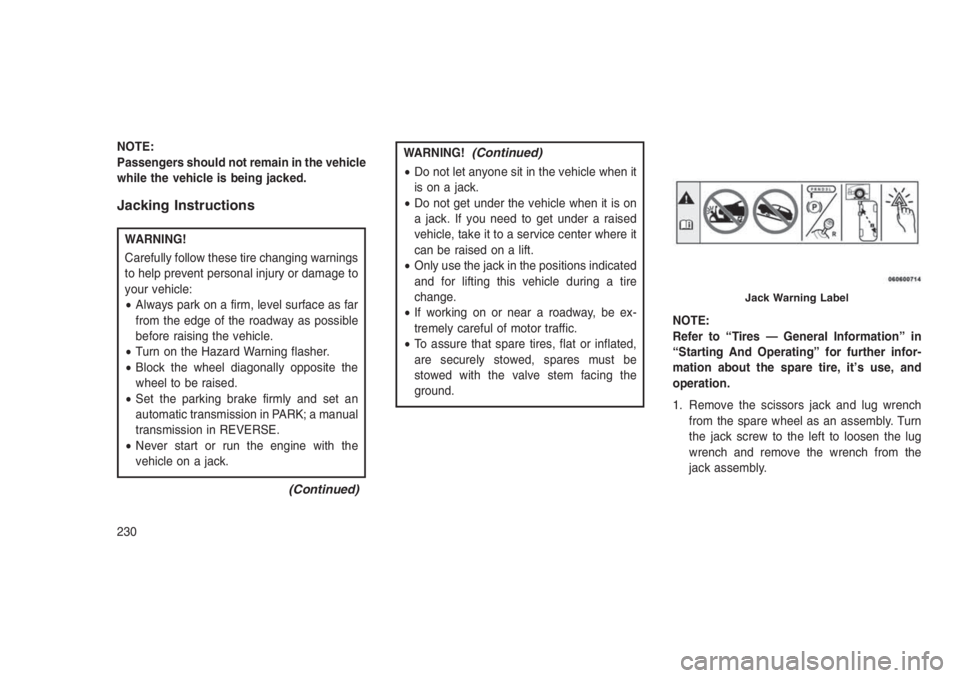
Jack Warning Label
230
Page 236 of 332

Do not raise the vehicle until you are sure the
jack is securely engaged.
3. Turn the jack screw to the left until the jack
can be placed under the jacking location.
Once the jack is positioned, turn the jack
screw to the right until the jack head is
properly engaged with the lift area closest to
the wheel to be changed.
WARNING!
Raising the vehicle higher than necessary
can make the vehicle less stable. It could slip
off the jack and hurt someone near it. Raise
the vehicle only enough to remove the tire.
4. Using the swivel wrench raise the vehicle by
turning the jack screw to the right. Raise the
vehicle only until the tire just clears the
surface and enough clearance is obtained to
install the spare tire. Minimum tire lift pro-
vides maximum stability.
5. Remove the wheel nuts and pull the wheel
and wheel covers, where applicable, off the
hub. Install the spare wheel and wheel nuts
with the cone shaped end of the nuts toward
the wheel. Lightly tighten the nuts.
WARNING!
To avoid the risk of forcing the vehicle off the
jack, do not tighten the wheel nuts fully until
(Continued)
WARNING!(Continued)
the vehicle has been lowered. Failure to follow
this warning may result in serious injury.
CAUTION!
Be sure to mount the spare tire with the valve
stem facing outward. The vehicle could be
damaged if the spare tire is mounted incor-
rectly.
Rear Jacking Location
Mounting Spare Tire
232
Page 237 of 332

WARNING!
To avoid possible personal injury, handle the
wheel covers with care to avoid contact with
any sharp edges.
NOTE:
The wheel cover is held on the wheel by the
wheel nuts. When reinstalling the original
wheel, properly align the wheel cover to the
valve stem, place the wheel cover onto the
wheel, then install the wheel nuts.
6. Lower the vehicle by turning the jack screw
to the left.
7. Finish tightening the lug nuts. Push down on
the wrench while at the end of the handle for
increased leverage. Tighten the lug nuts in a
star pattern until each nut has been tight-
ened twice. Refer to “Torque Specifications”
in this section for the correct lug nut torque.
If you doubt that you have tightened the nutscorrectly, have them checked with a torque
wrench by your authorized dealer or service
station.
8. Remove the wheel blocks and lower the jack
until it is free. Release the parking brake.
Reassemble the lug wrench to the jack as-
sembly and stow it in the spare tire area.
Secure the assembly using the means pro-
vided.
WARNING!
A loose tire or jack thrown forward in a
collision or hard stop could endanger the
occupants of the vehicle. Always stow the
jack parts and the spare tire in the places
provided.
9. Place the deflated (flat) tire in the cargo
area,have the tire repaired or replaced as
soon as possible.
WARNING!
A loose tire thrown forward in a collision or
hard stop could injure the occupants in the
vehicle. Have the deflated (flat) tire repaired
or replaced immediately.
10. Check the spare tire pressure as soon as
possible. Correct the tire pressure as re-
quired.
Road Tire Installation
Vehicles Equipped With Wheel Covers
1. Mount the road tire on the axle.
2. Align the valve notch in the wheel cover with
the valve stem on the wheel. Install the cover
by hand. Do not use a hammer or excessive
force to install the cover.
233
Page 249 of 332

7. Move the gear selector to the NEUTRAL
position.
8.
The vehicle may then be started in NEUTRAL.
9. Reinstall the gear selector override access
cover.
TOW EYE USAGE
Your vehicle is equipped with a tow eye that can
be used to tow a disabled vehicle.
When using a tow eye be sure to follow the “Tow
Eye Usage Precautions” and the “Towing A
Disabled Vehicle” instructions in this section.Tow Eye Usage Precautions
NOTE:
•Ensure that the tow eye is properly seated
and secure in the mounting receptacle.
•The tow eye is recommended for use with
an approved tow bar and or rope.
•Do not use the tow eye to pull the vehicle
onto a flatbed truck.
•Do not use the tow eye to free a stuck
vehicle. Refer to “Freeing A Stuck Ve-
hicle” in this section for further
information.
WARNING!
Stand clear of vehicles when pulling with tow
eyes.
•Do not use a chain with a tow eye. Chains
may break, causing serious injury or
death.
(Continued)
WARNING!(Continued)
•Do not use a tow strap with a tow eye. Tow
straps may break or become disengaged,
causing serious injury or death.
•Failure to follow proper tow eye usage may
cause components to break resulting in
serious injury or death.
Tow Eye
Tow Eye Warning Label
245
Page 253 of 332

All Transmissions
If you must use the accessories (wipers, de-
froster, etc.) while being towed, the key must be
in the ON/RUN position, not the ACC position.
Make certain the transmission remains in
NEUTRAL.
CAUTION!
•Do not use sling-type equipment when
towing. Vehicle damage may occur.
•When securing the vehicle to a flatbed
truck, do not attach to front or rear suspen-
sion components. Damage to your vehicle
may result from improper towing.Without The Ignition Key
Special care must be taken when the vehicle is
towed with the ignition in the LOCK/OFF posi-
tion. The only approved method of towing with-
out the ignition key is with a flatbed truck.
Proper towing equipment is necessary to pre-
vent damage to the vehicle.
249
Page 255 of 332

7
MAINTAINING YOUR VEHICLE
•ENGINE COMPARTMENT — 2.0L . . . . . . . . . . . . .. . . . . .253
•ENGINE COMPARTMENT — 2.4L . . . . . . . . . . . . .. . . . . .254
•ONBOARD DIAGNOSTIC SYSTEM — OBD II . . ..........255
•Onboard Diagnostic System (OBD II) Cybersecurity.......255
•Loose Fuel Filler Cap Message...................256
•REPLACEMENT PARTS . . . . . . . . . . . . . . . . . . . . . . . . .256
•MAINTENANCE PROCEDURES . . . . . . . . . . . . . . ......256
•Engine Oil................................256
•Engine Oil Filter............................258
•Engine Air Cleaner Filter.......................258
•Maintenance-Free Battery.......................258
•Air Conditioner Maintenance.....................259
•Body Lubrication............................261
•Windshield Wiper Blades.......................261
•Adding Washer Fluid.........................261
•Exhaust System............................262
•Cooling System............................263
•Brake System..............................266
•Automatic Transmission (6-Speed) — If Equipped........267
251