Page 254 of 626
�REFUELING THE VEHICLE — GASOLINE
ENGINE ............................. .359
▫ Emergency Fuel Filler Door Release ..........361
� VEHICLE LOADING .....................362
▫ Certification Label ..................... .362
� TRAILER TOWING ..................... .364
▫ Common Towing Definitions ...............364
▫ Trailer Hitch Classification ................366
▫ Trailer Towing Weights (Maximum Trailer Weight
Ratings) ............................ .367
▫ Trailer Hitch Receiver Cover Removal (Summit
Models) — If Equipped ..................368
▫ Trailer And Tongue Weight ...............369
▫ Towing Requirements .................. .370▫
Towing Tips ......................... .374
� SNOW PLOW ......................... .375
� RECREATIONAL TOWING (BEHIND
MOTORHOME, ETC.) ................... .376
▫ Towing This Vehicle Behind Another Vehicle. . . .376
▫ Recreational Towing — Two Wheel Drive
Models ............................. .377
▫ Recreational Towing — Quadra-Trac I (Single-Speed
Transfer Case) Four-Wheel Drive Models ......378
▫ Recreational Towing — Quadra–Trac II/Quadra–
Drive II Four-Wheel Drive Models ...........378
� DRIVING TIPS ......................... .382
▫ On-Road Driving Tips .................. .382
▫ Off-Road Driving Tips .................. .383
252 STARTING AND OPERATING
Page 323 of 626
•Clean the ParkSense sensors regularly, taking care not to
scratch or damage them. The sensors must not be
covered with ice, snow, slush, mud, dirt or debris.
Failure to do so can result in the system not working
properly. The ParkSense system might not detect an
obstacle behind the fascia/bumper, or it could provide a
false indication that an obstacle is behind the fascia/
bumper.
• Use the ParkSense switch to turn the ParkSense system
off if objects such as bicycle carriers, trailer hitches, etc.
are placed within 12 inches (30 cm) from the rear
fascia/bumper. Failure to do so can result in the system
misinterpreting a close object as a sensor problem,
causing the “PARKSENSE UNAVAILABLE SERVICE
REQUIRED” message to be displayed in the instrument
cluster display.
• ParkSense should be disabled when the liftgate is in the
open position and the vehicle is in REVERSE. An open
liftgate could provide a false indication that an obstacle
is behind the vehicle.
Page 333 of 626
•Clean the ParkSense sensors regularly, taking care not to
scratch or damage them. The sensors must not be
covered with ice, snow, slush, mud, dirt or debris.
Failure to do so can result in the system not working
properly. The ParkSense system might not detect an
obstacle behind or in front of the fascia/bumper, or it
could provide a false indication that an obstacle is
behind or in front of the fascia/bumper.
• Use the ParkSense switch to turn the ParkSense system
off if objects such as bicycle carriers, trailer hitches, etc.
are placed within 12 inches (30 cm) from the rear
fascia/bumper. Failure to do so can result in the system
misinterpreting a close object as a sensor problem,
causing the “PARKSENSE UNAVAILABLE SERVICE
REQUIRED” message to be displayed in the instrument
cluster.
• ParkSense should be disabled when the liftgate is in the
open position. An opened liftgate could provide a false
indication that an obstacle is behind the vehicle.
Page 354 of 626

WARNING!
•Drivers must be careful when performing parallel or
perpendicular parking maneuvers even when using
the ParkSense Active Park Assist system. Always
check carefully behind and in front of your vehicle,
look behind and in front of you, and be sure to check
for pedestrians, animals, other vehicles, obstructions,
and blind spots before backing up and moving
forward. You are responsible for safety and must
continue to pay attention to your surroundings. Fail-
ure to do so can result in serious injury or death.
• Before using the ParkSense Active Park Assist sys-
tem, it is strongly recommended that the ball mount
and hitch ball assembly is disconnected from the
vehicle when the vehicle is not used for towing.
Failure to do so can result in injury or damage to
vehicles or obstacles because the hitch ball will be
much closer to the obstacle than the rear fascia when
the loudspeaker sounds the continuous tone. Also,
the sensors could detect the ball mount and hitch
ball assembly, depending on its size and shape,
giving a false indication that an obstacle is behind
the vehicle.
CAUTION!
•The ParkSense Active Park Assist system is only a
parking aid and it is unable to recognize every
obstacle, including small obstacles. Parking curbs
might be temporarily detected or not detected at all.
Obstacles located above or below the sensors will
not be detected when they are in close proximity.
• The vehicle must be driven slowly when using the
ParkSense Active Park Assist system in order to be
able to stop in time when an obstacle is detected. It is
recommended that the driver looks over his/her
shoulder when using the ParkSense Active Park
Assist system.
LANESENSE — IF EQUIPPED
LaneSense Operation
The LaneSense system is operational at speeds above
37 mph (60 km/h) and below 112 mph (180 km/h). The
LaneSense system uses a forward looking camera to detect
lane markings and measure vehicle position within the
lane boundaries.
352 STARTING AND OPERATING
Page 360 of 626
![JEEP GRAND CHEROKEE LIMITED 2019 Owners Manual exceeds 8 mph (13 km/h), the vehicle is shifted into PARK,
the vehicle’s ignition is cycled to the OFF position, or the
user presses image defeat [X] to exit out of the camera
video display.
When en](/manual-img/16/56024/w960_56024-359.png "JEEP GRAND CHEROKEE LIMITED 2019 Owners Manual exceeds 8 mph (13 km/h), the vehicle is shifted into PARK,
the vehicle’s ignition is cycled to the OFF position, or the
user presses image defeat [X] to exit out of the camera
video display.
When en")
exceeds 8 mph (13 km/h), the vehicle is shifted into PARK,
the vehicle’s ignition is cycled to the OFF position, or the
user presses image defeat [X] to exit out of the camera
video display.
When enabled, active guide lines are overlaid on the image
to illustrate the width of the vehicle and its projected
backup path based on the steering wheel position. Adashed center line overlay indicates the center of the
vehicle to assist with parking or aligning to a hitch/
receiver. Different colored zones indicate the distance to the
rear of the vehicle. The following table shows the approxi-
mate distances for each zone:
CAUTION!
•
To avoid vehicle damage, ParkView should only be
used as a parking aid. The ParkView camera is
unable to view every obstacle or object in your drive
path.
• To avoid vehicle damage, the vehicle must be driven
slowly when using ParkView to be able to stop in
time when an obstacle is seen. It is recommended
that the driver look frequently over his/her shoulder
when using ParkView.
358 STARTING AND OPERATING
Page 368 of 626
Weight-Distributing Hitch
A weight-distributing system works by applying leverage
through spring (load) bars. They are typically used for
heavier loads to distribute trailer tongue weight to the tow
vehicle’s front axle and the trailer axle(s). When used in
accordance with the manufacturer’s directions, it provides
for a more level ride, offering more consistent steering and
brake control thereby enhancing towing safety. The addi-
tion of a friction/hydraulic sway control also dampens
sway caused by traffic and crosswinds and contributes
positively to tow vehicle and trailer stability. Trailer sway
control and a weight distributing (load equalizing) hitch
are recommended for heavier Tongue Weights (TW) and
may be required depending on vehicle and trailer
configuration/loading to comply with Gross Axle Weight
Rating (GAWR) requirements.
Page 369 of 626
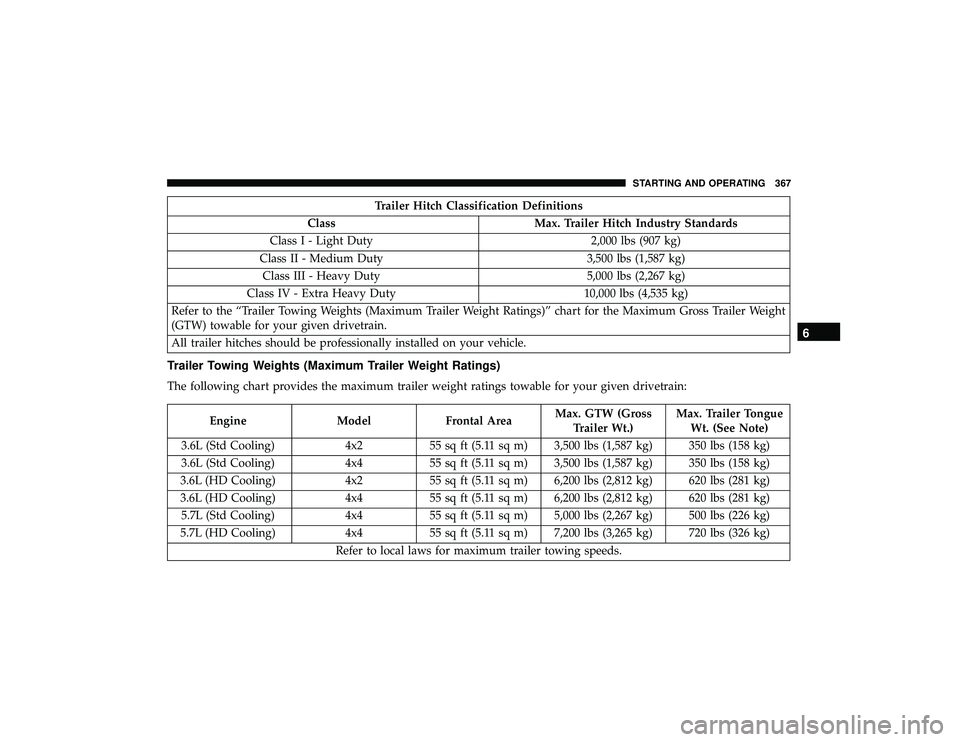
Trailer Hitch Classification Definitions
Class Max. Trailer Hitch Industry Standards
Class I - Light Duty 2,000 lbs (907 kg)
Class II - Medium Duty 3,500 lbs (1,587 kg)
Class III - Heavy Duty 5,000 lbs (2,267 kg)
Class IV - Extra Heavy Duty 10,000 lbs (4,535 kg)
Refer to the “Trailer Towing Weights (Maximum Trailer Weight Ratings)” chart for the Maximum Gross Trailer Weight
(GTW) towable for your given drivetrain.
All trailer hitches should be professionally installed on your vehicle.
Trailer Towing Weights (Maximum Trailer Weight Ratings)
The following chart provides the maximum trailer weight ratings towable for your given drivetrain:
Page 370 of 626
NOTE:The trailer tongue weight must be considered as
part of the combined weight of occupants and cargo, and
should never exceed the weight referenced on the Tire and
Loading Information placard. Refer to “Tires” in “Servicing
And Maintenance” for further information. The addition of
passengers and cargo may require reducing trailer tongue
load and Gross Trailer Weight (GTW). Redistributing cargo
(to the trailer) may be necessary to avoid exceeding Rear
Gross Axle Weight Rating (GAWR) of 3,700 lbs (1,678 kg).
Trailer Hitch Receiver Cover Removal (Summit
Models) — If Equipped
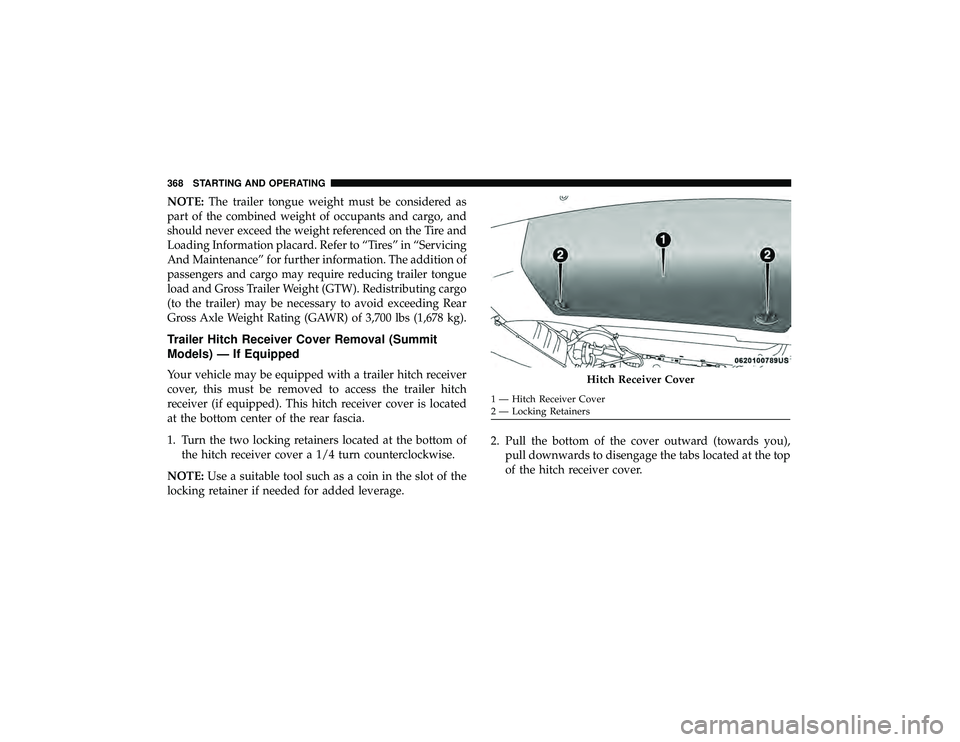
Your vehicle may be equipped with a trailer hitch receiver
cover, this must be removed to access the trailer hitch
receiver (if equipped). This hitch receiver cover is located
at the bottom center of the rear fascia.
1. Turn the two locking retainers located at the bottom of the hitch receiver cover a 1/4 turn counterclockwise.
NOTE: Use a suitable tool such as a coin in the slot of the
locking retainer if needed for added leverage. 2. Pull the bottom of the cover outward (towards you),
pull downwards to disengage the tabs located at the top
of the hitch receiver cover.