Page 380 of 685

5-56
Driving your vehicle
Press brake pedal to deactivate
AUTO HOLD
If you did not apply the brake pedal
when you release the Auto Hold by
pressing the [AUTO HOLD] switch, a
warning will sound and a message
will appear.
AUTO HOLD conditions not met.
Close door, bonnet, tailgate; fasten
seatbelt
When you press the [AUTO HOLD]
switch, if the driver’s door, engine
bonnet and tailgate are not closed or
the driver’s seat belt is unfastened, a
warning will sound and a message
will appear on the LCD display. At
this moment, press the [AUTO
HOLD] button after closing the dri-
ver’s door, engine bonnet and tail-
gate and fastening the seat belt.
Anti-lock Brake System (ABS)
An Anti-Lock Braking System
(ABS) or an Electronic Stability
Control (ESC) system will not
prevent accidents due to
improper or dangerous driving
manoeuvres. Even though vehi-
cle control is improved during
emergency braking, always
maintain a safe distance
between you and objects ahead
of you. Vehicle speeds should
always be reduced during
extreme road conditions. The
braking distance for cars
equipped with ABS or ESC may
be longer than for those without
these systems in the following
road conditions.
•Drive your vehicle at reduced
speeds during the following
conditions:
•Rough, gravel or snow-cov-
ered roads.(Continued)
WARNING
OTLE058235
■Type A■Type B
OLF054127N/OLF044407N
TLe UK 5.qxp 5/10/2018 12:22 PM Page 56
Page 397 of 685
5-73
Driving your vehicle
5
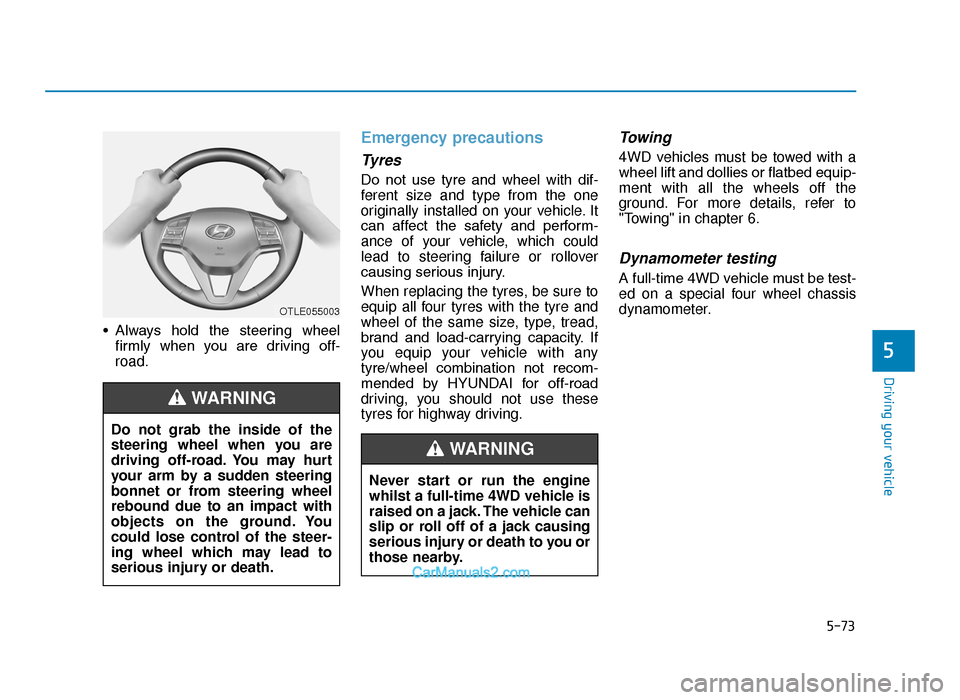
• Always hold the steering wheelfirmly when you are driving off-
road.
Emergency precautions
Tyres
Do not use tyre and wheel with dif-
ferent size and type from the one
originally installed on your vehicle. It
can affect the safety and perform-
ance of your vehicle, which could
lead to steering failure or rollover
causing serious injury.
When replacing the tyres, be sure to
equip all four tyres with the tyre and
wheel of the same size, type, tread,
brand and load-carrying capacity. If
you equip your vehicle with any
tyre/wheel combination not recom-
mended by HYUNDAI for off-road
driving, you should not use these
tyres for highway driving.
Towing
4WD vehicles must be towed with a
wheel lift and dollies or flatbed equip-
ment with all the wheels off the
ground. For more details, refer to
"Towing" in chapter 6.
Dynamometer testing
A full-time 4WD vehicle must be test-
ed on a special four wheel chassis
dynamometer.
OTLE055003
Do not grab the inside of the
steering wheel when you are
driving off-road. You may hurt
your arm by a sudden steering
bonnet or from steering wheel
rebound due to an impact with
objects on the ground. You
could lose control of the steer-
ing wheel which may lead to
serious injury or death.
WARNING
Never start or run the engine
whilst a full-time 4WD vehicle is
raised on a jack. The vehicle can
slip or roll off of a jack causing
serious injury or death to you or
those nearby.
WARNING
TLe UK 5.qxp 5/10/2018 12:23 PM Page 73
Page 400 of 685
5-76
Driving your vehicle
The ISG system is to reduce the fuel
consumption by automatically shut-
ting down the engine, when the vehi-
cle is at a standstill (i.e. red stop light,
stop sign, and traffic jam).
The engine is automatically started
upon satisfying the starting condi-
tions.
The ISG system is always active,
when the engine is running.
Information
When the engine is automatically
started by the ISG system, some warn-
ing lights (i.e. ABS, ESC, ESC OFF,
EPS, and parking brake warning
light) may illuminate for a few sec-
onds due to the low battery voltage.
However, it does not indicate a mal-
function with the ISG system.
To activate the ISG system
Prerequisite for activation
The ISG system operates in the fol-
lowing situations.
- The driver's seatbelt is fastened.
- The driver's door and the bonnet are closed.
- The brake vacuum pressure is adequate.
- The battery is sufficiently charged.
- The outside temperature is between -10 °C and 35 °C (14 °F and 95 °F).
- The engine coolant temperature is not too low.
- The system is not in the diagnostic mode.
- The steering wheel is not steered excessively. (for automatic
transaxle vehicle)
- The vehicle is driven on a steep incline. (for automatic transaxle
vehicle)
Information
• The ISG system is not activated,when the prerequisites to activate
the ISG system are unsatisfied. In
this case, the ISG OFF button indi-
cator illuminates, and the auto stop
indicator ( ) illuminates in yellow
on the instrument cluster.
• When the above indicator remains illuminated on the instrument clus-
ter, we recommend that you have
the ISG system checked by a
HYUNDAI authorised repairer.
i
i
IDLE STOP AND GO (ISG) SYSTEM (IF EQUIPPED)
WTF-444
TLe UK 5.qxp 5/10/2018 12:23 PM Page 76
Page 401 of 685

5-77
Driving your vehicle
5
Auto stop
To stop the engine in idle stop mode
Manual transaxle vehicle
1. Decrease the vehicle speed to 3mph (5 km/h).
2. Set the gear in N (Neutral).
3. Release the clutch pedal.
The auto stop indicator ( ) illumi-
nates in green on the instrument
cluster, when the engine stops.
Information
The driving speed must reach at least
6 mph (10 km/h) after an idle stop to
stop the engine in idle stop mode
again.
Automatic transaxle vehicle
1. Decrease the vehicle speed to 0 km/h.
2. Depress the brake pedal with the shift lever in D (Drive) or N
(Neutral).
The auto stop indicator ( ) illumi-
nates in green on the instrument
cluster, when the engine stops.
Information
The driving speed must reach at least
5 mph (8 km/h) after an idle stop to
stop the engine in idle stop mode
again. In auto stop mode, when the driver
opens the bonnet, the ISG system
will be deactivated.
When the system is deactivated:
The ISG OFF button indicator illumi-
nates.
i
i
■
Type A
OTLE055164R■Type B
OTLE058022R
TLe UK 5.qxp 5/10/2018 12:23 PM Page 77
Page 511 of 685
6-8
What to do in an emergency
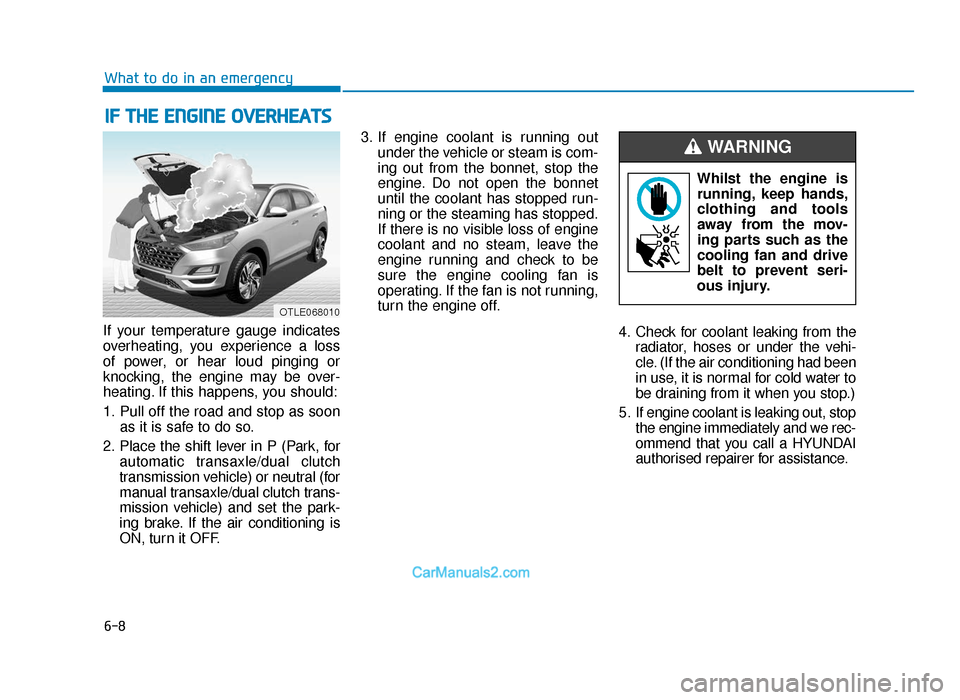
If your temperature gauge indicates
overheating, you experience a loss
of power, or hear loud pinging or
knocking, the engine may be over-
heating. If this happens, you should:
1. Pull off the road and stop as soon as it is safe to do so.
2. Place the shift lever in P (Park, for automatic transaxle/dual clutch
transmission vehicle) or neutral (for
manual transaxle/dual clutch trans-
mission vehicle) and set the park-
ing brake. If the air conditioning is
ON, turn it OFF. 3. If engine coolant is running out
under the vehicle or steam is com-
ing out from the bonnet, stop the
engine. Do not open the bonnet
until the coolant has stopped run-
ning or the steaming has stopped.
If there is no visible loss of engine
coolant and no steam, leave the
engine running and check to be
sure the engine cooling fan is
operating. If the fan is not running,
turn the engine off.
4. Check for coolant leaking from theradiator, hoses or under the vehi-
cle. (If the air conditioning had been
in use, it is normal for cold water to
be draining from it when you stop.)
5. If engine coolant is leaking out, stop the engine immediately and we rec-
ommend that you call a HYUNDAI
authorised repairer for assistance.
IF THE ENGINE OVERHEATS
Whilst the engine isrunning, keep hands,
clothing and tools
away from the mov-
ing parts such as the
cooling fan and drive
belt to prevent seri-
ous injury.
WARNING
OTLE068010
TLe UK 6.qxp 5/10/2018 1:20 PM Page 8
Page 559 of 685
7-10
Maintenance
At least monthly:
• Check coolant level in the enginecoolant reservoir.
• Check the operation of all exterior lights, including the stoplights, turn
signals and hazard warning flashers.
• Check the inflation pressures of all tyres including the spare for tyres
that are worn, show uneven wear,
or are damaged.
• Check for loose wheel lug nuts.
At least twice a year: (i.e., every Spring and Fall)
• Check radiator, heater and air condi-
tioning hoses for leaks or damage.
• Check windscreen washer spray and wiper operation. Clean wiper
blades with clean cloth dampened
with washer fluid.
• Check headlamp alignment.
• Check muffler, exhaust pipes, shields and clamps.
• Check the seat belts for wear and function.
At least once a year:
• Clean body and door drain holes.
• Lubricate door hinges and bonnethinges.
• Lubricate door and bonnet locks and latches.
• Lubricate door rubber weather strips.
• Check the air conditioning system.
• Inspect and lubricate automatic transaxle linkage and controls.
• Clean the battery and terminals.
• Check the brake fluid level.
TLe UK 7.qxp 5/10/2018 1:32 PM Page 10
Page 615 of 685
Maintenance
7-66
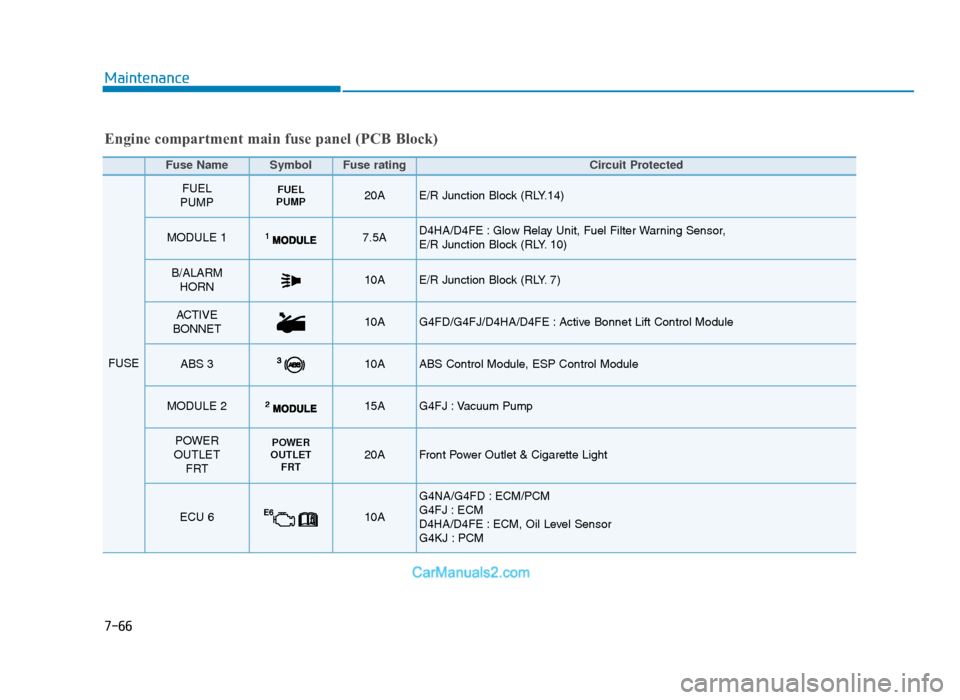
Fuse Name SymbolFuse ratingCircuit Protected
FUSE
FUEL
PUMPFUEL
PUMP20A E/R Junction Block (RLY.14)
MODULE 17.5A D4HA/D4FE : Glow Relay Unit, Fuel Filter Warning Sensor,
E/R Junction Block (RLY. 10)
B/ALARM HORN10A E/R Junction Block (RLY. 7)
ACTIVE
BONNET10AG4FD/G4FJ/D4HA/D4FE : Active Bonnet Lift Control Module
ABS 310A ABS Control Module, ESP Control Module
MODULE 215A G4FJ : Vacuum Pump
POWER
OUTLET FRTPOWER
OUTLET FRT20AFront Power Outlet & Cigarette Light
ECU 610A
G4NA/G4FD : ECM/PCM
G4FJ : ECM
D4HA/D4FE : ECM, Oil Level Sensor
G4KJ : PCM
Engine compartment main fuse panel (PCB Block)
TLe UK 7.qxp 5/10/2018 1:38 PM Page 66
Page 619 of 685
7-70
Maintenance
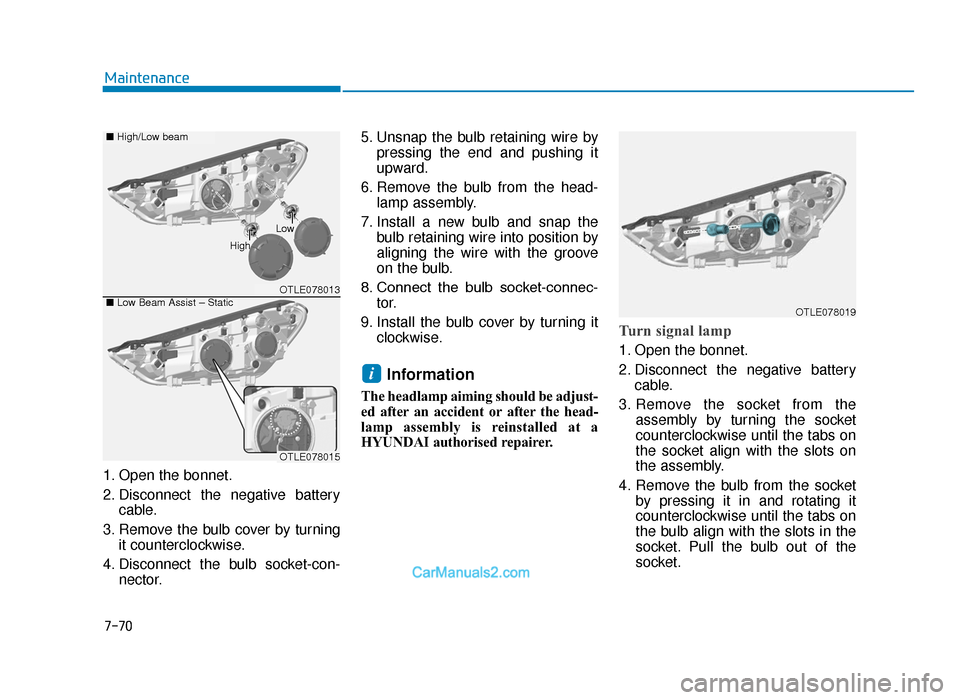
1. Open the bonnet.
2. Disconnect the negative battery cable.
3. Remove the bulb cover by turning it counterclockwise.
4. Disconnect the bulb socket-con- nector. 5. Unsnap the bulb retaining wire by
pressing the end and pushing it
upward.
6. Remove the bulb from the head- lamp assembly.
7. Install a new bulb and snap the bulb retaining wire into position by
aligning the wire with the groove
on the bulb.
8. Connect the bulb socket-connec- tor.
9. Install the bulb cover by turning it clockwise.
Information
The headlamp aiming should be adjust-
ed after an accident or after the head-
lamp assembly is reinstalled at a
HYUNDAI authorised repairer.
Turn signal lamp
1. Open the bonnet.
2. Disconnect the negative batterycable.
3. Remove the socket from the assembly by turning the socket
counterclockwise until the tabs on
the socket align with the slots on
the assembly.
4. Remove the bulb from the socket by pressing it in and rotating it
counterclockwise until the tabs on
the bulb align with the slots in the
socket. Pull the bulb out of the
socket.
i
OTLE078013
OTLE078015
■Low Beam Assist – Static
■High/Low beam
Low
High
OTLE078019
TLe UK 7.qxp 5/10/2018 1:38 PM Page 70