2019 Hyundai Kona fuel pump
[x] Cancel search: fuel pumpPage 9 of 526
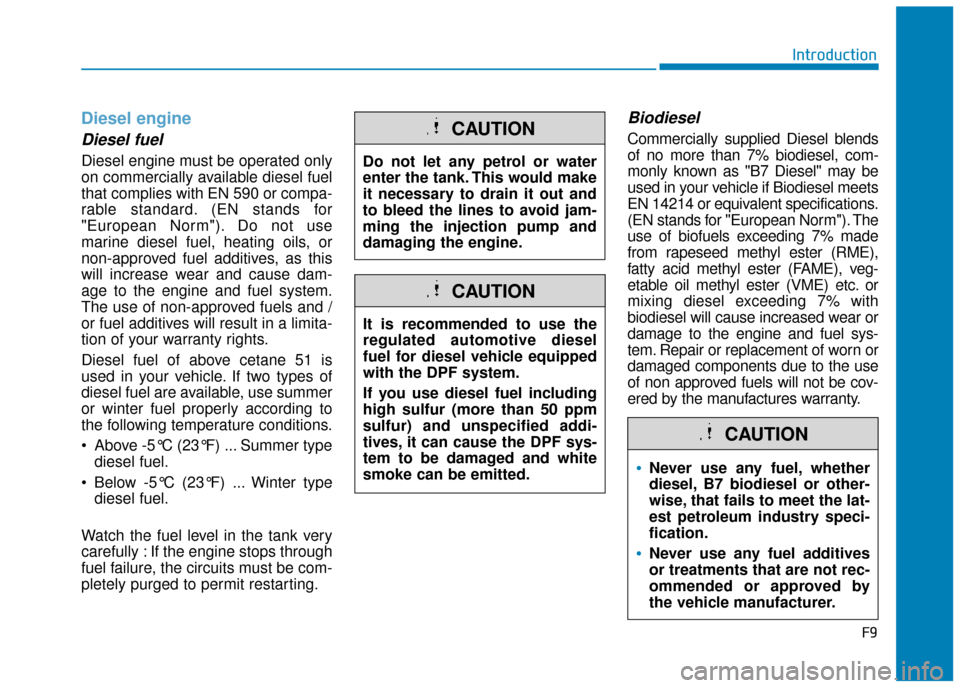
Diesel engine
Diesel fuel
Diesel engine must be operated only
on commercially available diesel fuel
that complies with EN 590 or compa-
rable standard. (EN stands for
"European Norm"). Do not use
marine diesel fuel, heating oils, or
non-approved fuel additives, as this
will increase wear and cause dam-
age to the engine and fuel system.
The use of non-approved fuels and /
or fuel additives will result in a limita-
tion of your warranty rights.
Diesel fuel of above cetane 51 is
used in your vehicle. If two types of
diesel fuel are available, use summer
or winter fuel properly according to
the following temperature conditions.
Above -5°C (23°F) ... Summer typediesel fuel.
Below -5°C (23°F) ... Winter type diesel fuel.
Watch the fuel level in the tank very
carefully : If the engine stops through
fuel failure, the circuits must be com-
pletely purged to permit restarting.
Biodiesel
Commercially supplied Diesel blends
of no more than 7% biodiesel, com-
monly known as "B7 Diesel" may be
used in your vehicle if Biodiesel meets
EN 14214 or equivalent specifications.
(EN stands for "European Norm"). The
use of biofuels exceeding 7% made
from rapeseed methyl ester (RME),
fatty acid methyl ester (FAME), veg-
etable oil methyl ester (VME) etc. or
mixing diesel exceeding 7% with
biodiesel will cause increased wear or
damage to the engine and fuel sys-
tem. Repair or replacement of worn or
damaged components due to the use
of non approved fuels will not be cov-
ered by the manufactures warranty.
F9
Introduction
Do not let any petrol or water
enter the tank. This would make
it necessary to drain it out and
to bleed the lines to avoid jam-
ming the injection pump and
damaging the engine.
CAUTION
It is recommended to use the
regulated automotive diesel
fuel for diesel vehicle equipped
with the DPF system.
If you use diesel fuel including
high sulfur (more than 50 ppm
sulfur) and unspecified addi-
tives, it can cause the DPF sys-
tem to be damaged and white
smoke can be emitted.
CAUTION
Never use any fuel, whether
diesel, B7 biodiesel or other-
wise, that fails to meet the lat-
est petroleum industry speci-
fication.
Never use any fuel additives
or treatments that are not rec-
ommended or approved by
the vehicle manufacturer.
CAUTION
Page 134 of 526
3-52
Convenient features of your vehicle
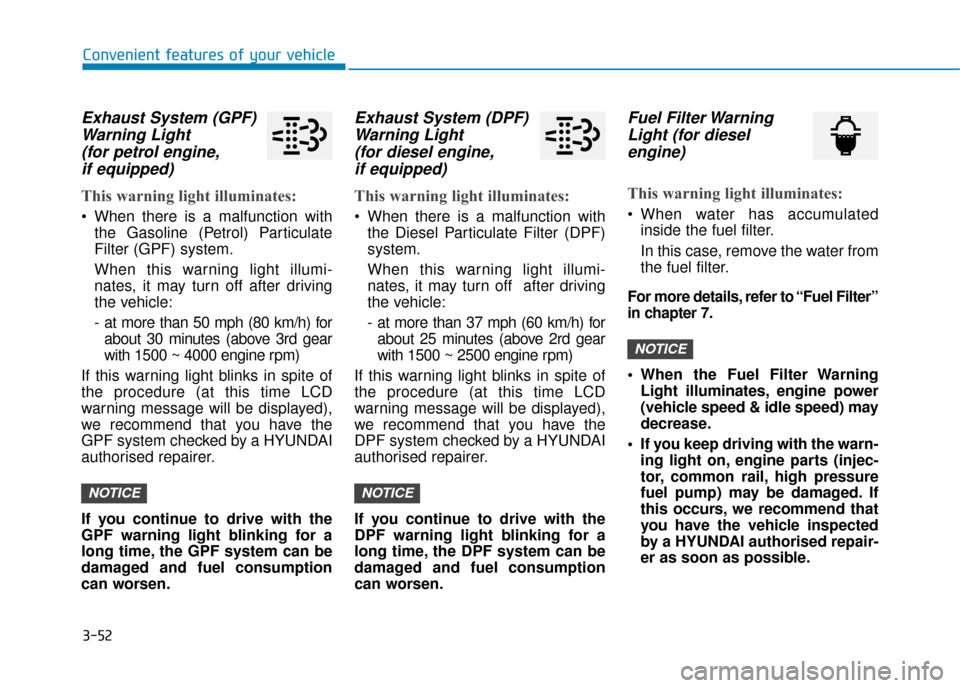
Exhaust System (GPF)Warning Light (for petrol engine,if equipped)
This warning light illuminates:
• When there is a malfunction with
the Gasoline (Petrol) Particulate
Filter (GPF) system.
When this warning light illumi-
nates, it may turn off after driving
the vehicle:
- at more than 50 mph (80 km/h) forabout 30 minutes (above 3rd gear
with 1500 ~ 4000 engine rpm)
If this warning light blinks in spite of
the procedure (at this time LCD
warning message will be displayed),
we recommend that you have the
GPF system checked by a HYUNDAI
authorised repairer.
If you continue to drive with the
GPF warning light blinking for a
long time, the GPF system can be
damaged and fuel consumption
can worsen.
Exhaust System (DPF) Warning Light (for diesel engine,if equipped)
This warning light illuminates:
When there is a malfunction with
the Diesel Particulate Filter (DPF)
system.
When this warning light illumi-
nates, it may turn off after driving
the vehicle:
- at more than 37 mph (60 km/h) forabout 25 minutes (above 2rd gear
with 1500 ~ 2500 engine rpm)
If this warning light blinks in spite of
the procedure (at this time LCD
warning message will be displayed),
we recommend that you have the
DPF system checked by a HYUNDAI
authorised repairer.
If you continue to drive with the
DPF warning light blinking for a
long time, the DPF system can be
damaged and fuel consumption
can worsen.
Fuel Filter Warning Light (for dieselengine)
This warning light illuminates:
When water has accumulated
inside the fuel filter.
In this case, remove the water from
the fuel filter.
For more details, refer to “Fuel Filter”
in chapter 7.
When the Fuel Filter WarningLight illuminates, engine power
(vehicle speed & idle speed) may
decrease.
If you keep driving with the warn- ing light on, engine parts (injec-
tor, common rail, high pressure
fuel pump) may be damaged. If
this occurs, we recommend that
you have the vehicle inspected
by a HYUNDAI authorised repair-
er as soon as possible.
NOTICE
NOTICENOTICE
Page 423 of 526
7-6
Maintenance
O
OW
W N
NE
ER
R
M
M A
AI
IN
N T
TE
EN
N A
AN
N C
CE
E
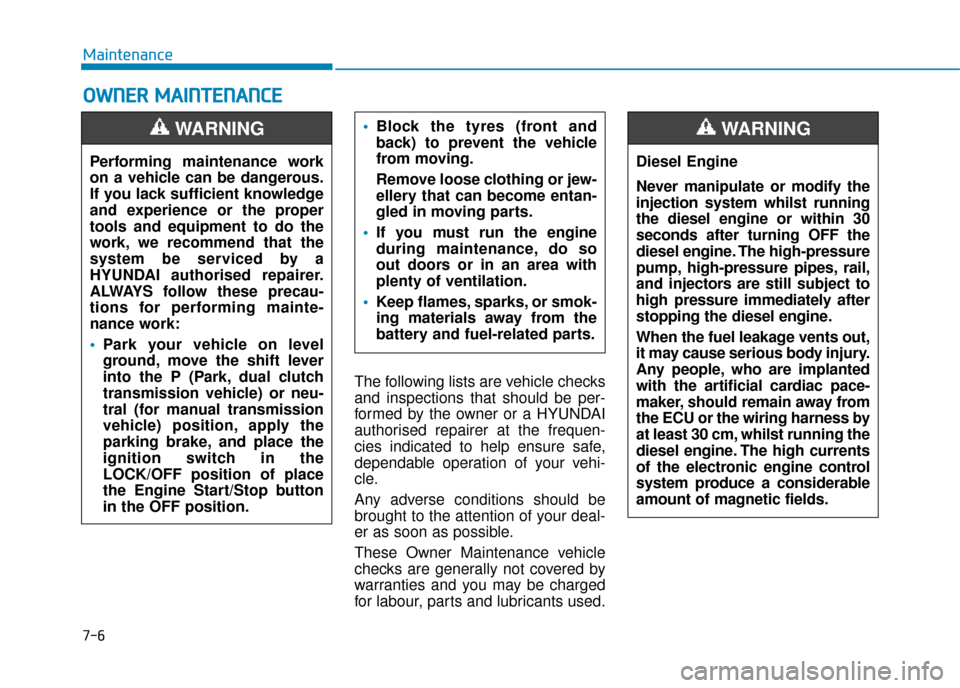
The following lists are vehicle checks
and inspections that should be per-
formed by the owner or a HYUNDAI
authorised repairer at the frequen-
cies indicated to help ensure safe,
dependable operation of your vehi-
cle.
Any adverse conditions should be
brought to the attention of your deal-
er as soon as possible.
These Owner Maintenance vehicle
checks are generally not covered by
warranties and you may be charged
for labour, parts and lubricants used.
Performing maintenance work
on a vehicle can be dangerous.
If you lack sufficient knowledge
and experience or the proper
tools and equipment to do the
work, we recommend that the
system be serviced by a
HYUNDAI authorised repairer.
ALWAYS follow these precau-
tions for performing mainte-
nance work:
Park your vehicle on level
ground, move the shift lever
into the P (Park, dual clutch
transmission vehicle) or neu-
tral (for manual transmission
vehicle) position, apply the
parking brake, and place the
ignition switch in the
LOCK/OFF position of place
the Engine Start/Stop button
in the OFF position.
WARNING Block the tyres (front and
back) to prevent the vehicle
from moving.
Remove loose clothing or jew-
ellery that can become entan-
gled in moving parts.
If you must run the engine
during maintenance, do so
out doors or in an area with
plenty of ventilation.
Keep flames, sparks, or smok-
ing materials away from the
battery and fuel-related parts.
Diesel Engine
Never manipulate or modify the
injection system whilst running
the diesel engine or within 30
seconds after turning OFF the
diesel engine. The high-pressure
pump, high-pressure pipes, rail,
and injectors are still subject to
high pressure immediately after
stopping the diesel engine.
When the fuel leakage vents out,
it may cause serious body injury.
Any people, who are implanted
with the artificial cardiac pace-
maker, should remain away from
the ECU or the wiring harness by
at least 30 cm, whilst running the
diesel engine. The high currents
of the electronic engine control
system produce a considerable
amount of magnetic fields.
WARNING
Page 469 of 526
7-52
Maintenance
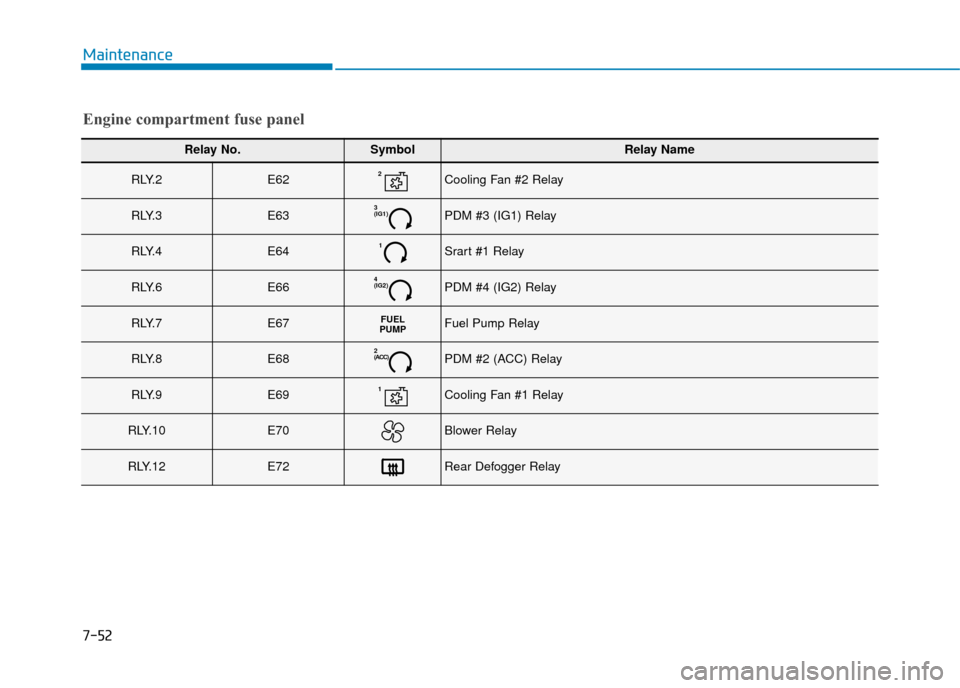
Engine compartment fuse panel
Relay No.SymbolRelay Name
R LY. 2E622Cooling Fan #2 Relay
R LY. 3E633
(IG1)PDM #3 (IG1) Relay
R LY. 4E641Srart #1 Relay
R LY. 6E664
(IG2)PDM #4 (IG2) Relay
R LY. 7E67FUEL
PUMPFuel Pump Relay
R LY. 8E682
(ACC)PDM #2 (ACC) Relay
R LY. 9E691Cooling Fan #1 Relay
RLY.10E70Blower Relay
RLY.12E72Rear Defogger Relay
Page 471 of 526
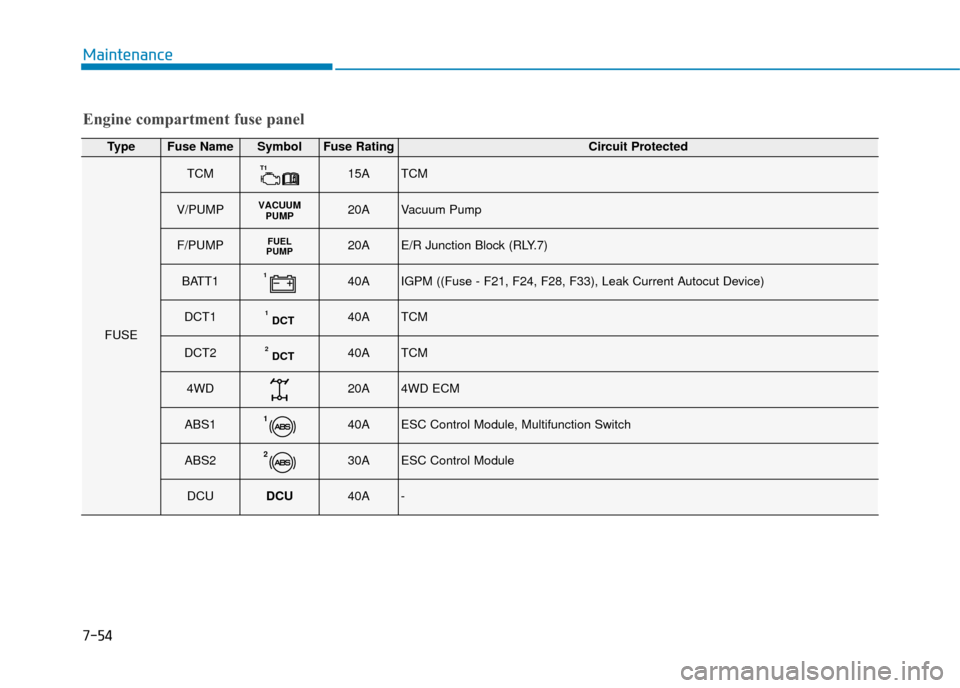
7-54
Maintenance
Engine compartment fuse panel
TypeFuse NameSymbolFuse RatingCircuit Protected
FUSE
TCMT115ATCM
V/PUMPVACUUMPUMP20AVacuum Pump
F/PUMPFUEL
PUMP20AE/R Junction Block (RLY.7)
BATT1140AIGPM ((Fuse - F21, F24, F28, F33), Leak Current Autocut Device)
DCT1DCT140ATCM
DCT2DCT240ATCM
4WD20A4WD ECM
ABS1140AESC Control Module, Multifunction Switch
ABS2230AESC Control Module
DCUDCU40A-