Page 2 of 599
H2
H
HE
EV
V
(
( H
H Y
Y B
BR
RI
ID
D
E
E L
LE
E C
CT
T R
R I
IC
C
V
V E
EH
H I
IC
C L
LE
E )
)
S
S Y
Y S
ST
T E
EM
M
Hybrid Vehicle
The HYUNDAI Hybrid Electric Vehicle (HEV) uses both the petrol engine and the electric motor for power. The electric
motor is run by a 270V high-voltage HEV battery.
Depending on the driving conditions, the HEV computer selectively operates between the engine and the electric motor
or even both at the same time.
Fuel efficiency increases when the engine is at idle, or when the vehicle is driven by the electric motor with the HEV bat-
tery.
The HEV battery charge must be maintained, so at times the engine will come on even at idle to act as a generator.
Charging also occurs when decelerating or by regenerative braking.
OAE056066
Startup/Low speed cruise
Electric motor
Acceleration
Electric motor + Engine
High speed cruise
Engine
Deceleration
Charging
Stop
Engine OFF
Page 4 of 599

H4
Charging Information
•Normal Charge :
The plug-in hybrid vehicle is
charged by plugging into a normal
charger installed in your home or a
public charging station. (For further
details, refer to the 'Normal
Charge'.)
Trickle Charge :
The plug-in hybrid vehicle can be
charged by using household elec-
tricity. The electrical outlet in your
home must comply with regulations
and can safely accommodate the
Voltage / Current (Amps) / Power
(Watts) ratings specified on the
portable charge.
Charging Time
Normal Charge :
Takes approximately 2 hours 15
minutes at room temperature. (Can
be charged to 100%.)
Information
Depending on the condition and dura-
bility of the high voltage battery, charg-
er specifications, and ambient tempera-
ture, the time required for charging the
high voltage battery may vary.
i
C CH
H A
AR
RG
G I
IN
N G
G
T
T H
H E
E
P
P L
LU
U G
G-
-I
IN
N
H
H Y
Y B
BR
RI
ID
D
V
V E
EH
H I
IC
C L
LE
E
Charging Types
CategoryCharging Inlet (Vehicle)Charging ConnectorCharging OutletHow to ChargeCharging Time
Normal
Charge
Use normal
charger installed
in homes or public
charging stationApprox. 2 hours
15 minutes (to fully
charge, 100%)
Trickle
Charge Use household
current
For charging at
home. Please note
that the Trickle charg-
er is slower than the
Normal charger.
• Depending on the condition and durability of the high voltage battery, charger specifications, and ambient temperature, the time required for charging the high voltage battery may vary.
Actual charger image and charging method may vary in accordance with the charger manufacturer.
OLFP0Q5006K
OAEEQ016020
OAEEQ016020
OAEEQ016024OLFP0Q5007K
OLFP0Q5006K
Page 5 of 599
H5
Charging Status
When charging the high voltage bat-
tery, the charge level can be checked
from outside the vehicle.
OAEEQ016025
Operation of Charging Indicator LampDetails(1)(2)(3)
�(OFF)�(OFF)�(OFF)Not Charged
Blink�(OFF)�(OFF)
Charging
0~33%
�(ON)Blink�(OFF)34~66%
�(ON)�(ON)Blink67~99%
�(ON)�(ON)�(ON)Fully charged (100%)(turns OFF in 5 seconds)
BlinkBlinkBlinkError whilst charging
�(OFF)�(OFF)BlinkCharging the 12 V auxiliary battery (Aux. Battery Saver+)
�(OFF)Blink�(OFF)Scheduled charging is operating (turns OFF after 3 minutes)
Page 12 of 599

H127. Check if the charging indicator
light of the high voltage battery on
the instrument cluster is turned
ON. Charging is not done when
the charging indicator lamp is
OFF.
When the charging connector and
charging plug are not connected
properly, reconnect the charging
cable to charge.
Information
• Even though charging is possible with the ignition switch in the
ON/START position, for your safe-
ty, start charging when the ignition
switch is in the LOCK/OFF position
and the vehicle shifted to P (Park).
After charging has started, you can
use electrical components such as
the radio by placing the ignition
switch in the ACC or ON position.
• During normal charging, the radio reception may be bad.
• Moving the shift lever from P (Park) to R (Reverse)/N(Neutral)/D (Drive)
stops the charging process.
To restart the charging process,
move the shift lever to P (Park),
place the ignition switch to the
LOCK/OFF position, and discon-
nect the charging cable. Then, con-
nect the charging cable. 8. After charging has started, the esti-
mated charging time is displayed on
the instrument cluster for about 1
minute.
If you open the driver seat door whilst charging, the estimated charg-
ing time is also displayed on the
instrument cluster for about 1
minute.
When scheduled charging is set, the estimated charging time is displayed
as “--" .
Information
Depending on the condition and dura-
bility of the high voltage battery,
charger specifications, and ambient
temperature, the time required for
charging the battery may vary.
i
i
OAEEQ016032OAEPH047193L
C
C H
H A
AR
RG
G I
IN
N G
G
T
T H
H E
E
P
P L
LU
U G
G-
-I
IN
N
H
H Y
Y B
BR
RI
ID
D
V
V E
EH
H I
IC
C L
LE
E
(
( C
C O
O N
NT
T.
.)
)
Page 13 of 599
H13
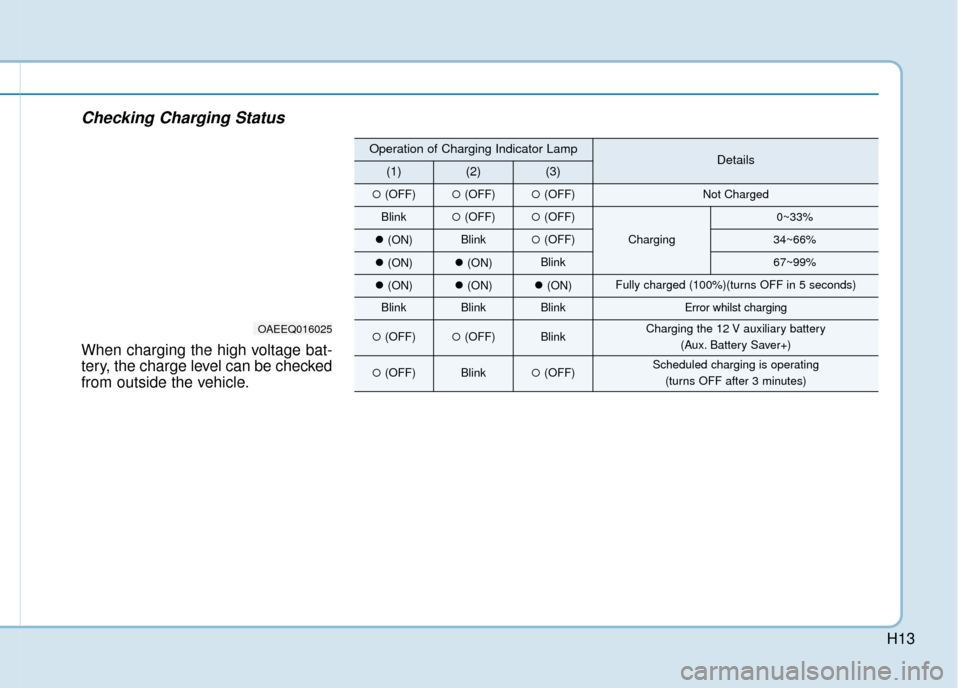
Checking Charging Status
When charging the high voltage bat-
tery, the charge level can be checked
from outside the vehicle.
OAEEQ016025
Operation of Charging Indicator LampDetails(1)(2)(3)
�(OFF)�(OFF)�(OFF)Not Charged
Blink�(OFF)�(OFF)
Charging
0~33%
�(ON)Blink�(OFF)34~66%
�(ON)�(ON)Blink67~99%
�(ON)�(ON)�(ON)Fully charged (100%)(turns OFF in 5 seconds)
BlinkBlinkBlinkError whilst charging
�(OFF)�(OFF)BlinkCharging the 12 V auxiliary battery (Aux. Battery Saver+)
�(OFF)Blink�(OFF)Scheduled charging is operating (turns OFF after 3 minutes)
Page 20 of 599

H208. Charging starts automatically
(charging lamp blinks). 9. Check if the charging indicator
light of the high voltage battery on
the instrument cluster is turned
ON. Charging is not done when
the charging indicator lamp is
OFF.
When the charging connector is not connected properly, reconnect
the charging cable to charge it
again.
Information
• Even though charging is possible with the ignition switch in the
ON/START position, for your safe-
ty, start charging when the ignition
switch is in the LOCK/OFF position
and the vehicle shifted to P (Park).
After charging has started, you can
use electrical components such as
the radio by placing the ignition
switch in ACC or ON position.
• Moving the shift lever from P (Park) to R (Reverse)/N(Neutral)/D (Drive)
stops the charging process.
To restart the charging process,
move the shift lever to P (Park),
place the ignition switch to the
LOCK/OFF position, and discon-
nect the charging cable. Then, con-
nect the charging cable.
i
OAEEQ016045OAEEQ016032
C
CH
H A
AR
RG
G I
IN
N G
G
T
T H
H E
E
P
P L
LU
U G
G-
-I
IN
N
H
H Y
Y B
BR
RI
ID
D
V
V E
EH
H I
IC
C L
LE
E
(
( C
C O
O N
NT
T.
.)
)
Page 21 of 599
H21
10. After charging has started, theestimated charging time is dis-
played on the instrument cluster
for about 1 minute.
If you open the driver seat door
whilst charging, the estimated
charging time is also displayed on
the instrument cluster for about 1
minute.
When scheduled charging is set, the estimated charging time is
displayed as “--" .
Information
Depending on the condition and dura-
bility of the high voltage battery,
charger specifications, and ambient
temperature, the time required for
charging the battery may vary.
Checking Charging Status
When charging the high voltage bat-
tery, the charge level can be checked
from outside the vehicle.
i
OAEPH047193L
OAEEQ016025
Page 27 of 599
H27
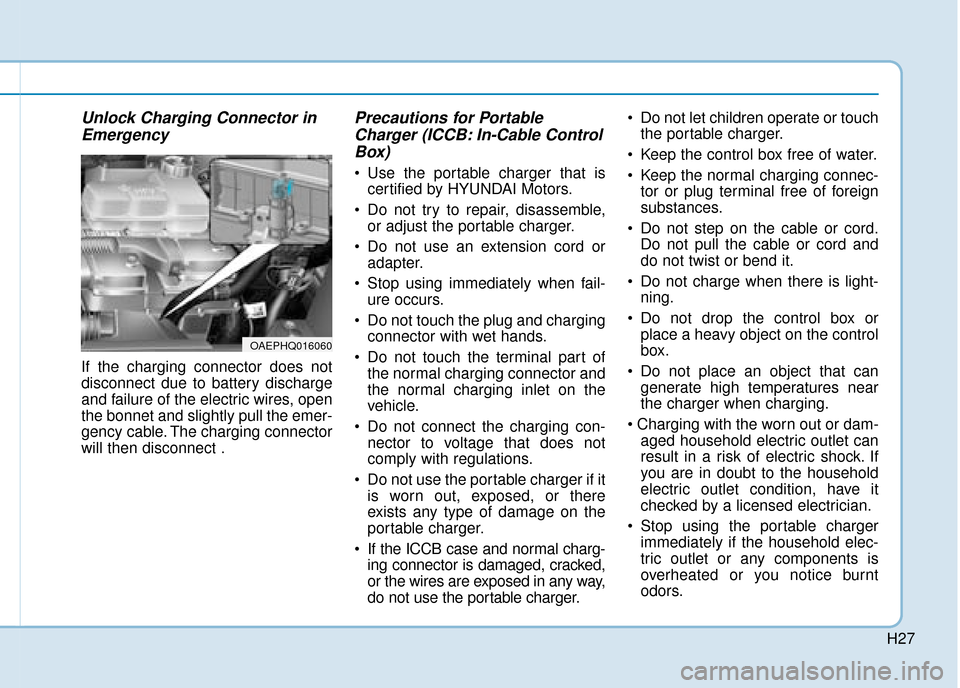
Unlock Charging Connector inEmergency
If the charging connector does not
disconnect due to battery discharge
and failure of the electric wires, open
the bonnet and slightly pull the emer-
gency cable. The charging connector
will then disconnect .
Precautions for PortableCharger (ICCB: In-Cable ControlBox)
Use the portable charger that is
certified by HYUNDAI Motors.
Do not try to repair, disassemble, or adjust the portable charger.
Do not use an extension cord or adapter.
Stop using immediately when fail- ure occurs.
Do not touch the plug and charging connector with wet hands.
Do not touch the terminal part of the normal charging connector and
the normal charging inlet on the
vehicle.
Do not connect the charging con- nector to voltage that does not
comply with regulations.
Do not use the portable charger if it is worn out, exposed, or there
exists any type of damage on the
portable charger.
If the ICCB case and normal charg- ing connector is damaged, cracked,
or the wires are exposed in any way,
do not use the portable charger. Do not let children operate or touch
the portable charger.
Keep the control box free of water.
Keep the normal charging connec- tor or plug terminal free of foreign
substances.
Do not step on the cable or cord. Do not pull the cable or cord and
do not twist or bend it.
Do not charge when there is light- ning.
Do not drop the control box or place a heavy object on the control
box.
Do not place an object that can generate high temperatures near
the charger when charging.
aged household electric outlet can
result in a risk of electric shock. If
you are in doubt to the household
electric outlet condition, have it
checked by a licensed electrician.
Stop using the portable charger immediately if the household elec-
tric outlet or any components is
overheated or you notice burnt
odors.
OAEPHQ016060