Page 515 of 659

7
Battery...................................................................7-48
For best battery service................................................7-49
Battery capacity label ....................................................7-49
Battery recharging .........................................................7-50
Reset items .......................................................................7-51
Tires and wheels ..................................................7-52
Tire care ............................................................................7-52
Recommended cold tire inflation pressures.............7-53
Check tire inflation pressure........................................7-54
Tire rotation .....................................................................7-54
Wheel alignment and tire balance ..............................7-55
Tire replacement .............................................................7-56
Wheel replacement .........................................................7-57
Tire traction ......................................................................7-57
Tire maintenance ............................................................7-57
Tire sidewall labeling ......................................................7-57
Low aspect ratio tires ....................................................7-61
Fuses ......................................................................7-62
Instrument panel fuse replacement ...........................7-63
Engine compartment panel fuse replacement.........7-64
Fuse/Relay panel description ......................................7-66
Light bulbs.............................................................7-85
Headlamp, static bending lamp,
position lamp, turn signal lamp and
daytime running light bulb replacement ...................7-86Front fog lamp .................................................................7-91
Headlamp and front fog lamp
aiming (for Europe) ........................................................7-91 Side repeater lamp replacement .................................7-97
Rear combination lamp bulb replacement ................7-98
Rear fog lamp ................................................................7-102
High mounted stop lamp replacement .....................7-103
License plate light bulb replacement .......................7-103
Interior light bulb replacement ..................................7-103
Appearance care ................................................7-105
Exterior care ..................................................................7-105
Interior care ...................................................................7-110
Emission control system ...................................7-111
1. Crankcase emission control system ...................7-111
2. Evaporative emission control system ................7-111
3. Exhaust emission control system .......................7-112
Page 521 of 659

7-8
Maintenance
Owner maintenance schedule
When you stop for fuel:
Check the engine oil level.
Check coolant level in the enginecoolant reservoir.
Check the windshield washer fluid level.
Check for low or under-inflated tires.
While operating your vehicle:
Note any changes in the sound of the exhaust or any smell of exhaust
fumes in the vehicle.
Check for vibrations in the steering wheel. Notice if there is any
increased steering effort or loose-
ness in the steering wheel, or
change in its straight-ahead position.
Notice if your vehicle constantly turns slightly or “pulls” to one side when
traveling on smooth, level road.
When stopping, listen and check for unusual sounds, pulling to one side,
increased brake pedal travel or
“hard-to-push” brake pedal.
If any slipping or changes in the operation of your transaxle occurs,
check the transaxle fluid level.
Check the automatic transmission/ dual clutch transmission P (Park)
function.
Check the parking brake.
Check for fluid leaks under your vehicle (water dripping from the air
conditioning system during or after
use is normal).
Be careful when checking your
engine coolant level when the
engine is hot. This may result in
coolant being blown out of the
opening and cause serious
burns and other injuries.
WARNING
Diesel Engine
Never manipulate or modify the
injection system while running
the diesel engine or within 30
seconds after turning OFF the
diesel engine. The high-pressure
pump, high-pressure pipes, rail,
and injectors are still subject to
the high pressure right after
stopping the diesel engine.
When the fuel leakage vents out,
it may cause serious body injury.
Any people, who are implement-
ed with the artificial cardiac
pacemaker, should remain away
from the ECU or the wiring har-
ness by at least 30 cm, while run-
ning the diesel engine. The high
currents of the electric engine
control system produce a con-
siderable amount of magnetic
fields.
WARNING
Page 522 of 659

7-9
7
Maintenance
At least monthly:
Check coolant level in the enginecoolant reservoir.
Check the operation of all exterior lights, including the stoplights, turn
signals and hazard warning flashers.
Check the inflation pressures of all tires including the spare for tires
that are worn, show uneven wear,
or are damaged.
Check for loose wheel lug nuts.
At least twice a year: (i.e., every Spring and Fall)
Check radiator, heater and air condi-
tioning hoses for leaks or damage.
Check windshield washer spray and wiper operation. Clean wiper
blades with clean cloth dampened
with washer fluid.
Check headlamp alignment.
Check muffler, exhaust pipes, shields and clamps.
Check the seat belts for wear and function.
At least once a year:
Clean body and door drain holes.
Lubricate door hinges and hoodhinges.
Lubricate door and hood locks and latches.
Lubricate door rubber weather strips.
Check the air conditioning system.
Inspect and lubricate automatic transaxle linkage and controls.
Clean the battery and terminals.
Check the brake fluid level.
Page 548 of 659
7-35
7
Maintenance
E
E N
N G
G I
I N
N E
E
O
O I
I L
L
Checking the engine oil level
1. Follow all of the oil manufacturer’s
precautions.
2. Be sure the vehicle is on level ground.
3. Start the engine and allow it to reach normal operating temperature.
4. Turn the engine off and wait for a few minutes (about 5 minutes) for
the oil to return to the oil pan.
5. Pull the dipstick out, wipe it clean, and re-insert it fully. 6. Pull the dipstick out again and
check the level. The level should
be between F (Full) and L (Low). 7. If it is near or at L, add enough oil
to bring the level to F.
Use only the specified engine oil.
(Refer to “Recommended lubricants
and capacities” in chapter 8.)
OPDE076067OPD076007
Radiator hose
Be very careful not to touch the
radiator hose when checking or
adding engine oil as it may be
hot enough to burn you.
WARNING
Page 551 of 659
7-38
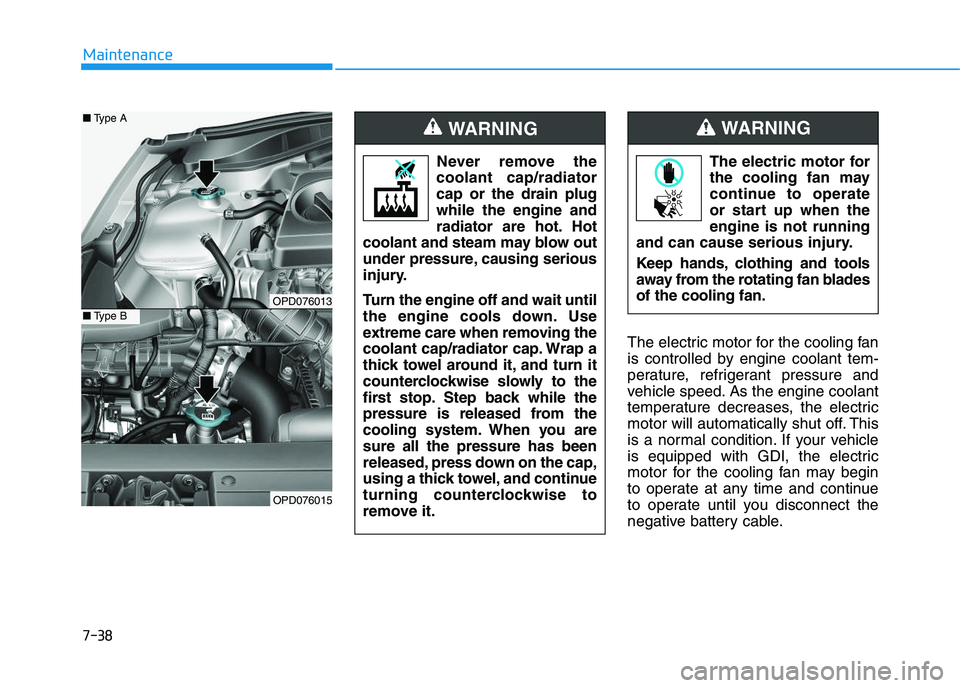
MaintenanceThe electric motor for the cooling fan
is controlled by engine coolant tem-
perature, refrigerant pressure and
vehicle speed. As the engine coolant
temperature decreases, the electric
motor will automatically shut off. This
is a normal condition. If your vehicle
is equipped with GDI, the electric
motor for the cooling fan may begin
to operate at any time and continue
to operate until you disconnect the
negative battery cable.The electric motor for
the cooling fan may
continue to operate
or start up when the
engine is not running
and can cause serious injury.
Keep hands, clothing and tools
away from the rotating fan blades
of the cooling fan.
WARNING
Never remove the
coolant cap/radiator
cap or the drain plug
while the engine and
radiator are hot. Hot
coolant and steam may blow out
under pressure, causing serious
injury.
Turn the engine off and wait until
the engine cools down. Use
extreme care when removing the
coolant cap/radiator cap. Wrap a
thick towel around it, and turn it
counterclockwise slowly to the
first stop. Step back while the
pressure is released from the
cooling system. When you are
sure all the pressure has been
released, press down on the cap,
using a thick towel, and continue
turning counterclockwise to
remove it.
WARNING
OPD076013
OPD076015
■ Type A
■Type B
Page 559 of 659
7-46
Maintenance
Blade replacement
When the wipers no longer clean
adequately, the blades may be worn
or cracked, and require replacement.
To prevent damage to the wiper arms
or other components, do not attempt
to move the wipers manually.
The use of a non-specified wiper
blade could result in wiper mal-
function and failure.
• In order to prevent damage tothe hood and the wiper arms, the
wiper arms should only be lifted
when in the fully up position.
Always return the wiper arms to the windshield before starting
your journey
Front windshield wiper blade
To replace a wiper blade, follow the
procedure mentioned to raise the
wiper arm.
Turn off the engine, move the wiper
switch to the single wiping (V) posi-
tion within 20 seconds and hold the
switch for more than 2 seconds until
the wiper arm is in the fully up posi-
tion. 1. Lift up the wiper blade clip (1).
Then lift up the wiper blade (2).
NOTICE
NOTICE
NOTICE
OPDE076027
OAD075074L
Page 560 of 659
7-47
7
Maintenance
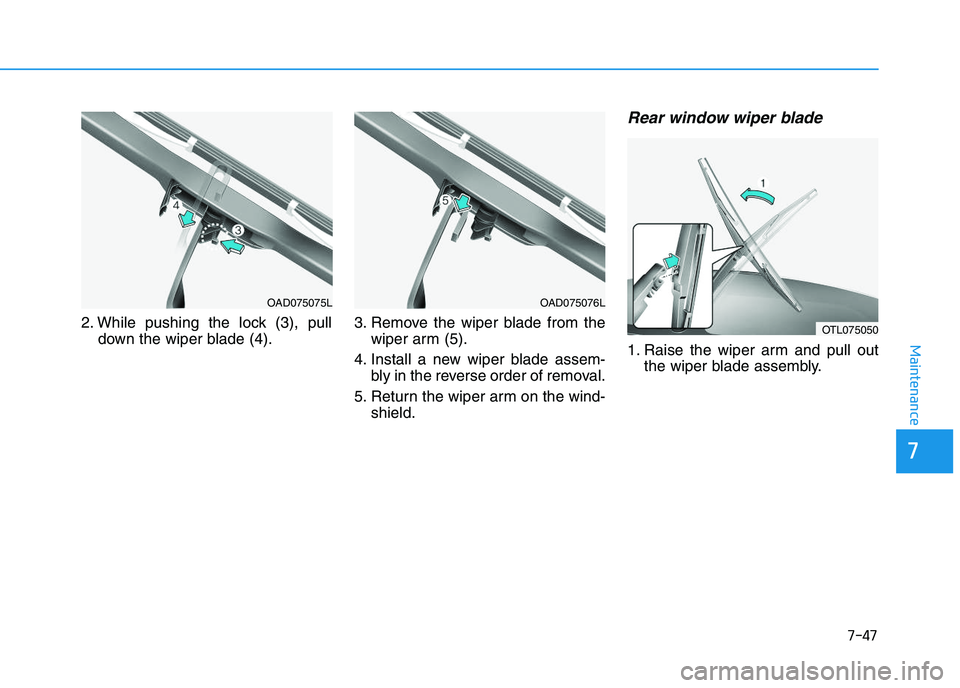
2. While pushing the lock (3), pulldown the wiper blade (4). 3. Remove the wiper blade from the
wiper arm (5).
4. Install a new wiper blade assem- bly in the reverse order of removal.
5. Return the wiper arm on the wind- shield.
Rear window wiper blade
1. Raise the wiper arm and pull outthe wiper blade assembly.
OAD075075LOAD075076L
OTL075050
Page 563 of 659

7-50
Maintenance
Battery recharging
By battery charger
Your vehicle has a maintenance-free,
calcium-based battery.
If the battery becomes dischargedin a short time (because, for exam-
ple, the headlights or interior lights
were left on while the vehicle was
not in use), recharge it by slow
charging (trickle) for 10 hours.
If the battery gradually discharges because of high electric load while
the vehicle is being used, recharge
it at 20-30A for two hours. Always follow these instructions
when recharging your vehicle’s
battery to avoid the risk of SERI-
OUS INJURY or DEATH from
explosions or acid burns:
Before performing mainte-
nance or recharging the bat-
tery, turn off all accessories
and place the Engine Start/
Stop button to the OFF posi-
tion.
Keep all flames, sparks, or
smoking materials away from
the battery.
Always work outdoors or in an
area with plenty of ventilation.
Wear eye protection when
checking the battery during
charging.
The battery must be removed
from the vehicle and placed in
a well ventilated area.
(Continued)
WARNING (Continued)
Watch the battery during
charging, and stop or reduce
the charging rate if the battery
cells begin boiling violently.
The negative battery cable
must be removed first and
installed last when the battery
is disconnected. Disconnect
the battery charger in the fol-
lowing order:
(1) Turn off the battery chargermain switch.
(2) Unhook the negative
clamp from the negative
battery terminal.
(3) Unhook the positive clamp from the positive battery
terminal.
Always use a genuine HYUNDAI
approved battery when you
replace the battery.