Page 393 of 472

7-36
Maintenance
Recommended engine coolant
Use only soft (distilled) water in the
coolant mixture.
The engine in your vehicle has alu-
minum engine parts and must be
protected by a phosphate-based
ethylene glycol coolant for alu-
minum radiator based coolant to
prevent corrosion and freezing.
DO NOT USE alcohol or methanol
coolant or mix them with the spec-
ified coolant.
Do not use a solution that contains
more than 60% antifreeze or less
than 35% antifreeze, which would
reduce the effectiveness of the
solution.
For mixture percentage, refer to the
following table.
Changing the coolant
We recommend that the coolant be
replaced by an authorized HYUNDAI
dealer.
Put a thick cloth or fabric around
the radiator cap before refilling
the coolant in order to prevent the
coolant from overflowing into
engine parts such as the alterna-
tor.
NOTICE
Ambient
TemperatureMixture Percentage
(volume)
Antifreeze Water
-15°C (5°F) 35 65
-25°C (-13°F) 40 60
-35°C (-31°F) 50 50
-45°C (-49°F) 60 40
Do not use radiator coolant or
antifreeze in the washer fluid
reservoir.
Radiator coolant can severely
obscure visibility when sprayed
on the windshield and may
cause loss of vehicle control or
damage to paint and body trim.
WARNING
Page 394 of 472

7-37
7
Maintenance
B BR
RA
AK
KE
E/
/C
CL
LU
UT
TC
CH
H
F
FL
LU
UI
ID
D
(
(I
IF
F
E
EQ
QU
UI
IP
PP
PE
ED
D)
)
Checking the brake/clutch
fluid level
Check the fluid level in the reservoir
periodically. The fluid level should be
between MAX (Maximum) and MIN
(Minimum) marks on the side of the
reservoir.Before removing the reservoir cap
and adding brake/clutch fluid, clean
the area around the reservoir cap
thoroughly to prevent brake/clutch
fluid contamination. If the level is low,
add fluid to the MAX (Maximum)
level. The level will fall with accumu-
lated mileage. This is a normal con-
dition associated with the wear of the
brake linings and/or clutch disc (if
equipped).
If the fluid level is excessively low, we
recommend that the system be
checked by an authorized HYUNDAI
dealer.
Use only the specified brake/clutch
fluid. (Refer to “Recommended lubri-
cants or capacities” in chapter 8.)
Information
Before removing the brake/clutch fil-
ter cap, read the warning on the cap
Information
Clean filler cap before removing. Use
only DOT3 or DOT4 brake/clutch
fluid from a sealed container.
i
i
Loss of brake fluid
In the event the brake system
requires frequent additions of
fluid, we recommend that the
system be inspected by an
authorized HYUNDAI dealer.
WARNING
OGS075006
OGS075006L
■Right Hand Drive
■Left Hand Drive
Page 403 of 472
7-46
Maintenance
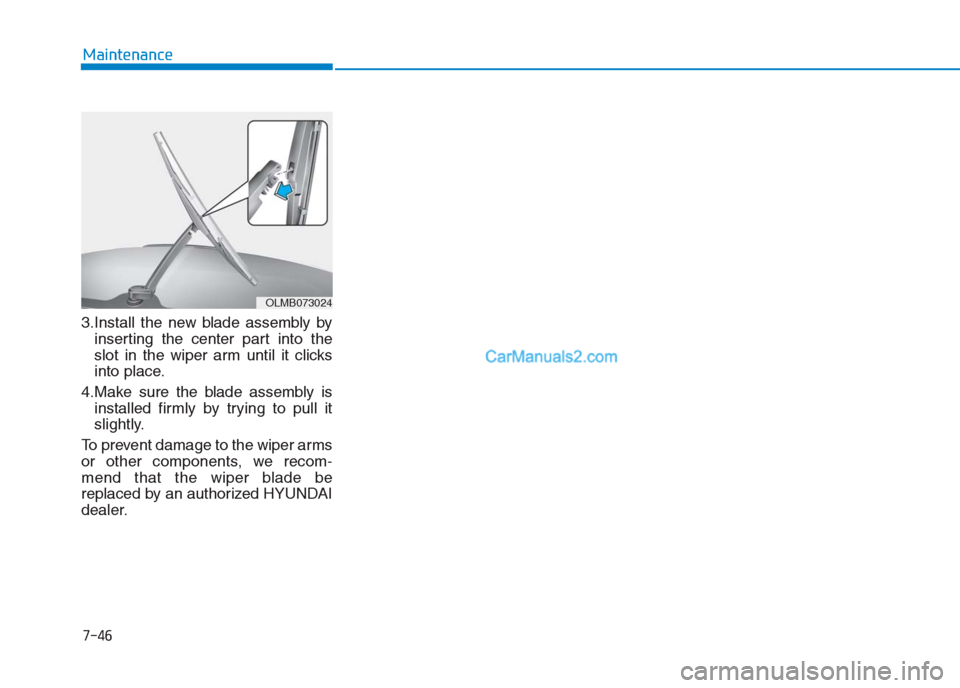
3.Install the new blade assembly by
inserting the center part into the
slot in the wiper arm until it clicks
into place.
4.Make sure the blade assembly is
installed firmly by trying to pull it
slightly.
To prevent damage to the wiper arms
or other components, we recom-
mend that the wiper blade be
replaced by an authorized HYUNDAI
dealer.
OLMB073024
Page 404 of 472
7-47
7
Maintenance
B BA
AT
TT
TE
ER
RY
Y
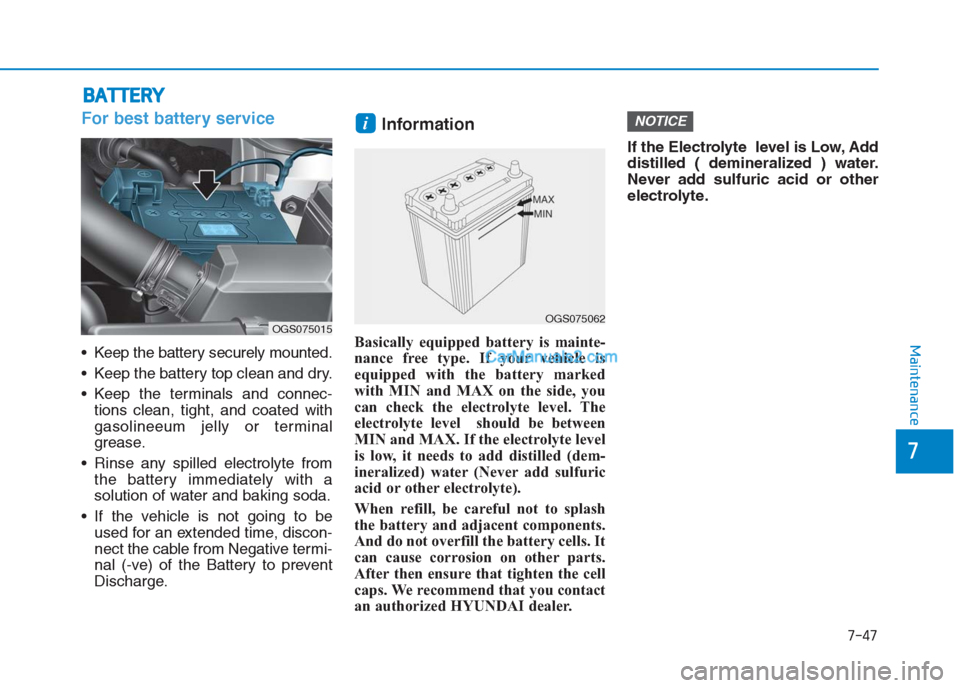
For best battery service
Keep the battery securely mounted.
Keep the battery top clean and dry.
Keep the terminals and connec-
tions clean, tight, and coated with
gasolineeum jelly or terminal
grease.
Rinse any spilled electrolyte from
the battery immediately with a
solution of water and baking soda.
If the vehicle is not going to be
used for an extended time, discon-
nect the cable from Negative termi-
nal (-ve) of the Battery to prevent
Discharge.
Information
Basically equipped battery is mainte-
nance free type. If your vehicle is
equipped with the battery marked
with MIN and MAX on the side, you
can check the electrolyte level. The
electrolyte level should be between
MIN and MAX. If the electrolyte level
is low, it needs to add distilled (dem-
ineralized) water (Never add sulfuric
acid or other electrolyte).
When refill, be careful not to splash
the battery and adjacent components.
And do not overfill the battery cells. It
can cause corrosion on other parts.
After then ensure that tighten the cell
caps. We recommend that you contact
an authorized HYUNDAI dealer.If the Electrolyte level is Low, Add
distilled ( demineralized ) water.
Never add sulfuric acid or other
electrolyte.
NOTICEi
OGS075062OGS075015
Page 405 of 472
7-48
Maintenance
(Continued)
If any electrolyte gets
into your eyes, flush
your eyes with clean
water for at least 15
minutes and get
immediate medical
attention. If electrolyte
gets on your skin,
thoroughly wash the
contacted area. If you
feel a pain or a burning
sensation, get medical
attention immediately.
Wear eye protection
when charging or
working near a battery.
Always provide venti-
lation when working in
an enclosed space.
(Continued)
(Continued)
An inappropriately
disposed battery can
be harmful to the envi-
ronment and human
health. Dispose the
battery according to
your local law(s) or
regulation.
The battery contains
lead. Do not dispose of
it after use. Please
return the battery to an
authorized HYUNDAI
dealer to be recycled.
When lifting a plastic-cased
battery, excessive pressure
on the case may cause battery
acid to leak, resulting in per-
sonal injury. Lift with a battery
carrier or with your hands on
opposite corners.
(Continued)
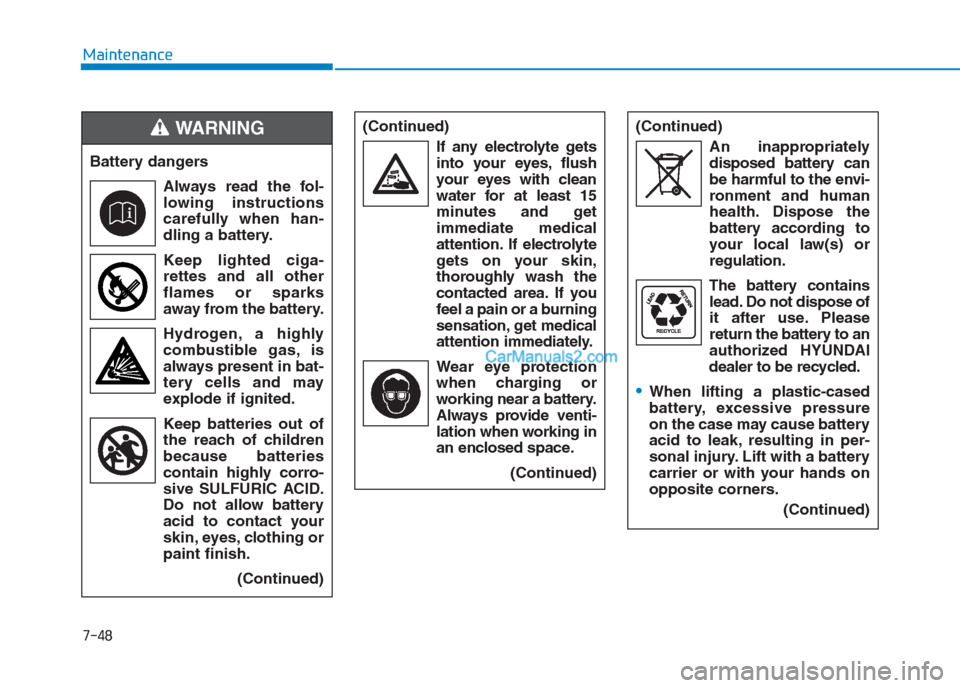
Battery dangers
Always read the fol-
lowing instructions
carefully when han-
dling a battery.
Keep lighted ciga-
rettes and all other
flames or sparks
away from the battery.
Hydrogen, a highly
combustible gas, is
always present in bat-
tery cells and may
explode if ignited.
Keep batteries out of
the reach of children
because batteries
contain highly corro-
sive SULFURIC ACID.
Do not allow battery
acid to contact your
skin, eyes, clothing or
paint finish.
(Continued)
WARNING
Page 407 of 472

7-50
Maintenance
Reset items
Items should be reset after the bat-
tery has been discharged or the bat-
tery has been disconnected.
Auto up/down window
(See chapter 3)
Climate control system
(See chapter 3)
Audio (See chapter 3)
Clock (See chapter3)
Trip computer (See chapter 3) When recharging the battery,
observe the following precau-
tions:
Before performing maintenance
or recharging the battery, turn
off all accessories and stop the
engine.
Do not allow cigarettes, sparks,
or flame near the battery.
Wear eye protection when
checking the battery during
charging.
The battery must be removed
from the vehicle and placed in
an area with good ventilation.
Watch the battery during
charging, and stop or reduce
the charging rate if the battery
cells begin gassing (boiling)
violently or if the temperature
of the electrolyte of any cell
exceeds 49°C (120°F).
(Continued)
WARNING (Continued)
The negative battery cable
must be removed first and
installed last when the battery
is disconnected.
Disconnect the battery charger
in the following order.
1. Turn off the battery charger
main switch.
2. Unhook the negative clamp
from the negative battery
terminal.
3. Unhook the positive clamp
from the positive battery
terminal.
Page 414 of 472

7-57
7
Maintenance
Tire traction
Tire traction can be reduced if you
drive on worn tires, tires that are
improperly inflated or on slippery
road surfaces. Tires should be
replaced when tread wear indicators
appear. Slow down whenever there
is rain, snow or ice on the road, to
reduce the possibility of losing con-
trol of the vehicle.
Tire maintenance
In addition to proper inflation, correct
wheel alignment helps decrease tire
wear. If you find a tire worn unevenly,
have your dealer check the wheel
alignment.
When you have new tires installed,
make sure they are balanced. This
will increase vehicle ride comfort and
tire life. Additionally, a tire should
always be rebalanced if it is removed
from the wheel.
Tire sidewall labeling
This information identifies and
describes the fundamental charac-
teristics of the tire and also provides
the tire identification number (TIN)
for safety standard certification. The
TIN can be used to identify the tire in
case of a recall.
1. Manufacturer or brand name
Manufacturer or Brand name is shown.
2. Tire size designation
A tire’s sidewall is marked with a tire
size designation. You will need this
information when selecting replace-
ment tires for your car. The following
explains what the letters and num-
bers in the tire size designation
mean.
Example tire size designation:
(These numbers are provided as an
example only; your tire size designa-
tor could vary depending on your
vehicle.)
205/65R16 95H
205 - Tire width in millimeters.
65 - Aspect ratio. The tire’s chapter
height as a percentage of its
width.
R - Tire construction code (Radial).
16 - Rim diameter in inches.
95 - Load Index, a numerical code
associated with the maximum
load the tire can carry.
H - Speed Rating Symbol. See the
speed rating chart in this chapter
for additional information.
I030B04JM
1
1
23
4
5,6
7
Page 416 of 472

7-59
7
Maintenance
4. Tire ply composition and
material
The number of layers or plies of rub-
ber-coated fabric in the tire. Tire
manufacturers also must indicate the
materials in the tire, which include
steel, nylon, polyester, and others.
The letter "R" means radial ply con-
struction; the letter "D" means diago-
nal or bias ply construction; and the
letter "B" means belted-bias ply con-
struction.
5. Maximum permissible infla-
tion pressure
This number is the greatest amount
of air pressure that should be put in
the tire. Do not exceed the maximum
permissible inflation pressure. Refer
to the Tire and Loading Information
label for recommended inflation
pressure.
6. Maximum load rating
This number indicates the maximum
load in kilograms and pounds that
can be carried by the tire. When
replacing the tires on the vehicle,
always use a tire that has the same
load rating as the factory installed
tire.
7. Uniform tire quality grading
Quality grades can be found where
applicable on the tire sidewall
between tread shoulder and maxi-
mum chapter width.
For example:
TREAD wear 200
TRACTION AA
TEMPERATURE A Tire age
Tires degrade over time, even
when they are not being used.
Regardless of the remaining
tread, it is recommended that
tires generally be replaced after
six (6) years of normal service.
Heat caused by hot climates or
frequent high loading condi-
tions can accelerate the aging
process. Failure to follow this
warning could cause sudden
tire failure, which could lead to
a loss of control and an acci-
dent involving serious injury or
death.
WARNING