2019 HONDA INSIGHT checking
[x] Cancel search: checkingPage 4 of 675

Contents
This owner’s manual should be considered a permanent part of the
vehicle and should remain with the vehicle when it is sold.
This owner’s manual covers all models of your vehicle. You may find
descriptions of equipment and features that are not on your
particular model.
Images throughout this owner’s manual (including the front cover)
represent features and equipment that are available on some, but
not all, models. Your particular mo del may not have some of these
features.
This owner’s manual is for vehicles sold in the United States and
Canada.
The information and specifications in cluded in this publication were
in effect at the time of approval for printing. Honda Motor Co., Ltd.
reserves the right, however, to discontinue or change specifications
or design at any time without notice and without incurring any
obligation.2 Safe Driving P. 39
For Safe Driving P. 40 Seat Belts P. 44 Airbags P. 51
2Instrument Panel P. 79
Indicators P. 80 Gauges and Driver Information Interface P. 128
2Controls P. 163
Clock P. 164 Locking and Unlocking the Doors P. 166
Moonroof* P. 189
Adjusting the Seats P. 207
2 Features P. 233
Audio System P. 234 Audio System Basic Operation P. 241, 262
Customized Features P. 359, 366 HomeLink ® Universal Transceiver* P. 386
2 Driving P. 441
Before Driving P. 442 Towing a Trailer P. 447
Parking Your Vehicle P. 541 Multi-View Rear Camera P. 543
2Maintenance P. 551
Before Performing Maintenance P. 552 Maintenance MinderTM P. 555
Checking and Maintaining Wiper Blades P. 579
Climate Control System Maintenance P. 594
2Handling the Unexpected P. 603
Tools P. 604 If a Tire Goes Flat P. 605
Indicator, Coming On/Blinking P. 633 Fuses P. 642
When You Cannot Open the Trunk P. 650
2 Information P. 651
Specifications P. 652 Identification Numbers P. 654
Emissions Testing P. 658 Warranty Coverages P. 659
19 INSIGHT HMIN-31TXM6000.book 2 ページ 2018年4月20日 金曜日 午後4時22分
Page 5 of 675

Contents
Child Safety P. 64Exhaust Gas Hazard P. 77Safety Labels P. 78
Opening and Closing the Trunk P. 180 Security System P. 183 Opening and Closing the Windows P. 186
Operating the Switches Around the Steering Wheel P. 190 Adjusting the Mirrors P. 205
Interior Lights/Interior Convenience Items P. 215 Climate Control System P. 225
Audio Error Messages P. 332General Information on the Audio System P. 337
Bluetooth ® HandsFreeLink ® P. 389, 414 Refuel Recommend P. 439
When Driving P. 448 Honda Sensing® P. 480 Braking P. 531
Refueling P. 546 Fuel Economy and CO
2 Emissions P. 549
Maintenance Under the Hood P. 562 Replacing Light Bulbs P. 575
Checking and Maintaining Tires P. 582 12-Volt Battery P. 591 Remote Transmitter Care P. 593
Cleaning P. 595 Accessories and Modifications P. 601
Power System Won’t Start P. 625 Jump Starting P. 628 Overheating P. 631
Emergency Towing P. 648 When You Cannot Unlock the Fuel Fill Door P. 649
Devices that Emit Radio Waves P. 655 Reporting Safety Defects P. 657
Authorized Manuals P. 661 Customer Service Information P. 662
Quick Reference GuideP. 4
Safe DrivingP. 39
Instrument PanelP. 79
ControlsP. 163
FeaturesP. 233
DrivingP. 441
MaintenanceP. 551
Handling the UnexpectedP. 603
InformationP. 651
IndexP. 664
19 INSIGHT HMIN-31TXM6000.book 3 ページ 2018年4月20日 金曜日 午後4時22分
Page 45 of 675

43
uuFor Safe Driving uSafety Checklist
Safe Driving
Safety Checklist
For the safety of you and your passengers, make a habit of checking these items
each time before you drive.
• After everyone has entered the vehicle, be sure all doors are closed and locked.
Locking the doors helps prevent an occupant from being ejected and an outsider
from unexpectedly opening a door.
2 Locking/Unlocking the Doors from the Inside P. 176
•Adjust your seat to a position suitable for driving. Be sure the front seats are
adjusted as far to the rear as possible while allowing the driver to control the
vehicle. Sitting too close to a front airbag can result in serious or fatal injury in a
crash.
2 Adjusting the Seats P. 207
•Adjust head restraints to the proper position. Head restraints are most effective
when the center of the head restraint aligns with the center of your head. Taller
persons should adjust their head restraint to the highest position.
2 Adjusting the Front Head Restraint Positions P. 212
•Always wear your seat belt, and make sure you wear it properly. Confirm that any
passengers are properly belted as well.
2 Fastening a Seat Belt P. 47
•Protect children by using seat belts or chil d seats according to a child’s age, height
and weight.
2 Child Safety P. 64
1Safety Checklist
If the door and/or trunk open message appears on
the driver information inte rface, a door and/or the
trunk is not completely cl osed. Close all doors and
the trunk tightly until the message disappears.
2 Driver Information Interface Warning and
Information Messages P. 102
19 INSIGHT HMIN-31TXM6000.book 43 ページ 2018年4月20日 金曜日 午後4時22分
Page 52 of 675

50
uuSeat Belts uSeat Belt Inspection
Safe Driving
Seat Belt Inspection
Regularly check the condition of your seat belts as follows:
• Pull each belt out fully, and look for frays, cuts, burns, and wear.
• Check that the latch plates and buckles work smoothly and the belts retract
easily.
u If a belt does not retract eas ily, cleaning the belt may correct the problem. Only
use a mild soap and warm water. Do not use bleach or cleaning solvents. Make
sure the belt is completely dry before allowing it to retract.
Any belt that is not in good condition or working properly will not provide proper
protection and should be replaced as soon as possible.
A belt that has been worn during a crash may not provide the same level of
protection in a subsequent crash. Have your seat belts inspected by a dealer after
any collision.1 Seat Belt Inspection
3WARNING
Not checking or maintaining seat belts can
result in serious injury or death if the seat
belts do not work properly when needed.
Check your seat belts regularly and have
any problem corrected as soon as possible.
19 INSIGHT HMIN-31TXM6000.book 50 ページ 2018年4月20日 金曜日 午後4時22分
Page 77 of 675
75
uuChild Safety uSafety of Larger Children
Continued
Safe Driving
Safety of Larger Children
The following pages give instructions on ho w to check proper seat belt fit, what kind
of booster seat to use if one is needed, and important precautions for a child who
must sit in front.
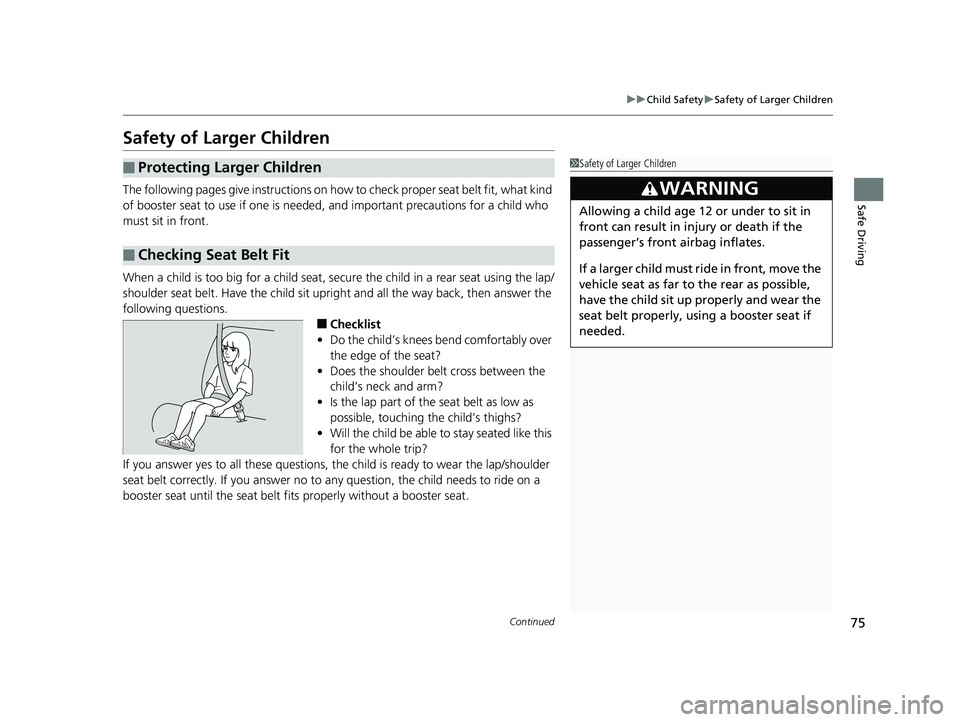
When a child is too big for a child seat, secure the child in a rear seat using the lap/
shoulder seat belt. Have the child sit upri ght and all the way back, then answer the
following questions.
■Checklist
• Do the child’s knees bend comfortably over
the edge of the seat?
• Does the shoulder belt cross between the
child’s neck and arm?
• Is the lap part of the seat belt as low as
possible, touching the child’s thighs?
• Will the child be able to stay seated like this
for the whole trip?
If you answer yes to all these questions, th e child is ready to wear the lap/shoulder
seat belt correctly. If you answer no to any question, the child needs to ride on a
booster seat until the seat belt fits properly without a booster seat.
■Protecting Larger Children
■Checking Seat Belt Fit
1 Safety of Larger Children
3WARNING
Allowing a child age 12 or under to sit in
front can result in injury or death if the
passenger’s front airbag inflates.
If a larger child must ri de in front, move the
vehicle seat as far to the rear as possible,
have the child sit up properly and wear the
seat belt properly, using a booster seat if
needed.
19 INSIGHT HMIN-31TXM6000.book 75 ページ 2018年4月20日 金曜日 午後4時22分
Page 106 of 675

104
uuIndicators uDriver Information Interface Wa rning and Information Messages
Instrument Panel
MessageConditionExplanation
●Appears when the washer fluid is low.●Refill the washer fluid.
2Refilling Window Washer Fluid P. 574
●Appears when the scheduled maintenance is due
soon.
●Consequently, Maintenance Due Now and
Maintenance Past Due follow.2Maintenance Minder Messages on the Driver
Information Interface P. 557
●Appears when there is a pr oblem with the sensor on
the 12-volt battery.●Have your vehicle checked by a dealer.
2 Checking the 12-Volt Battery P. 591
●Appears along with the 12-volt battery charging
system indicator when the 12-volt battery is not
charging.●Turn off the climate control system and rear defogger to
reduce electricity consumption.
2 If the 12-Volt Battery Charging System Indicator
Comes On P. 634
Canadian models
19 INSIGHT HMIN-31TXM6000.book 104 ページ 2018年4月20日 金曜日 午後4時22分
Page 444 of 675

442
Driving
Before Driving
Driving Preparation
Check the following items before you start driving.
• Make sure there are no obstructions on the windows, door mirrors, exterior
lights, or other parts of the vehicle.
u Remove any frost, snow, or ice.
u Remove any snow on the roof, as this can slip down and obstruct your field of
vision while driving. If frozen solid , remove ice once it has softened.
u When removing ice from around the wheels, be sure not to damage the wheel
or wheel components.
• Make sure the hood is securely closed.
u If the hood opens while driving, your front view will be blocked.
• Make sure the tires are in good condition.
u Check air pressures, and check for damage and excessive wear.
2Checking and Maintaining Tires P. 582
•Make sure there are no people or ob jects behind or around the vehicle.
u There are blind spots from the inside.
■Exterior Checks1Exterior Checks
NOTICE
When doors are frozen s hut, use warm water around
the door edges to melt any ice. Do not try to force
them open, as this can damage the rubber trim
around the doors. When done, wipe dry to avoid
further freezing.
Do not pour warm water into the key cylinder.
You will be unable to insert the key if the water
freezes in the hole.
Heat from the engine and exhaust can ignite
flammable material s left under the hood, causing a
fire. If you’ve parked y our vehicle for an extended
period, inspect and remove any debris that may have
collected, such as dried grass and leaves that have
fallen or have been carried in for use as a nest by a
small animal. Also check under the hood for leftover
flammable materials after you or someone else has
performed maintenance on your vehicle.
19 INSIGHT HMIN-31TXM6000.book 442 ページ 2018年4月20日 金曜日 午後4時22分
Page 474 of 675
472
uuWhen Driving uTire Pressure Monitoring System (TPMS)
Driving
Tire Pressure Monitoring System (TPMS)
Instead of directly measuring the pressu re in each tire, the TPMS on this vehicle
monitors and compares the rolling radius and rotational characteristics of each
wheel and tire while you are driving to determine if one or more tires are
significantly under-inflated. This will caus e the low tire pressure/TPMS indicator to
come on and a message to appear on the driver information interface.
You must start TPMS calibration every time you:
• Adjust the pressure in one or more tires.
• Rotate the tires.
• Replace one or more tires.
Before calibrating the TPMS:
• Set the cold tire pressu re in all four tires.
2Checking Tires P. 582
Make sure:
•The vehicle is at a complete stop.
• The transmission is in
(P.
• The power mode is in ON.
■TPMS Calibration
1Tire Pressure Monitoring System (TPMS)
The system does not monitor the tires when driving
at low speed.
Conditions such as low ambient temperature and
altitude change directly a ffect tire pressure and can
trigger the low tire pressure/TPMS indicator to come on.
Tire pressure checked and inflated in:
•Warm weather can beco me under-inflated in
colder weather.
•Cold weather can become over-inflated in warmer
weather.
The low tire pressure/TPMS indicator will not come
on as a result of over inflation.
The TPMS may not function pr operly if tire type and
size are mixed. Make sure to use the same size and
type of tire. 2 Checking and Maintaining Tires P. 582
The low tire pressure/TPMS indicator may come on
with a delay or may not come on at all when:
•You rapidly accelerate, decelerate, or turn the
steering wheel.
•You drive on snowy or slippery roads.
•Tire chains are used.
19 INSIGHT HMIN-31TXM6000.book 472 ページ 2018年4月20日 金曜日 午後4時22分